October Positivity: Another Perfect Stranger (dir by Jefferson Moore and Shane Sooter)


Ten years after Nikki Cominskey had the world’s most awkward dinner date with Jesus (played by Jefferson Moore), Nikki’s daughter is flying to Portland.

Having just graduated from high school, Sarah (Ruby Lewis) wants to attend an exclusive art school but she fears that she may not get the scholarship that she would need.  If that wasn’t stressful enough, she’s also not getting along with her parents.  She never thought that her mom and dad were actually seriously about all that church stuff but it turns out that they were and now they are scandalized to discover that Sarah doesn’t even consider herself to be a believer!  The night before Sarah’s trip, Nikki sat her daughter down and told her about the night that she had dinner with Jesus.  Now, Sarah is worried that her mother has lost her mind.

Because Sarah is flying the least efficient airline in existence, there’s a layover in Dallas on the way to Portland.  That leaves Sarah a lot of time to get to know the man who is sitting next to her on the airplane.  His name is Yesh and he says that he comes from a small town in the east.  He also says that he’s a counselor and that he works with his father.  When Sarah asks what Yesh’s father does, Yesh says that it’s not easy to explain but that his father has a lot of responsibility.  He’s in charge of many things.  Sarah thinks that Yesh is a friendly stranger but, since he’s played by Jefferson Moore, the audience knows who he actually is.

Yesh and Sarah discuss religion.  Sarah says she hates religion.  Yesh says that he agrees, because people have twisted religion to satisfy their own base desires.  Sarah says that she can’t understand her parents.  Yesh says that her parents love her just as his father loves everyone.  Sarah says that she wants to be an artist.  Yesh tells her to be sure not to fall asleep during art history class.  (Hold on, Yesh!  I majored in art history!  Art history rocks!)  Sarah assumes that Yesh is an atheist and gets a little annoyed when Yesh reveals that he’s actually not.  Yesh reads her a poem and explains that it was written by his father and that it’s in the Bible.  Sarah is amazed because she thought the Bible was just full of rules.  She doesn’t seem to notice that Yesh said that his father wrote the Bible but that’s because Sarah doesn’t really come across as being that smart.

You can pretty much guess where all of this leading.  With the exception of one surprisingly well-handled scene in which Sarah discusses the trauma that turned her away from religion, Another Perfect Stranger follows the same storyline as The Perfect Stranger.  The main difference is that Sarah is a teenager and the conversation takes place on a plane instead of at a restaurant.  Once again, Yesh wins every argument because the screenwriter is on his side and Sarah is incapable of coming up with any counterpoints that aren’t easily dismissed.  Unfortunately, this film is also 20 minutes longer than The Perfect Stranger and pace is much slower.  The majority of Sarah’s dialogue sounds like it was written by a computer program designed to basically approximate the speaking habits of someone under the age of 30.  On the plus side, Sarah is not quite as humiliated by Jesus as her mother was.

This was followed by one more Perfect Stranger film, which was only 61 minutes long and which I’ll take a look at tomorrow.
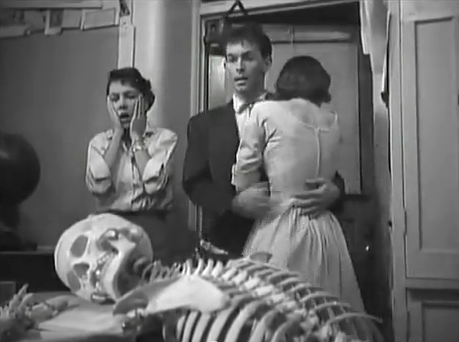
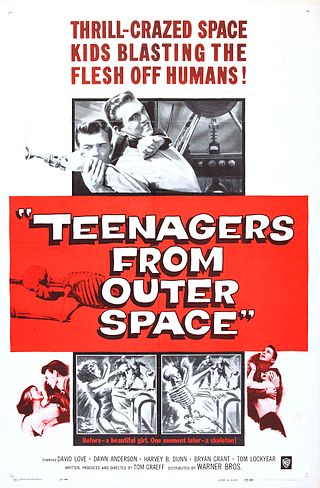
The TSL’s Horror Grindhouse: Teenagers From Outer Space (dir by Tom Graeff)


The aliens have landed in California!

And they’re teenagers!

That may sound like the set up of a 1960s beach movie but actually, Teenagers From Outer Space is an oddly somber little movie from 1959.  Now, just to be clear, somber does not necessarily equal good.  There’s a lot of humor to be found in Teenagers From Outer Space but next to none of it’s intentional.  Instead, this attempts to be a serious-minded movie that happens to be about intergalactic teens.

The teenagers are named Thor (Bryan Grant) and Derek (David Love).  They’ve been sent down to Earth so that they can raise Gargons, which are these lobster creatures that are considered to be a gourmet delicacy on their own world.  Thor is the arrogant and insensitive alien who thinks that he’s too good for Earth and reacts to nearly every social situation by pulling out his ray gun and firing.  (Whenever Thor vaporizes anyone, a perfectly white skeleton — the type that you’d expect to see hanging in a classroom — is left behind.)  Derek is sensitive and moody.  He’s got the soul of a poet.  He doesn’t want to vaporize people.  Instead, he wants to explore Earth and maybe hang out in a coffee house while reading Kerouac.  Though Derek may never actually say it, it’s obvious what’s going through his mind whenever he looks at the other teenagers from outer space.  “The scene is totally squaresville, man,” Derek thinks, “Real melvin.  Exploring planets with peaceful intentions is where it’s at!”

Anyway, Derek decides to run away and explore Earth on his own.  He ends up renting a room in a boarding house owned by Grandpa (Harvey B. Dunn) and his daughter, Betty (Dawn Bender).  Betty is immediately attracted to Derek, despite the fact that she already has a boyfriend (who is played by the film’s director, Tom Graeff).  She’s not particularly surprised when Derek tells her that he’s from outer space.  Nor is she upset when he reveals that, shortly after arriving on Earth, Thor vaporized her dog.  (Judging from her nonplussed reactions to everything, I’m assuming that Betty was an avid reader of both Sartre and Camus.)

As for Grandpa, he spends most of his time hanging out on the front porch and talking to strangers.  For instance, when Thor comes by and demands to know where Derek is, Grandpa cheerfully tells him.  This, of course, leads to a lot of innocent people being vaporized but Grandpa never seems to feel particularly bad about it.  Certainly, no one in the movie ever takes the time to point out how much trouble could have been avoided if Grandpa wasn’t so talkative.

Derek really just wants to stay on Earth but Thor knows that Derek is secretly the son of their planet’s leader and therefore, cannot be allowed to run away.  Why doesn’t Derek know this?  I have no idea.  It’s possible the movie explained this turn of events while I was busy wondering why no one seemed to be upset about all the skeletons that were turning up around town.

Anyway, as I said, there aren’t many intentional laughs to be found in Teenagers From Outer Space but there’s plenty of unintentional ones.  Between Betty’s calm acceptance of everything that Derek tells her and David Love’s continually confused stare and blank line readings, it’s impossible not to smile while watching this movie.

Teenagers From Outer Space was written, directed, and produced by Tom Graeff. Shortly after this film came out, Graeff took out an ad in the Los Angeles Times and proclaimed himself to be the second coming of Christ.  Hey, why not?  After you make a movie like Teenagers From Outer Space, I suppose it seems like anything could be possible.  Unfortunately, Graef committed suicide in 1970 and he didn’t get to see his misbegotten little film find a second life as a cult favorite.

Teenagers From Outer Space.  It’s not very good but it certainly is watchable.

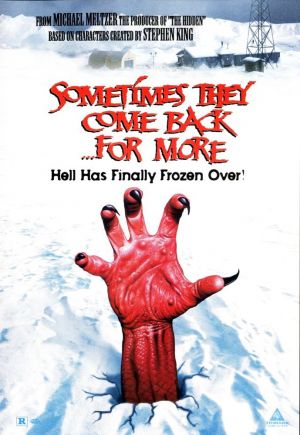
Sometimes They Come Back… For More (1998, directed by Daniel Zelik Berk)


The third and final Sometimes They Come Back film has nothing to do with the two films that preceded it.  Those two films dealt with dead juvenile delinquents who came back to life to haunt the people who they blamed for their deaths.  They came back for revenge.  The third film has more in common with The Thing than the other two movies.  If you’re going to make a movie that invites comparisons to The Thing, you better have the goods and unfortunately, this film doesn’t.

Captain Sam Cage (Clayton Rohner) and Major Callie O’Grady (Chase Masterson) are dispatched to an Arctic research center to follow up on reports that one of the researcher has snapped.  For Cage, the mission is personal because his brother-in-law is at the center.  What they discover is that almost all of the research personnel are dead and that Dr. Jennifer Wells (Faith Ford) and Lt. Brian Shebanski (Max Perlich) are the sole survivors.  Someone at the research center had been studying Satanism and that, along with a portal to Hell under the station, leads to trouble.  Soon, the dead are reanimating and stalking the living.

Sometimes They Come Back… For More gets off to a good start with the mystery at the base and a visual emphasis on the harshness of life in Antarctica.  Clayton Rohner appeared in a lot of straight-to-video horror movies and, by the time he made this one, he was a pro at handling bad dialogue.  Once Cage and O’Grady reach the base, the movie starts to go off the rails as the survivors make increasingly poor decisions, Faith Ford struggles to be a believable scientist, and an absurd twist is introduced concerning Cage and his brother-in-law (Damian Chapa).  The movie was obviously influenced by The Thing and Alien but it never duplicates the claustrophobic intensity that made those films work.  Not surprisingly, after this movie, they would not come back.

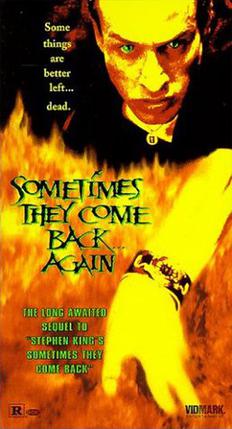
Sometimes They Come Back… Again (1996, directed by Adam Grossman)


When Jon Porter was a child, he witnessed the murder of his sister by three delinquents named Tony (Alexis Arquette), Vinnie (Bojesse Christopher), and Sean (Glen Beaudin).  The three thugs would have killed Jon too except that they were electrocuted by an electrical wire in a puddle of water.  Years later, the now adult Jon (Michael Gross) returns to his hometown for the funeral of his mother.  Jon is now a psychologist and has a daughter named Michelle (Hillary Swank).

The death of Jon’s mother was no accident.  Tony has come back to life and Michelle, not knowing that he’s a demon, has a crush on him.  Tony soon brings Vinnie and Sean back to life and they seek revenge on the man who they blame for their deaths.

This straight-to-video sequel to Sometimes They Come Back is slightly better than the first film, mostly because Tony and his gang are more intimidating than the ghost greasers that haunted Tim Matheson and Michelle wanting to date the man that her father killed adds a new wrinkle to the story.  There’s nothing about Hillary Swank’s performance that would make you think she was a future Oscar winner but she is likable and sympathetic.  The member of the cast who make the biggest impression is Jennifer Elise Cox, playing Michelle’s Tarot card-reading friend.  (Cox is probably best known for playing Jan Brady in The Brady Bunch movies.)  Cox brings a lot of kooky charm to the movie and is featured in the film’s most memorable scene.  Sometimes They Come Back… Again may not reinvent the horror genre but it’s a passably entertaining straight-to-video horror film.

Sometimes They Come Back (1991, directed by Tom McLoughlin)


In 1963, nine year-old Jim Norman witnessed a group of juvenile delinquents murder his older brother Wayne in a tunnel before getting killed themselves when a train came barreling down the tracks.  Twenty-seven yeas later, Jim (Tim Matheson) is a history teacher and he has returned to his hometown to take a job at his old high school.  He is haunted by memories of what happened in the tunnel and then he is haunted for real as, one by one, all of the dead delinquents returns to life and enroll in his class.  They want revenge on the man that they blame for their fiery deaths.

Based on a Stephen King short story, Sometimes They Come Back was actually produced for television.  It originally aired on CBS, complete with a warning that viewer discretion was advised.  Though the ghost greasers are too ridiculous to really be scary (one of them laughs like a hyena), the movie was still more graphic than anything else that played in primetime that year.  I wonder how television audiences, in those pre-American Horror Story days, reacted to one of Jim’s students being dismembered in the backseat of a car and the ghost greasers then tossing pieces of his body over the bridge?

Tim Matheson takes the material seriously and gives an intelligent performance as Jim Norman.  Fans of Newhart might enjoy seeing William Sanderson (a.k.a. Larry of Larry, Darryl, and Darryl) playing a serious role as the one greaser who wasn’t killed by the train.  Most of the other characters, including Jim’s wife and his students, are forgettable.  The movie’s glaring weakness is the ghost greasers themselves.  Even with their Satanic car and their threatening ways, they’re too cartoonish to be frightening.  Sometimes They Come Back has its strengths but ultimately, it’s a middling Stephen King adaptation.

Retro Television Review: Summer of Fear (dir by Wes Craven)


Welcome to Retro Television Reviews, a feature where we review some of our favorite and least favorite shows of the past!  On Sundays, I will be reviewing the made-for-television movies that used to be a primetime mainstay.  Today’s film is 1978’s Summer of Fear.  It  can be viewed on YouTube!

In this made-for-TV movie from 1978, Linda Blair (fresh from the first two Exorcist films) plays Rachel. Rachel is a teenager who lives on a ranch in California. She loves horses and she loves her boyfriend and she’s especially happy that her cousin, Julia (Lee Purcell) is coming to live with her. Julia recently lost both of her parents in a tragic auto accident. Though neither Rachel nor her parents have ever met Julia before, they’re all planning on welcoming her into their very nice home.

The only problem is that, once Julia arrives, she seems to be a little bit strange. She speaks with a strange accent that no one on the ranch has ever heard before. The horses all seems to be terrified of her. After Rachel discovers that Julia has stolen minor personal possessions from her new family, Rachel starts to suspect that Julia might be witch and that she might be casting spells! Of course, by this point, Julia is no longer as shy and awkward as she seemed when she first showed up. Instead, she’s now glamorous and every man who meets her becomes intrigued, including Rachel’s boyfriend!

Based on a best-selling novel, Summer of Fear originally aired on NBC. If it were made today, it would probably air on something like Lifetime and it would have a title like, “Deadly Spell” or “Dangerous Seductress.” Seen today, it’s a bit of a slow movie and Linda Blair occasionally seems to be trying too hard to come across as being wide-eyed and innocent in her role but it’s entertaining as long as Lee Purcell is giving people strange looks and chewing up the scenery. The more out-of-control Pucell becomes, the more entertaining the film. Summer of Fear does build to a satisfying conclusion but it’s still hard not to wish that the story itself had moved just a bit quicker.  Jaded audiences in 2022 are no longer as shocked at the idea of witch coming to visit as audiences in 1978 may have been.  In the end, probably the most interesting thing about Summer of Fear is that it was an early credit for horror master, Wes Craven. This was his third film and his first “major” production, one that he made in order to show that, after directing two independent films, he could be trusted with a mainstream, studio production.  As such, you can argue that, without this film, Craven never would have gone on to do Nightmare on Elm Street and Scream.  Modern horror would be very different without Summer of Fear.

Ultimately. the film’s a bit too slowly paced to really be successful but if you’re a fan of Wes Craven’s or even Linda Blair’s, you’ll probably want to watch it at least once.

International Horror Film: The Deep House (dir by Alexandre Bustillo and Julien Maury)


The 2021 French film, The Deep House, tells the story of Tina (Camilla Rowe) and Ben (James Jagger).  Originally from New York, Tina and James are driving across Europe and filming themselves as they explore haunted houses.  They have recently learned of a submerged house in France.  With the help of a local guide named Pierre (Eric Savin), they track down the lake that Pierre claims is the location of the house.  Tina and James put on their diving gear and jump into the water.  Pierre, on the other hand, stays on dry land.  In fact, Pierre seems like he might have an agenda of his own.

Tina and James find the underwater house and they continue to film themselves as they explore it.  (In fact, with their eagerness to go travel the world and film themselves disrupting their surroundings, you might be tempted to think that this film has something on its mind about American interventionism.)  Interestingly enough, the house is in surprisingly good shape despite having been underwater for a few decades.  In fact, the house is full of posters, photographs, and graffiti, all of which one would expect to be destroyed by exposure to water.  Why, there’s even a fake clown head just kind of sitting there.  However, Tina and James are a bit more concerned about why their equipment suddenly seems to be malfunctioning.  And then, of course, there’s the two dead bodies that are chained to the walls inside the house.

Now, you may be wondering why Tina and James don’t just leave the house.  Believe it or not, they try to leave as soon as they come across the bodies.  (Most of my friends would probably immediately try to leave as soon as they saw that clown.  You have to feel bad for all the misunderstood and misjudged clowns of the world.)  But suddenly, the window that they previously swam through has been blocked by a brick wall.  In fact, the house seems to be constantly changing and rebuilding itself, all to keep Tina and James from finding a way out.  With their air supply running out, Tina and James try to figure out how to escape the house and, even more importantly, how to escape the zombie that has suddenly shown up.

Oh, did I forget the mention the zombies?  Well …. there’s a zombie.

Well-directed by Julien Maury and Alexandre Bustillo, The Deep House is an atmospheric horror film, one that doesn’t waste any time launching into its story.  While there have been plenty of horror films about people exploring haunted houses and accidentally filming their own demise, The Deep House adds a new wrinkle by having almost all of the action occur underwater.  Even if Tina and James manages to escape the house and the zombies, you still have to wonder if they’ll have enough air left to make it to the surface.  Maury and Bustillo do a good job of generating suspense and the film has more than enough jump scares to keep most horror fans happy.  The Deep House is worth the dive.

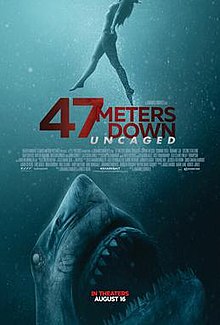
Horror Film Review: 47 Meters Down: Uncaged (dir by Johannes Roberts)


Let us take a moment or two to give some thought to the poor, misunderstood shark.

Sharks have a reputation for being the most dangerous predators in the ocean but, for the most part, sharks just swim around and eat whatever is in front of them.  They are certainly not harmless but they’re also not the clever, calculating monsters that they’ve been made out to be.  As opposed to what all the sequels to Jaws have told us, sharks do not stalk people.  They do not seek revenge.  They do not look at certain humans and think, “That is my mortal enemy.”  A shark will not follow you from New England to the Caribbean just because you’re the widow of the man who killed its cousin.  Sharks look scary and, certainly, you should stay out of the water if one of them is swimming nearby.  But, for the most part, the only thing that one needs to have to avoid being attacked by a shark is common sense.

Unfortunately, none of the characters in the 2019 film, 47 Meters Down Uncaged, have any common sense.  The film tells the tale of Mia (Sophie Nelisse) and her stepsister, Sasha (Corrine Fox).  Mia and Sasha are both students at a new school in Mexico.  Their father, Grant (John Corbett), has been exploring a submerged Mayan city.  Along with their two friends, Alexa (Brianne Tju) and Nicole (Sistine Stallone), Mia and Sasha decide to spend the weekend scuba diving and exploring the ancient city.  The girls have a good time looking at all of the mummies and the sacrificial chamber.  Unfortunately, a great white shark shows up to ruin their fun.  The simplest solution would probably be too leave the city but, because the girls keep screaming and accidentally knocking stuff over, they soon find themselves trapped in the newly collapsed city.  Not only have they upset a shark but they’ve managed to destroy a bunch of valuable historical artifacts.  Way to go!

47 Meters Down: Uncaged was sold as being a sequel to 47 Meters Down, the Mandy Moore/shark film that came out in 2017.  However, other than having the same director, the only thing that the two films have in common is that they both spend a lot of time underwater and they both feature a shark.  In fact, I’m not even sure if they get down to the 47 meters in Uncaged but that’s just because, as an American, I find the metric system to be extremely confusing.  The original 47 Meters Down also had a slightly interesting premise and a good performance from Mandy Moore.  47 Meters Down: Uncaged, on the other hand, is just about four girls who did something incredibly stupid and then did something else incredibly stupid and then just kept on doing every stupid thing that came to mind.  Most people will be cheering for the shark.

That said, it should be noted that Johannes Roberts definitely uses that shark for all that its worth.  The film’s characters may be stupid but the shark itself is scary and generates its share of effective jump scares.  This is one of those diabolically clever sharks that knows how to hide behind corners until someone swims by.  As I mentioned at the start of this review, that’s not exactly realistic shark behavior but it’s definitely effective movie behavior.  The scenes where the shark suddenly emerged from the darkness definitely made jump.  The scene where one of the girls attempted to climb out of the cave and then fell into the water in super slow motion made me laugh.  There’s something to be said for a film that can make you both jump and laugh.

One final note: the sharks lived in that submerged Mayan city for over a hundred years without damaging anything.  Mia, Sasha, and their friends visit the city for less than an hour and manage to destroy the place.  Remember that the next time anyone says anything against the sharks.

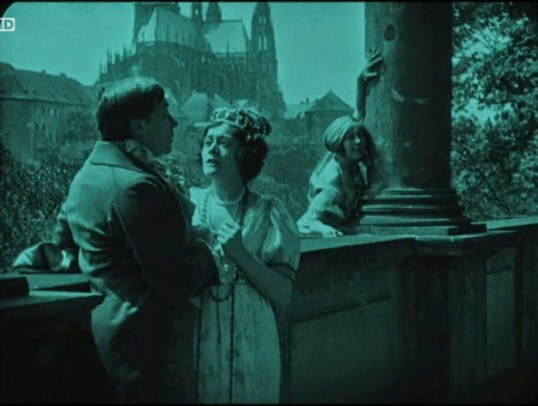
Horror On The Lens: The Student of Prague (dir by Stellan Rye and Paul Wegener)


For today’s horror on the lens, we have a film from 1913!  A German adaptation of Edgar Allan Poe’s William Wilson, The Student of Prague is often considered to be the first feature-length horror film.  Featuring Paul Wegener (who also co-directed the film) in the lead role, this is the story of what happens when the popular but poor Balduin attempts to get rich by dealing with the dark arts.  These things never work out well, as Balduin discovers once his reflection steps out of a mirror and goes out of its way to make Balduin’s life difficult.

Of course, to watch the film today, audiences have to adjust both their expectations and the way that they take in and process cinematic storytelling.  As of this writing, The Student of Prague is 109 years old and it’s definitely a film of its time.  The camera largely remains stationary and, from a modern perspective, the film is rather slow-paced.  And yet, the film’s story remains rather intriguing.  Despite the static camera work, the film manages to create and maintain a properly ominous atmosphere and a scene in which Balduin and Margit attempt to meet in a cemetery is effectively creepy.  Paul Wegener’s performance holds up well.  Largely eschewing the overly theatrical acting style that we usually tend to associate with silent cinema, Wegener gives a nuanced and effectively subtle performance as both Balduin and his doppelganger.  When he’s acting opposite of himself, you don’t think about the fact that you’re witnessing an early camera trick.  Instead, Wegener creates two separate but believable versions of the same character.  The doppelganger represents all of Balduin’s undesirable impulses and everything that has kept Balduin from achieving happiness.  By the end of the film, Balduin can’t live with his doppelganger but he can’t live without him as well.

The Student of Prague is an interesting piece of history and one that every true student of horror should watch and learn from at least once.

And here’s your chance!

Enjoy!

October Positivity: The Perfect Stranger (dir by Jefferson Moore and Shane Sooter)


The 2005 film, The Perfect Stranger, opens with Nikki Cominsky (Pamela Brumley) feeling very stressed and underappreciated.

She’s an attorney and she really should be heading off for work but first, she has to make her daughter’s school lunch.  (Her daughter is not extremely appreciative.)  Meanwhile, her husband has just informed her that he’s canceling their date night because he has to go to a baseball game with a client!  Nikki was so looking forward to going to a nice restaurant.  Finally, to top all off, the neighbors are religious and they keep inviting Nikki to church.  Argggh!  The frustration!

Nikki gets to work and the aggravation continues.  Her administrative assistant calls her “Mrs. Cominskey,” making Nikki feel old.  (“Mrs. Cominskey is my mother-in-law!” Nikki snaps.)  Plus, there’s a weird note on Nikki’s desk.  The note is inviting her to dinner and it is signed Jesus.  At first, Nikki is convinced that her neighbors somehow broke into the office and left the note on her desk.  But then she realizes how weird that sounds.  Instead, she decides that the note is from her husband.  Obviously, he canceled his plans and they’re going to go out to dinner.  Yay!  But why would her husband sign the letter as Jesus?  “He must be joking,” Nikki says, with a laugh.  Okay, then.  Everyone has their own sense of humor.

Nikki heads to the restaurant straight after work and discovers …. that her husband is not there.  Her husband went to the baseball game.  Her husband was not playing a joke on her.  He really is the type of insensitive idiot who would break a date with his wife and go to a baseball game with client.  (You deserve better, Nikki!)  However, her neighbors aren’t there either.  Instead, there’s a blonde man (Jefferson Moore) wearing a suit who says that his name is Jesus and he wants to have a conversation with her.  Nikki’s first instinct is to leave but Jesus offers to pay for dinner.  That changes Nikki’s mind and I guess that’s understandable.  A free dinner is a free dinner!

Nikki and Jesus go on to have the most awkward dinner date ever.  Nikki wants to talk about how annoyed she is with her life.  Jesus wants to talk about Heaven.  Nikki complains about religion.  Jesus tells her that her problem is not with religion but with religious people.  Nikki says that she feels like she could get just as much out of being a Hindu or Muslim as she could out of being a Christian.  Jesus laughs at her.  There’s one long stretch of time when we just see Jesus and Nikki talking but we don’t actually hear what they’re saying.  Maybe they’re discussing the food, which does look pretty good.

The Perfect Stranger is an example of a popular sort of faith-based film, one in which Jesus has dinner or coffeewith an unbeliever and basically spends an hour telling them that they’re stupid.  Jesus always has the advantage in these films, largely because the screenwriter is on his side and the non-believers are usually limited to repeating a bunch of clichés about all the bad things in the world.  That’s certainly the case with The Perfect Stranger, in which Nikki is not only an agnostic but also a bit of a flake.  One gets the feeling that many of these films was made less to reach nonbelievers and more to give believers a chance to laugh at the other side.  Then again, consider how negatively most people of faith are portrayed in mainstream films, one could argue that the faith-based film industry is basically looking at Hollywood and yelling, “I learned it from watching you!”

Anyway, the important thing is that Nikki felt better about her life and she got a free dinner.  Good for Nikki.