A bunch of teenagers hang out in a house during one snowy weekend. It’s just too bad that the house is located near Donner Pass, the infamous Colorado location where George Donner ate several people while trapped by a blizzard. Legend has it that Old Man Donner is still out there, his spirit tracking down others dumb enough to get lost in the snow and eating them. And even if Old Man Donner doesn’t get them, what about the escaped criminal who is currently missing somewhere in the Colorado wilderness?
As far as the types of film are concerned, Donner Pass is okay. There is one creative kill, the film does feature an unexpected twist or two, and probably enough gore to keep the gorehounds happy. For those of us looking for something more than just gore, Donner Pass suffers from a lack of sympathetic characters. Other than Kaylee (played by Desiree Hall), all of the characters are either wimpy or just alcoholic jerks. There are some atmospheric night shots of the blizzard and the house is a great location but, since you don’t care about any of the characters it’s hard to get invested in the film. The Donner Party is one of those true stories that is so creepy that its true horror defies even the bloodiest of films.
The 1985 film, Out of the Darkness, takes place in New York City.
It begins in 1977 and it ends in 1978. As the opening title card informs us, it’s a film about a city that was living in fear of the gunman known as the Son of Sam. One of the first images that we see is an a handgun being fired at two people who are making out inside of a car. We then cut to a police station where a homicide detective (played by Sam McMurray) reads aloud the letter that the Son of Sam sent to Jimmy Breslin.
That said, David Berkowitz, the killer who claimed that he was told to murder by a dog before later changing his story and claiming that he was a part of a Satanic conspiracy, spends most of the film in the shadows. His name isn’t even mentioned until the film’s final third. Instead, the majority of the film focuses on Ed Zigo (Martin Sheen), a New York City detective who tries to balance his desire to catch the Son of Sam with taking care of his wife (Jennifer Salt), who is due to have surgery for her heart condition. Ed Zigo is dedicated and intelligent New York cop, the type who has no problem walking into a Mafia-controlled bar and asking the owner if his son has any connections to the family business. He’s also a dedicated family man who freaks out when his daughter goes out on a date. When his wife dies after surgery, Ed Zigo deals with his grief by throwing himself into his work but, as he tells his priest (Hector Elizondo), he no longer has his old confidence. He fears that he’s going to make a mistake that’s either going to put his partner (Matt Clark) in harm’s way or allow the Son of Sam to continue to killing.
And really, it’s not a problem that the film focuses less on the killer and more on the people trying to track him down. Martin Sheen gives a strong and sincere performance as the dedicated Ed Zigo, perfectly capturing not only his dedication but also his fear and his weariness. (In many ways, his performance here feels like a forerunner to his performance in The Departed.) The film captures the feel of living in a city where no one trusts anyone and it is also a good example of a “New Yorkers will be rude to anyone” film. Even with a killer running around, no one wants to listen to a word the police have to say. When David Berkowitz does show up, he’s played by an actor named Robert Trebor who gives an appropriately creepy performance.
Interestingly enough, Joe Spinell also appears in Out of the Darkness, playing the small but important role of an early Son of Sam suspect. Though he only appears in two scenes, Spinell makes a memorably seedy impression. Of course, today, Spinell is remembered for playing a character based on the Son of Sam in the infamous 1980 grindhouse shocker, Maniac.
(Trivia fans will also want to note that Charlie Sheen has a wordless cameo as a man who shuts his apartment door in the face of Martin Sheen and Matt Clark when they attempt to ask him if he witnessed the latest murder. “Nice guy,” Martin says, in response.)
If you’re looking for a film in which Berkowitz is cursed out by a dog, Summer of Sam is probably the one to go for. However, if you’re looking for a more low-key but realistic portrayal of Berkowitz’s reign of terror, Out of the Darkness is a good one to go with.
A few Octobers ago, I got the bright idea to try to review all of Dario Argento’s films over the course of TSL’s annual horrorthon. Unfortunately, I got that idea on September 29th, two days before the start of Horrorthon. I managed to make my way through Inferno until I had to temporarily abandon the project to focus on everything else that was going on that month. However, since I’m not the type to fully give up on anything, I figured this would be the great year to finish up my Argento reviews.
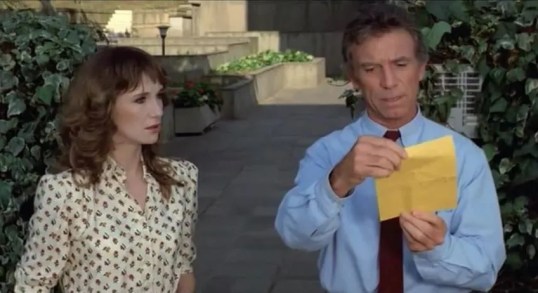
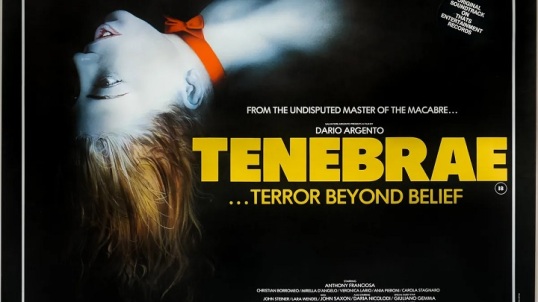
Following the commercial failure of Inferno, a disillusioned Dario Argento returned to Rome. His bad experience with 20th Century Fox had soured Argento on continuing to work with Hollywood and his struggles to film Inferno (as well as his increasingly strained relationship with girlfriend Daria Nicolodi) left him with little desire to continue The Three Mothers trilogy. Instead, he focused on a new idea, one that was inspired by his own experience with an obsessed fan who had left vaguely threatening messages for him when he was in New York. Released in 1982, Tenebrae was Argento’s return to the giallo genre and it would turn out to be a very triumphant return, even if in, typical Argento fashion, it would take a few years for many people to realize just how triumphant.
Argento himself claimed that, while the film was certainly a giallo, it was also his first stab at science fiction. In an interview that appeared in Cinefantastique, Argento said that the film was meant to take place a few years in the future, after some sort of calamity had occurred that has greatly reduced the world’s population. Interestingly, Argento said that the survivors were largely from the upper class and that none of them wanted to talk about or remember what had happened.
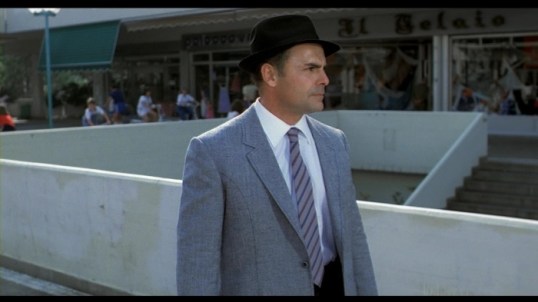
Is the science fiction element actually present in this film? I think it is, though perhaps only because I’ve specifically looked for it. Rome, as portrayed in Tenebrae, is a city that is full of sleek but impersonal buildings, the type that would have been recently built by a wealthy society that was unsure of what it believed. Argento specifically avoids filming any scene near any historical landmarks, suggesting all of the evidence of Rome’s former greatness has been wiped out.
Perhaps the most futuristic element of the film (and the most prophetic) is that no one really seems to have a connection with anyone else. The crowd scenes in Tenebrae aren’t really that crowded, even the ones that take place in what should be a busy airport. (In many ways, the film’s portrayal of a Rome that is both busy but strangely empty brings to mind Jean Rollin’s portrayal of Paris in The Night of the Hunted.) Even when we see people socialize, there seems to be an invisible barrier between them, as if they don’t want to run the risk of getting too close to each other. When one character is fatally stabbed while out in public, perhaps the most disturbing aspect of the murder is that so many people just walk away, as if they’ve been conditioned to ignore anything unpleasant. The only thing that prevents this scene from feeling like a vision of 2023 is that there aren’t a bunch of people filming the victim’s final moments on their phone.
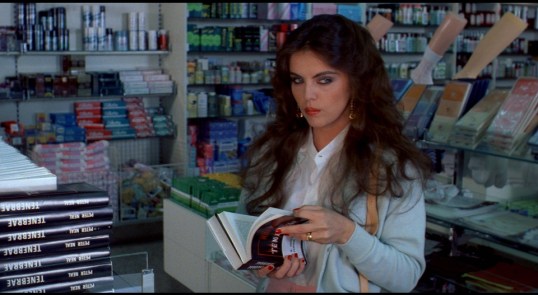
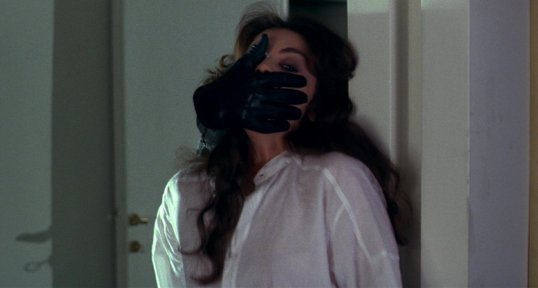
The film opens with a sequence that, as a former teen shoplifter, left me feeling disturbed. Elisa Manni (Ania Pieroni, who played The Mother of Tears in Inferno and the enigmatic housekeeper in Fulci’s The House By The Cemetery) is a shoplifter who gets caught trying to steal the latest book by thriller novelist Peter Neal. After being released, the carefree Elisa walks back to her home and, after being menaced by both a barking dog and a pervy old man, Elisa arrives in the safety of her house, starts to undress, and is promptly attacked by a black-gloved killer who slashes her neck and stuffs pages of Neal’s book into her mouth. It’s not just the murder that makes this scene disturbing but also the fact that the killer was somehow waiting for Elisa in her house, establishing that this is a world where the safety of even a locked door is an illusion.
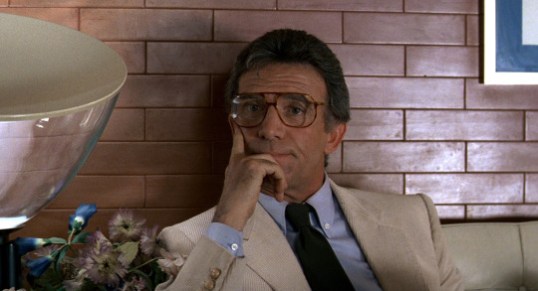
Peter Neal (Anthony Franciosa), who we first see riding his bicycle in New York, has come to Italy to promote his latest book, Tenebrae. He arrives in Rome with his manager, Bullmer (John Saxon, giving a likable performance) and his assistant, Anne (Daria Nicolodi). Confident to the point of arrogance, Peter is a pro at dismissing claims that his books are violent and misogynistic but even he is taken aback when an old friend of his, the journalist Tilde (Mirella D’Angelo), suggests that Tenebrae might inspire violence.
Peter Neal is a celebrity and a pretty obvious stand-in for Argento and everyone in the film is obsessed with him. His ex-fiancée, Jane (Victoria Lario), has followed Peter to Rome, intent on getting some sort of revenge for the way that he treated her while they were together. (Daria Nicolodi felt the vindictive and unstable Jane was based on her, which was another thing that strained her notoriously volatile relationship with Dario.) Peter’ young assistant, Gianni (Christian Borromeo, of Deodato’s The House on the Edge of the Park and Fulci’s Murderrock) hero worships him. The puritanical talk show host, Christiano Berti (John Steiner), wants to interview Peter about the morality of his books. And the killer, whoever they may be, is leaving letters for Peter, informing him that his book have inspired the killer’s crimes. Detective Germani (Spaghetti western star Giuliano Gemma) is investigating the letters and he is an admitted fan of Peter Neal’s novels but, somewhat alarmingly, he mentions that he’s never able to guess the killer’s identity.
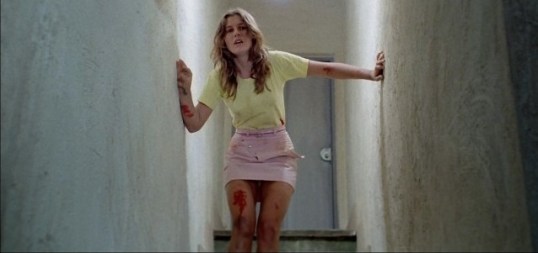
Argento’s camera restlessly prowls his futuristic Rome while Goblin’s music booms on the soundtrack as the people in Peter Neal’s life are murdered by a killer wearing black gloves and carrying a straight razor. The murder scenes feature some of Argento’s best work, directed in such a ruthless and relentless manner that we understand the killer’s determination without having to see their face. This is a film of elaborate set pieces and, as if in direct response to 20th Century Fox’s attempts to control his work on Inferno, Argento is eager to show what he can do when left alone. The film is remembered for the sequence where the camera glides over the exterior of an apartment building while the killer stalks the inhabitants but, for me, the scariest scene is when poor Maria (Lara Wendel), the daughter of Neal’s landlord, finds herself being chased straight into the killer’s lair by a very viscous Doberman.
When the film does slow down, it’s for flashbacks to a beach and acts of sexual violence performed by and against an enigmatic woman (who is played by transgender performer, Eva Robbins). The beach flashbacks unfold in a hazy, dream-like manner and they leave us to wonder if what we’re watching is real or if it’s just a fantasy. If the “modern” scenes feature Argento at his most energetic, the beach scenes feature Argento at his most enigmatic.
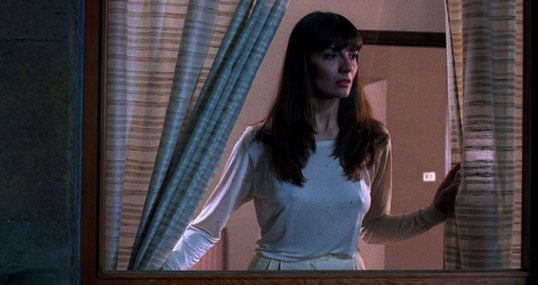
Daria Nicolodi often said that she considered her final scene in this film to be Argento’s greatest act of cruelty to her. Coming across the killer’s final tableaux and discovering the truth about who the killer is, Anne stands in the rain and screams over and over again. Nicolodi apparently felt that Argento required her to stand there soaked and screaming in order to punish her for having worked (with Tenebrae co-star John Steiner) on Mario Bava’s Shock, instead of having accepted a supporting role in Suspiria.
Whatever personal motives may have been involved in the decision, I think Nicolodi’s screaming is one of the most powerful moments to be found in Tenebrae. It’s certainly the most human moment because I think anyone with a soul would scream upon learning the truth of what has been happening in Rome. Every assumption that Anne had has been overturned. Who wouldn’t scream? Continuing with Argento’s claim that the film was about a world where people no longer discuss the terrible things that have happened, Anne’s screams are the most human part of the movie.
Tenebrae is the last of Agento’s truly great and flawless films. Of course, in usual Argento fashion, it was not treated well in the States, where it was initially released in a heavily edited version and with a terrible title (Unsane, under which it can still be found in certain Mill Creek box sets). But Tenebrae has since been rediscovered and today stands as one of Argento’s greatest triumphs.
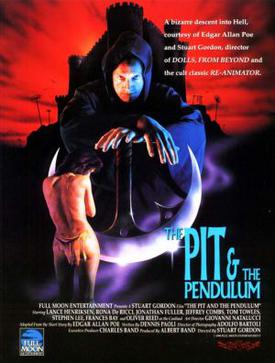
That was my reaction when I watched the 1991 film, The Pit and the Pendulum. Based very narrowly on several Edgar Allan Poe short stories, The Pit and the Pendulum takes place at the height of the Spanish inquisition. Despite the objections of the Pope, Grand Inquisitor Torquemada (Lance Henriksen) is leading a reign of terror though 15th Century Spain. In his torture chambers, Torquemada forces confessions from accused witches and other criminals. The dirty prison cells are full of starving and beaten partners. Witches are burned at the stake and explode while the crazed citizenry calls for blood and Torquemada tests out new torture devices.
Torquemada presents himself as being a grim and emotionless man, someone who is above all sin and who is allowed to sit in judgment of the people who are brought before him. However, Torquemada is hardly the sinless figure that he portrays himself as being. His actions are fueled by his repressed lust and his anger. Maria (Rona De Ricci) has been brought before him, accused of being a witch and Torquemada is determined to get her to confess. Maria’s refusal to be broken by Torquemada only increases Toquemada’s anger but, at the same time, Torquemada has also decided that he’s in love with Maria. While Maria waits in the prison and takes advice from the witch Esmerelda (Frances Bay), Maria’s husband, Antonio (Jonathan Fuller), attempts to break Maria out of prison. When Antonio is captured, Torquemada decides to try out his latest device, a swinging and sharpened pendulum that hangs in a pit….
The Pit and the Pendulum is not always an easy movie to watch. I have to admit that I spent the majority of the movie with my hands over my eyes, not wanting to watch the extremely graphic torture scenes. Like many of director Stuart Gordon’s film, The Pit and the Pendulum is gripped by an atmosphere of pervasive corruption and the movie captures the feeling of not being able to escape from the worst place on Earth. Poor Maria spends a good deal of the movie naked and chained to various devices but Rona De Ricci gives such a strong and such a committed performance as Maria that, instead of being offended by the obvious exploitation element of the scenes, you instead find yourself admiring Maria and her strength.
It’s probably not a coincidence that Oliver Reed shows up in the film as a Cardinal because The Pit and the Pendulum, with its portrayal of blood frenzy and hypocrisy, is definitely influenced by Ken Russell’s The Devils. The imagery is graphic and often disturbing but the most memorable thing about the film is Lance Henriksen’s intense performance as the evil Torquemada. Henriksen plays Torquemada as being a hateful and self-loathing figure, a man who deals with his own demons by bringing his fury down on the innocent. It’s a truly frightening villainous performance, one that carries shades of Vincent Price’s excellent performance in The Witchfinder General.
The Pit and the Pendulum is not an easy film to watch and I doubt I’ll watch it a second time. In the end, it’s a disturbing film but one that definitely leaves an impression.
Seriously, the best thing about the 1964 film, Monstrosity, is that it features a black cat named Xerxes. Xerxes is not only a cute little kitty (and, seriously, who doesn’t love a black cat?) but Xerxes is also the best actor to be found in the entire film. While everyone else is struggling to deliver their lines and not wander out of the shot, the cat delivers its meows with the skill of a pro and always hits the right mark. If there was an Oscar category for best animal actor, Xerxes definitely would have been the one accepting the Oscar from the Breakfast at Tiffany’s cat. Seriously, I hope Xerxes was paid well for this role. I hope it opened up a lot of doors for Xerxes. When animal actors get together, I hope that they take a few minutes to raise a toast and to praise a true trailblazer and a wonder performer, Xerxes the Cat!
Unfortunately, the rest of the film doesn’t really live up to Xerxes’s work. Xerxes was obviously doing the best that a cat could do to save this film but there is only so much that a cat can do. At some point, the humans have to step up and make a little bit of effort as well.
Monstrosity, which is also known as The Atomic Bomb, tells the story of Mrs. Hettie March (Marjorie Eaton), a thoroughly unpleasant but very wealthy woman who lives in an isolated mansion. Working in her basement is Dr. Otto Frank (Frank Gerstle), a mad scientist whose work in the field of brain transplantation has led to a lot of strange things happening at the house. For instance, there’s a guy who has the brain of a bulldog. There’s also a woman who wanders around the laboratory with a blank look on her face. Still, Mrs. March is convinced that Dr. Frank will eventually be able to take her brain and transplant it into a younger and more attractive woman.
An ad is put in the classifieds, asking for a young woman to come work as a housekeeper at Mrs. March’s mansion. Three women show up for the job, not realizing that they are actually being set up as candidates to become Mrs. March’s new body. Nina Rhodes (Erika Peters) is from Austria and is the most level-headed. Bea Mullins (Judy Bamber) is from the United Kingdom and speaks with such a thick accent that the viewer will automatically know that she’s not actually British. Anita Gonzalez (Lisa Lang) is from Mexico and rarely speaks. The women arrive at the mansion and soon find themselves at the mercy of the rich old woman, the mad doctor, and all of the failed experiments.
Monstrosity is pretty dumb and remarkably poorly acted, with Lisa Lang’s performance as Anita being the main offender. (Bradford Dillman, who would go on to become a very busy character actor, provided the film’s narration.) That said, Xerxes was a true star. All hail Xerxes!
(I originally shared this film back in 2011, 2019, and 2022 — can you believe we’ve been doing this for that long? — but the YouTube upload keeps getting taken down! So, I’m resharing it today!)
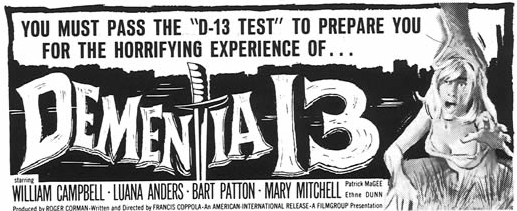
For today’s excursion into the world of public domain horror, I offer up the film debut of Francis Ford Coppola. Before Coppola directed the Godfather and Apocalypse Now, he directed a low-budget, black-and-white thriller that was called Dementia 13. In a possible sign of things to come, producer Roger Corman and Coppola ended up disagreeing on the film’s final cut and Corman reportedly brought in director Jack Hill to film and, in some cases, re-film additional scenes.
Regardless of whether the credit should go to Coppola, Corman, or Hill, Dementia 13 is a brutally effective little film that is full of moody photography and which clearly served as an influence on the slasher films that would follow it in the future. Speaking of influence, Dementia 13 itself is obviously influenced by the Italian giallo films that, in 1963, were just now starting to make their way into the drive-ins and grindhouses of America.
Speaking of giallo films, keep an eye out for Patrick Magee, who gave a memorable performance in Lucio Fulci’s The Black Cat. Luana Anders, who plays the duplicitous wife in this film, showed up in just about every other exploitation film made in the 60s and yes, the scene where she’s swimming freaks me out to no end. Other films featuring Luana Anders include Night Tide and Easy Rider, in which she played one of the hippies who unsuccessfully enticed Peter Fonda and Dennis Hopper to stay at the commune.
As for Francis Ford Coppola, his career has had its up and downs but he’s a beloved figured on the pop cultural landscape and a director whose best films continue to inspire and influence. He is currently filming Megalopolis.
The 2018 Australian film, Trust, tells the story of Daniel Rainwater (Keith Austring).
Daniel is an illustrator whose seemingly perfect life falls apart in just one day. He loses his job and doesn’t even receive a severance package. He discover that his wife (Lisa Carey) has been unfaithful and wants a divorce. With no money coming in, he loses his home. His children move in with his wife. At one point, he develops a terrible rash on his face. When he does get a new place to live, it’s a tiny apartment that is so cluttered and dusty that it looks like it should be on an episode of Hoarders. When he gets a new car, he is involved in a terrible car crash and ends up breaking his leg in five different places. When he finally gets the cast off, the first thing he does is fall flat on his face. When he does get another job, he finds himself working in a warehouse….
Well, you get the idea.
At one point, one of Daniel’s friends informs him, “I think you’re going through a Job-like test.”
“Awesome,” Daniel replies.
Yes, Trust is yet another film based on the Book of Job but, as opposed to so many similar films, Trust actually has a sense of humor about itself. Instead of resorting to melodrama, as so many other Job-inspired films do, Trust often finds the humor in Daniel’s various situations. I mean, the guy just cannot catch a break. Indeed, Daniel’s problems can often just as easily be ascribed to him having terrible luck as they could to an wager between God and Lucifer. Daniel is the type whose laptop dies right before he needs to use it. He’s the type who always locks his keys in his car. He’s the type who gets drenched by a sudden rainstorm. Daniel has a lot to deal with and he frequently gets discouraged but he never gives up and, as played by Keith Austring, it’s hard not to like him.
Yes, it’s based on the Book of Job and Job is a Rorschach test for how one feels about the idea of being tested. Many see the book as a celebration of faith in the face of adversity. Others see it and wonder why poor Job and his family (the majority of whom ended up dying) had to be put through so much for just a wager. Trust avoids a lot of the issues inherent in the Job narrative by making Daniel’s problem more down-to-earth. Daniel may have to move out of the house and he may not get to see his children as much as he likes but at least they aren’t killed by a plague. Though Daniel eventually finds peace with all of his problems and realizes that they’ve helped to make him a stronger man and a better father, the film itself never feel preachy. Trust is a well-directed and well-acted film, one that understands the importance of humor and humanity.
Henry (Daniel Charles DesVerges) has been depressed ever since he was in a car accident that left one woman dead. His three friends — Phil (Akam Khiziryan), Elizabeth (Kerri Smith), and Amanda (Baylee Vidal) — try to lift his spirits by taking him on vacation to a cottage in a small town. It doesn’t work because Henry keeps having violent dreams and visions of a ghostly woman walking around the cottage. While his friends try to help Henry come to peace with the past, Henry fears that the spirit of the woman who died the night of the accident will never stop stalking him.
The main problem with Enchantress is that Henry is such an annoying sad sack of a character that it doesn’t take long to get bored with watching him feeling bad for himself. The movie doesn’t add up too much but it does leave you appreciating the patience of Henry’s friends, who deserve a gold medal for putting up with him.
The actors are okay and usually, they manage to make their dialogue sound naturalistic. Movies like this always feature at least one D-List celebrity cameo and for this one, it’s Daniel Baldwin, who plays Henry’s father in a scene that lasts a minute. Daniel is the forgotten Baldwin brother, though I will always remember him as Detective Beau Felton during the first seasons of Homicide: Life on the Streets.
Jim Van Bebber’s The Manson Family (a.k.a. Charlie’s Family) opens with chaos. The viewer is assaulted with a series of quick cuts and disturbing images. The American flag flies. The American flag is covered in blood. Insane faces flash by. We catch glimpses of blood squirting and we hear people screaming while two performers go through with some sort of S&M bondage ritual with a red, white, and blue dildo. I have to admit the opening few minutes of the montage actually made me nuaseus. That’s not necessarily criticism, though. If anything, I imagine that was Van Bebber’s intention. The opening announces that the viewer is not just about to see another film about the Manson murders. Instead, TheManson Family is a plunge into the heart of darkness that beat at Spahn Ranch. It’s not a film for those who cannot handle being shocked.
The disjointed nature of the film’s montage is carried over into the film’s narrative. The Manson Family deals with two different time periods. In 1996, a journalist named Jack Wilson (Carl Day) sits in the studio of his show, Crime Time, and watches grainy footage of the former members of Manson’s Family being interviewed. Some of them still proudly have X’s carved into their foreheads and continue to parrot Manson’s hippie psychobable. Others are interviewed from prison and try to play down their own roles in the crimes. Tex Watson (Marc Pitman) and Sadie Atkins (Maureen Alisse) both appear to be in a prison chapel. Tex, who was one of the most brutal of the murderers in Manson’s Family, comes across as mild-mannered. Sadie — who was nicknamed Sexy Sadie when she was a member of the Family — now has gray hair, glasses, and the speaking style of a high school guidance counselor. At first, only Bobby Beausoliel (played by director Van Bebber) seems to be willing to fully admit to what happened but even he eventually changes his story to seemingly protect Manson. While Wilson watches the footage, a group of young Manson fans ominously wait outside of his studio.
During the interviews, the film frequently flashes back to 1969 and we watch as Charles Manson (Marcello Games) unsuccessfully pursues rock stardom and gathers the members of his so-called Family at the Spahn Movie Ranch. While Manson’s followers talk about how charismatic and wise he was, the flashbacks reveal that Manson was actually a cowardly racist who ordered others to kill for him and who went into hiding after he shot a drug dealer because he was convinced that the Black Panthers were going to come after him. The film suggests that Manson’s murders had less to do with Helter Skelter or any of his other hippie psychobabble and more to do with Manson’s anger over not being famous. At Spahn Ranch, Manson lives like almost a parody of a rock star, complete with all the drugs, groupies, and sex that he could want. But, ultimately, it doesn’t matter because, unlike his friend and follower Bobby Beausoliel, Manson can’t even get a record contract. The murders are depicted and this is a very bloody movie but, to its credit, the film never attempts to make Manson or the majority of his followers into sympathetic characters. Instead, by featuring the character of Jack Wilson putting together yet another exploitive TV show about Manson, the film examines how the media can even turn as scummy a loser as Charles Manson into an icon of sorts.
It’s a chaotic film, one that features its share of shockingly explicit footage. When the incarcerated members of the Family say that the early days at Spahn Ranch were a nonstop orgy, Van Bebber doesn’t hesitate to show us what they’re talking about. At the same time, there’s a constant threat of violence to be found in every scene. Every shot feels just a little bit off-center, preventing the viewer from ever feeling like they can relax. Even the moments that shouldn’t work, like Tex briefly turning into the devil, do work when viewed as being a part of the film’s portrayal of a world that’s spiraling out of control. Throughout the film, we hear snippets of not Charles Manson but instead Jim Jones, exhorting his followers to commit mass suicide at Jonestown. It’s a reminder that Manson was not the only cult leader who convinced his followers to do terrible things. The Manson Family is a messy, raw, but effectively disturbing film of a death-obsessed culture.
The production of The Manson Family was, itself, a rather chaotic one. Van Bebber spent ten years filming the movie and, indeed, one reason why the character of Charles Manson disappears from a lot of the film is because the actor himself stopped showing up on set. (Interestingly enough, that works to the film’s advantage as it makes Manson into a character who always feels like he’s present even when he isn’t.) A rough cut of the film made the festival circuit in 1997. The film, itself, didn’t get an official release until 2003. One gets the feeling that the disjointed nature of the film’s production was reflected in the film’s equally disjointed narrative but again, that works to the film’s advantage. Though not always easy to watch, The Manson Family is one of the better Manson family films to have been made. If nothing else, watching the film makes it much easier to understand why so many people cheered when Leo DiCaprio set Sadie Atkins on fire at the end of Once Upon A Time In Hollywood.
Well, we’re more than halfway done with October and, traditionally, this is when all of us in the Shattered Lens Bunker gather in front of the television in Arleigh’s penthouse suite, eat popcorn, drink diet coke, and gossip about whoever has the day off.
Of course, after we do that, I duck back into my office and I watch the classic 1962 film, Carnival of Souls!
Reportedly, David Lynch is a huge fan of Carnival of Souls and, when you watch the film, it’s easy to see why. The film follows a somewhat odd woman (played, in her one and only starring role, by Candace Hilligoss) who, after a car accident, is haunted by visions of ghostly figures. This dream-like film was independently produced and distributed. At the time, it didn’t get much attention but it has since been recognized as a classic and very influential horror film.
This was director Herk Harvey’s only feature film. Before and after making this film, he specialized in making educational and industrial shorts (some of which we’ve watched on this very site), the type of films that encouraged students not to cheat on tests and employees not to take their jobs for granted. Harvey also appears in this film, playing “The Man” who haunts Hilligoss as she travels across the country.
 A bunch of teenagers hang out in a house during one snowy weekend. It’s just too bad that the house is located near Donner Pass, the infamous Colorado location where George Donner ate several people while trapped by a blizzard. Legend has it that Old Man Donner is still out there, his spirit tracking down others dumb enough to get lost in the snow and eating them. And even if Old Man Donner doesn’t get them, what about the escaped criminal who is currently missing somewhere in the Colorado wilderness?








 Through the Shattered Lens