The Lone Hand Texan (1947, directed by Ray Nazarro)


Oil’s been discovered on the Texas frontier and Sam Jason (Fred Sears) has got the rights to several wells.  Someone in town keeps sabotaging his operations and blowing up his oil wells.  Sam sends a telegram to his old friend, Steve Driscoll (Charles Starrett).  Steve shows up in town to help Sam set up his business.  Meanwhile, Steve’s alter ego, the masked Durango Kid, works to discover who has been targeting Sam.

This is actually more of a Smiley Burnette movie than a Durango Kid film.  As always, Smiley is the Kid’s sidekick in the movie.  Smiley owns a general store and he’s the towns postmaster.  Everywhere Smiley goes, he is followed by two musicians, Mustard and Gravy.  Smiley sings even more songs than usual in this movie and he even has a brief romance with the local widow (Mary Newton), who unfortunately is also behind the efforts to drive Sam out of business.  Smiley may be the sidekick but he gets more screentime than the Durango Kid in The Lone Hand Texan and he does a mighty fine job with it.

One of the curious things about The Lone Hand Texan is that one of the bad guys also decides to wear a mask and claim to be The Durango Kid.  I wish the movie has done more with that because I have never really understood why Steve feels like he has to pretend to be Durango in the first place.  It’s not as if it’s difficult to recognize Steve, even when he’s wearing a mask.  I have never understood why no one in his movies ever notices that you never see Steve and the Durango Kid in the same place at the same time.  Even Lois Lane should have been able to figure out Durango’s secret identity.

The Lone Hand Texas is a standard Durango Kid outing, albeit not as dependent on stock footage as some of Durango’s other films.  Smiley gets to do more than usual, which is the only thing that really sets it apart.  As with most of the Durango Kid films, it will be best appreciated by those who are already fans.


Retro Television Review: Shattered Innocence (dir by Sandor Stern)


Welcome to Retro Television Reviews, a feature where we review some of our favorite and least favorite shows of the past!  On Sundays, I will be reviewing the made-for-television movies that used to be a primetime mainstay.  Today’s film is 1988’s Shattered Innocence!  It  can be viewed on YouTube.

Shattered Innocence starts with a young woman shooting herself in a nice bedroom, while someone on the outside bangs on the door.

The rest of the movie shows the events the led up to the suicide of Pauleen Anderson (Jonna Lee).  On the one hand, starting a film with a literal bang is definitely a way to capture the audience’s attention.  On the other hand, letting us know that the story is going to end with a suicide pretty much robs the story of the element of surprise or the ability to take the viewer by surprise.  We know how the story is going to end and it doesn’t take long for us to figure out why it’s going to end that way.

From the minute we see Pauleen as a naive cheerleader with an overprotective family, we know that she’s going to end up hooking up with Cory (Kris Kamm), the local bad boy.  As soon as she graduates from high school and gets a job as a waitress, we know that Pauleen is not going to be staying in Kansas.  As soon as she and Cory end up in California and Cory suggests that Pauleen is pretty enough to be a model, we know that she’s going to end up modeling topless and that she’s going to deal with her nerves and her weight by snorting cocaine.  We also know that she’s going to end up appearing in adult films and that her concerned mother (Melinda Dillon) is constantly going to be begging her to come back home and forget about Los Angeles and its sinful ways.

Apparently based on a true story, there’s not really anything surprising about Shattered Innocence.  It tells a sordid story but, because it was made-for-TV, the scene usually ends right before anything really explicit happens.  (Ironically, by keeping the sordid stuff off-camera, the film invites the audience to imagine scenarios that are probably a hundred times more trashy than anything that could be recreated on film.)  Shattered Innocence gets by on innuendo, with frequent scenes of people saying stuff like, “Did you see the pictures?” or “You may recognize her from her centerfold.”  Nerdy Mel Erman (John Pleshette), who becomes Pauleen’s business partner, first meets her when he asks her to autograph the cover of Penthouse.  Otherwise, this film is actually pretty tame.

In fact, the one scene that really jumped out and made me go “Agck!” was a scene in which Pauleen’s nose suddenly started bleeding as a result of all the cocaine that she had recently done.  That was frightening, just because I’ve always had to deal with nosebleeds due to my allergies.  I hate them and the taste of blood in the back of my throat.  In that scene, I could relate to Pauleen’s shock and embarrassment.

Shattered Innocence tells a story that’s as old as Hollywood itself, which is a bit of a problem.  Too often, the movie just seems to be going through the expected motions.  Jonna Lee was a bit dull in the lead role but Melinda Dillion and John Pleshette both did well as the only two people who seemed to really care about Pauleen.  For the most part, though, Shattered Innocence was sordid without being memorable.

Retro Television Review: For My Daughter’s Honor (dir by Alan Metzger)


Welcome to Retro Television Reviews, a feature where we review some of our favorite and least favorite shows of the past!  On Sundays, I will be reviewing the made-for-television movies that used to be a primetime mainstay.  Today’s film is 1996’s For My Daughter’s Honor (a.k.a. Indecent Seduction)!  It  can be viewed on YouTube, Tubi, and Prime.

Welcome to Tate, Oklahoma.

It’s a nice little town in what is usually referred to as being the heartland of America.  It’s a place where the streets are clean, the people are friendly, and where everyone roots for the local high school football team.  That makes Coach Pete Nash (Gary Cole) a pretty important person in Tate.  At a start-of-the-year pep rally, the football team is introduced as “Oklahoma’s team” and that would make Pete Nash Oklahoma’s coach.  Make no mistake about it, they love football in Oklahoma.  They love it almost as much as we love it in Texas.

Coach Nash also teaches Biology and he’s known for being the cool teacher that all of the students like to hang out with.  Soon, Nash is hanging out with 14 year-old Amy Dustin (Nicholle Tom) and Amy’s friends, Kelly (Allyson Hanigan) and Kimberly (Sara Rue).  With Coach Nash, they all get to drink beer.  They get to break into the school library and have fun with the copy machine.  Coach Nash sends Amy flirty little notes and she writes back.  Nash even encourages his daughter to invite Amy over for a sleepover so that she can lose her virginity.  Yikes!

Amy’s mother (Mary Kay Place) and her father (Mac Davis) both have their concerns about the amount of time that Amy is spending with Coach Nash.  Amy’s father is especially upset when he hears that Coach Nash threw a fit after he saw Amy dancing with a boy her own age.  But everyone in town tells them that they’re being paranoid and that Coach Nash is a good guy who just happens to be very close to his students.  He’s a family man and he’s a good football coach and that’s all that matters.

Though the names and the central location have all been changed, For My Daughter’s Honor is based on a true story.  The actual events took place in Texas and, as happens in the movie, the parents of the victim ended up suing the school district for failing to do anything about the predatory teacher.  The film certainly does capture the feeling of living in a small community where everyone thinks that they know everyone else and where people often choose not to believe what is obviously happening right in front of them.  Coach Nash makes no effort to hide his activities but he gets away with it because no one wants to confront what’s going on.  It’s easier to just say that Coach Nash is a passionate teacher or that he’s someone who lets his emotions get the better of him.  For many in the town, it’s easier to blame Amy and her family than it is to hold Coach Nash responsible for his own actions.

Gary Cole gives a strong performance as Coach Nash and is equally believable whether being blandly affable or obsessively creepy.  One of the reasons why this film works is because everyone has had at least one Coach Nash in their lives, that person who seems friendly but just gives off a strange vibe.  In the end, this is a film that says that it’s okay to be concerned.

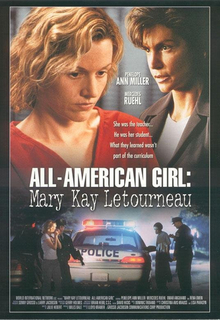
Retro Television Review: All-American Girl: The Mary Kay Letourneau Story (dir by Lloyd Kramer)


Welcome to Retro Television Reviews, a feature where we review some of our favorite and least favorite shows of the past!  On Sundays, I will be reviewing the made-for-television movies that used to be a primetime mainstay.  Today’s film is 2000’s All-American Girl: The Mary Kay Letourneau Story!  It  can be viewed on YouTube.

In 1996, a 34 year-old teacher named Mary Kay Letourneau decided that she had fallen in love with someone who was not her husband.

A 34 year-old deciding that they are no longer happy in their marriage and subsequently deciding that that they’ve found love with someone else is hardly an unusual or even surprising occurrence.  What made Mary Kay Letourneau’s case a national scandal was that the person that she decided that she was in love with was a 12 year-old student named Vili Fualaau.  Mary Kay started her affair with Vili when she was his sixth grade teacher.  When she was arrested and charged with two counts of second-degree rape of a child, Letourneau was pregnant with Vili’s child.  Even after being arrested, Letourneau insisted that she and Vili were soulmates.  After giving birth to Vili’s child, Letourneau was sentenced to six months of prison and somehow managed to avoid having to register as a sex offender.  After serving her sentence, Letourneau was promptly arrested again with Vili and was sent back to jail, where she gave birth to Vili’s second child.

All-American Girl opens with Mary Kay Letourneau (Penelope Ann Miller) in jail, insisting that everything that happened between her and Vili was consensual and that their love is real.  The majority of the film is shown in flashbacks.  Some of those flashbacks deal with Mary Kay, her husband (Greg Spottiswood), and Vili (Omar Anguiano).  Watching the flashbacks, I couldn’t help but notice that the film really did seem to be on Mary Kay’s side, to an almost ludicrous extent.  Her husband is portrayed as being a soulless sociopath, even before Mary Kay starts sneaking around with Vili.  As for Vili, he is presented as being the one who initiated his relationship with Mary Kay, flirting with her in class and comforting her when she starts crying in a school hallway.  The actor playing Vili looked, acted, and sounded considerably older than just 12 years old.  At times, he appeared to be nearly as old as Penelope Ann Miller.  And I’ll admit that it’s totally possible that Vili could have looked older than his age and maybe he did have a surprisingly mature vocabulary.  But still …. he was 12 years old!  Apparently, Letourneau cooperated with the film’s producers and that’s pretty obvious from the first minute we see Vili giving Letourneau a wolfish smile in the 6th grade.

The flashbacks dealing with Letourneau’s childhood are a bit more interesting, if just because Letourneau was the daughter of a congressman who ran for president in 1972.  (One of her brothers served in the first Bush White House.  Another served as an advisor to the 2016 Trump campaign.)  At one point, she taunts a group of protestors that have gathered outside of her family’s home and her father praises her courage.  The film hints that it was the twin traumas of her brother’s death and the discovery that her beloved father had fathered two children with a mistress that led to Letourneau’s subsequent instability.  Perhaps that’s true, though I think the film is a bit too eager to accept that as an all-purpose explanation.

You may have guessed that I had mixed feelings about this film.  Penelope Ann Miller gave an excellent performance as Mary Kay but the film’s attempts to portray May Kay as being even more of a victim that Vili were undeniably icky.  

As for the real Mary Kay, she married Vili four years after being released from prison.  They separated a year before Mary Kay died in 2020.  Their relationship inspired several films, most recently May/December.

Cyclone Fury (1951, directed by Ray Nazarro)


Brock Masters (Mark Roberts) has been awarded a contract to supply the army with horses.  Corrupt businessman Grat Hanlon (Clayton Moore) wants that contract for himself so he sends his henchmen to kill Brock.  Because Brock has no known relatives, Grat believes that both the horses and the contract will soon be his.

However, Brock does have an heir!  He adopted an Indian child named Johnny (Louis Lettieri).  Johnny inherits the contract and both the Durango Kid (Charles Starrett) and Smiley Burnett are going to make sure that Johnny is able to deliver the horses.  Smiley is also going to find some time to sing some songs that have even less to do with the story than usual.

Cyclone Fury was one of the later entries in the Durango Kid series.  By the time it was made, Colombia was no longer willing to spend much money on the series so that majority of the film’s action scenes are lifted from other Durango Kid movies.  If you’ve never seen another Durango Kid movie, the action scenes are exciting and feature some impressive stunts.  If you have seen another Durango Kid movie, this one is going to seem really familiar.

For western fans, the main appeal here will be seeing Clayton Moore playing a bad guy.  Moore had already played The Lone Ranger when he appeared in this movie.  At the time Cyclone Fury was made, Moore had been unceremoniously fired from his most famous role and The Lone Ranger was being played by John Hart.  Hart would only last a season and Moore would subsequently be invited back to play the role that defined his career.  As for Cyclone Fury, Moore is convincing as Grat, though the character himself is just a typical Durango Kid bad guy.  The Durango Kid was always going up against seemingly respectable businessmen who were actually outlaws.

One final note: Moore’s Lone Ranger co-star, Jay Silverheels, appears in this film but only in archival footage from an early adventure of The Durango Kid.

3 Desperate Men (1951, directed by Sam Newfield)


Tom and Fred Denton (Preston Foster and Jim Davis) are two frontier lawmen who are frustrated with their jobs.  They are both owed backpay.  When they shoot an outlaw, they are expected to pay the $80 burial fee.  Neither Tom nor Fred feels that they are appreciated by banks and the railroads that expect them to risk their lives on a daily basis.

When Tom and Fred are informed that their younger brother, Matt (Kim Spalding), has been convicted of murder and sentenced to hang in another town, they ride off to save him.

Even though Tom and Fred can both provide an alibi for Matt and it is obvious that Matt has been framed by a corrupt railroad agent, the town is still determined to hang him.  Tom and Fred manage to rescue him from the gallows but, in the process, a deputy is killed.  Now wanted by the authorities, the Denton brothers are forced to team up with the same outlaws that they used to hunt.  Soon, the Dentons are robbing banks and trains and their old friend, Pete Coleman (Monte Blue), has been ordered to captured them, dead or alive.

One of the many low budget westerns to be produced by the Lippert Company, Three Desperate Men is a cut above the usual B-western.  None of the Dentons want to be outlaws but they are forced into it by circumstances out of their control.  The real villains of the film are the bankers and the railroad tycoons who hoard the land and the money and who try to cheat men like Tom and Fred out of their rightfully earned wages.  The Denton brothers ultimately decide that their number one loyalty is to each other and that leads to the movie’s fatalistic conclusion, which is surprisingly violent for a 1951 western.  Preston Foster, Jim Davis, and Monte Blue head a cast that is full of tough and authentic western veterans and the action scenes are imaginatively staged by director Sam Newfield.  Three Desperate Men is a B-western that can be enjoyed even by those who don’t like westerns.

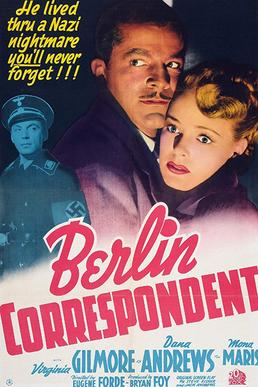
Film Review: Berlin Correspondent (dir by Eugene Forde)


In the 1942 film, Berlin Correspondent, Dana Andrews plays Bill Roberts.

Bill is an American journalist, working out of Berlin.  Because the film takes place before America’s entry into World War II, Bill pretends to report only what the Germans want him to report.  Even while there are bombs exploding outside of the studio, Bill and his fellow correspondents report that everyone in Berlin is happy and that the German government is doing a great job.

However, Bill fills his reporting with code words, which are then interpreted by listeners in the American Intelligence service.  They understand that when Bill says that the people are happy, that means that they’re actually miserable.  When Bill says that the weather in Berlin is cloudy, that means that there is dissent brewing in the government.

Still, Captain Von Rau (Martin Kosleck) comes to suspect that Bill might be sending out secret messages and he decides to send someone to not only compromise Bill but to also discover who is feeding Bill information.  Von Rau sends his own fiancée, Karen Hauen (Virginia Gilmore), to seduce Bill.  Little does Von Rau suspect that Bill’s source of information is Karen’s own father (Erwin Kalser) and that Karen herself is going to end up falling in love with Bill.

Berlin Correspondent is typical of the films that were made to try to build support for the American war effort during the Second World War.  The hero is a tough and cynical American who pretends to not care about what is happening in the rest of the world but who eventually reveals himself to be an idealist with a strong sense of right and wrong.  Bill may say that he’s only in Berlin to report the news but, when Karen’s father is sent to a concentration camp, Bill proves himself to be willing to risk his own life to help the older man make it to Switzerland.  Karen’s father stands in for the members of the German resistance who worked from the inside to bring down the Nazis.  Bill and Karen’s love serves as a reminder that the world can come back together but only after Hitler has been defeated.

The two main Nazi villains are played by Martin Kosleck and Sig Ruman, two German actors who immigrated to the United States to escape the real-life Nazis.  Kosleck and Ruman play their characters as being buffoonish bullies who are easily outsmarted by street smart Americans like Bill.  It’s the film’s way of saying to the audience, “Are you really going to let these idiots think that they can defeat America?”  Still, a scene is included in which a crippled girl is described as being someone who should be put to death.  It’s a necessary reminder that the Nazis may be idiots but they’re also a legitimate threat.

Berlin Correspondent clocks in at a brisk 70 minutes and it features a typically strong leading performance from Dana Andrews.  If you needed someone to fight for America, 40s-era Dana Andrews would definitely be a good pick to go with.  It’s a joy to watch him outsmart the Nazis.

Law of the Canyon (1947, directed by Ray Nazarro)


When a gang of outlaws starts hijacking freight wagons and then ransoming them back to their owners, government agent Steve Langtry (Charles Starrett) is sent to investigate.  He both goes undercover as an inexperienced traveler and as the masked Durango Kid.  As always, he is accompanied by Smiley Burnette.  In this installment, Smiley tries to invent a machine that can find silver and he also sings a few songs.  His backing band, The Lone Star Cowboys, follow him everywhere that he goes but they don’t actually get involved in the action.

This is another Durango Kid movie, with all of the usual horse chases and shootouts.  The same action montage that started Phantom Valley also starts this movie.  As always, Charles Starrett is convincing when riding a horse or shooting a gun.

What sets this Durango Kid movie apart from the others is the main villain.  Dr. Middleton (played by a regular member of the Durango Kid stock company, Fred F. Sears) appears to be a kindly man who serves as a middleman between the citizens and the outlaws.  Actually, he is working with the outlaws and receives a commission of every ransom that he negotiates.  The reason he can get away with it is because he’s drugged the Sheriff (George Cheseboro)!  He attempts to drug Durango too but luckily, Smiley drinks the water instead.

While it won’t convert anyone who isn’t already a fan of the genre or the character, this is another entertaining outing for the Durango Kid.

Film Review: The Man I Married (dir by Irving Pichel)


In 1940’s The Man I Married, Joan Bennett stars as Carol Cabbott Hoffman.

Carol is a New York-based art critic.  She is young, sophisticated, wealthy, and politically naive.  Because she has been married to a German for seven years, she has been keeping up with what has been happening in Germany but it’s clear that she doesn’t really understand the full story of what she’s hearing.  As she says, at one point, she has heard bad things about the Nazis but she also tries to keep an open mind and not get drawn in by “propaganda.”

Her husband, Eric Hoffman (Francis Lederer), has not been back to Germany in ten years and he says that he has little interest in ever returning.  But, when he receives a letter from his father (Otto Kruger), Eric announces that he has to return home for a visit.  Before Carol, Eric, and their son, Ricky (Johnny Russell), leave for Germany, they are approached by their friend, Dr. Hugo Gerhardt (Ludwig Stossel).  He explains that his brother has been imprisoned in a concentration camp and he asks Carol and Eric to deliver money to him and to appeal to the American embassy for help.  Carol agrees to do so.  Eric is noticeably reticent.

As soon as they arrive in Germany and Eric learns that his father wants him to take over the family’s factory, Eric starts to change.  He and a former schoolmate named Freida (Anna Sten) are a bit too happy to see each other again.  Eric insists on listening to the nightly radio broadcasts from Dr. Goebbels.  When Freida mentions that it is illegal to joke about Hitler, Eric surprises Carol by defending the law.  With Eric spending all of his time with Freida and dismissing Carol’s understandable suspicions by saying that she’s just being jealous, Carol meets an American correspondent named Keith (Lloyd Nolan) who reveals to her the truth of life in Nazi Germany.  Carol discovers that, rather than being the economically-strong paradise that Eric and Freida claim it to be, Germany is a place where many citizens live in fear of being heard saying the wrong thing and, as a result, they’ve chosen to close their eyes to what is going on around them.

The Man I Married is an interesting film.  It’s an anti-Nazi film that was released at a time when America was still technically a neutral nation.  Indeed, the film almost feels like it was made to prepare Americans for the inevitability of war with Germany.  When Keith mocks Carol for trying to be neutral about the Nazis, it’s clear that he’s meant to be speaking to the audience watching the film.  Eric begins the film as an erudite and seemingly charming man but, as soon as he arrives in Germany and is reunited with Freida, he reveals himself to be a fervent Nazi.  The film warns the audience not to trust those who were trying to excuse or dismiss Germany’s actions.

This is also one of the few films made before World War II that really acknowledged just how central anti-Semitism was to the Nazi ideology, acknowledging the concentration camps at a time when many in the West were refusing to admit they existed, either because they were in denial or because they just didn’t care.  Towards the end of the film, a major character is discovered to have had a Jewish mother and the reaction to the news reveals the hate that was at the heart of the Third Reich.

The Man I Married, with its portrayal of a populace that has convinced itself that their government is never to be questioned and that all dissent must be punished, is a film that feels just as relevant today as it did in 1940.  It’s a film that warns viewers of the risk of disbelieving their own eyes.

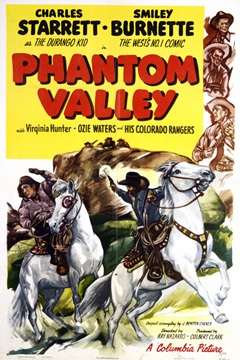
Phantom Valley (1948, directed by Ray Nazarro)


There’s trouble in Phantom Valley.  The ranchers who founded the town are increasingly at odds with the newly arrived homesteaders.  Each side blames the other for the tensions.  Marshal Steve Collins (Charles Starrett) is sent to investigate who is responsible for all of the trouble but, when two people are murdered, it is up Steve’s alter ego, the masked Durango Kid, to investigate and solve the murders.  Helping him out is his ever-loyal sidekick, Smiley Burnette.  Smiley compares himself to Sherlock Holmes, walks around with a magnifying glass, and sings a few songs.

This Durango Kid film opens with a exciting montage of cattle stampedes, shoot-outs, floods, and horse chases.  Even though it’s almost all stock footage that appeared in a countless number of other B-movies, it’s still exciting to watch.  Despite the opening montage, there’s still less stock footage than usual in Phantom Valley.  The emphasis is instead on the Durango Kid as a detective, trying to solve a stone-cold whodunit.  It makes for an interesting change of pace and the Durango Kid gets to show off his intelligence along with his shooting and horse riding skills.  Charles Starrett is convincing as a detective.  Even if he is trying to solve the case a century before finger printing, The Durango Kid knows that hand-writing is just as easy a way to identity a culprit.  Smiley Burnette, as usual, handles the comedic relief and the singing.  I could have done without the songs but Smiley trying to use a magnifying glass and losing his temporary position as the town’s marshal to a child will always be good for a laugh.

Phantom Valley was a welcome change of pace for the Durango Kid.  Western fans will find much to appreciate.