Retro Television Review: If Tomorrow Comes (dir by George McCowan)


Welcome to Retro Television Reviews, a feature where we review some of our favorite and least favorite shows of the past!  On Sundays, I will be reviewing the made-for-television movies that used to be a primetime mainstay.  Today’s film is 1971’s If Tomorrow Comes!  It  can be viewed on YouTube.

If Tomorrow Comes tells the story of a forbidden marriage.

In 1941, Eileen Phillips (Patty Duke) meets David Tayanaka (Frank Liu) and the two of them quickly fall in love.  David asks Eileen to marry him and Eileen says yes, even though they both know that it won’t be easy.  Eileen’s father (James Whitmore) and her brother, Harlan (Michael McGreevey), are both prejudiced against the Japanese and David’s parents (played by Mako and Buelah Quo) would both rather than David marry someone of Japanese descent.  Eileen and David decide to elope first and tell their parents afterwards.

On December 7th, Eileen sneaks out of the house and joins David at his church.  They are married by Father Miller (John McLiam), who agrees to keep their secret.  Eileen and David then drive over to the church attended by Eileen’s family but no sooner have they arrived than the local sheriff (Pat Hingle) pulls up and announces that the Japanese have bombed Pearl Harbor.  The sheriff instructs everyone to return home and to listen to their radios.  David slips his wedding ring off his finger.  Telling the parents will have to wait.

Eileen’s father and brother are convinced that every Japanese person in town, even though the majority of them were born in America and have never even been to Japan, is a subversive.  David and his family are harassed by government agents like the oily Coslow (Bert Remsen).  One morning, they discover that all of their farm animals have been killed and someone has written “REMEMBER PEARL HARBOR” with their blood.  When Franklin D. Roosevelt orders the internment of the Japanese, David’s father is among those taken away.  When Harlan continues to harass David, it eventually leads to not just one but two tragedies.

If Tomorrow Comes is a real tear-jerker, one that features a great performance from Frank Liu and a good one from Patty Duke.  Though it may seem a tad implausible that David and Eileen would get married just an hour before Japan attacked Pearl Harbor (and considering the attack occurred on a Sunday morning, I’m a little curious how they found a priest who was free to secretly marry them), the film does a good job of showing how fear can lead to otherwise good people doing terrible things.  One of the film’s strongest moments comes as David’s father is taken away to an internment camp and the Japanese prisoners try to prove their loyalty by spontaneously singing America, The Beautiful.  It’s a moment that reminds us of the danger of letting our fear destroy our humanity.

It’s a film that still feels relevant today, with its portrayal of heavy-handed government agents searching for subversives and ignoring the Constitution in order to save it.  When David visited his father at the internment camp, I thought about how, at the heigh of the COVID pandemic, it was not unusual to see people demanding that the unmasked and the unvaccinated by interned away from the rest of the world.  If Tomorrow Comes is a love story and a melodrama and tear-jerker but, above all else, it’s a warning about the destructive power of fear and prejudice.

What Lisa Watched Last Night #227: Roommate Regret (dir by Peter Foldy)


On Sunday, I turned the channel to the Lifetime Movie Network and I watched Roommate Regret!

Why Was I Watching It?

Because it was on the Lifetime Move Network!  It’s been a while since I’ve gotten to sit down and watch a Lifetime film and that’s a shame because my Lifetime reviews used to be a staple of this site.  After a rough two weeks, I figured it was time to start once again embracing the melodrama.

What Was It About?

Jessica (Maryana Dvorska) has just purchased her first house in Florida!  To help pay the mortgage, she is planning on renting out the spare bedroom.  A series of odd people come by the house and check out the room.  Jessica wants to rent the room to an eccentric lawyer but her best friend, Louisa (Veronica Long), insists that Jessica take a chance on Alec (Josh Cole), an English music producer who doesn’t have any credit but who swears that he’ll be able to pay her five months rent upfront as soon as his latest deal goes through.  Jessica is reluctant but Alec charms both her and Louisa by claiming to be an associate of rock star Preston Black (Sam Benjamin).

Jessica gives the room to Alec and …. well, not surprisingly, that turns out to be a mistake.  Alec is a terrible tenant who plays loud music and who regularly fights with the mysterious woman who comes to visit him.  Alec is also late with the rent and when he does pay, Jessica ends up getting arrested for passing counterfeit bills!  Jessica wants Alec out but complicating matters is that 1) Alec is now dating Louisa and 2) Alec does not want to leave.

What Worked?

This was actually a lot of fun, with an enjoyably melodramatic plot and a collection of quirky supporting characters.  Jessica was a likable enough character that I was willing to overlook the fact that she made some truly questionable decisions over the course of the film.  (Hey, who hasn’t made a questionable decision or two?)  My favorite character, however, was Louisa, who was just a pure force of nature and chaos.  She was the perfect best friend, the type who would support you while also encouraging you to live a little.

I appreciated the fact that, while Alec was definitely a bad guy, the film didn’t turn him into some sort of diabolic criminal mastermind.  For the most part, he was just a very bad and very sleazy tenant and an all-around dorky guy.  That was all that he really needed to be.  As a veteran Lifetime watcher, I spent the entire film waiting for him to murder someone and it was kind of a nice change-of-pace that he didn’t.

What Did Not Work?

Through no fault of actor Sam Benjamin, Preston Black was perhaps the world’s least convincing rock star.  Maybe if the film had been taking place 20 years in the past, I would have bought the character.

“OH MY GOD!  Just like me!” Moments

Beyond a shared appreciation for generic college sweatshirts and old movies, I can’t say that I had that much in common with Jessica.  She was much more practical-minded than I tend to be.  However, I did totally relate to Jessica’s fun-loving best friend, Louisa.  Even after learning she had been sleeping with a potentially violent criminal, Louisa remained enthusiastic about the prospect of meeting (or at least hearing the voice of) Preston Black.  Like me, Louisa was an optimist!

Lessons Learned

Just because someone has a cute accent, that doesn’t mean you should live with them.

Retro Television Review: The Glass House (dir by Tom Gries)


Welcome to Retro Television Reviews, a feature where we review some of our favorite and least favorite shows of the past!  On Sundays, I will be reviewing the made-for-television movies that used to be a primetime mainstay.  Today’s film is 1972’s The Glass House!  It  can be viewed on YouTube.

The Glass House starts with three men arriving at a location that will define the next few months of their lives.

Brian Courtland (Clu Gulager) is a veteran of the Vietnam War.  He spent part of his service working as a guard in the brig.  Now that he’s back in the United States and in need of a regular paycheck, he has gotten a job working as a prison guard.  Courtland is not naive about where he’s going to be working or who he is going to be working with.  But he is an idealist, one who tries to treat everyone fairly and who hopes that he will be able to do some sort of good in his new position.

Alan (Kristoffer Tabori) is a young man who has been arrested for selling marijuana.  He is quiet and just hoping to serve his time and then get on with his life.  His fellow prisoners have different plans for him.

Finally, Jonathan Paige (Alan Alda) is a liberal professor who, in a moment of rage, accidentally killed a man in a fight.  Convicted of manslaughter, Paige enters the prison in a daze and cannot stop flashing back to the one moment that changed his life forever.  Paige is assigned to work in the pharmacy, where he meets a prisoner-turned-activist named Lennox (Billy Dee Williams).  Paige struggles to retain his humanity despite the harsh conditions.

All three of the men find themselves having to deal with the attentions of Hugo Slocum (Vic Morrow), the predatory “king” of the prison.  Slocum expects Paige to help him run drugs though the the pharmacy.  Slocum preys on Alan and sends his gang to punish him when Alan refuses Slocum’s advances.  And Slocum expects that Courtland will just be another corrupt guard who agrees to look the other way when it comes to Slocum’s activities.  Courtland, however, turns out to have more integrity than anyone was expecting.

The Glass House opens with a title card, informing the viewer that the film was shot at an actual prison and that the majority of the people in the film were actual prisoners.  Not surprisingly, The Glass House does feel authentic in a way that a lot of other films about incarceration does not.  The prison is claustrophobic and dirty, with every crack in the wall reminding the prisoners and the viewer that no one cares about what happens there.  The extras have the blank look of men who understand that showing any emotion will be taken a sign of a weakness.  Made in 1972, at a time when America was still struggling to integrate, The Glass House takes place in an almost totally segregated world.  The black prisoners stick together.  The white prisoners stick together.  Everyone understands that’s the way that it will always be and, as we see by the end of the film, that’s the way the guards and the warden (Dean Jagger) prefer it because that means almost any incident can be written off as a being “a race riot.”

The real actors amongst the population do a good job of blending into the surroundings.  Alda, Williams, and Tabori all give good performance while Vic Morrow is truly menacing in the role of the vicious Slocum.  Slocum may not be particularly bright but, because he has no conscience, he is uniquely suited to thrive in a world with no morality.  The film’s best performance comes from Clu Gulager, who does a great job of portraying Courtland’s growing disgust with how the system works.

Though it’s over 50 years old, The Glass House is a still a powerful look at life on the fringes.  Society, for the most part, doesn’t really care much about what happens to the incarcerated.  This film makes a strong case that we probably should.  One is left with little doubt that, even if relatively harmless prisoners like Paige and Campbell survive being locked up with men like Slocum, they’ll still be incapable of returning to the “real world” afterwards.  The viewer, like Brian Courtland, is left to wonder how much corruption can be tolerated before enough is enough.

Retro Television Review: Getting Away From It All (dir by Lee Philips)


Welcome to Retro Television Reviews, a feature where we review some of our favorite and least favorite shows of the past!  On Sundays, I will be reviewing the made-for-television movies that used to be a primetime mainstay.  Today’s film is 1972’s Getting Away From It All!  It  can be viewed on YouTube.

For Fred Clark (Larry Hagman) and Mark Selby (Gary Collins), life is New York City just isn’t that much fun anymore.  The weather is terrible.  The traffic cannot be navigated.  The only people ruder than the cabbies are the doormen.  Fred and Mark have come up with the perfect plan.  They’ve decided to move to a small country town and purchase a house on a small island.  In fact, they’re going to buy the entire island!  It’s surprisingly cheap.  Fred and Mark don’t ever really stop to wonder why the island is available for so little money.  Seriously, if you’re buying an island, you should probably ask yourself those questions.

Mark’s wife, Alice (E.J. Peaker), is enthusiastic about the idea.  Less excited is Fred’s wife, Helen (Barbara Feldon).  Helen enjoys living in the city and having a nice job in an office building.  She gets along with her boss (played by Jim Backus, one of many veteran actors to show up in a small role in this film).  Perhaps hoping that Fred will change his mind once he’s confronted with the reality of actually living in the country, Helen finally gives in.

It does turn out that the island is not quite the paradise that Fred and Mark were expecting.  The only way to get out to the island is in a leaky rowboat.  The house is falling apart and, as Helen is disgusted to learn, it also doesn’t have indoor plumbing.  There’s no electricity either but fortunately, the local handyman is working on it.  His name is Herbie and he’s played by a very young and thin Randy Quaid.  If you’ve ever wanted to hear Randy Quaid speak with an exaggerated New England accent, this is the film for you.  There’s nothing convincing about Quaid’s accent but it still seems only fair, considering all of the Yankee actors who have butchered the Southern accent over the years.

Just when it looks like Fred and Mark have managed to make the Island livable, they get a disturbing letter.  As the new owners of the Island, they owe 20 years worth of back taxes.  As Fred puts it, the tax bill is more than either of them can afford.  If they can’t raise the money, the town will take back the Island.   Fred and Mark consider trying to get jobs but it turns out that neither one of them knows much about being fisherman.  They then decide to charm the town into nullifying the tax bill.  That turns out to be more difficult than either man imagines.

Getting Away From It All is a comedy that deals with a universal theme, the desire to escape from the harshness of everyday life and find a perfect place to which to escape.  That said, the film’s main reason for existing is a parade of comedic cameos.  Jim Backus, Vivian Vance, Joe E. Ross, Burgess Meredith, Paul Hartman, and J. Pat O’Malley all appear in small roles, appearing just long enough for 1972 viewers to say, “Hey, I recognize that person!”  The end result is a rather shallow film that has a few chuckle-worthy moments.  (Again, Randy Quaid pretending to be from Maine has to be worth something.)

In the end, for all of the film’s celebration of getting away from it all, it’s hard not to feel that Gary, Mark, Alice, and Helen will all end up back in Manhattan sooner than later.  Some people are just city folks.

The Black Hole, Short-Film Review (Dir. Philip Sansom, Olly Williams)


Gravity …..

No not that gravity. The gravity that makes you feel fat like Your Mom.

Specifically, black holes- A star is big – Really big. So, I’m tryin to get close the center of this star like everyone does with Your Mom. I’m getting closer to this star’s center, but it’s radius is REALLY big so I’m feelin some gravity, but when it collapses on itself and turns into a black hole- there’s serious gravity ahead. Before, the star was 2 million millions wide like Your Mom. Now, this star is just a few miles wide like Your Mom wishes she could be. So now, I can get WAAAAAY closer to the star’s center because the radius is tiny tiny tiny now. Therefore, this black hole will pull me harder than before like way harder just like Your Mom.

Before I was two million miles from the center because stars are what what scientists call BIG. Now, I can get right up on that star’s center like everyone does with Your Mom. As I get closer and closer to the center, I can’t get away because the pull is so strong like Your Mom’s grip. In fact, the light around me is curving and can’t get away. So, I will look like I’m frozen in a photograph like this Pearl Jam song:

This short film – poorly depicts a black hole, but it accurately depicts GREED. A man prints out a hole that is black, but not a Black Hole because we’d all be dead. He uses it to steal from his company by placing a hole that is black over the company’s safe with a tiny bit of tape. He takes out a bunch weird European looking monopoly currency, which checks as legit because Europeans are weird. Wanting to grab as much as he can, like everyone does with Your Mom, he climbs in the safe but the hole that is black falls off the safe, trapping him inside.

I tricked you into learning! HA!

The Elevator, Short-Film Review


Two for Two!!!! Unreal! I haven’t found two great short-films in a row in like two years! It has a clear joke, no words, told in pictures, and is just well done!

This short is only 3 minutes, but you appreciated the angst! This random man, who is very thin, gets on an elevator with a max capacity of 2000lbs. The elevator rapidly gains passengers of the more expansive variety. As a formerly fat person, I felt for the guy because I remember when my body took up too much space – especially on airplanes. As I would approach my row and seat, I would see a look of fear and disappointment.

It’s hard to be fat, but it can be beaten! In this man’s case, he is rapidly calculating how many more pounds of humanity can enter the elevator before he plunges to his death!

This is a gem!

The Gunfighter, Short-Film Review, (Dir. Eric Kissack, Writer Kevin Tenglin)


There are many times when I watch a short-film with FEAR because so many are just terrible. “The Gunfighter” is VERY funny and I put it in the MUST WATCH category. For my dedicated readers, you know that recommending a film as a Must Watch is a small club. The Gunfighter won a number of awards, however, very few of the actors or directors went on to a big career, which is a real shame. See, I can still pull depression from the jaws of happiness. I think I need a Rx.

The Gunfighter takes the Western and gives the characters the ability to hear the Narrator (Nick Offerman). This creates a lot of comedy because the narrator is determined to have everyone in the saloon kill each other. I know this is dark, but it is HILARIOUS! The narrator reveals who is having affairs with each other, who is having sex with a man’s favorite sheep, and a prostitute who was given a disease from a man who has sex with a man’s favorite sheep.

This is definitely a short-film to watch …. like right now!

The Life of Death, Short-Film Review (Dir. Marcin Dubinec)


Death has been on my mind A LOT the past several months. I recently lost my Uncle and he was a lot closer to a Dad than what I was assigned. My uncle lived an authentic life and was OUT when it was not okay to be out, but in the words of the philosopher Bruce Springsteen- “Closets are for Hangers.” Sadly, he suffered a great deal, but he faced Death like a Man.

In this short, Death has a life- A really really really banal life. He acts out in school, gets drunk in college, marries, and gets run over by a car. Actually, how he died was the most interesting event that happened to Death.

I’m really trying to be nice here, but sometimes I just can’t. You might notice that I tagged Alex Magana; well, he makes terrible short films too and I feel like Alex should get a royalty when someone else spits out a crappy film. Apparently, Marcin won some awards for THIS??! So ugggghhh, I guess people like terrible things sometimes.

Where did the short go right? It had a beginning, middle, and an end. I can write that without a doubt that this was a film that was made. Also, this film had a script where words were written down. I can assume that real dollars were spent to make this…film, which is fine. I mean, well people can buy all sorts of things with cash. It should be noted that as a society we forbid people to spend money on certain things: murder, heroin, but maybe this could be considered to make that list…let’s not rule that out. He did murder my time and patience.

Where did it go wrong? It was boring. I really just did not care that Death had a boring life or that he had children. If anything, I thought it was tacky. I really didn’t find the writing really moving. I never cared about Death as a “Person”. I did Chuckle Out Loud COL once, but that’s it. You could say, Case, you’re down and grieving; of course, you’ll hate this, BUT I argue that this short-film is still crap and the filmmaker is not great and should do something else with his time. Decoupage? Extreme Couponing? Boxing? Whatever, just stop bothering us.

I once wrote that we could stop Alex Magana from making films – he can only be so strong and if we ganged up and brought a tall guy, we could taunt him by holding his camera up really high and make him futilely jump for it. There’s basically TWO Alex Magana’s now; so, we might have to bring more people into stopping them, but we can do this! Left, Right, Libertarian, or Vegetarian let’s stop them- TOGETHER!

43,000 Feet, Short Film Review by Case Wright (Dir. Campbell Hooper, Written by Matt Harris)


It’s good to see you again. I’ve been away, but now I’m going to take you back in time. All the back to 2012. Yes, things kinda sucked then too, but not as much as for this protagonist especially because he is about to fall from a plane at 43,000 Feet. I have to give him credit- he died like a Man – calm, cool, and collected *tips hat.* May we all go out with such courage and dignity.

This short is hosted by Dust, a Youtube channel that focuses on Science Fiction, but I guess this counts because …. He talks about math? Whether this counts as Science Fiction or not (it does NOT), it is still a fun short film. John Wilkins (Dylan Pharazyn) calculated how long he has before his body impacts the earth from 43,000 feet. It appears that he calculated this before being blown out of the plane.

John contemplates how he should fall to lessen his impact on the head, what he should say to the press if he survives, and his encounter with a homeless person. What got to me was that at no point did he express fear. He stared down death and normally you would think of a STEM person being weaker or less manly, but his calculations calmed him. I have to write that math calms me down too. I know a number of people who had bad experiences with math, but math has an ability of calm because it forces order from chaos. There is no possibly of a sequel for this Man, but his ability to look at his impending death within the structure of mathematics spared him anguish because Math is order and can be the remedy for fear.

I absolutely recommend this film, especially if you want to give math a second chance.

Retro Television Review: Indict & Convict (dir by Boris Sagal)


Welcome to Retro Television Reviews, a feature where we review some of our favorite and least favorite shows of the past!  On Sundays, I will be reviewing the made-for-television movies that used to be a primetime mainstay.  Today’s film is 1974’s Indict & Convict!  It  can be viewed on YouTube.

There’s been a murder!

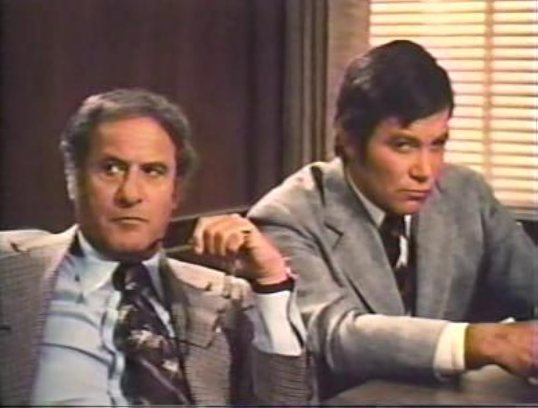
The wife of Assistant District Attorney Sam Belden (William Shatner) has been found, shot to death.  Making things especially awkward is that the body of her lover is found next to her.  Though Belden is the obvious suspect, he has an alibi for the time of the murders.  He claims that he was in Las Vegas, attending a convention.  Two gas station attendants remember seeing him filling up his car with gas at around the same time that his wife and her lover was being shot.

Attorney General Timothy Fitzgerald (Ed Flanders) is not so sure that Belden is innocent.  He instructs two of his top prosecutors to check out Belden’s story and to see if there’s enough evidence to not only indict but also to convict.  Bob Matthews (George Grizzard) is a veteran prosecutor and he’s the one who narrates the story for us.  Assisting him is Mike Belano, who is played by the always likable Reni Santoni.  Just three years before this movie aired, Santoni played Harry Callahan’s partner in Dirty Harry.  There was just something about Santoni’s friendly but determined demeanor that made him perfect the role of the supportive partner or assistant.

The film is very much a legal procedural, with the emphasis on not only the investigation but also on the strategies and the techniques that are used in the courtroom by Matthews and defense attorney DeWitt Foster (Eli Wallach).  In many ways, it feels like a forerunner to Law & Order.  Usually, I love court procedurals but Indict & Convict was a bit too slow and high-minded for its own good.  Maybe it’s because I’ve been spoiled by all of the legal shows that I’ve seen but I have to admit that I spent a good deal of Indict & Convict wanting the prosecutors to get on with it.  Flanders, Grizzard, Santoni, and Wallach were all ideally cast but the film itself sometimes got bogged down with all the debate about the best way to win a conviction.  It’s a shame because the story itself is an intriguing one and I actually enjoyed the movie’s use of spinning newspaper headlines to let us know what had happened in between scenes.  Also, as a classic film fan, I enjoyed seeing Myrna Loy as the judge.  She didn’t get to do much other than say, “Sustained” and “Overruled,” but still …. Myrna Loy!

Most people who watch this film will probably do so out of the hope of seeing some trademark Shatner overacting.  William Shatner doesn’t actually get to say much in this film.  He spends most of the running time sitting silently at the defense table.  Towards the end, he does finally get a chance to deliver a brief speech and it’s everything you could hope for.  Shatner takes dramatic pauses.  Shatner emphasizes random words.  Every line is delivered with the subtext of, “Pay attention, Emmy voters!”  Eventually, Shatner would learn the value of laughing at oneself but apparently, that lesson had not yet been learned when he did Indict & Convict.