Ever since the birth of film, Robert Louis Stevenson’s Dr. Jekyll and Mr. Hyde has been a popular subject for adaptation. Not only does the classic story of a good doctor who unleashes his evil instinct via potion serve as a potent metaphor for everything from sexual repression to drug addiction, but the dual role of Dr. Jekyll and Mr. Hyde has provides an excellent opportunity for an actor to show off.
The first film adaptation of Dr. Jekyll and Mr. Hyde is believed to have been made in 1908. Two more version followed in 1912 and 1913 and then, suddenly, 1920 saw three different film versions.
The best known of the 1920 version is our film for today. This version is best remembered for John Barrymore’s powerful performance in the title role but it also holds up remarkably well as a work of cinematic horror.
1979’s Delirium takes place on the mean streets of St. Louis and the surrounding countryside. Crime is out of control and something has to be done about it! Thanks to Earl Warren and the Carter administration, the police are powerless to stop the criminals. (“Miranda rights my ass!” you can almost hear the film’s screenwriter shouting.) So, the wealthier citizens of St. Louis get together and hire a bald Vietnam vet named Eric Stern (Barron Winchester) to lead a paramilitary group of vigilantes. One of Stern’s men is another vet, Charlie (Nick Panouzis). Charlie suffers from PTSD and it turn out that being a part of a militia is not the best way to deal with war trauma. Who would have guessed?
Charlie snaps. He starts killing people, in both St. Louis and the surrounding farms. One victim is a hitchhiker who is dumb enough to hitch a ride from him and then to taunt him when he refuses to go skinny dipping with her. It turns out that Charlie’s been impotent ever since he came home from the war. He doesn’t respond well to jokes about it.
As Charlie claims more and more victims, both the police and vigilantes search for him. The police want to stop his rampage, The vigilantes don’t want Charlie to accidentally reveal their existence. The whole thing ends in violence, gun fights, and flashbacks in which Vietnam looks a lot like rural Missouri.
Delirium is a film that I first noticed on my list of Tubi recommendations a few months ago. I finally watched it last night and I have to admit that my first reaction was, “What the Hell was that?” Delirium is bizarre mix of slasher horror and vigilante thrills, the type of mishmash that one can only really find in a grindhouse film. That the budget was low is obvious in every shot. The wealthy conspiracy meets in what appears to be a hut. As I previously mentioned, the Vietnam scenes were clearly filmed in Missouri. The acting is largely amateurish, with the exceptions of the intense Nick Panouzis and the absolutely insane performance of Barron Winchester. The film was gory enough to have earned a spot on the infamous Videos Nastys list but, as is so often case, what was shocking in 1979 seems rather tame in 2024. I did like the conspiracy aspects of the film. The idea of a group of wealthy people putting together a vigilante squad without actually bothering to do any background checks on the people they recruited actually has a good deal of potential. The film is a mess but it’s a mess in the oddly fascinating way that many low-budget 70s films were. The mix of ambition and a low budget often led to watchable oddities like Delirium.
The main thing that really stuck with me about Delirium is just how annoyed and angry almost every single character in the film seemed to be. Even the cop trying to stop Charlie seems like he was pissed off about having to actually do his job. I guess St. Louis does that to people.
A group of college students on holiday stay at an abandoned house, little knowing that it was once the sight of a Satanic ceremony. After one of the women gets upset over a game of spin the bottle, she steps outside and finds a doll. She gets possessed and goes on to stalk her friends.
A standard slasher/possession film, Babydoll would have worked better if the doll didn’t look like some demented version of Raggedy Anne. It would have also helped if the characters had been memorable or at least likeable. The possession scene is effective and it didn’t bother me that the movie left some questions unanswered at the end. It’s a horror movie so it doesn’t have to wrap everything up in a neat package. But I just couldn’t get past that stupid doll. Truly evil dolls don’t look like something you would order as a joke from Etsy.
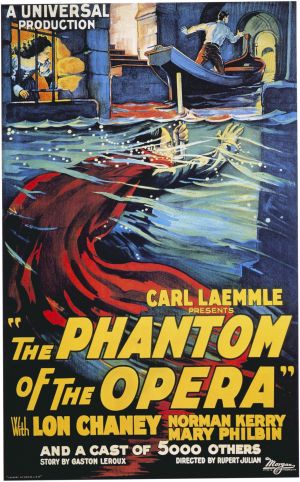
Today’s horror movie on the Shattered Lens is both a classic of silent era and one of the most influential horror films ever made. It’s one that I previously shared in 2013, 2015, 2016, 2108, 2019, 2020, 2021, and 2022 but it’s such a classic that I feel that it is worth sharing a second (or fifth or even a sixth or perhaps an ninth) time.
First released in 1925, The Phantom of the Opera is today best known for both Lon Chaney’s theatrical but empathetic performance as the Phantom and the iconic scene where Mary Philbin unmasks him. However, the film is also a perfect example of early screen spectacle. The Phantom of the Opera was released during that period of time, between Birth of the Nation and the introduction of sound, when audiences expected films to provide a visual feast and Phantom of the Opera certainly accomplishes that. Indeed, after watching this film and reading Gaston Leroux’s original novel, it’s obvious that the musical was inspired more by the opulence of this film than by the book.
This film is also historically significant in that it was one of the first films to be massively reworked as the result of a poor test screening. The film’s ending was originally faithful to the end of the novel. However, audiences demanded something a little more dramatic and that’s what they got.
A group of hikers decide to take a walk through the hills of Ireland. Things do not go well. First, one hiker is injured in an accident. Then the other hikers ignore a “No Trespassing” sign while looking for help and end up being stalked and targeted by a the people living on the land. The hikers have no one to blame but themselves. If you look through your binoculars and see someone wearing a skull mask and carrying a rifle, that should be enough to make you turn around.
The story is basic and the characters are poorly drawn but the Irish landscape is stunning, even when people are fighting for their lives. The budget is low and there are more than a few scenes where you can see the blood squibs under everyone’s clothes before their shot. If you can overlook or forgive that, Hillwalkers is occasionally suspenseful and it has enough action to appeal to thriller fans. This is a standard city folks vs country folks movie and there’s nothing surprising about it but it does a good job of showing why it’s best to stay on the approved path while hiking. Pay attention to those warning signs. They’re there for a reason!
Handling The Undead opens, as many Norwegian films tend to do, with a shot of an overcast sky, an ugly apartment complex, and a forest that appears to be submerged in shadows. From the opening shots, it’s a depressing film. Again, that won’t come as a surprise to anyone who has ever watched a Norwegian film.
Three families are dealing with death. A woman has buried her young son and is now struggling not only with her grief but also her loving but overbearing father, whose attempts to make her feel better have the exact opposite result. An old woman’s longtime spouse lies in a coffin, having not yet been put back into the Earth. A woman is rushed to a hospital after an automobile accident and is not expected to live.
At night something happens. The lights turn off. Static is heard on every radio. When the lights come back, so do the dead. The grandfather hears his grandson wheezing and beating on his coffin and promptly digs him up. The old woman’s spouse climbs out of her coffin on her own and returns to the home where she lived for decades. The car accident victims opens her eyes and is alive, even though the doctor say that her heart is not beating rapidly enough to sustain life. While the local authorities try to figure out why the dead have come back to life and to try to keep track of where they’ve all gone, their relatives spend one more day with their loved ones.
The problem is that dead may be alive but they’ve come back as silent and unemotional empty shells. They seem to have a slight memory of their former lives but they don’t react to anything in a normal way. Instead, they stare straight ahead. The child has already started to decay and his return brings no happiness to his mother. In fact, there’s not much happiness to be found anywhere in Handling the Undead. One gets the feeling that even Ingmar Bergman would want to tell this film to lighten up.
Handling the Undead unfolds at a leisurely pace. There are a few creepy scenes but, for the most part, the horror comes from what we’re expecting the zombies to do than what we actually see them do. Everyone watching the movie knows what is eventually going to happen with the zombies. We know that eventually, the undead will attack the living. Handling the Undead, however, is more concerned with how the living would react to the dead than how the dead will eventually destroy the living. There’s very little dialogue and every scene is darkly lit and full of shadows. The majority of the characters hope that the returned dead will act like their old selves but they soon discover that they can’t go back to the way things once were. It’s an intelligent film about how we grieve and deal with loss.
That said, it’s also a rather dull film. It’s a deliberately boring film and, at times, it’s low-key approach feels almost as gimmicky as the blood and guts that can be found in more traditional zombie films. Stretched out to 90 minutes, the running time feels like an endurance test. And again, that’s probably what the filmmakers were going for but it doesn’t make the film any easier to sit through. When one reaches the end of a 90-minute film that is this purposefully slow, one has the right to expect more of an emotional or intellectual payoff than this film provides. This is a film that I can grudgingly respect but it’s not something that I’ll ever watch again.
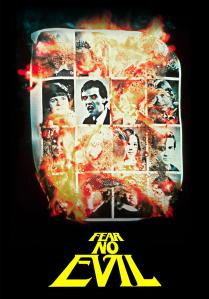
In the early 1980s, my Dad owned a RCA Videodisc player. Among the assortment of films he owned, a few were listed as “Do Not Watch” for the kids. The Omen films, Cruising, The Exorcist, Rosemary’s Baby, Raging Bull, The Life of Brian, and Fear No Evil. There may be others, but those were the ones I remember in particular growing up. Over time, I’ve been able to see almost all of them save for Raging Bull & Cruising. I was able to catch Fear No Evil via AMC+ earlier this year, and honestly, I wish my Dad were still alive. I’d ask him what prompted him to get this film, and watch it on purpose. I’ll never know, but here’s this movie that he was curious enough to buy at one point.
Directed by Frank LaLoggia, Fear No Evil is the tale of three Angels – Mikhail, Gabriel, and Rafael – who are out to bring back or smite Lucifer (Richard Jay Silverthorn, who also did the make up for the film), running around on Earth as a man. Lucifer states he’ll be reborn and then smites himself. We then celebrate the baptism of Baby Andrew Williams, which really doesn’t go as planned. His parents, Greg (Barry Cooper, Johnny Firecloud) and Marion (Alice Sachs, Seems Like Old Times) struggle with Andrew (Stefan Arngrim, The A-Team) over the years until his 18th birthday. An incident with the birthday cake leaves the mother injured, a father at a loss, and a teen with more freedom than he needs.
Fear No Evil basically takes Damien: The Omen II‘s story and drops it into a public school. As the Antichrist, Andrew is pretty aware of what he is and has no real regrets about it. Having an eye for Julie (Kathleen Rowe McAllen, TV’s All My Children), Andrew stalks the grounds of his local high school. He’s found brooding from the building’s fire escape and tries his best to dodge Tony (Daniel Eden, St. Elmos Fire) and his crew. Outside of the religious themes, there’s a sequence where the bullies corner Andrew in the High School shower (though it doesn’t quite turn out the way it did in Brian DePalma’s Carrie). I’m thinking that probably was the big thing that caused my Dad to keep this off our radar. When Julie discovers she’s the reincarnation of Gabriel (now Gabrielle), she and Mikhail (Elizabeth Hoffman, NBC’s Sisters, Dante’s Peak) join forces. Will they be able to stop Andrew before it’s too late?
When it comes to the acting, Fear No Evil has some over the top performances. With the notable exception of Hoffman and McAllen, most of the cast amped up the camp level with their characters. Arngrim and Cooper both have moments where their characters are completely losing it. Whether it’s a Dad starting a bar fight because his son’s the devil, or a dodgeball sequence that goes off the rails (and had me laughing throughout), everyone kind of hams it up. I will give Arngrim some marks for his voice. When he speaks up, he reminds me of the Sister of Mercy’s Andrew Eldritch, for some reason.
I did enjoy the effects and makeup, for what it’s worth. Some of the effects are full of glitter and lasers, feeling a bit like Flash Gordon or the climax of The Manitou. Richard Jay Silverthorn, who also plays Lucifer at the beginning of the film, handled the makeup and the effects. For a movie with a pretty low budget, it’s not bad at all. The music may be the film’s greatest strength. With tunes like “Blitzkreig Bop” and “Psycho Killer”, the movie’s high school setting is peppered mix of classic rock and orchestral work. The film’s score does work well with the notion that evil things are afoot.
Overall, Fear No Evil isn’t that great a film compared to others before or after it. It does deserve some kudos for trying to deliver a tale with a small budget, and the effects are somewhat interesting. It comes across, however, as just a bit much with the acting. It’s more an “In your face” kind of evil than anything subtle.
Today’s Horror on the Lens is a classic film that really needs no introduction! Released in 1922, the German silent film Nosferatu remains one of the greatest vampire films ever made. It’s a film that we share every October and I’m happy to do so again this year!
It can be easy to forget just what a big splash God’s Not Dead made when it was released back in 2014. Today, it’s taken for granted that every year, at least one faith-based movie will be released to terrible reviews and then “shock” everyone by opening up strong at the box office. However, in 2014, God’s Not Dead was the film that started the whole trend, along with sparking the ongoing debate about whether or not Hollywood has the slightest idea what most Americans want to see.
That’s not to say, of course, that God’s Not Dead was a good film. It’s not. It’s a ludicrously simplistic and smug film that, over the course of its overly long run time, promotes the idea that the only reason atheists exist is because they’re either bitter, evil, or both. (For the record, if a professor truly threatened to fail a paying student solely because of his religious beliefs, the end result would probably be a lawsuit.) The idea that someone could sincerely disagree with the film’s heroes or even believe differently than them without having an ulterior motive is not one that is entertained in the God’s Not Dead universe. Indeed, perhaps the most interesting thing about the God’s Not Dead films is that they are just as heavy-handed and often just as condescending as the secular films being churned out by the major studios.
God’s Not Dead has, to date, spawned four sequels. The second was enjoyably campy and featured an earnest performance from Melissa Joan Hart. The third, which is the the closest that the franchise has gotten to actually making a good film, was surprisingly even-handed, or at least as even-handed as a film in this franchise can be. The fourth was way too talky but, because it came out during the COVID lockdowns, its condemnation of government overreach reflected the way that a lot of people were feeling at the time. Somewhat inevitably, the fifth film finds Reverend David Hill (David A.R. White) running for Congress again the villain from the second film, dastardly atheist Peter Kane (Ray Wise).
The film opens with the death of an incumbent congressman. His opponent, Peter Kane, tells the press that the congressman was a good man and then proceeds to gloat about his death in private. Kane is an ultra-liberal atheist. Usually, the villains in the God’s Not Dead universe have a dead relative to help explain why they’ve lost their faith but Kane is just evil. (In God’s Not Dead 2, Kane specifically put Melissa Joan Hart on trial for expressing her Christian beliefs and then chortles, “We are going to prove God is dead!”) With Kane on the verge of being elected to Congress by default, Rep. Daryl Smith (Isaiah Washington) suggests that David Hill, who went viral for denouncing Congress in the fourth film, should be the party’s new nominee.
After some hesitation, Hill agrees. However, he drives his campaign manager, Lottie Joy (Samaire Armstrong), crazy by basing his campaign on his religious beliefs. Of course, if you didn’t want a candidate to talk about his religious beliefs in a campaign, why would you nominate a pastor whose fame is totally based on those beliefs? Add to that, Hill is running for a Congressional seat in Arkansas. I have family in Arkansas. Growing up, I occasionally lived in Arkansas. Sure, there are liberals in Arkansas and there are atheists in Arkansas. But none of them are going to get elected to Congress anytime soon. Arkansas is probably one of the few states where Hill’s faith-based campaign wouldn’t be considered controversial.
(That Mike Huckabee has a cameo as himself should be all the reminder that viewers need that Arkansas is not at all hesitant about electing pastors to higher office.)
It’s heavy-handed and cartoonish, which is probably to be expected. Unfortunately, it’s also rather boring, with not even Ray Wise’s villainy providing much entertainment value. Outside of arguing that atheists are evil and that separation of church and state is just a catch phrase, the film argues that money is a divisive force in politics and that politicians shouldn’t be bought. Wow, really!? It’s a film about politics that has little fresh insight to offer. David Hill goes from being a media-savvy pastor to being an innocent naïf who is shocked to discover that politics is a dirty business. God’s Not Dead: In God We Trust makes Billy Jack Goes To Washington seem like a hard-hitting portrayal of American politics.
I will give this franchise some credit for maintaining a surprising sense of continuity. As I mentioned earlier, Ray Wise returns as the character that he played in the second film. Paul Kwo is back as Hill’s associate pastor. Dean Cain returns as the amoral businessman from the first film. You have to imagine that Kevin Sorbo is kicking himself for allowing his smug professor character to die in the first film. What’s funny is that the college student who kicked off the franchise by refusing to sign a piece of paper declaring God to be dead has pretty much vanished from the films. Whatever happened to that kid?
In the end, we all know where this is going. The next film will undoubtedly feature David Hill running for president. 2028 is right around the corner.
In 1992’s Fraternity Demon, Isha (Trixxie Bowie) is a succubus who is summoned into the real world by a nerdy frat boy who is doing something with a personal computer. To be honest, I’m not totally sure what nerdy Dave (Al Darrouch) did to summon the succubus but she shows up in the real world and proceeds to have softcore sex with some 30 year-old frat boys in her quest to find Dave.
To be honest, I should have stopped this film as soon as I saw the New York skyline and “Troma Presents” at the start of it. I’ve seen enough Troma films that I knew exactly what I was getting myself into but I kept watching the film just in case it turned out to be some sort of lost masterpiece. Unfortunately, the film turned out to just be another boring Troma softcore film, featuring bad acting, bad humor, and terrible sound quality. I honestly cannot begin to put into words just how wooden most of the acting was. This was apparently C.B. Rubin’s only film as a director and watching the film, one can see why. Fraternity Demon is an 86 minute film that feels like four hours, largely because the director obviously had no idea how to tell a story cinematically.
That said, I stuck with the film because everything that I read about Fraternity Demon said that the film was worth sitting through for the performance of Shock-Ra, the band that plays the fraternity party. And I will say that I did like Sh0ck-Ra. They reminded me a bit of X, the Los Angeles punk band that I’ve been obsessed with ever since I watched The Decline of Western Civilization a few months ago. Speaking of punk, the film features a character who apparently lives on the front steps of the frat house. He wears a Black Flag t-shirt and he growls at people. He was probably the best actor in the film, assuming that he was an actor and not just some guy who the director couldn’t convince to leave.
Let’s see, what else was amusing in this film? The fraternity was named SUX. The sorority was named ASS. That was pretty dumb but it made me laugh because, when I get delirious in my boredom, I tend to laugh at dumb things. Nerdy Dave and his potential girlfriend, Kelly (Deborah Carlin), were kind of a cute couple. One of the sorority girls comments that she likes a shy guy that she’s seen in at the frat house. Kelly immediately says, “Dave?” because, of course, frat houses are only allowed to have one shy guy.
I initially assumed that Trixxie Bowie was an adult actress slumming in a Troma softcore flick but it turns out that Fraternity Demon was her only film role. She made her debut as a star and then she never made another film. Her performance in this film isn’t particularly good but she does manage to get off a few good one-liners.
Is that 500 words yet? It is? Good, let’s end this review.





 Through the Shattered Lens