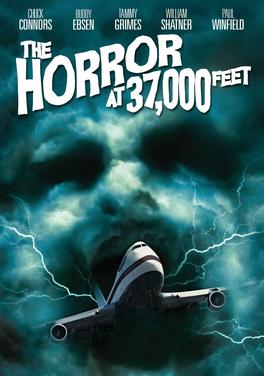
Today, we have the 1973 made-for-TV movie, The Horror at 37,000 Feet. This film starts off like a typical disaster film, with a collection of familiar celebrities catching a flight from Heathrow Airport. What they don’t know is that celebrity is not the only thing flying across the ocean! There’s a sacrificial altar sitting in the baggage hold and soon, all sorts of strange things are happening! Truly, it’s a horror at 37,000 feet!
This film is silly and perhaps even a little bit dumb but it’s also definitely a lot of fun. To be honest, when you’ve got William Shatner playing an ex-priest who is wondering what happened to his faith, how can you go wrong? Along with Shatner, keep an eye out for Chuck Conners, Buddy Ebsen, Roy Thinnes, Paul Winfield, Tammy Grimes, and France Nuyen. Basically, every TV actor who needed a job in 1973 boarded The Horror at 37,000 Feet.
Happy October and enjoy The Horror at 37,000 Feet!
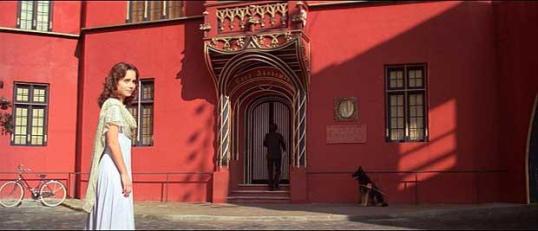
Suspiria (1977, dir by Dario Argento, DP: Luciano Tavoli)
I can’t wait to re-watch Dario Argento’s Suspiriatonight! Today’s horror scene of the day is one of my favorite scenes from that film.
As you probably guessed from the title of this post, that scene is the famous “Names that start with S” scene. This is the scene in which dance student Suzy Banyon’s new roommate explains that names that start with S are often the names of snakes! Suzy’s new best friend, Sarah, disagrees.
When I first saw Suspiria, this was a scene to which I, as a dance student, could immediately relate. As odd as the dialogue may have sounded and as silly as the two students may have appeared to be, it actually felt very authentic. By nature, dancers are competitive and we are dramatic. If anyone is going to accuse you of having the name of a snake, it’s probably going to be dancer.
Admittedly, no one ever told me that I had the name of the snake. But there was the girl who told me that I was “soooooo pretty,” or at least I would be pretty if I got the nose job that I obviously required if I ever had any hope of being happy or successful. “But,” she added as she turned away from me, “I guess you’d have to figure out how you could possibly pay for it.” Of course, she was also quick to explain that she was only telling me the truth and that she had the best of intentions. I had about the same reaction to her advise as Sarah has to be calling a snake.
(Sarah stuck out her tongue. I may have said something about her boyfriend not having any issue with the size of my nose when he was hitting on me the night before. But basically, it was pretty much the same reaction…)
This scene made such an impression on me that, in the months after I first saw Suspiria, I would often randomly launch into the name of snakes monologue. Unfortunately, I had failed to take into account that I was literally the only student at my high school who would actually take the time to watch an Italian horror film from the 1970s. As such, no one knew what I was talking about and I lost a few friends named Susan and Sarah as a result.
Oh well!
Anyway, you can watch the scene below! Pay special attention to the way Jessica Harper reacts to being caught in the middle of the conversation. Dario Argento will probably never be known as a great director of actors but Jessica Harper is great in Suspiria!
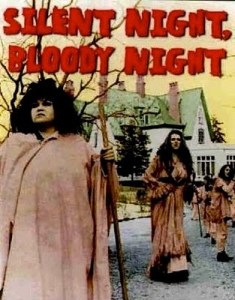
The 1974 film Silent Night, Bloody Night is an oddity.
On the one hand, it’s pretty much a standard slasher film, complete with a menacing mansion, a horrible secret, a twist ending, and John Carradine playing a mute newspaper editor.
On the other hand, director Ted Gershuny directs like he’s making an underground art film and several of the supporting roles are played by actors who were best known for their association with Andy Warhol.
Personally, I like Silent Night, Bloody Night. It has a terrible reputation and the film’s star, Mary Woronov, has gone on record calling it a “terrible movie” but I like the surreal touches the Gershuny brought to the material and the sepia-toned flashbacks have a nightmarish intensity to them. The film makes no logical sense, which actually makes it all the more appealing to me. As the saying goes, your mileage may vary.
“Tom Stewart killed me!” shouts the spirit of Vi Mason (Juli Reding).
Technically, it’s debatable whether or not Tom Stewart (Richard Carlson) actually killed Vi. As is seen during the opening moments of 1960’s Tormented, Vi actually slipped and was clinging onto the lighthouse’s balcony for dear life before she fell to her death on the rocks below. Tom didn’t push her and he didn’t force her to fall. However, Tom did refuse to pull her up. After she fell, he ran into the ocean and thought he had dragged back to safety. But then it turned out that he was just dragging around a bunch of seaweed.
To a certain extent, Tom is glad to be done with Vi. Vi was his ex-girlfriend and she was determined to keep Tom from marrying the rich and innocent, Meg (Lugene Sanders). Meg’s father (Harry Fleer) already hates Tom because he’s not only a pianist but he’s also a jazz pianist! Still, Meg loves Tom and, in a somewhat disturbing way, Meg’s little sister, Sandy (Susan Gordon), seems to be kind of obsessed with Tom as well. “Why can’t I get married!?” Sandy demands. BECAUSE YOU’RE LIKE TEN, YOU LITTLE BRAT!
Still, it’s not helping Tom that he keeps hearing Vi’s voice and seeing her ghost. Everyone in the village think that Tom is acting strangely but they dismiss it as pre-wedding jitters. (And, of course, his future father-in-law just assumes that Tom is being weird because he’s one of those jazz pianists.) If it wasn’t bad enough that Tom is having to deal with Vi’s ghost, he’s also got a hepcat blackmailer named Nick (Joe Turkel). Nick was hired to take Vi out to the island where Tom lives. When Vi doesn’t return to pay him, Nick goes to Tom for the money. When Nick overhears that Tom is about to marry a rich woman, Nick decides that he needs even more money.
Joe Turkel was one of the great character actors. A favorite of Stanley Kubrick’s, he appeared in Paths of Glory and later played Lloyd the Bartender in The Shining, Turkel also played Eldon Tyrrell in Blade Runner, in which he made the mistake of talking down to Rutger Hauer’s Roy. In the role of Nick, Tukel is the best thing to be found in Tormented. Turkel delivers all of his dialogue with a wonderfully insolent attitude. He’s the type of character who, in the style of Robert Mitchum in Cape Fear, refers to everyone he meets as “Dad.” He’s a lowlife and criminal but he’s got the spirit of Kerouac and Cassady in him and it doesn’t take him long to see straight through Tom.
Tormented was directed by Bert I. Gordon, who was best-known for his movies about giant monsters. There aren’t any monsters in Tormented but there is a really shrill ghost and a truly unlikable protagonist. There’s a lot flaws to be found in this film but Joe Turkel makes up for a lot of them. And the scene where Vi’s ghost objects to Tom’s wedding is a lot creepier than it really has any right to be. This is probably the best film that Bert I. Gordon ever directed, which does not necessarily mean its a good film. Bert I. Gordon was still Bert I. Gordon. But Tormented is definitely entertaining.
Well, there’s less than a week to go until Halloween and, traditionally, this is when all of us in the Shattered Lens Bunker gather in front of the television in Arleigh’s penthouse suite, eat popcorn, drink diet coke, and gossip about whoever has the day off.
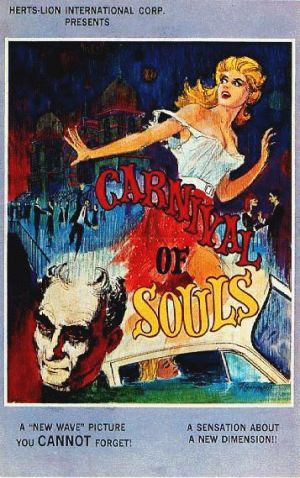
Of course, after we do that, I duck back into my office and I watch the classic 1962 film, Carnival of Souls!
Reportedly, David Lynch is a huge fan of Carnival of Souls and, when you watch the film, it’s easy to see why. The film follows a somewhat odd woman (played, in her one and only starring role, by Candace Hilligoss) who, after a car accident, is haunted by visions of ghostly figures. This dream-like film was independently produced and distributed. At the time, it didn’t get much attention but it has since been recognized as a classic and very influential horror film.
This was director Herk Harvey’s only feature film. Before and after making this film, he specialized in making educational and industrial shorts (some of which we’ve watched on this very site), the type of films that encouraged students not to cheat on tests and employees not to take their jobs for granted. Harvey also appears in this film, playing “The Man” who haunts Hilligoss as she travels across the country.
At the start of 2011’s The Reverend, the Devil (Rutger Hauer) pulls up in front of a luxurious hotel. He gets out of his limo, enters the hotel, and finds God (Giovanni Lombardo Radice) sitting at his desk, surrounded by armed priests.
God asks the Devil what he’s been doing. The Devil says he’s been traveling the world and tempting men to do evil. The Devil says that he wants permission to ruin the life of one man who is virtuous and God-fearing, saying that the man will reject his faith as things get worse and worse. God agrees, as long as the man is not killed….
Does this sound familiar? Yep, this is yet another adaptation of the Book of Job. Or, I should say, this film pretends to be an adaptation of the Book of Job. The nameless Reverend (Stuart Brennan) is a God-fearing man whose life goes downhill after he’s bitten by a vampire. That said, there’s really not much of a comparison to be made between the Reverend and Job. Job lost everything, including his land and his family and the majority of his friends. The Reverend doesn’t really have any friends to lose and he actually gets better at his job after he is turned into a vampire and proceeds to take out his village’s criminal element.
In fact, the entire prologue between God and the Devil feels as if it was tacked on at the last minute. It really doesn’t connect to the rest of the film and we certainly don’t learn whether it was God or the Devil who won the bet. Hauer and Radice only appear in that one scene and then they are never heard from again. That’s a shame because, to be honest, the only reason I watched this movie was for the chance to see Hauer and Radice together. They were both incredible character actors and tragically, both of them are no longer with us. Hauer passed away in 2019 and Radice died last year. Neither one of them looks particularly healthy in the prologue, though it is nice to see the two of them sharing the screen together, albeit for just a few minutes.
As for the rest of the film, it did have potential. There’s a lot of blood spilled and that’s always a plus when it comes to a vampire movie. Doug Bradley gives a good performance as the Reverend’s enigmatic superior. Stuart Brannen is himself likable enough as the Reverend and the scene where he’s first bitten has a kinetic energy to it that briefly gave me some hope for the rest of the film.
Unfortunately, with the exception of the aforementioned scenes, The Reverend is a rather slow movie and one that never succeeds in building up any sort of narrative momentum. (I guess that’s a polite way of saying that it’s kind of boring.) As a character, The Reverend is likable but he’s never compelling and the film ends on a rather anticlimactic note. The film had potential but sadly, most of it went unrealized.
Today’s horror scene that I love is the opening production number of Michele Soavi’s 1987 masterpiece, Stagefright.
Not only does the opening scene wonderfully satirize both a certain type of stage production and a certain type of exploitation film, it also lets the audience know that they’re about to something that is more than just another Italian slasher film. With this opening sequence, Soavi announced his arrival as a major filmmaker.
Personally, I can’t help but laugh when the saxophone makes an appearance. Anyone who has ever been involved in a community theater will relate to the moment.
With only a few days left until Halloween, I wanted to make sure that I continued an important tradition here at the Shattered Lens by sharing this film with our faithful and wonderful readers. Messiah of Evil was first released in 1973 and, since it’s in the public domain, it has since been included in a countless number of bargain box sets from Mill Creek.
I can still remember the first time that I saw Messiah of Evil. It was on a Monday night, many years ago. I had recently picked up a 10-movie DVD box set called Tales of Terror and I was using the movies inside to try to deal with a bout of insomnia. I had already watchedThe Hatchet Murders (a.k,a. Deep Red) and The House At The Edge of the Parkand, at two in the morning, I was faced with a decision. Should I try to sleep or should I watch one more movie?
Naturally, I chose to watch one more movie and the movie I chose was Messiah of Evil. So, there I was at two in the morning, sitting at the edge of my bed in my underwear and watching an obscure horror movie while rain fell outside.
And, seriously — this movie totally FREAKED me out!
Messiah of Evil tells the story of Arletty (Marianna Hill), a neurotic woman who drives to an isolated California town in order to visit her father. Her father is an artist who specializes in painting eerie pictures of large groups of black-clad people. However, once she arrives at his home, Arletty discovers that her father has vanished and left behind a diary where he claims that a darkness has overtaken the town.
Meanwhile, a mysterious man named Thom (Michael Greer) is wandering about town with two groupies (played by Anita Ford and Joy Bang) and interviewing random townspeople. One crazed man (Elisha Cook, Jr.) explains that “the dark stranger” is returning. After meeting Arletty, they all end up moving into her father’s house.
But that’s not all. There’s also an odd albino man who shows up driving truck and who eats mice….
Messiah of Evil is literally one of the strangest films that I’ve ever seen. It’s shot in a dream-like fashion and the much of the film is left open to the viewer’s interpretation. There are two classic scenes — one that takes place in a super market and one that takes place in a movie theater and the movie’s worth watching for these two scenes alone.
Messiah of Evil is a film that will be appreciated by all lovers of surrealism and intelligent horror and I’m happy to share it with you today.
The fraternity is throwing their “Winter Luau,” the biggest and wildest party of the year. It’s a night of drugs, drink, sex, and pranks. It’s just too bad that the members of fraternity ripped open a hole to another world in their basement and now an evil spirit is offing every last one of them.
Shot on a camcorder to give it that Blair Witch feel, Haunting on Fraternity Row‘s budget is low and the members of the cast are convincingly obnoxious. One member of the fraternity puts on a bunny suit and I could not wait for him to hurry up and meet the evil in the basement. It takes forever to get to the supernatural part of the story. Instead, most of the movie is the fraternity setting up for the party and then throwing the party. I think the people behind the film just wanted to throw a rager and they came up with all of the supernatural stuff as a way to convince people to give them money. Good for them. The party looks fun. Why didn’t my college ever throw any parties like that?
Don’t watch if you’re expecting sympathetic or even likable characters. Don’t watch if you want a plot that makes sense. Don’t watch if you’re expecting to see anything like the picture to the left. Do watch if you just can’t get enough beer pong.
For today’s horror on the lens, we have 1973’s The Night Strangler.
This is the sequel to The Night Stalker and it features journalist Carl Kolchak (Darren McGavin) in Seattle. (After all the stuff that happened during the previous movie, Kolchak was kicked out of Las Vegas.) When Kolchak investigates yet another series of murders, he discovers that paranormal murders don’t just occur in Las Vegas and aren’t just committed by vampires.
I actually prefer this movie to The Night Stalker. The Night Strangler features a truly creepy villain, as well as a trip down to an “underground city.” It’s full of ominous atmosphere and, as always, Darren McGavin is a lot of fun to watch in the role in Kolchak.


 Through the Shattered Lens