Love On The Shattered Lens: The Bitch (dir by Gerry O’Hara)


“Joan Collins is THE BITCH” announced the opening credits of the 1979 film, The Bitch.  Seriously, how can you not love a film that opens that way?

Joan Collins returns of Fonatine Khaled, the character that she previously played in The Stud.  Once again based on a novel by Jackie Collins, The Bitch follow Fontaine as she adjusts to life as a freshly divorced woman.  Though she received a good deal of money in the divorce and she has her own personal fortune as well, Fontaine is struggling to maintain her extravagant lifestyle.  A new disco has opened and is taking away the crowds that used to populate her club.  She’s running out of cash and soon, she might not even be able to fly first class!

It’s on an airplane that she meets Nico (Michael Colby, who is not particularly charismatic but still isn’t quite as dull as Oliver Tobias was in The Stud).  In an amusing in-joke, the movie that they watch on the plane is The Stud.  Nico says that he can’t decide if the movie is funnier with the sound or without.  “It’s not meant to by funny,” Fontaine replies.  Nico claims to be a wealthy Italian businessman, which immediately gets Fontaine’s attention.  Of course, Nico’s lying.  He’s actually a con artist and a jewel thief.  Fontaine figures that out when Nico tries to use her to smuggle a diamond through customs.  Fontaine is angered but she’s intrigued.

Nico is in debt to the Mafia.  The head of the British mob is a man named … and I’m not making this up …. Thrush Feathers (Ian Hendry).  Thrush Feathers demands that Nico cause a horse to lose an upcoming race.  The horse belongs to Fontaine’s friends from the first film, Vanessa (Sue Lloyd) and Mark Grant (Mark Burns).  Thrush Feathers also offers to help Fontaine keep her club open but his help comes with a price.  Whatever the price is, could it possibly be worse than being named Thrush Feathers?  Seriously, in what world is someone with that name going to take over a London crime syndicate?  How do you go from the Kray Brothers to Thrush Feathers?

Anyway, the plot really isn’t that important.  There’s a lot of double crosses and manipulation as Fontaine lives up to the title of the film.  The plot is really just an excuse to tease the viewer with visions of the decadent rich.  The clothes are expensive.  The mansions are ornate.  The conversations are always arch and full of double entendres.  This film is less about how the rich live and more about how middle class like to imagine the rich live.  It’s also about sex, though none of it quite reaches the lunatic abandon of The Stud’s swimming pool orgy scene.  The important thing is that whole thing is scored to a disco beat.

As with The Stud, it’s Joan Collins who holds the film together, giving a fierce and uninhibited performance in which she gleefully embraces the melodrama and delivers her lines with just enough attitude to let the viewer know that she’s in on the joke.  “Bitch” may have been meant as an insult but, as played by Joan Collins, Fontaine wears the title as a badge of honor.  She understands what had to be done to survive in a male-dominated world and she makes no apologies for it.  Even more importantly, she knows that once you fly first class, you can never go back.

The Bitch is not necessarily good but it is definitely fun in its sordid way.

Love On The Shattered Lens: The Stud (dir by Quentin Masters)


Oliver Tobias is …. THE STUD!

It is true that Oliver Tobias does play the title character of this 1978 British film, which was itself based on a novel by Jackie Collins.  Tobias is cast as Tony Blake, a youngish Englishman who runs the hottest discotheque in the UK.  He runs it on behalf of its actual owner, the decadent Fontaine Khaled (Joan Collins).  Fontaine is married to the fabulously wealthy Benjamin Khaled (played by Walter Gotell, who also had a recurring role in the James Bond films as the head of the KGB) but she seeks her carnal pleasure elsewhere.  Tony’s job and all the glamour that goes with it is dependent upon being Fontaine’s personal plaything.  If Fontaine wants to do it in the elevator while the security cameras film, that is what’s going to happen.  If Fontaine wants Tony to take part in a swimming pool orgy while she swings back and forth over the festivities, that’s what is going to happen.  Tony Blake is the stud, after all.

Tony, however, tires of all the nonstop decadence.  He’s not as empty-headed as Fontaine assumes him to be.  Tony’s complicated.  Tony has feelings.  At least, that’s what the films wants us to believe.  To be honest, Tony is kind of boring but we’ll get to that later.  Tony allows himself to be used by Fontaine but he finds himself truly falling in love with Fontaine’s stepdaughter, Alexandra (Emma Jacobs).  But does Alexandra feel the same way towards Tony or is she just using Tony to get revenge on her hated stepmother?

Let’s start with something positive about this film.  The Stud is one of the most 70s movies ever made.  Everything from the fashion to the slang to the cinematography to the wah wah soundtrack simply screams 70s.  There’s several scenes that take place in the discotheque.  Very few of them actually move the story forward in any meaningful way but they do give you a chance to look at the clothes and the haircuts and to listen for the sound of people snorting cocaine in the background.  If you’re a student pop culture or if you’re just fascinated by the tacky and the trashy, the film is very enjoyable on that level.  There’s also a lot of sex, all of it filmed in vibrant color and featuring a camera that will not stop moving as The Stud tries to convince us that it’s actually high art.

Unfortunately, the stud of the title is a bit of dud.  (And they say I’m not a poet!)  Oliver Tobias is handsome and has a superficially charming screen presence.  But, whenever he has to deliver dialogue or show any hint of emotion, the film falls flat.  As played by Tobias, Tony just comes across as a bland gigolo, enjoyable to look at but impossible to really care about.  The film is so dominated by Joan Collins’s cheerfully over-the-top performance as Fontaine that Tobias seems to spend a lot of the movie disappearing into the background.  Indeed, Collins’s performance is the best thing about the film.  She fully understand what type of movie she’s appearing in and she fully embraces the melodrama, delivering her arch dialogue with just the right amount of self-awareness to suggest that she’s in on the joke.

The Stud is a love story featuring people who are only capable of loving themselves.  At its worst, it gets bogged down in Tobias’s dull lead performance.  At its best, its trashy fun with a disco beat.  I like trashy fun so I can excuse the boring leading man.  A good beat that you can dance to can make up for a lot.

Top Of the World (1997, directed by Sidney J. Furie)


Ray Mercer (Peter Weller) has just gotten out of prison and already, he and his wife Rebecca (Tia Carrere) are heading to Nevada for a quicky divorce.  However, a stopover in Las Vegas leads to Ray having a run of luck in a casino owned by Charles Atlas (Dennis Hopper).  Ray and Rebecca start to reconsider their divorce but their reconciliation is temporarily put on hold when the casino is robbed by a bunch of thieves led by Martin Kove.  Because of Ray’s criminal history, the police (led by David Alan Grier) consider Ray to be the number one suspect.  Ray and Rebecca try to escape from the casino and clear Ray’s name, leading to a night on nonstop action and an explosive climax at the Hoover dam.

One thing that you can say about Top of the World is that it certainly isn’t boring.  The action starts earlier and lasts nonstop until the end of the movie.  No sooner has Ray escaped from one scrape than he finds himself in another.  Despite the low-budget, the action scenes are often spectacularly staged and exciting to watch.  Another thing that you can say about Top of the World is that, for a B-movie, it certainly has a packed cast.  Along with Weller, Carrere, Hopper, Grier, and Kove, the movie also finds room for Peter Coyote, Joe Pantoliano, Ed Lauter, Gavan O’Herlihy, Eddie Mekka, Cary-Hiroyuki Tagawa, and even Larry Manetti of Magnum P.I. fame.  This movie paid off a lot of mortgages and probably funded more than a few vacations.

One thing you can’t say about Top of the World is that it makes any sense.  It doesn’t.  There are so many holes in the plot that you could fly a helicopter through them and that’s exactly what this film does.  But with the nonstop action and the entertaining cast, most people won’t mind.  I certainly didn’t!

I CAN ONLY IMAGINE (2018) – a movie that came out at just the right time in my life! 


I CAN ONLY IMAGINE (2018) is the story of Bart Millard, the lead singer of the band MercyMe. He also wrote the song of the same name that inspired the movie. I remember when the song was released in 2001 as it immediately became a huge hit. As a person who attended church regularly and listened to contemporary Christian music, I heard it often either on radio or when other people would sing it at church. There was no getting away from the song as it was so popular. I really liked the song, but to be completely honest, it wasn’t especially meaningful to me. I just really liked it as a beautiful song. Fast forward to March of 2018 when the movie came out. 2018 was probably the most difficult year in my life, and I was needing hope. I saw I CAN ONLY IMAGINE at the movie theater, and its message of redemption and reconciliation provided glimmers of hope for me when my life had gotten really dark.

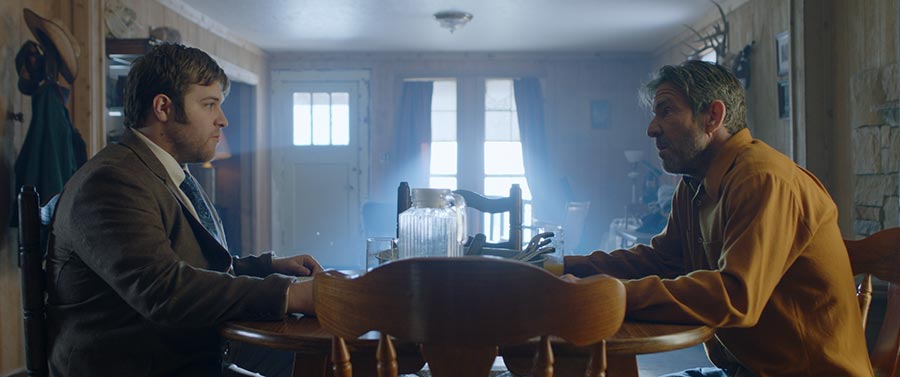
The movie provides us snapshots of Bart’s early life.  We see him at church camp where he meets the girl who would go on to be the love of his life, Shannon. We see him as a boy dealing with the fact that his mother has left the family because she was no longer able to deal with the abusive behavior of his dad, Arthur (Dennis Quaid). We also see how that abuse has extended to Bart himself. We see him as a high schooler (actor John Michael Finley) playing football in Greenville, TX, to try to please his dad. When he gets injured playing football and turns to the school’s music program, we see him hide the fact that he got the lead in the school production of “Oklahoma” because he knows his dad will make fun of him. Arthur is the kind of man who never has a nice word to say to his son. When he does find out about Bart performing in the musical, he tells him that it “sounds like a good joke.” It all boils over when the two get into a fight before Bart heads to church one morning, and Arthur smashes a plate over his head. Bart leaves for good, he thinks.  

With his love of music and great singing voice, Bart joins a band in need of a singer. Now we get snapshots of this portion of Bart’s life as the band hits the road and performs at different places, trying to sell as many of their homemade records as possible. Through sheer determination, Bart is able to convince Scott Brickell (Trace Adkins) to take over management of the band. After traveling with the group for a while, Brickell believes that they have a shot at making it in Nashville, so he secures the band, now known as “MercyMe,” a showcase in front of a group of top record executives. Unfortunately, the executives aren’t that impressed, with one even going so far as to tell Bart that he’s just not good enough. With those words bringing back all of the doubt that his father had instilled in him, Bart decides to quit the band. Sensing that Bart needs to resolve his family issues, Brickell asks him to take some time for himself. Bart asks the band to give him some time so he can go home for a while, not knowing what might be in store for him.

When Bart returns home, he finds his dad Arthur acting really strange… he’s being nice. He makes his son breakfast and then tells him about a project he’s hoping they can work on together, which is the restoration of his old Jeep. Bart doesn’t know what to make of this and even confronts his dad. Arthur tells him that he has become a Christian and even goes so far as to ask Bart for forgiveness for the way he has treated him in the past. Bart refuses to forgive him and gets in his dad’s truck to leave. While looking for the keys, Bart sees papers in his dad’s truck that reveal a terminal pancreatic cancer diagnosis. Discovering this information allows Bart to soften his heart towards his dad, and he even begins the process of forgiveness. The two men would be inseparable up to the point that Arthur passes away. Bart would say of his dad during this time that “he went from being a monster to the man I wanted to be.” At the funeral, Bart’s grandma (Cloris Leachman), who he called Me Maw, tells Bart, “I can only imagine what your dad’s seeing right now.” Ultimately inspired by his Me Maw’s words, as well as his own journey of grief and healing with his dad, Bart would write the lyrics that would turn into the most-played song in the history of Christian radio as well as the best-selling Christian song of all time (linked just below).

Movies that feature relationships between dads and sons always get to me, and I’m not even sure why that is. My dad and I have always had a great relationship. We were inseparable when I was growing up. My dad was my coach in sports, we always worked together on his projects, and he loved to take us fishing. My dad has always shown unconditional support and love towards me, and he continues to do so to this day. Maybe it’s my appreciation for my dad that leads me to this sort of emotional response when those relationships are presented on screen, but I think it’s even deeper than that. There’s a scene near the end of I CAN ONLY IMAGINE where Arthur shares his conversion experience with his son that always makes me cry like a baby. It seems that same day that he smashed that plate over Bart’s head, Arthur listened to his son sing at church on the radio and decided to turn his life over to God. Watching Arthur admit to his faults and become a man who shows great love and kindness to Bart is a beautiful sight to behold. And watching Bart accept that love and show that forgiveness may even be more beautiful. As a deeply flawed Christian myself, I think that’s why this movie means so much to me. I never tell other people how they should live their lives. In my opinion, each person has their own journey, and their lives will be based on their own decisions and actions. But it’s my personal belief that God is in the business of making things that seem impossible, possible, and He does it all while showing unconditional love and forgiveness. I can honestly say that when I’ve been at my lowest points in my own life (here’s looking at you 2018), it has been the process of turning things over to God that has opened me up both spiritually and emotionally to opportunities for meaningful, life-changing connections with other people. This movie tried to tell me that, and my own life is proving it out.

Check out the trailer below:

Welcome Home, Soldier Boys (1971, directed by Richard Compton)


Talk about embarrassing!  When Lisa told me that today was Joe Don Baker’s birthday, I decided that I would review Speedtrap, as 1977 car theft movie that Lisa and I watched last week.  But, when I took a look at the imdb to double check the name of the character that Baker played in Speedtrap, I discovered that I had already reviewed it!

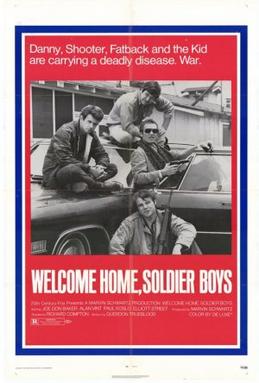
Instead of talking about Speedtrap a second time, I’m going to recommend one of Joe Don Baker’s early films.  In Welcome Home, Soldier Boys, Baker stars as Danny, the leader of a group of Green Berets who have just returned from Vietnam and can no longer find a place in society.  Danny, Kid (Alan Vint), Shooter (Paul Koslo), and Fatback (Elliott Street) go on a cross-country road trip.  After they kill a prostitute (Jennifer Billingsley) who demanded more money than they were willing to pay, they visit many sites from their youth.  They go to a high school basketball team.  They spend some time in a sleazy motel.  (Geoffrey Lewis plays the desk clerk.)  They get into a fight with a mechanic (Timothy Scott) over the price of some auto repairs.  After being cheated by one too many people and realizing that no one cares about the sacrifices that they made for their country, they put on their uniforms and violently take over a small town, leading the National Guard to show up to take them all out.

Welcome Home, Soldier Boys is a pretty ham-fisted anti-war allegory and the plot sometimes meanders too much for its own good.  With its road trip violence, its a dry run for director Richard Compton’s far more cohesive Macon County Line.  The movie still packs a punch, due to the efforts of the cast and the violent ending.  The movie is full of familiar characters actors, who are all convincing in their roles but it really is dominated by Joe Don Baker’s hulking intensity.  Danny is the dark side of the amiable country boys that Joe Don Baker would play in so many other movies.  Danny is angry but, as a stranger in a strange land, he’s sometimes sympathetic.  Ultimately, Danny wants the respect that was given to the returning soldiers of the previous generation.  Instead, he comes back to country that doesn’t want much to do with him or his friends.  Returning from serving overseas and still trying to deal with the things that he saw in overseas, Danny feels lost in and rejected by his home country.  It’s one of Baker’s best performances.

Behind The Camera: The Unauthorized Story of Charlie’s Angel (2004, directed by Francine McDougall)


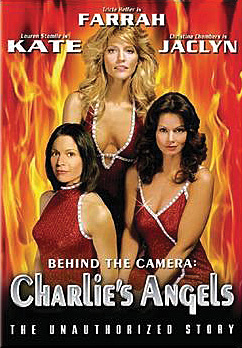
Looking for a new hit, television producer Aaron Spelling (Dan Castellanata) comes up with the story of “three little girls who went to the police academy and who were assigned very hazardous duties” but who were taken away from all that by the mysterious Charlie.  The show is conceived as a star vehicle for Kate Jackson (Lauren Stamile), with fashion model Jaclyn Smith (Christina Chambers) and actress Farrah Fawcett-Majors (Tricia Helfer) playing her partners in investigating and solving crimes.  Kate wants to make a feminist statement.  Jaclyn wants to be a good role model to the little girls who sneak out of their room to watch the show.  Farrah wants to be a star without losing her possessive husband, Lee Majors (Ben Browder).  The critics hate the show.  Studio president Fred Silverman (Dan Lauria) and showrunner Barney Rozenweig (Michael Tomlinson) are embarrassed by it.  But Spelling has a hit and the actresses become stars.  But when Farrah decides she wants to leave after one season, the show’s future is put in doubt.

This was one of NBC’s Behind The Camera films and the only one to take us behind the scenes of a “drama” program.  (The other films looked at Diff’Rent Strokes, Mork and Mindy, and Three’s Company.)  This is probably the best of them, though “good” and “best” are both relative terms when it comes to these movies.  As with all of the films, there’s too many inside jokes about the network execs, with Dan Lauria stepping into the shoes of Brian Dennehy and Saul Rubinek as Fred Silverman.  But Dan Castellanata did a surprisingly good job as Aaron Spelling and the three actresses playing the Angels were all convincing, especially Christina Chambers.  The film’s main villain is Lee Majors, who is blamed for forcing Farrah to leave the show and who is portrayed as yelling, “Her name is Farrah Fawcett-Majors!”  It’s low-budget and doesn’t offer much that isn’t already known but at the cast keeps the story interesting.

MacGruber (2010, directed by Jorma Taccone)


A nuclear warhead has been stolen and Captain Jim Faith (Powers Boothe) knows just who to recruit to track it down.  Former CIA agent MacGruber (Will Forte) agrees to come out of retirement, so he can save the world from Dieter Von Cunth (Val Kilmer), the man who blew up MacGruber’s fiancée (Maya Rudolph) on the day of their wedding.

MacGruber re-assembles his old team.  Sure, Vicki St. Elmo (Kristen Wiig) no longer wants to be a part of the adventure and MacGruber refuses work with Lt. Dixon Piper (Ryan Phillippe) but he still brings together a collection of men who look like they eat carburetors for breakfast.  And then he accidentally blows them up.  MacGruber’s assembling a new team!  While mentoring Dixon and falling in love with Vicki, MacGruber seeks his revenge on Cunth.  He also makes peace with his past by having sex with his fiancée’s ghost on her tombstone.

Based on the SNL skit that was itself based on a one-joke premise, MacGruber is a surprisingly entertaining action comedy, mixing frequently crude humor with heartfelt pathos.  MacGruber works because, even while it makes fun of action movies, it still respects the rules of the genre.  The jokes and the bullets fly with equal power.  MacGruber is an idiot but he’s also the only man who can save Washington from Cunth’s plot and Will Forte does an admirable job of delivering every bizarre line of dialogue with a fully committed straight face..  Val Kilmer plays Cunth as being a classic action villain, right down to his dismissive attitude and his long-winded speeches.  Kristen Wiig is both sexy and adorably awkward as the love interest.  And Ryan Phillippe does a surprisingly good job as the the one person who seems to understand how crazy MacGruber really is.  Every good comedy needs a good straight man and Ryan Phillippe proves himself to be more than up to the task.

MacGruber is full of quotable lines and scenes that are so out-there that you might need to rewind and confirm that you actually saw what you just did.  There have been a lot of bad Saturday Night Live movies.  MacGruber is one of the good ones.

Smoky Canyon (1952, directed by Fred Sears)


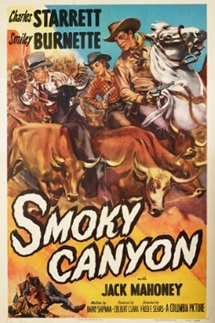
There’s a $2500 dollar reward out for the masked bandit known as the Durango Kid but little do the residents of Timber Rock know that the Kid is actually Steve Brent (Charles Starrett), a Treasury agent who puts on a mask whenever he needs to go undercover and discover what the bad guys are doing.

A range war has broken out between the sheep farmers led by Jack Mahoney (Jock Mahoney) and the cattlemen led by Carl Buckley (Tristram Coffin).  To broker a peace and discover which side is the most to blame, Brent works for the cattlemen while the Durango Kid sides with the sheepmen.  It turns out that Buckley’s to blame here.  He’s using the war to thin out his cattle so that an Eastern beef syndicate can keep prices high.  When Mahoney gets too close to the truth, he is framed for the murder of Mr. Woodstock and it’s up to the Durango Kid to prove that Mahoney is innocent.  Meanwhile, Carl wants to blow up an entire mountain so that it will really thin out his cattle herd.

This is a typical Durango Kid movie, entertaining if you like B-westerns and probably boring if they’re not your thing.  It has all the usual gunfights, horse chases, and dynamite explosions that are promised by every Durango Kid film.  Starrett was always one of the most convincing cowboys on screen, even if his use of the Durango Kid alter ego didn’t always make sense.  All the usual members of the Durango stock company show up, all playing different characters than they did in the previous Durango Kid film.  Mahoney gets to play one of the good guys for once and his spirited girlfriend is played by the lovely Dani Sue Nolan.  Smiley Burnett shows up to provide comic relief.  This time, he’s a singing tour guide.  He sings a song called It’s Got To Get Better.  Let’s hope so.

THE BLOOD OF HEROES (1989) – Rutger Hauer and Joan Chen play in the Jugger Super Bowl! 


As an obsessed Rutger Hauer fan of the early 90’s, I was working my way through the man’s back catalogue of films when I came across THE BLOOD OF HEROES (1989) on the shelves at my local video store. With its post-apocalyptic setting and its strange sport of jugger, I’ll admit that it was not the kind of film that I’m most drawn to. I generally preferred watching Hauer taking down the bad guys in movies like WANTED DEAD OR ALIVE (1986) and BLIND FURY (1989), which was released the very same year. However, it was a relatively recent Hauer film, so I rented it, cautiously optimistic that it would be entertaining. At the time, it was not my favorite Hauer film, but I remember an 18-year-old version of myself thinking it was okay. I’ve watched it a couple of times over the last 30 years, and even own the DVD, but it’s not one that I pull off the shelf very often. I decided it was time for a fresh viewing. 

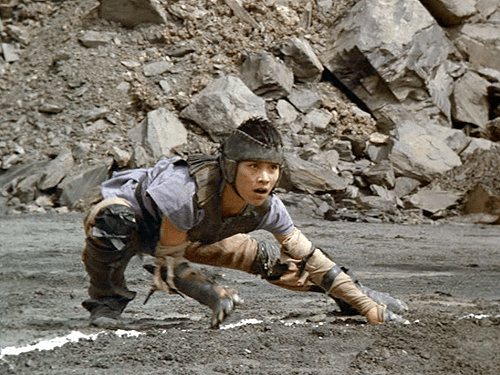
In the bleak, desolate, futuristic world of THE BLOOD OF HEROES, Rutger Hauer plays Sallow, the leader of a team of juggers. They go from town to town challenging the local team in a sport where you win by placing a dog skull securely on a stake. It’s an extremely violent game consisting of two teams with five players. Four players basically beat the crap out of the opposition with clubs and chains, in hopes that they can provide protection to their one player, the “quick,” who can get the skull on the stake. We meet Sallow’s team who consists of Dog Boy (Justin Monjo), Mbulu (Delroy Lindo), Big Cimber (Anna Katarina), and Young Gar (Vincent D’Onofrio) as they enter a town ready for a match. They win, but Dog Boy, their quick, has his leg broken in the process. Luckily for them, the opponent’s quick Kidda (Joan Chen), who was at least partially responsible for Dog Boy’s gruesome injury, is available to head towards the next town with the ragtag crew! She turns out to be a hell of a player, who’s willing to do whatever it takes to win, including biting an ear off when it’s required. This is what I call dedication. During the course of the story, we find out that Sallow used to be a professional jugger who played in “The League” in the underground cities where the rich, aristocratic people live and treat their champion juggers “almost” like one of them. He got banished when he engaged in a forbidden relationship with one of the overlord’s daughters. With his team of juggers, especially the super talented Kidda and Gar, Sallow leads them to the big city where they will challenge the professionals. For Sallow, it’s a shot at redemption. For the others, it’s a chance to be noticed by the League, which will lead to a much more luxurious life, when they’re not bashing their opponents brains in of course. I may have exaggerated a bit in my headline when I referred to this challenge as the “Jugger Super Bowl,” but it’s still kind of a big deal! 

After rewatching THE BLOOD OF HEROES again, while it’s still not my favorite kind of film, I can confidently say that I enjoyed it very much this time around. Most of that joy stems from watching Rutger Hauer in his prime. He’s such a charismatic actor and that even comes across in such a grim setting. I also like his character type, that of the disgraced former hero searching for redemption against a system that had previously discarded him. There’s usually much satisfaction to be had with this type of character, and this movie delivers on that premise. Joan Chen is very good as the new addition to the team who dreams of escaping her town and becoming a jugger star! She and Hauer really carry the film. The rest of the cast also added to my enjoyment of the movie. For me, It’s a lot of fun watching actors like Vincent D’Onofrio and Delroy Lindo in relatively early roles in their long and distinguished careers. I really enjoyed seeing Australian actors Hugh Keays-Byrne and Max Fairchild, both veterans of the MAD MAX series, appear near the end of the film when they make it to the city. Max Fairchild is especially impressive as one of the League juggers and former friend to Hauer. I wanted to give one more shout out, and this one goes out to actor Gandhi MacIntyre, who plays the team manager and doctor in the film. He has a very likable presence and made me smile on multiple occasions. The movie’s pretty serious and dark, and Gandhi’s sense of humor is a welcome presence. 

THE BLOOD OF HEROES is written and directed by David Webb Peoples. To date, it’s the only feature length film that Peoples has directed. In my opinion, he does a fine job. He certainly creates an interesting world, with huge contrasts between the barren, rocky outside landscapes and the overcrowded, underground cities. This is not a world I want to live in, but Peoples brought his vision to the screen, albeit within clear budget limitations. Considering it’s from the same guy who wrote BLADE RUNNER (1982) and UNFORGIVEN (1992), the story is pretty simple. And this is fine by me. The story of redemption for some, and of the dream of newfound glory for others, is a story that all of us can relate to at some point in our lives. At this point in my own life, I can relate to both! The movie features some ugly and violent images, but I found myself emotionally pulling for the ragtag group of underdogs in the big game at the end. It’s also pretty cool that Peoples made up his own game when writing the screenplay, albeit a game I would never want to play. The game Jugger, a less violent version of the game introduced in the film, is currently played all over the world. 

One final thing I wanted to point out about THE BLOOD OF HEROES is the fact that an author named Danny Stewart has written a book called “Saluting the Blood of Heroes – Behind the Apocalyptic Film.” I just learned of this book while researching the film today for this review. It was published in July of 2024. I just love a world where a person is able to get a book published about the making of an obscure, low budget film from the late 80’s. I won’t be surprised if this ends up in my Amazon cart really soon. 

I’ve included the trailer for THE BLOOD OF HEROES (AKA – THE SALUTE OF THE JUGGER) below:

Renegade Girl (1946, directed by William Berke)


Missouri in 1864.  The Civil War is raging and the state is divided between those who support the Union and those secretly support the Confederate guerillas led by Willian Quantrill (Ray Corrigan).  The Union’s Major Baker (Jack Holt) is determined to track down rebel Bob Shelby (Jimmie Martin) and he enlists the Native American Chief Whitecloud (played by Chief Thundercloud) to help find him.  Whitecloud has a personal vendetta against the Shelby family and, when he finds Bob, he executes him in cold blood.  Bob’s sister, Jean Shelby (Ann Savage), is also a Confederate sympathizer and she seeks revenge.  Complicating things is that Jean has fallen in love with Union Captain Fred Raymond (Alan Curtis).

One of the many B-westerns produced by Robert L. Lippert and directed by William Berke, Renegade Girl packs a lot of plot into just 65 minutes.  The action is nonstop and fans of westerns will find all of the horse chases, gunfights, and threats of hanging that they could want.  The main thing that distinguishes Renegade Girl from other B-westerns is the fierce performance of Ann Savage as Jean Shelby, a woman who will not stop until she gets her revenge.  While the film’s portrayal of the Quantrill and Chief Whitecloud definitely goes against modern sensibilities, Ann Savage’s performance feels ahead of her time.  No one is going to stand in Jean Shelby’s way.

Chief Thundercloud’s real name was reportedly Victor Daniels, though his past is shrouded in mystery.  He claimed to be a Cherokee from Arizona, though he was listed as being Mexican on a marriage record that was filed before he started his film career.  As Chief Thundercloud, he was a mainstay in westerns from the 30s to the time of his death in 1955.  He was the first actor to play the Lone Ranger’s Tonto and he also played Geronimo in a 1939 Paramount film of the same name.  His final film role was a posthumous appearance in John Ford’s The Searchers.