Horror Book Review: The Exorcist by William Peter Blatty


Which is better, the movie or the book?

That’s a question that’s often asked and I think the knee jerk reaction is always to say that the book was better but that’s certainly not always true.  There are a few notable cases where the film has been dramatically better than the book.  Just check out The Godfather, if you don’t believe me.  Occasionally, you’ll run into something like the recent two-part adaptation of Stephen King’s It.  The first film was dramatically better than the novel while the second film was significantly worse.

And then occasionally, you’ll have a case where the book and the movie are equally good, albeit for different reasons.  That’s the case with William Peter Blatty’s 1971 novel, The Exorcist.

The book and the movie both tell the same story.  Perhaps because Blatty served as both the writer and the producer of the film version, the movie sticks closely to the basic plot of his novel.  Regan McNeil, the daughter of an atheist actress named Chris McNeil, is possessed by a demon called Pazuzu.  It falls to Father Merrin and Father Karras to perform an exorcism.  Unfortunately, Merrin is old and in bad healthy while Karras fears that his faith might not be strong enough to defeat the demon.

Though the plot does remain the same, there are, of course a few differences between the film and the book.  As befits a novel written by a screenwriter, the book gets a bit more gossipy when detailing the production of Chris’s film.  The book also spends a good deal more time on Inspector Kinderman’s investigation into the deaths of characters like film director Burke Dennings.  In the film, Kinderman only appears in a few scenes.  In the book, he’s as important a character as Karras and it’s rather obvious that he was Blatty’s favorite character to write.  (It’s not a surprise that Kinderman was subsequently the main character in Legion, which was filmed as The Exorcist III and which starred George C. Scott as Kinderman.)  The book also spends a good deal more time on Karras’s crisis of faith.  In the film, Karras was portrayed as being initially hesitant to accept that Regan was possessed.  In the book, Karras researches the history of exorcisms and considers almost every other alternative before committing himself to performing the exorcism.  When the book was first published, those scenes were included to make the reader themselves question whether or not Regan was actually possessed.  Modern readers, however, already know that answer to that.

Myself, I appreciated the extra time that the novel spent with Kinderman and Karras.  As written by Blatty, they’re both engaging characters and Karras’s crisis of faith is actually handled with a good deal more skill in the book than in the movie.  If the movie is a nonstop roller coaster of terror, the book is a bit more thoughtful.  Whereas the movie shocks you into accepting its premise, the book actually tries to convince you that demons are real and that they’re responsible for the evil in the world.  (The books opens with a series of quotes from real-life dictators and mobsters.)  The movie aims for your gut while the book’s horrors are often more cerebral but they both get under your skin and inspire you to make sure that every door is locked and every window is closed.  Not that any of that would protect you, of course.  Both the movie and the novel understand that the scariest thing about what happens to Regan is that it’s out-of-her-control and could, in theory, happen to any of us.  Demons are going to do whatever they can.  Both the book and the film are fantastically effective and worthy of being known as horror classics.

This October, definitely be sure to watch The Exorcist and The Exorcist III.  Hell, maybe even watch The Exorcist II.  It’s not that bad!  (Okay, well, actually, it is.  But still, it’s kind of …. fun, in its way.)  But also take the time to read the books.  Doing one without doing the other is only getting half the story.
Book Review: Go Ask Alice by “Anonymous”


“Another day, another blow job,” writes the anonymous author of Go Ask Alice.

It’s only been a few months since she first dropped acid and smoked weed for the first time and the narrator has already run away from home and turned to prostitution to support her raging drug habit.  First published in 1971 and continuously in print since then, Go Ask Alice is presented as being the narrator’s journal, found amongst her belongings after she died of a drug overdose.  (Despite popular belief, the narrator is not named Alice.  Her name is never actually mentioned in the journal.)  That one line — “Another day, another blow job” — pretty much sums up Go Ask Alice.  It’s very dramatic.  Depending on who is reading it, it’s very shocking.  And it’s so perfectly quotable that it’s hard to believe that someone just scrawled it down in a journal.

Of course, some of that’s because Go Ask Alice isn’t actually a diary.  Though it’s never been officially confirmed, most researchers believe that it was actually written by Beatrice Sparks, a therapist who originally presented herself as being the diary’s editor.  Sparks later went on to “edit” several other anonymous diaries, all written by teenagers who had gotten involved with things like Satanism, eating disorders, and gang violence.

Even if I hadn’t read (on, I’ll admit it, Wikipedia) that Go Ask Alice was not actually written by a 15 year-old girl, it would be obvious just from some of what it is written in the diary.  I reread it a few weeks ago and the thing that immediately jumped out at me was that the narrator apparently didn’t write much about anything that didn’t have to do with drugs.  There’s none of the banal stuff that you would typically expect to find in someone’s personal journal.  The narrator doesn’t mention television or movies or music or books.  She barely even talks about the boy she likes, other than to mention that he exists and she’s not sure if he likes her back.  Instead, she pretty much goes straight from drinking a coke that’s been dosed with acid to running away to Berkeley.  She spend several hundred words meticulously detailing an acid trip but she tells us very little about anyone that she goes to school with.  (And I have to say that, for someone who has just taken acid for the first time, she’s remarkably coherent and detailed when it comes to writing about her trip.)  She also includes a lot of statistics about how how many people her age are estimated to have experimented with drugs, which doesn’t doesn’t seem like the usual behavior of a 15 year-old addict.  It’s not something that I would have done at 15 and, trust me, I was a very smart 15 year-old.  (It’s vaguely like something you would expect to hear in an old sitcom.  “Can you believe it?  That child’s 15 years old and already hooked on speed.”  “Oh, honey, it’s not that unusual.  I was reading an article that said 40% of children under the age of 16 have tried some sort of narcotic substance.”)

Another thing that I found to be interesting about Go Ask Alice is how generous everyone was with their drugs.  Even after the narrator goes through rehab, her classmates still walk up to her and casually drop drugs in front of her.  Maybe it’s a generational thing but my experience in high school was the exact opposite.  At my high school, the few people who regularly had drugs tended to be pretty stingy with them.  They certainly weren’t going to waste any just to play a joke on someone.  (Indeed, I’ve never been able to relate to people who claim that people pressured them into trying drugs because, at my high school, everyone was too greedy to share.  “You want a hit off this joint?  This is mine, get your own!”)  But I guess that maybe in 1971, drugs were cheaper and people just had a more generous spirit.

Anyway, Go Ask Alice is a quick read and it fulfills the number one rule of successful propaganda: it takes it story to the worst possible conclusion, even though a less dramatic conclusion would have been more realistic and perhaps more effective.  From the minute you start reading the diary, you know that the diarist is going to end up dead of a drug overdose because that’s the type of story that Go Ask Alice is.  Over the course of a year, our narrator goes from being sweet and innocent to being dead because stories like this don’t work unless the narrator dies at the end.  Simply having the narrator write, “I did a lot of drugs and I wish I hadn’t but now I’m going try to rebuild my life,” just does’t carry the same punch as, “A week later, the writer of this diary was found dead of an overdose.”  Go Ask Alice understands the importance of embracing the melodrama and it does so fully.  As a result, it’s not as convincing as a realistic look at drug abuse would have been but it’s considerably more entertaining.

Go Ask Alice was a huge success when it was first published.  They even turned it into a movie, which can currently be viewed on YouTube and Prime.  Somewhat inevitably, William Shatner’s in it.   The movie is actually better than the book but you should read the book as well, if just to see what frightened your grandparents back in the day.

Lisa Marie’s Top 10 Novels of 2019


  1. This Storm by James Ellroy
  2. A Friend Is A Gift You Give Yourself by William Michael Boyle
  3. Imaginary Friend by Stephen Chbosky
  4. The Girl in Red by Christina Henry
  5. The Lost Night by Andrea Bartz
  6. The Twisted Ones by Ursula Vernon as T. Kingfisher
  7. One Night At The Lake by Bethany Chase
  8. Sherwood by Meagan Spooner
  9. An Anonymous Girl by Greer Hendricks and Sarah Pekkanen
  10. Blood Oath by Kelly St. Clare and Raye Wagner

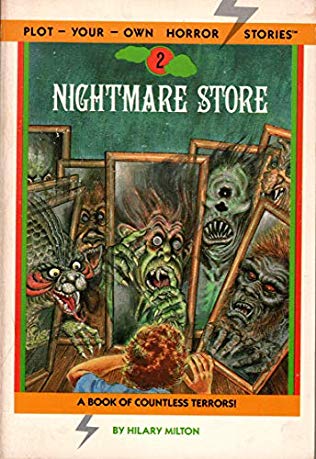
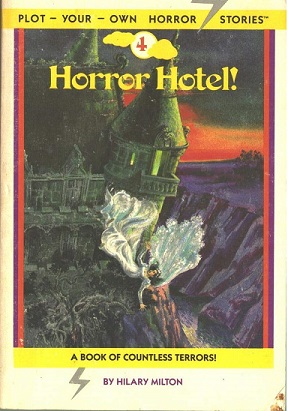
Book Reviews: Nightmare Store and Horror Hotel by Hilary Milton


You are trapped in a department store overnight!  Can you survive even while being pursued by ghosts, monsters, and killer mannequins?

Or

You are trapped in a hotel!  No one else seems to be around!  Can you survive even while being pursued by ghosts, monsters, and a crazy doctor with a scalpel?

It all depends on which one of these two books you read!

These are two books that I ordered off of Amazon two years ago and they’re both enjoyable reads.  They’re choose your own adventure-style books, where you get trapped in a location overnight and you have to try to survive while various monsters and ghosts try to kill you.  Every few pages, you’re given an option for what you want to happen next in the story.  What’s interesting is that, instead of it being the usual “If you run got page 75” sort of thing, it’s instead more like, “If you hear a noise, go to page 33.  If you see something out of the corner of your eye, go to page 28.”  So, to an extent, you get to decide how your scary story plays out.  These books were written for children, of course but both of them still get surprisingly grisly and intense at time.

Of the two, I preferred Horror Hotel.  The hotel was just a more interesting locations than the store and there was a lot more variety to the options and storylines in Horror Hotel.  I mean, yes, it’s obvious that Horror Hotel is basically just The Shining for kids but so what?  It had some scary moments!  It also had some scary pictures to go along with the text.  I wonder how many children in the 80s were traumatized by that picture of a scaly hand reaching out from underneath the bed and grabbing your ankle?  Or how about the picture of the crazy-haired scientist running at you with a scalpel in his hand?  AGCK!

Anyway, these are fun books.  They can orered off of Amazon and and they’re an enjoyable way to kill a little time in between hauntings.

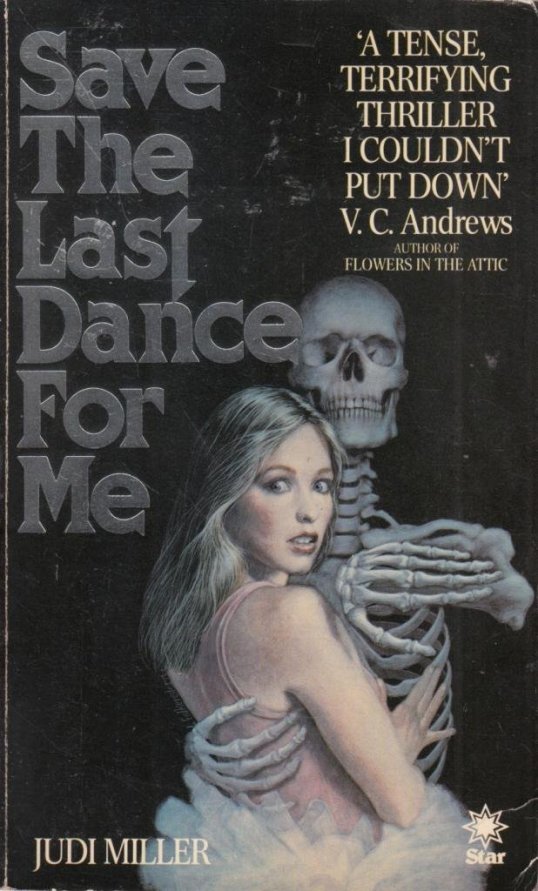
Horror Book Review: Save The Last Dance For Me by Judi Miller


The 1981 novel, Save The Last Dance For Me, is another book that I found in my aunt’s paperback collection.  I have to admit that I got really excited when I found it.  This is a book that I had wanted to read ever since I came across the cover in Paperbacks From Hell.

Jennifer is blonde, beautiful, young, and ambitious.  She’s a driven dancer who is totally obsessed with becoming a soloist for one of New York’s best dance companies.  She’s got an older boyfriend, of course.  He’s a podiatrist who hopes that Jennifer will abandon her dreams and marry him.  Jennifer, however, is not so eager to settle down for a boring domestic life.

Max is a pianist who was raised by a narcissistic alcoholic who continually pressured her young son to learn ballet.  Neither Max nor his mother may have had much of a career as a dancer but that hasn’t stopped him from dreaming and obsessing.  Max has a basement and a bathroom that is full of ballet slippers.

Together …. THEY SOLVE CRIMES!

No, sorry.  (I know, I know.  I use that joke a lot but what can I say?  It amuses me.)  Instead, they have a drunken sexual tryst after Jennifer has an argument with her boyfriend and this leads to Jennifer not only getting locked in the basement but also being forced to eat a totally disgusting hamburger!  (EEEEEK!)  Max demands that Jennifer learn a terrible solo and he demands that she practice and practice it until she collapses.  It turns out to all be an elaborate revenge scheme, with a hint of Phantom of the Opera tossed in.  (It’s perhaps not a coincidence that Judi Miller also wrote a book called Phantom of the Soap Opera.)

There’s actually quite a bit going on in Save The Last Dance For Me.  This is a very plot-heavy book.  It’s full of bitchy and duplicitous characters, all of whom have their own agendas.  It also turn out that Max has been killing ballerinas for years.  The two detectives who are investigating the murders have to deal with a lot of pervy suspects, all of whom have their own fetishes when it comes to dancers.  As someone who grew up dancing, I can tell you that, in its hyper and melodramatic way, this book gets a lot of things right.

Anyway, not surprisingly, I really loved this book.  This was one of the most wonderfully trashy books that I’ve ever read, full of twists and subplots and red herrings and even a memorably overdone sex scene.  Basically, imagine the most melodramatic and sordid Lifetime movie ever but in book form.  In fact, I’m actually kind of surprised that Lifetime hasn’t ever made a movie out of this book.  I mean, if they can turn V.C. Andrews novel into an “event,” why not Save The Last Dance For Me?  Get on it, Lifetime!

Horror Book Review: The Stranger Return by Michael R. Perry


On January 24th, 1989, Ted Bundy — then America’s most notorious serial killer — was executed by the state of Florida.  Before he died, he confessed to all of his crimes and then gave an interview where he blamed it all on an addiction to pornography.  It was all a part of a scheme to avoid the electric chair but it didn’t work and he was put to death while thousands stood outside the prison and cheered.

Or was he?

The 1992 novel, The Stranger Returns, suggests that Bundy — who was once as notorious for his ability to escape custody as for his murderous rampage — escaped one last time.  A duplicate was sent to the electric chair while Bundy made his escape.  I know that probably made no sense when you read it in this review.  It really doesn’t make much sense in the book either.  But I guess things had to start somewhere.

Now believed to be dead, Bundy is free to change his identity, romance a young mother, and once again resume his murderous ways.  Only one man suspects that Bundy may have cheated the executioner, the father of one of his victims.  While he tries to get someone to listen to his theory about Bundy being alive, Bundy continues to move across the landscape like a dark shadow of death.

Earlier this year, it seemed like the entire nation briefly went Bundy crazy.  There was a documentary on Netflix.  Zac Efron starred in a movie.  It seem like almost every true crime show around did at least one episode on Bundy this year.  30 years after his execution, Ted Bundy was trending on twitter, a macabre testament to the power of celebrity.

I found myself thinking about Bundy’s morbid fame as I read The Stranger Returns.  The book was well-written and it was a quick read but it was still a bit troublesome that the book was essentially a novel starring Ted Bundy.  Too often, the book treated him like some sort of Hannibal Lecter-type character whereas Bundy was actually, by most accounts, an impotent drunk who was never as handsome, charming, or intelligent as he is frequently made out to be.  What is this power that a loser like Bundy holds over the popular imagination?

The Stranger Returns is a testament to that power.  I mean, how many other real-life serial killers have starred in a novel?  That’s usually an honor reserved for vampire hunters like Abraham Lincoln.  To be honest, I probably would have liked this book better if it had been about someone who thought he was Ted Bundy as opposed to being Ted Bundy himself.  In fact, I probably would have enjoyed the book if it had featured Bundy’s ghost or if Bundy had used some other supernatural check to come back to life.  But making Bundy into some sort of criminal genius was just a bit too icky for me.

Incidentally, I found this book in my aunt’s paperback collection.  According to her, she found the book being sold in the “true crime” section of Half-Price Books.  Fortunately, it’s not true crime.  Ted Bundy is dead and good riddance.

Book Review: Shadow of Evil by Greye La Spina


Direct from my aunt’s paperback collection, it’s the story of Portia Differdale and her aunt Sophie!

The time is the 1920s.  Sophie has come to Brooklyn, in order to live with the recently widowed Portia.  Portia, unfortunately, is having some issues with her neighbors.  Portia’s late husband was an occultist and, now that he’s died (more or less a victim of his profession), she’s decided to continue on his work.  Needless to say, the local gossips aren’t particularly happy about that.  Personally, I would love to live next door to an occultist, just because I would always some place to send any spirits who showed up in my house.  “Really, you’re undead?” I would say, “Head on next door.”  Sadly, I guess that’s just not the ways things were done in Brooklyn back in the day.

Anyway, Portia is lucky enough to have a potential new suitor.  His name is Owen and Sophie thinks that he would be the perfect new husband for Portia!  Portia, for her part, agrees.  However, it turns out that someone else has her eyes on Owen, as well.  Princess Irma Andreyevna Tchernova is wealthy, beautiful, and charming.  The uninhibited and flirtatious Princess Tchernova soon appears to have all the men in the community under her spell, including Owen!  None of them seem to find it odd that the Princess has an oddly silent servant or that she owns several wolves.  Not even the fact that the Princess eats nothing but meat strikes anyone as odd….

Except, of course, for Portia.  It doesn’t take long for Portia to figure out that there’s something sinister about the Princess but will she be able to save Owen from her grasp?  Read the book to find out!

Greye La Spina was born in 1880 and stared writing horror fiction in the early 20th century, at a time when it was considered somewhat scandalous for a woman to even write fiction, much less horror.  Shadow of Evil was originally published over the course of three issues of Weird Tales in 1925.  It was then reprinted, in paperback form, in 1966.  The cover at the top of this post (and which my sister shared earlier this month) is from the 1966 edition.  Since that time, the book has been occasionally reprinted.

It’s a fun read.  La Spina was a lively and entertaining writer and she tells this tale with the right mix of melodrama and satire.  La Spina obviously loves her unconventional characters and the story is as much about their desire to be independent from the conventions of society as it is about any paranormal activity.  It’s got everything — intrigue, romance,humor, scares, thrills, and a wonderful atmosphere.  It’s an enjoyable story and, if you can track down a copy, one that’s worth reading.

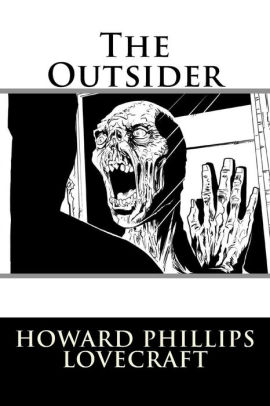
The Outsider, Review By Case Wright


hp4.jpg

Isn’t it just awkward when you’re trying to make friends and people run away because unbeknownst to you, you are an inter-dimensional-hell-beast?  It’s right up there with telling people that you’ve had the best barbecue ever and you’ve only ever been to Smokey Bones or having Nickelback as your ringtone or quoting “The Notebook”.  It’s just …GAH!

In “The Outsider”, Lovecraft tells the story from the monster’s POV.  Shelley did it for the first time in Frankenstein, but it is rarely done; we don’t want to put ourselves into the Devil’s shoes.  Even today, the Devil’s POV is scorned – see Joker reviews.  The creature in “The Outside” actually seems kinda nice, but lonely.  The monster-beast crawls and claws its way out of a crypt and goes up people in a church and wonders what must be chasing him because everyone is running for their lives.  This goes on for A WHILE! People flee and he has no idea what’s going on.

Finally, he sees the monster, he goes to touch the horrible creature, and his outstretched finger touches a mirror.  I enjoyed the twist.  If done right, the Devil is always appealing.  Breaking Bad made Bryan Cranston a total badass and he did terrible things, but we rooted for him.  Like Walter White who only felt akin to his blue meth at the end, this creature is scorned so he flees into the night doing whatever Hell-Beasts do; my guess it has something to do with making robocalls or working for Ticketmaster.

This Halloween season I’ve been strung out on short-stories for days because I’m amazed at the ability to convey a story in limited space like a Haiku.

See you, tomorrow.

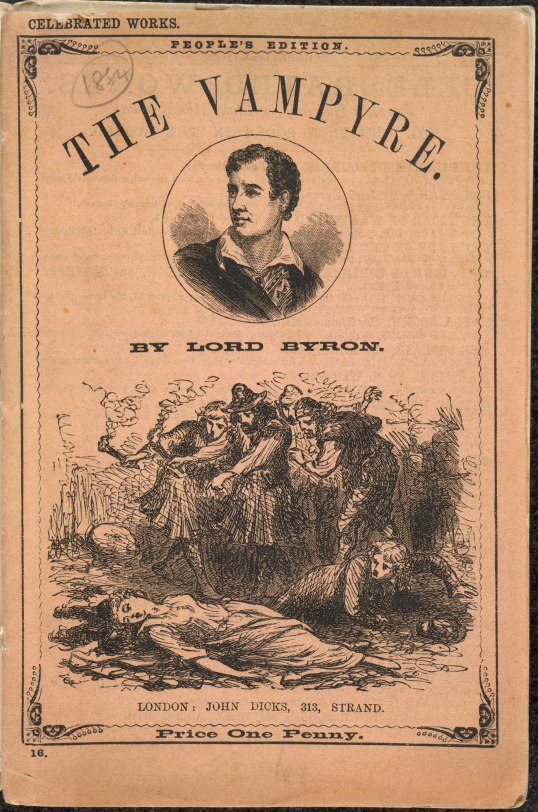
Book Review: The Vampyre by John William Polidori


Though The Vampyre was often erroneously attributed to Lord Byron, it was written by John William Polidori

First written way back in 1816, The Vampyre is a story about an amazingly naive young gentleman named Aubrey who becomes friends with the mysterious Lord Ruthven.

Everything about the enigmatic Lord Ruthven would seem to suggest that he’s a vampire but Aubrey never figures that out while he and the nobleman travel across Europe.  Even after an inkeeper’s daughter dies of a vampire attack shortly after telling Aubrey about vampires (and, also, immediately after the sudden arrival of Ruthven), it still doesn’t occur to Aubrey that there might be something strange about Lord Ruthven.  When Lord Ruthven is mortally wounded by bandits, he makes Aubrey swear an oath that he will not tell anyone about Ruthven’s death for a year and a day.  Aubrey promises to keep the oath.

Now, apparently, back in the 19th century, people took those oaths very seriously because, even after Lord Ruthven shows up alive once again and now claiming to be the Earl of Marsden, Aubrey can’t tell anyone that he saw Ruthven die.  Even after Ruthven starts to court Aubrey’s sister with the obvious intention of draining her blood, Aubrey still cannot bring himself to break his oath.  Is it because oaths were really that important or is it that Aubrey himself is as in thrall of Ruthven as his sister?

John William Polidori was a physician and a writer, as well as a contemporary and friend to Mary Shelley, Lord Byron, and Percy Shelley.  The Vampyre was conceived and written as a part of the same contest that saw Mary Shelley write Frankenstein.  Though Polidori’s story is understandably overshadowed by Mary Shelley’s (and, it must be said, Polidori was nowhere near as good a writer as his famous friends), it’s still historically significant as the first “romantic” vampire tale.  It’s the story from which so many others have sprung.

Many have also speculated that the story was based on Polidori’s friendship with Lord Byron, with Polidori represented by the unstable Aubrey while the self-centered but charismatic Lord Ruthven was perhaps meant to be a stand-in for Byron himself.  This may be true or it may not.  (When it comes to Byron, the Shelleys, and Polidori, it’s always perhaps a bit too tempting to read too much between the lines.)

The Vampyre is a historically important piece of work so, if you’re a fan of vampires, you have to read it.  Flaws and all, we owe much to Lord Ruthven and John William Polidori.


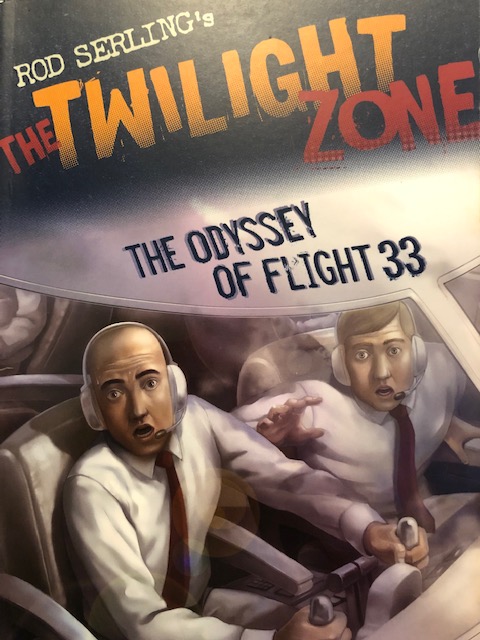
The Odyssey of Flight 33, Comic Review, by Case Wright


tw3

Yes, they have comic versions of The Twilight Zone! I really enjoyed this and I know that some of you are like….hmmm is this horror? Yes… Yes, it is. No further questions!  Besides, we have a Twilight Episode to discuss.  The Twilight Zone always leaned more into horror IMO.  The Outer Limits was all about teaching you a moral lesson, but TTZ was all about the scare factor.

I enjoyed this format too.  Face it, a lot of the TTZ episodes don’t hold up amazingly well.  It’s the truth….Deal With It!  The book has all the components of a good TTZ episode: the setup of perceived normality that takes a terrible left turn.  There aren’t many things more normal or boring than air travel.  The flight is just a typical run to La Guardia and the passengers appear very normal as well: the chatty passenger, the braggy passenger, and the emotionally unstable passenger.

These archetypal passengers pull us into the story much like the Stephen King stories do. Stephen’s characters are your neighbors and these passengers are too.  But, something isn’t right is the friendly skies! They feel hit a pocket of air and their speed goes into the thousands of miles per hour and whammo – they start time traveling! They arrive in 1939 and don’t stop because they want to get back to their own time- So no killing Hitler for these time travelers.  Then, they arrive in the Cretaceous and decide not to land because Jurassic Park is so five minutes ago, but then they arrive in the future.

This one troubled me a bit.  They are low on fuel and the future has cable and they can’t screw up time.  Really, they could just try to make a go of it in their new time.  No one seemed like things were that amazing for them in the present.  I mean, why not just land? You’d at least make a living on the talk show circuit. The comic ends with ambiguity.  They are low on fuel and lost in time.

I would recommend checking these issues out.  They’re a lot of fun and have a good creep factor.