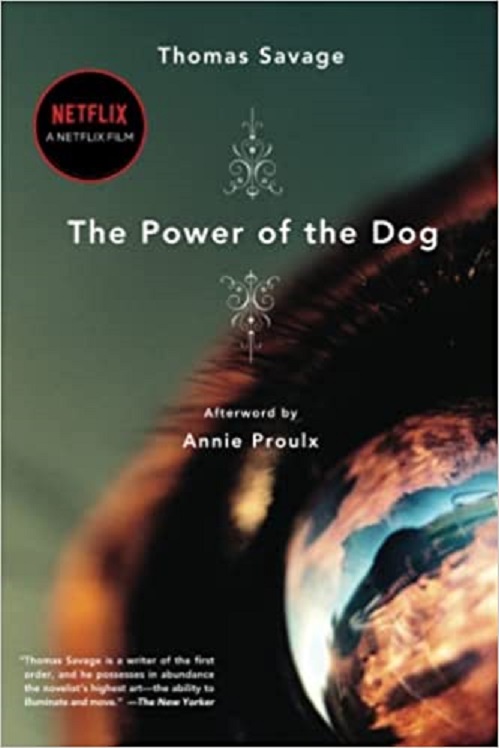
Novel Review: The Power of the Dog by Thomas Savage


If I may be allowed to open with a cliché: “You’ve seen the movie, now read the book!”

I ordered a copy of and read Thomas Savage’s 1967 novel, The Power of the Dog, before the release of Jane Campion’s film adaptation.  Hence, when I watched Campion’s film, I already knew about the Burbank Brothers, Bronco Henry, Rose, and Peter Gordon.  Neither the film’s big twist nor the diabolically clever ending were quite as much of a shock to me as they apparently were for others, though both were still undeniably effective in both the book and the movie.  Campion’s film sticks close to the plot of the book and visually, it captures Thomas Savage’s simple but effective prose.

In case you’ve yet to see the film or read the book, The Power of the Dog takes place in Montana in the 1920s.  Phil and George Burbank are brothers.  Ever since their parents retired, Phil and George have owned and managed the family ranch.  The gentle and kind-natured George has spent almost his entire life allowing himself to be led around by Phil.  Phil, meanwhile, has fully embraced the identity of being a tough cowboy and all of the myths that go along with it.  He rarely bathes.  He makes it a point to castrate all of the cattle personally.  He seldom wears gloves, believing the all work should be done bare-handed.  He’s dismissive of anyone who he believes has shown any sign of weakness.  He’s a bully and a sadist but he’s also an Ivy League graduate who takes pride in his ability to quote Ovid in the original Latin.  Phil is brutally dismissive of almost everyone.  He only seems to truly care about his brother and the memory of his mentor, the mysterious Bronco Henry.  When George meets and marries a widow named Rose, Phil can’t handle it.  George is breaking free of Phil’s influence and Phil seeks revenge against Rose, psychologically tormenting her and driving her to drink.  When Rose’s son, Peter, arrives at the ranch, Phil initially dismisses Peter as being weak.  But, to Rose’s horror, Phil soon starts to take an interest in Peter….

Author Thomas Savage was born in Montana and grew up on his stepfather’s ranch.  Savage later said that, much like Peter, he always felt like a misfit on the ranch.  His stepfather was a man who was much like Phil Burbank while Savage felt a lot like Peter Gordon.  Despite never feeling like he belonged, Savage was still able to use his early experiences as a ranch hand as the inspiration for his first published short stories.  Savage went on to write several western novels, many of which dealt with dysfunctional ranch families.  Though well-reviewed, The Power of the Dog was not a best seller when it was originally published and even the positive reviews often seemed to wilfully miss the subtext behind Phil’s homophobia and his devotion to the memory of Bronco Henry.  In 1967, The Power of the Dog was ahead of its time.

Hopefully, with the release of Campion’s adaptation, the original novel will be read by an entirely new audience.  As I mentioned earlier, Campion remains faithful to the book’s plot but there are a few elements in the original novel that will add to one’s understanding of the film.  For instance, the book goes into more detail about the history and the culture of the town and it also goes into more details about  the ranch’s dealings with the local Native tribes.  Whereas both the film and the book present Phil as being a wilfully malicious agent of chaos, the book makes clear that Phil is also a creation of the culture in which he was raised.  The book makes clear that, for all of his overt macho energy, Phil still feels like an outsider among even the ranch hands who worship him and that adds an element to his relationship with Peter that is only suggested at in the film.

Perhaps most importantly, the book devotes a chapter to the life of Rose’s first husband and the circumstances that led to his suicide.  Rose’s first husband is a doctor who comes to Montana to try to help people but who is slowly destroyed by the town’s apathy.  We learn of the argument that led to his suicide and, again, it adds an entirely new element to Phil and Peter’s relationship.

So, if you’ve seen the movie, read the book.  Or read the book and then see the movie.  They’re both excellent deconstructions of the mythology of the American west.
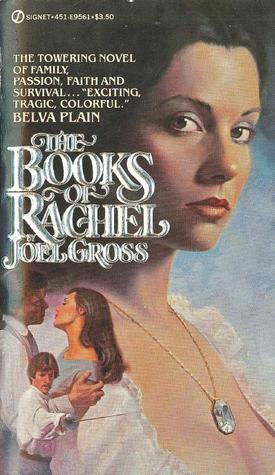
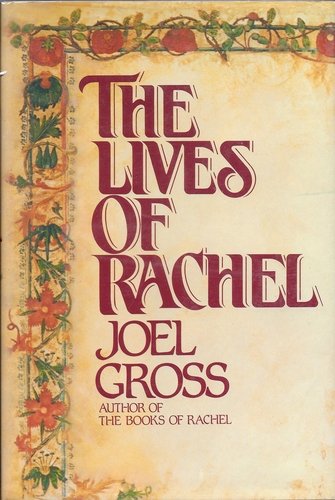
Novel Review: The Books of Rachel and The Lives of Rachel by Joel Gross


My aunt has always been a prodigious reader and, when I was growing up, I always enjoyed looking through the stacks of books that she had sitting in the closets of her room. A few years ago, for medical reasons, my aunt had to move out of her house.  Because she wouldn’t have room for all of her books in her new place, she gave the majority of them to me.  So far, I’ve only read a few but this year, I plan to read all of them and review the ones that I like.  That’s one of my resolutions for 2022.

When I first got my aunt’s collection, one of the first books that I came across was a paperback called The Books of Rachel.  The cover featured a beautiful woman with a lovely necklace, a man fencing, and a couple kissing.  The blurb promised that Joel Gross’s The Books of Rachel was “exciting, tragic, colorful!”  That’s all I needed to see!  I read the book and I liked it so much that I went on Amazon to see what else Joel Gross had written.  That’s when I came across the prequel to The Books of Rachel, The Lives of Rachel.  Of course, I immediately ordered a copy of that book and read it as well.

The Books of Rachel was first published in 1979.  The Lives of Rachel was published in 1984.  Taken together, these two books tell the epic story of one family, following them from ancient Judea all the way to 1980s New York.  Though the family is frequently forced to relocate and each section of the book takes place in a different country and in a different century, a few things remain the same.  There is always a Rachel.  Whenever a Rachel passes, the first daughter to be born after her is given the name and becomes the heiress to centuries of strength, faith, and struggle.  They also, eventually, become the owner of a flawless, 60-carat diamond, the Cuheno Diamond.  The other thing that remains true is that, no matter where or when the individual Rachels may live, they do so under the shadow of the oldest of all prejudices and evils. From the ancient Romans to the Spanish Inquisition to the fascists and Nazis of post-World War I Europe, anti-Semitism is the one constant that every evil in the world tends to share.

There are many different Rachels.  Some are kind.  Some are innocent.  Some are less kind and some are definitely not innocent.  But what they all have in common is that they’re willing to fight, for themselves, for their family, and ultimately for their people.  For all of the sex and the melodrama (and, make no mistake, there is quite a bit and that’s definitely a good thing), The Books of Rachel and The Lives of Rachel are a tribute to survival, inner strength, and the faith and legacy of a people who would not allow themselves to be defeated.  With everything going on in the world today and so many prominent people openly embracing anti-Semitic conspiracy mongering, the lessons of these books are even more needed than ever.

Finally, another reason why I loved these books is because, as I’ve mentioned many times on the site, I am a total history nerd and these books are historical fiction at their finest.  The books are obviously very well-researched and the attention to detail makes them a wonderful read for those us who are interested in how life was once lived.

They’re good books.  I recommend them.  We can all learn from the Rachels.

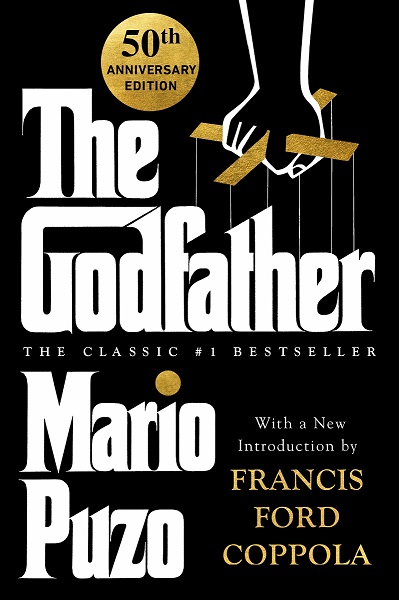
Book Review: The Godfather by Mario Puzo


“The book,” it is often said, “is always better than the film.” But is that always true?

No, it’s not and, if you need proof, just read Mario Puzo’s The Godfather and then re-watch the movie. Or re-watch the movie and then read the book. Either way, you’ll be left with the conclusion that, while the novel did lay the foundation for what became the greatest movie ever made, the novel itself is still a bit …. off.

The Godfather was originally published in 1969 and, before I write anything else, it should be noted that Mario Puzo himself never claimed that the book was meant to be a great work of literature. Puzo had previously written three novels and one children’s book. One of those novels was a pulp paperback that he wrote under a pseudonym for a quick payday. The other two novels were both meant to be works of “serious literature” that examined the human condition. Puzo considered his second novel, The Fortunate Pilgrim, to be his best and most poetic work. The only problem is that, while the reviewers were respectful, hardly anyone read Puzo’s “serious” fiction. As such, The Godfather was Puzo’s attempt to write the most commercial book possible, a page-turner that would climb the best seller list and help Puzo pay off his gambling debts. The Godfather certainly did that, spending 67 weeks on the New York Times’s Best Seller List and selling over 9 million copies in two years. Producer Robert Evans was so sure that the novel would be a hit that he even paid for the film rights while the book was still in the galleys.

Reading the book, especially after watching the movie, can be an odd experience.  The film itself is largely faithful to the book. Just about everything that happens in the movie can be found in the book.  Michael, Sonny, Tom, Fredo, Vito, Kay, Barzini, Sollozzo …. they’re all here.  Usually, characters are more complex in the original book than they are in the subsequent film adaptation.  In this case, the opposite is true and reading Puzo’s somewhat leaden prose really does make you appreciate the depth and nuance that actors like Al Pacino, Marlon Brando, James Caan, Robert Duvall, and John Cazale brought to the characters.  (Perhaps the most extreme example is Kay Adams, who was written as a dull nonentity with none of the nervous likability than Diane Keaton brought to the role.)  To be honest, perhaps the only character who comes across more vividly in the book than in the film is Luca Brasi.  The book goes into the details of what Brasi did for the Don in the past and, as a result, it’s much easier to understand why everyone was so terrified of him.

But, as I said, all of the events that can be found in the movie can also be found in the book.  However, there’s also a lot of things in the book that we’re left out of the film and it’s easy to see why.  In the film, for instance, Johnny Fontane shows up in only two scenes.  Tom Hagen goes to Hollywood.  Jack Woltz ends up with a horse’s head in his bed.  And that’s it for the film industry.  (In the book, the horse’s head is just placed in Woltz’s room as opposed to his bed.  Francis Ford Coppola later admitted that he misread the passage where Woltz finds the head.)  In the book, however, the Hollywood scenes go on forever.  Large sections of the narrative are handed over to Johnny Fontane and his best friend as they party in Hollywood.  It gets frustrating.  You want to read about the Corleones but instead, you’re reading predictable Frank Sinatra fanfic.

When the book’s not getting bogged down on Fontane, it’s getting caught up with Lucy Mancini and her quest to find a man who is as well-endowed as the late Sonny Corleone.  Lucy was Sonny’s lover.  He was the only man who was large enough to satisfy her.  After Sonny’s death, Lucy is given a casino in Las Vegas.  It’s while in Vegas that Lucy meets Dr. Jules Segal, an abortionist who explains to Lucy that she can’t achieve sexual satisfaction because her vagina is too big.  Fortunately, he can help.  Or, as he puts it, “Baby, I’m going to build you a whole new thing down there, and then I’ll try it out personally.” Awwwwwww!

Anyway, for whatever reason, Francis Ford Coppola decided not to include any of this when he made his film version.  And it’s for the best.  When it comes to The Godfather as a book …. well, the movie’s great.  And the sequel’s even better!  The book really makes you appreciate what Coppola and his amazing cast and crew were able to accomplish.

Horror Novel Review: The Knife by R.L. Stine


I thought I was done with reading R.L. Stine this October when I finished up Trapped but then I noticed that his 1991 YA novel, The Knife, was still sitting on my desk. Being a completest, I decided to go ahead and read it now, as opposed to leaving it for next year’s Horrorthon. Afterall, it was short and the title promised all sorts of grisly Fear Street fun. It’s not like a title would be misleading, right?

Well, there is indeed a knife in The Knife. It’s being wielded by a man who is chasing the book’s main character, Laurie, at the start of the story. And, later on, a bitchy nurse ends up getting a scalpel shoved in her throat and a scalpel is a type of knife so I guess the title isn’t completely misleading. That said, the book’s use of knives is actually a fairly minor detail. Stine could have just as easily called the book “The Teddy Bear” after the gift that Laurie tries to give to the boy at the center of the book’s plot.

Laurie is volunteering at Shadyside Hospital. She works in the Fear Wing, named after the Fear Family. She becomes attached to a patient named Toby. When Toby is discharged, Laurie is happy that he didn’t die but she is disturbed when Toby tells her that the woman taking him home is not his mother. Laurie decided to investigate Toby’s homelife on her own and, after doing a lot of stalking and basically repeatedly beaking the law, she stumbles across one of those huge crime rings that always seemed to popping up all over Shadyside.

It’s an okay book. If you’ve seen enough Lifetime films, you’ll be able to figure out what’s going on with Toby and his fake mother. And you’ll also figure out who murdered the nurse. There aren’t many surprises to be found but it’s a quick read and it’s kind of fun to watch Laurie try to balance getting a new boyfriend with cracking the case of an international crime ring. It’s like those weird episodes of Saved By The Bell where Lisa Turtle worked at her mom’s hospital. Technically, there are knives in the book so let’s give Stine credit for that.

And now, I think I’m done with reading about Fear Street for this month.

Book Review: Night of the Living Dead by John A. Russo


A few years ago, I found a slightly beat-up copy of John Russo’s novelization of Night of the Living Dead at Half-Price Books. Of course, I immediately purchased it. From my own knowledge of the making of George Romero’s classic horror movie, I knew that John Russo was the one who came up with an idea involving zombies which led to Romero writing a story outline for Night of the Living Dead which Russo then turned into the film’s screenplay.

I also knew that Romero and Russo had a falling out of sorts after the success of Night of the Living Dead. With the film in the public domain as the result of a screw-up on the part of the movie’s distributor, there was some controversy over who had the rights to the original’s story. That’s one reason why the titles of Romero’s subsequent zombie films (i.e., Dawn of the Dead, Day of the Dead, Land of the Dead, and the rest) were all about “the Dead” as opposed to “the Living Dead.” Russo’s subsequent zombie-themed work (i.e. Return of the Living Dead) featured the term “Living Dead” and was also sold as a sequel to the original Night of the Living Dead.

With all that in mind, I was curious to see what Russo’s novelization would be like. What extra information would the book contain about the characters? Would there be any extra details that were cut from the film? How about an alternate ending? It’s been known to happen. (Check out the novelization for Halloween if you want to see how much a novelization can differ from the film that inspired it.)

Well, it turns out that novelization of Night of the Living Dead is pretty much a straight recreation of the film. We do learn a bit more about just how bad a relationship Barbara has with her brother Johnny. And it’s firmly established that Ben was a truck driver before the dead came back to life. Otherwise, it’s pretty much just the movie in novel form. We don’t learn much about the characters that we didn’t already know. Harry is still stubborn and cowardly. Ben is still the designated hero who manages to get everyone killed through his own stubbornness. Barbara is still catatonic for most of the book. (I know some would complain about Barbara being so passive but her stunned disbelief is perhaps the most realistic part of the film and the novel. That’s how most of us would react to going through what she’s just been through.) Russo is a good writer and he does a good job capturing the tension in that little house. The final few chapters — which recreate the film’s downbeat ending — are particularly well-done. But there’s not much in the book that isn’t also in the movie.

One interesting thing about the novelization is that it was originally published in 1974, six years after the release of Night of the Living Dead. Was it written in an attempt to help establish that Russo and/or Romero owned the rights to the film? Or did it just take the publisher that long to realize that they’re might be a market for a novel based on the film? Who knows?

The book doesn’t add much to the overall story but I’m still glad I’ve got a copy, You can never have enough Night of the Living Dead memorabilia.

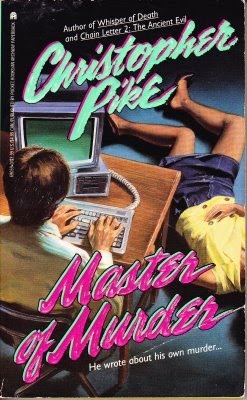
Book Review: Master of Murder by Christopher Pike


This is a weird book from Christopher Pike.

First published in 1992, Master of Murder tells the story of Marvin.  Marvin is 18 and he seems like just your average high school student.  He’s still in love with his ex-girlfriend, Shelly.  He’s haunted by the mysterious death of Harry, who was Marvin’s best friend but who was also dating Shelly at the same time that Marvin was.  Marvin also takes care of his younger sister because, as was typical of YA books like this, their parents aren’t in the picture.  Obviously, if there were parents in these books, the adults would always want to call the police or solve the mysteries themselves.  Pike’s response was usually to either kill them, divorce them, or turn them into drunks.

Anyway, back to Marvin.  In the year since Harry’s death, Marvin has been leading a secret life.  He writes YA novels!  In fact, they’re the most successful YA novels ever!  He’s published five of them, all about a dead girl named Ann.  (Wait a minute …. that’s also his sister’s name!  Ewwww and Agck!)  From what I know about the publishing industry, none of this seems plausible but we’ll just go with it.  I mean, of course, Marvin is a high school senior who secretly writes best sellers and who regularly gets explicit fan mail from his teenage readers.  That makes purrrr-fect sense, as my cat would put it.

Anyway, Shelly asks Marvin to help her figure out who was responsible for death of Harry.  She might even date him again if he helps her out!  Plus, Marvin is getting mysterious letters from someone who writes, “I know who you are!”  Could the two events be connected?  Of course, they are!  And yes, Shelly has a secret of her own.

There’s no supernatural or intergalactic monsters in this Christopher Pike novel.  Instead, it’s a straight-forward murder mystery.  To be honest, when compared to other Pike books, it’s kind of bland.  The most interesting way to read it is as a sort of wish fulfilment for Pike.  One gets the feeling that, at the time that he wrote this book, he wished he was Marvin, a teenager who gets to live like he’s Christopher Pike.  As I said, it’s a weird book, one that makes it look as if the only thing simpler than solving a murder is writing a best seller when you’re 18.  If only it were true, there would be a lot more bestsellers and a lot more prison overcrowding.  Oh well!

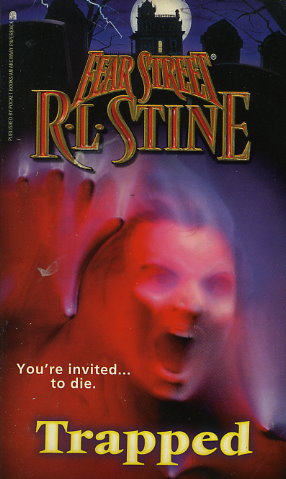
Horror Novel Review: Trapped by R.L. Stine


All good things must come to an end and so must all bad things. The original Fear Street series concluded with Trapped, an enjoyably macabre and kind of grotesque take on The Breakfast Club.

You know how these things go. You’ve got five students and they’re all stuck in detention. Elaine is the smart girl who failed to turn in her homework. (They give you detention for that?) The principal hopes that the other detainees won’t be a bad influence on her. (Then don’t give her detention in the first place, you jerk!) Darlene is the girl who doesn’t take any crap from anyone. Jerry is the Brain, who was sent to detention because he refused to dissect a frog. (I remember an entire episode of Saved By The Bell that dealt with the same issue.) Max is a spray paint artist who uses the school as his canvas. And Bo? Well, Bo’s a good-looking rebel who likes to burn stuff.

Anyway, detention is kind of boring and, since no one wants to have a therapy session like they did n the Degrassi episode that was based on The Breakfast Club, the students decide to explore the tunnels that are underneath Shadyside High. It’s rumored that some kids died down there in the 60s! Stupid hippies! Though some are initially hesitant, all five of the students end up in the tunnels. And that’s where they get trapped!

And, listen, I can understand how this happens. I get lost in mazes too. I once spent hours lost in a hedge maze and it was not fun. (I later got revenge by building a similar hedge maze in the Sims and then setting it on fire. The resulting inferno killed all of my Sims but, fortunately, their ghosts stuck around to haunt the house.) But it’s not just the maze aspect that makes the tunnels difficult to escape. There’s also this red mist that, when it envelopes you, snaps your bones and folds you into a tiny cube and basically kills you in the worst, most painful way possible.

AGCK!

Seriously, that mist is so viscous and the deaths are so drawn out and the book ends on such a downbeat note, I had to remind myself that I was reading a book by R.L. Stine and not Christopher Pike. There’s not much humor to be found in Trapped. Unlike other Fear Street novels, it doesn’t end on a note of hope. Instead, there’s just death, violence, and pain. It makes sense, I guess. This was the final Fear Street book so Stine wasn’t obligated to try to get people to come back for the next one. He could be as morbid as he wanted to be and the end result is actually pretty good. That red mist is actually pretty scary!

I enjoyed Trapped. I’m glad I never explored any of the underground tunnels under my school. Who knows what might have been down there! Hmmm …. now, I’m tempted to find out….

Horror Book Review: Killer’s Kiss by R.L. Stine


R.L. Stine’s 1997 YA novel, Killer’s Kiss, tells the story of Karina and Delia.

Karina and Delia have always been rivals.  If one gets a good grade, the other has to get a better grade.  If there’s a competition for a prestigious prize, you can bet that Karina and Delia will be at the center of it.  You can’t be friends with Karina if you’re going to be friends with Delia, that’s just a given.  And, since this is an R.L. Stine book, Karina and Delia are especially competitive when it comes to boys!

That’s where Vincent comes in.  When the book open, Vincent is making out with Delia and Delia mentions how happy she is that Vincent chose her over Karina.  Well, it turns out that Vincent is either totally wishy washy or just has a bad sense of humor because guess what?  He didn’t chose Delia over Karina.  Instead, he chose both of them!  Vincent is secretly seeing both girls but you know how it is on Fear Street.  You can’t keep a secret for long.

Soon, Delia and Karina are competing for more than the Conklin Award (which is one of those weird high school prizes that always end up leading to murderous drama on Fear Street).  They’re competing for Vincent, who really doesn’t seem like he deserves all the attention but again, it’s an R.L. Stine book.  When Vincent turns up dead, it not only means that prom night is going to have to be replanned.  It also means that either Delia or Karina is the murderer!  Karina accuses Delia!  Delia accuses Karina!  Who is the guilty party!?

As you may have guessed from my strained attempts to fake some enthusiasm while discussing the plot of this novel, Killer’s Kiss is not one of the better Fear Street entires.  Basically, it’s a book about two rivals competing for the chance to date a complete jerk.  It’s hard to get emotionally involved in something like that.  Beyond that, the whole rivalry between Delia and Karina just feels exaggerated and fake.  They’re both kind of annoying.  I wouldn’t want to know either one of them.  Finally, the mystery itself is pretty easy to figure out.  The novel does end with a bit of deus ex machina that simply has to be read to believed but, otherwise, this is lesser Stine.

Horror Novel Review: Witch by Christopher Pike


First published in 1990, Christopher Pike’s extremely weird YA novel Witch tells the story of Julia Florence and her friend Amy.

Basically, Julia is the latest in a long line of witches.  She has the power to see the future and to heal people, with the only problem being that, when she heals them, she takes their illnesses and injuries into her own body.  So, if she heals someone who is on the verge of death, that means that she’ll be the one who dies.  That’s what happened to Julia’s mother and Julia’s determined not to let the same thing happen to her.  It seems like the simple solution would be to just not heal anyone.

But then her friend Scott gets shot during a convenience store robbery.  Scott is in a coma and is going to die unless he gets some supernatural healing.  Julia can either heal him or she can buy a gun (?), use her abilities to see the future, and go all vigilante in an attempt to take out the robber who shot Scott.  Julia goes for the latter but then Amy discovers that the robber has a weird, kind of out-of-nowhere connection to a girl who was previously healed by Julia’s mother.  And, she also discovers that there’s a coven of witches searching for Julia because …. well, who knows?

Anyway, it all comes down to whether or not Julia will risk her life to save Scott.  Scott is an aspiring director and kind of an annoying guy, to be honest.  But everyone is charmed by how annoying he is and he has a great future ahead of him, unless he dies.

Whatever will Julia do!?

This is a weird one.  Between the witchcraft, the healing, the psychic visions, the high school drama, and the vigilante action scenes, one gets the feeling that Pike just threw random darts at a bunch of story points that he had taped to the wall and he pretty much just went wherever the darts led him.  And don’t get me wrong.  It is a little fun to see just how many different genres and plot elements that Pike could stuff into one book but the story itself is still a bit of a mess.  There’s a lot in here and not all of it really comes together.

Plus, this is yet another Pike novel to end on a downbeat note.  R.L. Stine wrote some pretty morbid books but he always ended with a joke.  Pike’s books, on the other hand, always seem to end with the message that there is no such thing as a completely happy ending.  Normally, I’m all for a book that ends on a down note but this time, after all the messiness that came before the ending, I really could have used a Stine-style one liner.  Sometimes, the best way to deal with an existential crisis is to laugh your way through it.

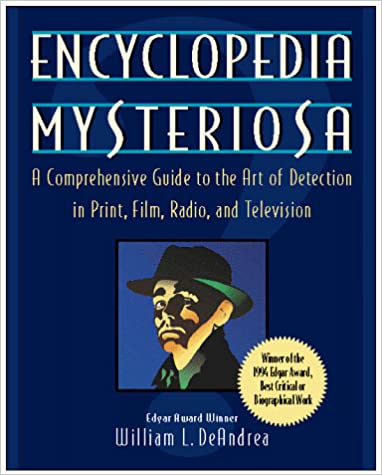
Book Review: Encyclopedia Mysteriosa by William L. DeAndrea


This is a fun book that I came across at Half-Price Books two Decembers ago.  It went right on my Christmas list and, ever since then, it’s a book that I’ve found useful many times.

As you can probably tell, it’s an encyclopedia, one that is devoted to detectives.  You can’t have a good mystery without a good detective and this book proves that, with entries for fictional detectives, their creators, and the TV shows, movies, and books in which they appeared.  It’s all written in a concise and lively manner, which is another way of saying that it’s a fun read.  That’s especially true if you’re a fan of mysteries, as I am.

Now, I should mention that this book was originally published in 1994.  Another edition came out in 1997.  As far as I can tell, that was it.  As such, a lot of the information in the book is a bit of out-of-date.  Authors who have passed or who have retired are still listed as being very much alive and active.  More recent detectives are not mentioned.  (Sorry, Mr. Monk.)  The original Magnum P.I. and Hawaii 5-0 get entries but not the reboots.  There’s no mention of CSI and Thomas Harris’s entry is rather small, with no mention of the post-Silence of the Lamb Lecter films, largely because they hadn’t been made yet.  You get the idea.   But, even with that in mind, this book is still full of useful information, especially if you’re into the older, classic detectives or if you’re a history nerd like I am.  (Trust me, if you have to choose between Wikipedia and reading a book that was actually written during the period in which you’re interested, go with the book every time.)  What it doesn’t contain about recent detectives, it makes up for with information on Poirot, Holmes. Philip Marlowe, Mike Hammer, Sam Spade, and many others.

If nothing else, Encyclopedia Mysteriosa is a good starting point for those looking for a good mystery!  And, if you’re looking for a little inspiration to maybe write a mystery of your own, this book may provie you with exactly the inspiration you need.  There are several copies for sale on Amazon, all reasonably priced.