Book Review: Night of the Ripper by Robert Bloch


As you might guess from the title, Night of the Ripper is set in London in 1888.  A shadowy figure is haunting the foggy alleyways of Whitechapel, savagely murdering prostitutes, terrifying the public, and leaving the police baffled.  In the taunting letters that he writes to the authorities, he says that his name is Jack.

Jack the Ripper, to be exact.

With both high and low society demanding an end to the murders, can the respected and determined Inspector Abberline discover the true identity of Jack the Ripper and bring his reign of terror to an end?  Helping him out will be an American doctor named Mark Robinson.  Robinson is an expert in a developing science called psychology but will that be enough?

*sigh*

This 1984 novel from Robert Bloch is an unfortunate misfire.  I say that as someone who has spent a countless amount of time reading about the murders and all of the identified suspects.  (Back in March, when Jeff and I were in London, we went on one of those Jack the Ripper walking tours.  It was wonderfully creepy!)  A century after his crimes, Jack the Ripper continues to fascinate us because, not only was he the first widely identified serial killer, but it also appears that he got away with it.  The police may have speculated that Jack was a disgraced lawyer who committed suicide after the murder of Mary Kelly but they never actually presented any evidence to back that up.  Over the last 130 years, countless people have been accused of being Jack the Ripper, everyone from an anonymous Russian doctor to Lewis Carroll to the son of Queen Victoria.  Solely based on the fact that she didn’t care much for his paintings, Patricia Cornwell wrote an entire book arguing that the artist Walter Sickert was the murderer.  In all probability, Jack the Ripper was an anonymous nobody but he’s become such a huge figure in the popular imagination that it’s difficult for many to accept that he was probably just a sexually dysfunctional loser who hated women.  Instead, elaborate conspiracy theories are pursued and films like Murder by Decree and From Hell are produced.

Bloch’s novel features plenty of prominent Victorians, though none of them are identified as suspects.  Oscar Wilde, Joseph Merrick, Conan Doyle, and Robert Lees all show up and then quickly disappear from the story.  When Bloch does eventually reveal the identity of Jack the Ripper, he turns out to be a minor character who was first introduced just a few chapters previously.  It’s a bit of a letdown.

Actually, the whole book is a letdown.  It comes across as if it was written in haste and Bloch’s attempt to give the story some gravitas by opening the final few chapters be describing ancient torture methods doesn’t really have the effect that I presume he was going for.  It’s a disappointment because, after all, this is Robert Bloch that we’re talking about.  Bloch not only wrote Psycho but he also wrote Yours Truly, Jack the Ripper, one of the best short stories ever written about Jack.

Read the short story but avoid the novel.  And if you ever get a chance to take a Jack the Ripper walking tour, do it!

Book Review: The Killer Inside Me by Jim Thompson


Lou Ford is 29 years-old, the deputy sheriff of a town in Texas that’s so small that Fort Worth is viewed as being the “big city.”  Lou is friendly.  Lou appears to be popular among the citizenry.  Lou has a sweet and wholesome girlfriend named Amy.  Lou speaks in a cheerful clichés and seems to be content with his reputation for being a dependable but slightly slow-witted good ol’ boy.

Of course, we know the truth about Lou.  We know the truth because Lou tells us.  In Jim Thompson’s 1952 novel, The Killer Inside Me, Lou narrates his story to us.  Underneath his friendly exterior, Lou is an ice-cold sociopath who is proud of the fact that he could literally beat someone to death if he wanted to.  He speaks in clichés only because he’s mocking his listeners and even Amy is ultimately expendable to his plans.  Most disturbing of all, Lou knows that he’s a sociopath.  He even reads a book on the subject.  He knows but he doesn’t care.

Lou has plans, most of which involve blackmailing a local construction magnate.  His partner in his blackmail scheme is the local prostitute, Joyce Lakeland.  Lou’s been having an affair with Joyce and, as far as Lou knows, she’s the only person who is aware of his true nature.  Lou’s solution to that problem is to not only frame Joyce for murder but to also beat her into a coma.  While Lou waits for Joyce to die, he’s busy covering his own tracks and committing additional murders.  Through it all, Lou struggles to keep everyone else in the world from catching a glance of the killer inside of him.

The Killer Inside Me may be over 60 years old but it’s still one of the most intense and disturbing portraits of a sociopath ever written.  Secure that he will be forever protected by his status as a member of law enforcement, Lou Ford feels free to pursue every sadistic whim that pops into his head.  Jim Thompson traps us in Ford’s mind but interestingly, the best parts of the book are the parts that suggest that Ford may not be correctly interpreting what’s happening around him.  Towards the end of the book, it starts to become evident that Ford may not have been as clever as he insists that he is and we’re force to consider that we just spent several chapters taking the word of a sociopath.

You may be tempted to watch the 2010 film version instead of reading the book.  Don’t do it!  The book is a hundred times better and the movie totally screwed up the ending.

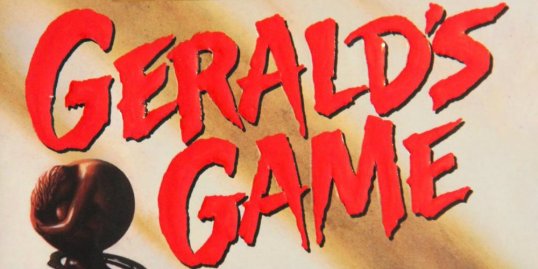
Gerald’s Game- Book Review by Case Wright


ggame4

Hello Horrorthon Readers! It’s a great day to get scared and Retweet and Reblog my work! “Gerald’s Game” is a throwback for Stephen King.  It was published in 1992 and his readers were used to near or over 1000 page tomes.  This book clocks in at a meager 332 and is very pithy and often gross.  At this point in King’s life, he was in the middle of or just finished a relapse into drugs and alcohol.  Gerald’s Game mirrored his life in many ways; he was tormented by his past and incarcerated by his unresolved demons in his present.

The story depicts Jessie, a woman, who has become subservient to her husband.  Over the years of their unequal marriage, she has given up her career and identity at his request to be his quiet lawyer’s wife.  This manifests into Gerald’s last desire of pure possession.  He begins play a sex game with his spouse where she role plays a handcuffed woman and he plays a pirate rapist.  To get the full effect, Gerald uses an off season beach house to use for his game because there will be no one who could come to her aid.

When Gerald begins to perform is rape-game, Jessie decides that she has had enough.  She stands up to Gerald, but he decides to rape his handcuffed wife.  This causes Jessie to snap and kick Gerald right in the balls, giving him a fatal heart attack.  Jessie’s road to hell turns into the autobahn.  A dog comes by and eats her husband’s dead body, causing her psyche to kick into high gear hallucinations.  In order to save herself, she must deal with her past and how all of her decision led her to her current situation.

This book also deals with two horrific acts that recur often in King’s work – Incest and Rape.  The rape/incest scene in this book is purely vomit inducing.  We are forced to live through Jessie’s horrible present and past.  Her psyche appears often as a college friend and her younger self as a puritan who is being pilloried for sexual enticement.  The sexual enticement charge being her self-blame for her father raping her.  The book makes you live through each and every moment of her losing her sense of self and volition.

As in his other books, King likes the idea of a primitive sacrifice to conquer a monster or a demon.  We see that in It, The Stand, Misery, and his many other stories.  In this story, her psyche let’s her know how free herself after she deals with the ghosts of her past.  The solution: she must …… I’m not spoiling it that much.  You know me better than that by now.

I would recommend this book, but the creepy factor is extremely high.   I would recommend this book in audio or paper format.  It is perfect for a plane ride or if your weekend plans fall through.

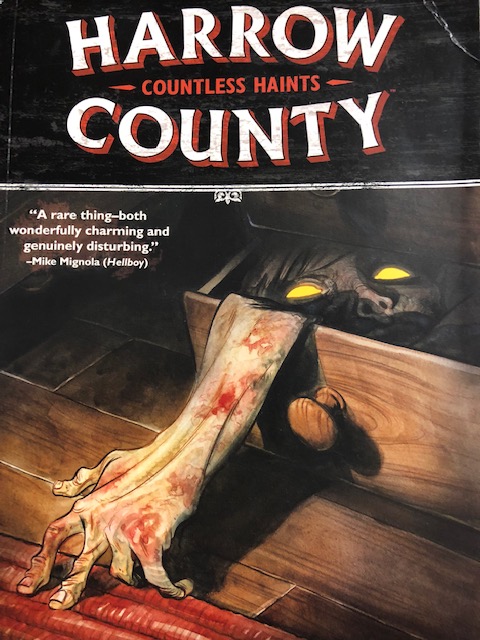
Harrow County – Countless Haints, Review by Case Wright


HC

Happy Horrorthon!!! We are in the thick of it folks.  October is happening! We’re all eating things with pumpkin flavor, baseball’s in full swing (pun intended), and we all get into trying something scary.

There are few things that truly scare me as much as clowns do, but I’d rather sit on Bozo’s lap than live one solitary moment in Harrow County.  Harrow County is a comic series by Cullen Bunn and Tyler Crook published by Dark Horse.  Saying this comic is scary is like writing that Charles Lindbergh dabbled in flying planes.  After the first few pages, I was thoroughly creeped out and turned on all the lights in my home.

The story revolves around Emmy, a nearly adult woman, who is discovering that she is not an ordinary farmer’s daughter, but terrifyingly powerful witch.   Years earlier, Emma’s “mother” Hester was an evil witch with the powers of Satan.  The townsfolk weren’t too fond of all of her child sacrifices and dark arts so they decide to shoot, stab, hang, and burn Emma’s “mother”.

*Slight Spoiler*—- Emma learns that she is the born again version of Hester and not an actual daughter.  Emma was born from murder and vengeance and Harrow County is about to reap the whirlwind.

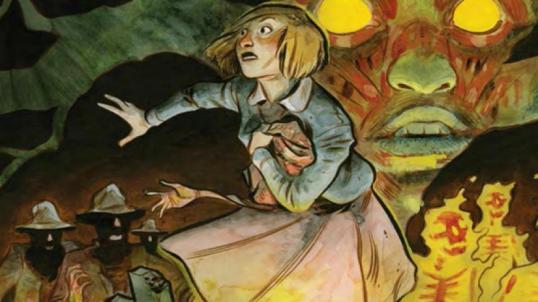
The art of this story is so off-putting and chill-inducing.  Their eyes pull you in as if you are one of the townsfolk being judged and co-opted by good or evil.  The story has a wide streak of ambiguity; it never allows you to fully see the true good or evil of any the characters after the first five pages.  In essence, the characters are real.  They are you neighbor, your brother, your sister: imperfect and conflicted.  This duality is exemplified by Emma’s only a friend a ghost or “Haint” who is actually bifurcated.  One half of the friend acts as Emma’s bodyguard: pure rage that is only muscle akin to the Human Body figures from biology class and the other half of her friend is a kind and scared bag of skin who acts as a guide for Emma.  The bifurcated friend is a great visual example of our rage that hides just under the surface of all people.

This story is scary as Hell.  Go Buy It!

hc skin friend

Book Review: The Zero Factor by William Oscar Johnson


Consider this.

William Henry Harrison was elected President in 1840.  A few months later, he became the first President to die in office, the result of giving a rambling inauguration speech in the rain.

Abraham Lincoln was elected in 1860.  He was assassinated by an actor in 1865.

James A. Garfield was elected in 1880.  He was shot and subsequently died of medical malpractice in 1881.

William McKinley was reelected in 1900.  He was assassinated by a leftist in 1901.

Warren Harding was elected in 1920 and was murdered by his wife in 1923.

Franklin D. Roosevelt was reelected in 1940.  He died of natural causes in 1945.

John F. Kennedy was elected in 1960.  He was assassinated by a lone gunman in 1963.

The second President to die in office, Zachary Taylor, was elected in 1848 but died in 1850!  (In his case, he was either poisoned or died of natural causes.  It depends on which book you read.)

That is the Zero Curse.  For a period of 120 years, any president was elected in a zero year died before the end of his term.  Some people thought it was a coincidence.  Some people thought it was a supernatural occurrence.  Whatever it was, it was a strange piece of American history.

In fact, it even inspired a novel!  The Zero Factor was published in 1980, presumably to capitalize on that year’s presidential election.  The Zero Factor tells the story of Augustus “Gus” York, a Republican governor who is nominated for President after the convention deadlocks.  Gus is honest, homespun, and naive.  To everyone’s shock, Gus narrowly wins the election.

Gus is an ethical President whose moderate political stances manage to alienate every powerful person in the world.  Not surprisingly, a group of evil rich people hire an assassin to take out President York.  Will Gus be able to survive the zero factor!?

So, this may seem like a strange book to review for October and I’ll be the first to admit that I nearly scheduled this review for November.  However, the book does feature three rather odd scenes where Gus is haunted by the ghosts of the zero year presidents.  Those scenes are actually a lot of fun.  I especially liked the description of Franklin Roosevelt’s ghost rolling around the Presidential bedroom while his eyes glow a ghostly yellow.  Best of all, Gus gets advice from the ghost of my favorite scandalous president, Warren G. Harding!  Thanks to President Harding and the gang, The Zero Factor can be classified as a book for October.

As for the rest of the book, it’s a well-written political thriller.  At times, the book’s politics can be rather heavy-handed (why write about a Republican President if you’re just going to make him act like a Democrat?) and the portrayal of the gay assassin is dated and a bit cringe-inducing.  But Gus is a likable character and I appreciate any book that takes the time to rehabilitate Warren Harding.

As for the Zero Curse, it was broken by the President who actually was elected in 1980, Ronald Reagan.  George W. Bush continued to break it in 2000.  (That said, both Bush and Reagan were targeted by potential assassins during their presidencies.)  The next zero year election will be 2020, an election that looks like it’s going to involve a record number of elderly candidates.

Book Review: 666 by Jay Anson


Published in 1981, 666 is a book that will make you wonder, “How do people not know what 666 means?”

It’s the story of Keith and Jennifer, an attractive young couple who move into a new home and immediately become fascinated by the empty house across the way.  The empty house’s address is 666 Sunset Brooke Lane and no one finds that strange.

Keith decides to explore the house and discovers not only a coin that was minted by the Roman Empire but also a stained glass window that appears to feature someone who looks exactly like him.  Keith does find that strange but it still doesn’t occur to him that there might be a clue to be found in the address.

Jennifer friend, David, decided to rent out 666 Sunset Brooke Lane and immediately starts to have visions of not only Christians being tortured during the reign of Nero but also of a naked Jennifer standing on the house’s front porch.  And yet, David never associates this with the house’s address.

Keith’s brother is a priest (!) who is investigating a local Satanic cult and yet somehow, it never occurs to him to be concerned about 666 Sunset Brooke Lane.

Anyway, it all ends in (tame) sex, violence, and tragedy, as these things often do.  The main lesson that I took away from this book was that you should be concerned if a notorious murder house suddenly appears in your backyard.  It’s a lesson that I won’t forget.

666 was written by Jay Anson, who had previously written a “non-fiction” book called The Amityville Horror666 is a story about four incredibly dumb people, all of whom inspired me to shout, “Why don’t you just leave the damn house!?” more than a few times.  That said, it’s also enjoyably pulpy and the main characters are all so thinly drawn and unlikable that you really don’t mind when they start dying.  Though you’ll be shaking your head at many of the book’s implausibilities, the final chapters are crudely effective and, when it’s time to describe the torture techniques of ancient Rome, Anson goes all out.

Plus, the book has a really cool inside cover!

“All The Boys Love Mandy Lane” AKA All the Bland Love Blandy Lane, Review By Case Wright


ATHBLML6

IT’S OCTOBER!!!! WOOHOO!!!! The Most Wonderful Time of The Year!!!!

All The Boys Love Mandy Lane….for some reason.  Let’s begin by admitting Amber Heard is pretty, but …. love at first sight obsession?! Word?! Word?!  This film was written by Jacob Forman who went on to …. not much.  Jacob Forman does have a few recent credits as a special thanks over the last few years, which means he let someone sleep on his couch or something who was making a movie.  I wonder if the film deserved to make enough money to afford the futon that he used to get those special thanks.  But it’s on Netflix; so, if you’re on an elliptical and have already caught up on your YouTube subscriptions…. I guess this would be a choice that you could make … on purpose.

Jonathan Levine (director 50/50) directed this mess and he’s a very talented director for … Dramatic Comedy and Drama… Horror…not so much.  It was one of his first films (2006) and didn’t get a US release until 2013 … for good reason.  He’s very good at filming true to life couch conversations, which was certainly evident in 50/50, but in a Horror/Thriller the camera work/direction has to act as another character to pull us into suspense and punch us with payoffs.  This piece uses a lot of shaky cam in a 1980s style with artsy cuts that never allow us to feel worried about anyone on-screen.  The direction is like someone constantly spilling water on your charcoal as your trying to get the barbecue going.

The exploitation premise is simple enough: A bunch of boys try to corrupt a naive virginal archetype – Mandy Lane (Amber Heard).  Mandy is kind of bland and has a friend Emmet who everyone picks on and gets even by somehow convincing a guy to jump off his roof into a pool and he dies.  It’s weird.

After the pool incident, Emmet is a pariah. Mandy, on the other hand, is apparently the paragon of the feminine ideal because every man within 100 miles will give up his eternal soul for a tryst with her.  She agrees to go to a ranch in the middle of nowhere with a bunch of dudes and girls who are equally boring.  They arrive at the ranch and there’s a ranch hand on the property who is supposedly a Gulf War veteran even though he’s 27 and not in his later 40s.  Sigh.  Mandy Lane and all the other girls are obviously smitten with the ranch hand and why not….the ranch hand defies time and math itself!!!  As the song goes, every girl crazy for a …. man who defies the space-time-continuum! [Sung as ZZ Top]  The ranch hand is bored with the teens and returns to his home sweet shed.

Later, the teens start doing a ton of drugs and booze and Emmet or someone (dun dun dun) arrives and starts murdering everyone.  They are pretty gruesome deaths and it does border on torture porn at one point, which makes sense because it was written around 2004/2005 when Hostel was all the rage.  Even though people aren’t returning, all of the guys continue to try to make out with Mandy in the creepiest ways possible.  Mandy Lane has 20 lines of very bland dialogue total in the film and there is a slight twist at the end that fails to thrill.

What bugged me about this film is that horror is always treated as the Red-Headed Stepchild of film.  Everybody seems to think the genre is easy to write and do and this film is proof that both of those assumptions are false.  First, you need to at least have some sympathy for the people getting killed.  Second, you need to explain in someway at the halfway why they don’t just leave.  In this film, it’s not clear why the dudes want Mandy to stay at the halfway point of the film when it’s clear that she’s not interested in any of them.  Third, the camera work and direction to pull you into the house and into the story to ratchet up tension; otherwise, it’s just boring.

I’m glad that Jonathan Levine found his voice soon after this. Amber Heard did a fair enough performance for what she had to work with.  There was good performance by Melissa Price, but from IMDB, it appears that this film probably tanked her career.  In any case, I’m crazy excited that October is here!!!


Book Review: Carrie by Stephen King


First published in 1974, Carrie is often cited as being Stephen King’s first novel.

That, of course, isn’t technically true.  King had written three novels before Carrie, the majority of which weren’t very good.  Carrie is a novel that King says he wrote in a hurry because he was living in a trailer and needed the money.  It’s also a novel that King says he had absolutely no faith in because he didn’t feel like he could write from a female perspective.  Despite King’s then-low opinion of what he had written, Carrie went on to become his first published novel.  Thought the novel wasn’t an immediate success (the hardback edition only sold 13,000 copies), it subsequently became a best seller after it was adapted into Brian DePalma’s 1976 film of the same name.

By now, we all know the story, don’t we?  Even if you’ve never read the book or seen any of the film versions, there’s been so many different rip-offs and unofficial remakes of Carrie that I doubt that there’s anyone who doesn’t know the story.  Everyone knows that Carrie White was a high school outcast and that her mother was a religious fanatic.  We all know what happened the night that Tommy Ross took Carrie White to prom.  We all know about the cruel prank that was played on Carrie, about the pig’s blood that was dumped on her right after Tommy and Carrie were crowned king and queen of the prom.  And we all know that Carrie’s response was to use her own telekinetic powers to burn down the entire town and to kill the majority of her tormentors.

44 years after it was first published, it’s still interesting to read Carrie.  On the one hand, you can definitely see the beginnings of King’s signature style, especially towards the end of the book when Sue Snell comes across a dying Carrie.  On the other hand, this book is definitely different from any other King novel.  For one thing, it’s only 199 pages long.  Living in a trailer and struggling to make ends meet may not have been easy for King but I would say it actually made him a better writer.  Carrie contains none of the rambling, self-indulgent filler that’s come to typify much of King’s recent work.  One imagines that, if King wrote Carrie today, we’d have to wade through at least 500 pages of people talking about the history of psychic phenomena before the book even got around to Sue asking Tommy to take Carrie to prom.  Instead, because King was writing while hungry, there’s a hunger to the book.  It doesn’t waste any time.

King structured the novel so that half of it was narrative and half of it was, for lack of a better term, evidence.  We get excerpts from police reports, newspaper articles, and books written after the prom disaster.  The White Committee offers up their official report.  We get to read a little bit of Sue Snell’s book, I Am Sue Snell.  I imagine the structure was largely the result of King’s self-confessed insecurity with the book’s subject matter.  (For instance, whenever you doubt that Tommy Ross would actually take Carrie to prom, an except from the final report of the White Committee pops up and assures you that he did.)  Though borne of insecurity, the structure actually works pretty well.  It leaves little doubt that, after Carrie’s prom, the world will never be the same again.

The thing that really struck me while rereading this novel was that Stephen King himself seemed to dislike Carrie White almost as much as her classmates did.  King focuses, to an almost uncomfortable degree, on Carrie’s unattractive appearance and, often times, he seems to be keeping his own distance from his main character, as if he was weary about trying to get inside of her head.  When Carrie does go on her rampage, she comes across more as an out-of-control monster than someone who has been pushed too far.  Our popular conception of Carrie being a tragic victim really has more to do with how Sissy Spacek played her in the original film than in how King wrote about her in his novel.

Instead, the book is far more concerned with Sue Snell and Tommy Ross, who are both portrayed as being everyone’s idealized high school companion.  As both a novel and a film, Carrie‘s greatest weakness has always been that the plot hinges on the idea that any teenager, no matter how guilt-ridden, would actually ask their romantic companion to take someone else to prom.  The pig’s blood, I believe.  The prom, less so.

Carrie has its flaws but, to be honest, I actually think it’s better than some of King’s more recent books.  If nothing else, it’s a chance to look into Stephen King’s mind before he became the Stephen King.

Jack Ryan (Season 1) Review by Case Wright


jack-ryan-1035300-1280x0

There are two types of streaming television series: Get a sitter and watch in rapt silence with your SO and friends and Elliptical and/or Hangover Television.  Jack Ryan is in the latter category.  It’s a solid: NOT BAD.   Ok, it was a little weird seeing Jack Ryan (John Krasinski) put Osama Bin Laden’s AK-47 in a Jello Mold, but I thought it was a nice call back.  JK!

Jack Ryan has been a staple for nerds who like action for decades.  Jack Ryan is a data analyst badass who defeats terrorism and rogue commies, in other words, fictional.  He’s been in countless books, films, and video games.  The only other character that gets this much media has to use The Force.  In this iteration, Carlton Cuse of “Lost” fame takes a crack the characters.

Jack Ryan is a young Marine Vet turned CIA officer with PTSD.  He is teamed up with Greer who in the books and previous iterations was a tough talking Admiral with shitty dialogue; whereas, in this version, Greer’s a down and out muslim CIA officer whose career is in decline after killing a Pakistani asset.  They are on the hunt for the big bad: Sulieman.

Sulieman is the product of the American intervention in the Lebanese civil war in 1986, which…checks out.  He is hell bent on causing all kinds of mayhem in America and abroad.  They make a big show about how he was treated badly throughout his life-  Boo hoo.  I guess it was supposed to make him more human. I thought it made him really really whiny.  So what, you didn’t get your dream job that gives you the right to blow everybody up?!

The big question most of my readers have: Did John Krasinski – Jim- have a passable performance as a super spy?????  KINDA. He was pretty close at times, but was he held back by some purposely slowed down plot points.  I will get to the derpy derp moments later, but really the season should’ve been 6 episodes instead of 8 because there were too many contrivances, which inhibited John’s performance.  I have to write that he was in fact believable.   I did not know what to expect, but he delivered a good performance.

What they got right:

Sleepless nights with PTSD and drinking too much.  They portrayed that spot on.  I thought, I’ve had those late nights.  Ok, Pass!

The SEAL/Ranger team: I’ve known many Special Operators over the years and they are all real salt of the Earth types.  They played those matter of fact tough guys perfectly. Ok, Pass!

The inherent turpitude of civilian government officials: Very good, they’re all presumptive Dirtbaggus Americanus.  Ok, Pass!

The director building suspense? Yep, the direction was done quite well.  No complaints.

What was so very dumb?  NO F#@#!NG Way!!! NFW!!!! NFW!!!

1.  They portrayed Jack Ryan as dealing PTSD, giving him pause to shoot his weapon.  I get that, BUT he’s still a Marine.  There’s a scene where he makes the decision to shoot and misses by a mile just so they could have fight scene later.  This is just dumb.  Marines are ALL crackshots.  If you are in a Marine’s line of fire and he’s got a clear shot, you’re dust.  When you see it, you’ll roll your eyes.

2.  There’s a terrorist strike by Sulieman and he claims responsibility.  They show his face being plastered on all television networks. He’s on tv more than Anderson Cooper. Then, with no face disguise, he’s NEVER recognized.  We’re not talking just one time, but FIVE times at least.  His face would’ve been burned in everyone’s memory.  It was just dumb,  lazy, and contrived to keep the villain the in the action.

3.  A CIA Officer meets Sulieman’s wife and he just lets her walk away the same day as a major terror attack: NFW! Anyone who said that they knew an Osama equivalent would be sequestered and interrogated immediately, but it was obvious that they needed to pad the plot to squeeze three unnecessary episodes for story arc.

4.  There’s a duo who are drone pilots that are just sort of shoehorned into the story for no reason at all.  I couldn’t even figure out the message if drones were supposed to be good or bad.  I left thinking… Man, drones work really well.  Then, one of the drone pilots gets all guilty about a mistargeting incident and flies to Syria because ya know Active Duty Soldiers just get to go anywhere they like on leave…. NFW!!!!!!! Just think about it…we shouldn’t just get to go wherever we like.  It’s dangerous for us and could lead to a Soldier getting compromised.  NFW!

5.  There’s a plot point where a doctor becomes aware of a biological threat and just sends an email.  WHAAAA?!  She would be calling everyone and their brother to report that because she’s supposed to be smart.

Is it worth watching?

Yes, yes it is.  It’s got real problems in terms of story holes, but my hope is that Carlton Cuse learns from this.  He can DM me if he likes.  I’ll consult or script doctor for a very reasonable rate.  Jack Ryan is great for watching on the Elliptical at the gym or if you’re hungover or something.  It is NOT at this time get a babysitter and everyone be quiet television, but it is …. fun.


Book Review: THE LAST STAND by Mickey Spillane (Hard Case Crime 2018)


gary loggins's avatarcracked rear viewer

2018 is the centennial anniversary of Mickey Spillane’s birth! Spillane got his start in comic books, then caused a sensation with his 1947 novel I, THE JURY, introducing the world to that hardest of hardboiled PI’s, Mike Hammer. Hard Case Crime, an imprint every pulp fiction fan should know about, celebrates Spillane’s birth by releasing THE LAST STAND, The Mick’s last completed novel, with a bonus unpublished novella from the early 1950’s.

Spillane with friend/literary executor Max Allan Collins

Mickey’s literary executor and friend Max Allan Collins writes the introduction. Collins is no stranger to the hardboiled genre himself, having been Chester Gould’s replacement on the long-running comic strip Dick Tracy from 1977-92, author of the graphic novel ROAD TO PERDITION, and the Quarry series of books (made into a Showtime series in 2016). Since Spillane’s death in 2006, Collins has been editing and completing the writer’s (“I’m not an…

View original post 553 more words