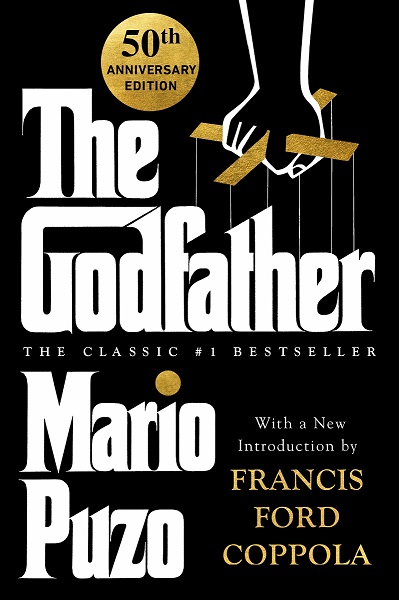
Book Review: The Godfather by Mario Puzo


“The book,” it is often said, “is always better than the film.” But is that always true?

No, it’s not and, if you need proof, just read Mario Puzo’s The Godfather and then re-watch the movie. Or re-watch the movie and then read the book. Either way, you’ll be left with the conclusion that, while the novel did lay the foundation for what became the greatest movie ever made, the novel itself is still a bit …. off.

The Godfather was originally published in 1969 and, before I write anything else, it should be noted that Mario Puzo himself never claimed that the book was meant to be a great work of literature. Puzo had previously written three novels and one children’s book. One of those novels was a pulp paperback that he wrote under a pseudonym for a quick payday. The other two novels were both meant to be works of “serious literature” that examined the human condition. Puzo considered his second novel, The Fortunate Pilgrim, to be his best and most poetic work. The only problem is that, while the reviewers were respectful, hardly anyone read Puzo’s “serious” fiction. As such, The Godfather was Puzo’s attempt to write the most commercial book possible, a page-turner that would climb the best seller list and help Puzo pay off his gambling debts. The Godfather certainly did that, spending 67 weeks on the New York Times’s Best Seller List and selling over 9 million copies in two years. Producer Robert Evans was so sure that the novel would be a hit that he even paid for the film rights while the book was still in the galleys.

Reading the book, especially after watching the movie, can be an odd experience.  The film itself is largely faithful to the book. Just about everything that happens in the movie can be found in the book.  Michael, Sonny, Tom, Fredo, Vito, Kay, Barzini, Sollozzo …. they’re all here.  Usually, characters are more complex in the original book than they are in the subsequent film adaptation.  In this case, the opposite is true and reading Puzo’s somewhat leaden prose really does make you appreciate the depth and nuance that actors like Al Pacino, Marlon Brando, James Caan, Robert Duvall, and John Cazale brought to the characters.  (Perhaps the most extreme example is Kay Adams, who was written as a dull nonentity with none of the nervous likability than Diane Keaton brought to the role.)  To be honest, perhaps the only character who comes across more vividly in the book than in the film is Luca Brasi.  The book goes into the details of what Brasi did for the Don in the past and, as a result, it’s much easier to understand why everyone was so terrified of him.

But, as I said, all of the events that can be found in the movie can also be found in the book.  However, there’s also a lot of things in the book that we’re left out of the film and it’s easy to see why.  In the film, for instance, Johnny Fontane shows up in only two scenes.  Tom Hagen goes to Hollywood.  Jack Woltz ends up with a horse’s head in his bed.  And that’s it for the film industry.  (In the book, the horse’s head is just placed in Woltz’s room as opposed to his bed.  Francis Ford Coppola later admitted that he misread the passage where Woltz finds the head.)  In the book, however, the Hollywood scenes go on forever.  Large sections of the narrative are handed over to Johnny Fontane and his best friend as they party in Hollywood.  It gets frustrating.  You want to read about the Corleones but instead, you’re reading predictable Frank Sinatra fanfic.

When the book’s not getting bogged down on Fontane, it’s getting caught up with Lucy Mancini and her quest to find a man who is as well-endowed as the late Sonny Corleone.  Lucy was Sonny’s lover.  He was the only man who was large enough to satisfy her.  After Sonny’s death, Lucy is given a casino in Las Vegas.  It’s while in Vegas that Lucy meets Dr. Jules Segal, an abortionist who explains to Lucy that she can’t achieve sexual satisfaction because her vagina is too big.  Fortunately, he can help.  Or, as he puts it, “Baby, I’m going to build you a whole new thing down there, and then I’ll try it out personally.” Awwwwwww!

Anyway, for whatever reason, Francis Ford Coppola decided not to include any of this when he made his film version.  And it’s for the best.  When it comes to The Godfather as a book …. well, the movie’s great.  And the sequel’s even better!  The book really makes you appreciate what Coppola and his amazing cast and crew were able to accomplish.

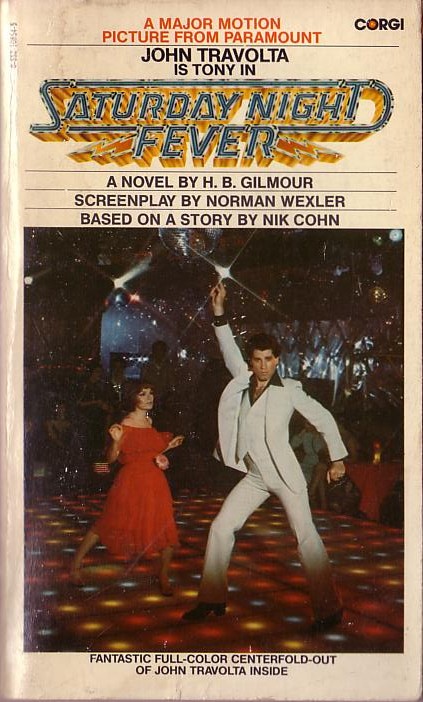
Book Review: Saturday Night Fever by H.B. Gilmour


About two years ago, I came across a paperback sitting on the shelf of a Goodwill in Dallas. It was the novelization of the 1978 film, Saturday Night Fever. Naturally, as soon as I saw it, I knew that I had to buy it.

Novelizations of popular films are always an interesting read. Since they’re usually based on the early drafts of a film’s screenplay, the novelization will often include extra scenes or details that may have not been apparent in the film itself. Often, things that may have been left unclear in the completed film will be cleared up in the novelization. At the same time, as a writer, I always find it interesting to see whether or not the author of a novelization can succeed at putting their own spin on familiar material.

Take the Saturday Night Fever novelization. There are two things that everyone automatically thinks about whenever they think about Saturday Night Fever as a film. They think about the Bee Gees soundtrack and they think about the scenes of John Travolta dancing. Obviously, with the novelization, there is no soundtrack. The Bee Gees aren’t even mentioned in the book. As for Travolta’s dancing, the book doesn’t go into a great deal of detail beyond acknowledging that Tony Manero is a good dancer and that everyone wants to join him out on the dance floor. But Gilmour wisely doesn’t try to describe any of Tony’s dance moves. Instead, he focuses on how Tony feels when he’s the center of attention.

Indeed, the entire novelization focuses on Tony as a character. We spend a lot of time inside of Tony’s head and it’s not always a pleasant place to explore. At the same time, we also discover that Tony isn’t quite as clueless as he sometimes comes across as being in the movie. From the start, he knows that he’s going nowhere and he knows that his friends are losers. Without Travolta’s charismatic performance or Staying Alive playing as he struts across New York, Tony often comes across as being an even bigger jerk in the novel than he does in the movie. And yet, we still sympathize with him because the novel makes clear that Tony understands, more than his family and his friends, that he’s trapped in a life that doesn’t provide much hope. Saturday Night Fever is a dark film, even with the music. In novel form, it becomes downright existential in its portrait of Brooklyn as being a Hellish prison, both a location and state-of-mind from which there is little chance of escape.

Tony’s family is a bit more abusive in the novel, which makes the film’s famous “watch the hair” dinner scene a bit more difficult to laugh at. The novelization spends a lot of time on Tony’s brother and his decision to leave the priesthood. In the movie, Frank, Jr. just kind of vanishes. In the book, it’s explained that he went to a sort of halfway house for former priests. I assume this was all stuff that was in the screenplay but cut from the actual film. One can see why it was cut but, at the same time, it was still interesting to learn a bit more about Tony and his family.

In the end, it’s not a bad novelization. At 182 pages, it’s a quick read and it not only does a good job of showing what exactly Tony is escaping from when he gets out on the dance floor but it also provides some new insight into the story. (Of course, the majority of that insight deals with Tony being a misogynistic homophobe but, then again, that’s pretty much who he was in the film too. The book just makes it even clearer, as well as showing that Tony’s prejudices are largely due to where he’s from and how he’s been raised.) It’s a good companion piece to the film and a good collector’s item. The copy that I found still had a pull-out poster of John Travolta in the middle of it!

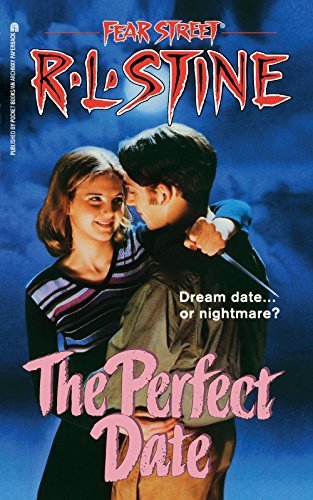
Book Review: The Perfect Date by R.L. Stine


In this YA novel from 1996, Brady Karlin is one of the most popular boys at school.  Everyone knows him.  Everyone likes him.  He’s got a likable best friend named Jon.  He’s got a beautiful and popular girlfriend named Allie.  The only problem that Brady has is that he’s still haunted by the death of his former girlfriend, Sharon Noles.

And really, he should be haunted considering that it was all his fault!  Sharon told him that she wasn’t ready to go sledding down that hill lat summer.  Brady, however, insisted and Sharon went hurtling down the hill and eventually ended up dead and without a face.  Honestly, I don’t care how good-looking or charming you are.  If your last girlfriend lost her face because of your stupidity, you’re simply not going to be attractive to me.  Sorry.

Anyway, it’s winter again and Brady is already thinking about ending things with Allie.  There’s only so many basketball games and pizza parties that he can go to.  However, instead of just breaking up with Allie, Brady instead starts to secretly a date a new girl named Rosha Nelson.  Brady soon finds himself growing obsessed with the mysterious Rosha, who refuses to tell him anything about her past and who seems to really have a talent for getting Brady involved in dangerous, potentially life-threatening situations.

Meanwhile, there’s a mysterious “scarred girl” following Brady and Rosha around.  Soon, people are mysteriously dying and the entire books leads to a climatic fight in which bodies are literally dismembered!

So, I liked The Perfect Date.  It was as grotesque and morbid as a Christopher Pike book without any of the pretentious philosophizing that occasionally turns up in Pike’s work.  While Rosha’s secret is pretty easy to figure out, Stine deserves a lot of credit for following the story to it’s natural conclusion.  The book ends with a scene so weird that I had to read it twice.  Really, what more can you ask for?

All in all, this book made me happy that I live in Texas.  No snow equals no tragic sled accidents.  This book made me appreciate our 60-degree winters.

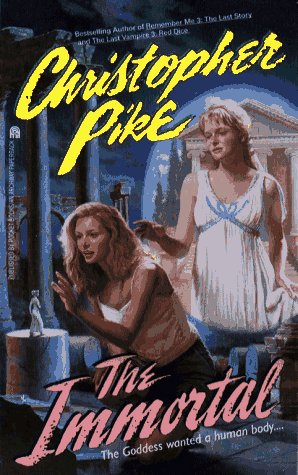
Book Review: The Immortal by Christopher Pike


This 1993 novel tells the story of two friends on a Greek vacation.

Now, when I say “friends,” what I mean is that we’re told that they’re friends and they spend a lot of time hanging out with each other and the entire book is pretty much about the developments in their relationship.  However, for two lifelong friends, they really don’t seem to like each other that much.  I mean, when I was in high school, I had friends who I secretly disliked but I never went to Greece with them.

Our friends are named Helen and Josie.  Josie has a rich father, who is a screenwriter and who is accompanying the girls to Greece.  Helen has a less rich father because this is a Christopher Pike book and someone always has to come from a poor but honest family.  Both Helen and Josie are recovering from near-death experiences.  Helen attempted to commit suicide.  Josie had a heart problem of some sort.  You would think that, having come close to dying, Helen and Josie would be all about celebrating life but actually, they’re still fighting over Ralph.  Ralph used to date Helen and then he dated Josie and then he left town.

One thing that I quickly discovered while reading this book is that it’s not always easy to remember what happened to Helen and what happened to Josie.  Even while I was reading it, I kept mixing up who had which tragic backstory.  I probably should have kept better notes but, honestly, when you’re reading a 200-page YA novel from the early 90s, your first thought is not going to be, “I better go grab my notebook because these 200 pages might be too complicated for me to keep track of.”

Anyway, Josie hooks up with Tom, who is British and sensitive and who refuses to have sex on a nude beach without a condom.  Helen kind of hooks up with Pascal, who doesn’t speak English.  Josie steals an ancient artifact.  Helen serves Josie a hamburger that’s full of ground-up glass. There’s a big storm that overturns a boat and …. wait a minute, what?  Ground up glass in a hamburger!?  AGCK!

Anyway, it’s all because Helen and Josie were apparently possessed by two angry Greek goddesses during their last visit to Greece.  Apparently, these angry Greek spirits have been trying to kill each other for centuries or something like that.  I couldn’t really follow it and, to be honest, I think Christopher Pike just made it up as he was going along.

That said, I kind of enjoyed the book, just because of how silly it all was.  I mean, Helen and Josie seriously are the worst friends ever.  The book may not make sense but between all of the strange dreams, the deadly hamburgers, and all the passive aggressive insults, it was never boring.  If nothing else, it made me think about the vacation that I took the summer after I graduated from high school.  My sisters and I traveled all over Europe and we saw all sorts of ancient ruins and we managed to do it without stealing any artifacts or trying to kill each other.  I’m proud of what we accomplished!

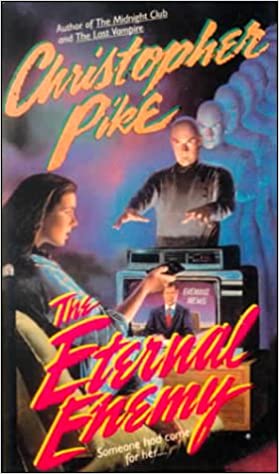
Book Review: The Eternal Enemy by Christopher Pike


The 1993 YA novel, The Eternal Enemy, starts out with a typical Christopher Pike situation.

Rela is a teenager.  Rela is adopted.  Rela doesn’t know much about her past.  Rela has a crush on my boy whom she’s too shy to ask out but luckily she has a confident best friend who is willing to do it for her.  She also has another male admirer, who she just considers to be a friend.  It’s all standard Pike.

However, the twist of this particularly novel is that Rela has a VCR and apparently, the VCR can tell the future!  Whenever she tries to record an old horror movie, she instead ends up with a recording of a future news broadcast.  At first, Rela uses this to her advantage.  She makes money betting on a football game.  She heads to Vegas to make even more money and then she goes to San Francisco and saves the lives of a bunch of window washers!  Other than offering up a crisp picture, allowing viewers to easily skip around in a movie, and not eventually becoming an obsolete artifact of a past age, there’s absolutely nothing that this VCR can’t do.

However, even while Rela is having fun making money and saving lives, she’s also having disturbing dreams which seem to indicate that there are strange things hidden in her past.  (Well, of course.  It’s a Christopher Pike book.)  A mysterious and creepy older man appears to be stalking her.  Maybe she should stop messing with the VCR….

Then she sees a news report about her own death.

The Eternal Enemy is one of Pike’s more uneven books.  It starts out nicely, with the promise of YA horror, but then it turns into this sort of Looper/Terminator sci-fi thing.  As the story reveals more about the actual identities of Rela and the creepy old man, it gets bogged down trying to explain how everything works and, if you’re not already into science fiction, it becomes a bit of chore to read.  It’s hard not to get annoyed that the book starts with an interesting premise and then kind of waves it all way by using the “It’s science!” excuse.

Probably the most interesting thing about The Eternal Enemy is that the entire narrative revolves around the mystical and complex powers of a VCR.  If only Rela had been born a decade later, she wouldn’t have had to deal with any of this.

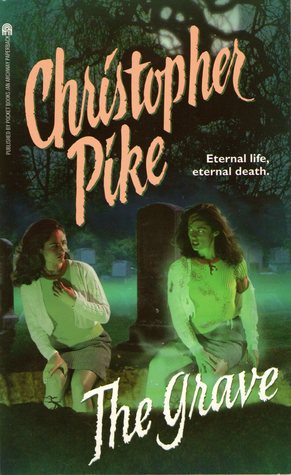
Horror Book Review: The Grave by Christopher Pike


First published in 1999, this is a weird book.

It opens with a college student named Ted Lovett thinking that he’s going to meet a woman in the woods, just to instead get captured by a cult who strip him naked and then bury him alive.  We then jump over to the story of Kerri, who is a typical 90s YA heroine — she’s got a job at a record store, her sister is dead, her father abandoned the family, her mom is hooked on cocaine, and her boyfriend is clingy loser.  It’s the boyfriend part that bothers Kerri the most.  She’s totally bored with him but just can’t bring herself to sit down with him and tell him that it’s over.

Then, one day, the mysterious and handsome Oscar shows up in the record store and soon, Kerri is spend the night over at his place and kind of cheating on her boyfriend.  I say “kind of” because Kerri doesn’t really consider him to be a boyfriend, despite the fact that they’re dating and they’ve slept together a few times.  With her mother still abusing drugs and Oscar acting all mysterious, Kerri has a lot to deal with but all of that drama is nothing compared to what happens when Oscar tosses Kerri into a freezer.

So, is Oscar a part of the cult that buried poor Ted Lovett?  Or is he the ghost of Ted Lovett and this all a part of grand plan to turn Kerri into a half-dead, half-living zombie who is pregnant with the modern day equivalent of Pan, a hooved God who will maybe save the world but maybe not?

Yes, The Grave is an odd book.  There’s a lot going on in The Grave.  In fact, there’s probably a little bit too much going on.  The Grave is only a 194 pages long, which means that Kerri is often surprisingly quick to accept the strangest explanations for what’s going on.  If you learned that you had been selected to give birth to a satyr that’s going to save the world but, in order to do so, you have to basically die first, you’d probably demand a bit more of an explanation than Kerri does.  I know that I would.

Speaking of Kerri, how much drama can one person have in their life?  Abandoned by her father, haunted by her sister’s death, and forced to deal with her mom’s cocaine addiction, just one of those would have been enough but tossing all three in there just feels like overkill.  And that’s eve before she becomes pregnant with Pan.

With The Grave, you get the feeling that Christopher Pike just tossed a bunch of random stuff at the wall to see what would stick.  It’s a mess but occasionally, it’s entertaining in its messiness.  If nothing else, it has an important lesson to impart about not putting yourself in a situation where you can be buried alive.  That’s an important lesson to learn.


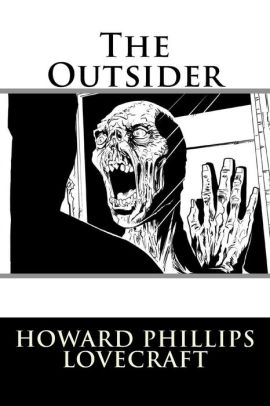
The Outsider, Review By Case Wright


hp4.jpg

Isn’t it just awkward when you’re trying to make friends and people run away because unbeknownst to you, you are an inter-dimensional-hell-beast?  It’s right up there with telling people that you’ve had the best barbecue ever and you’ve only ever been to Smokey Bones or having Nickelback as your ringtone or quoting “The Notebook”.  It’s just …GAH!

In “The Outsider”, Lovecraft tells the story from the monster’s POV.  Shelley did it for the first time in Frankenstein, but it is rarely done; we don’t want to put ourselves into the Devil’s shoes.  Even today, the Devil’s POV is scorned – see Joker reviews.  The creature in “The Outside” actually seems kinda nice, but lonely.  The monster-beast crawls and claws its way out of a crypt and goes up people in a church and wonders what must be chasing him because everyone is running for their lives.  This goes on for A WHILE! People flee and he has no idea what’s going on.

Finally, he sees the monster, he goes to touch the horrible creature, and his outstretched finger touches a mirror.  I enjoyed the twist.  If done right, the Devil is always appealing.  Breaking Bad made Bryan Cranston a total badass and he did terrible things, but we rooted for him.  Like Walter White who only felt akin to his blue meth at the end, this creature is scorned so he flees into the night doing whatever Hell-Beasts do; my guess it has something to do with making robocalls or working for Ticketmaster.

This Halloween season I’ve been strung out on short-stories for days because I’m amazed at the ability to convey a story in limited space like a Haiku.

See you, tomorrow.

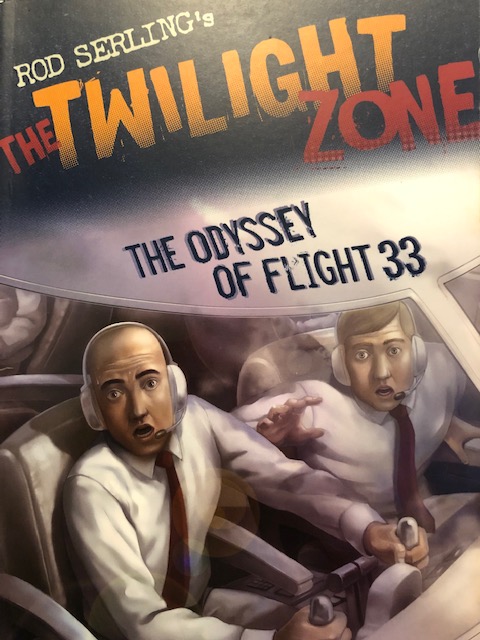
The Odyssey of Flight 33, Comic Review, by Case Wright


tw3

Yes, they have comic versions of The Twilight Zone! I really enjoyed this and I know that some of you are like….hmmm is this horror? Yes… Yes, it is. No further questions!  Besides, we have a Twilight Episode to discuss.  The Twilight Zone always leaned more into horror IMO.  The Outer Limits was all about teaching you a moral lesson, but TTZ was all about the scare factor.

I enjoyed this format too.  Face it, a lot of the TTZ episodes don’t hold up amazingly well.  It’s the truth….Deal With It!  The book has all the components of a good TTZ episode: the setup of perceived normality that takes a terrible left turn.  There aren’t many things more normal or boring than air travel.  The flight is just a typical run to La Guardia and the passengers appear very normal as well: the chatty passenger, the braggy passenger, and the emotionally unstable passenger.

These archetypal passengers pull us into the story much like the Stephen King stories do. Stephen’s characters are your neighbors and these passengers are too.  But, something isn’t right is the friendly skies! They feel hit a pocket of air and their speed goes into the thousands of miles per hour and whammo – they start time traveling! They arrive in 1939 and don’t stop because they want to get back to their own time- So no killing Hitler for these time travelers.  Then, they arrive in the Cretaceous and decide not to land because Jurassic Park is so five minutes ago, but then they arrive in the future.

This one troubled me a bit.  They are low on fuel and the future has cable and they can’t screw up time.  Really, they could just try to make a go of it in their new time.  No one seemed like things were that amazing for them in the present.  I mean, why not just land? You’d at least make a living on the talk show circuit. The comic ends with ambiguity.  They are low on fuel and lost in time.

I would recommend checking these issues out.  They’re a lot of fun and have a good creep factor.


Horns, Book Review, By Case Wright


horns

Horns.  What if you woke up and realized? Gee Whiz, I’m a demon! Well, that’s exactly how it was for Ig Perrish in Horns.  One day he was the pariah of his town because everyone believed he murdered his girlfriend and the next day he’s got budding horns with magical demon powers!

Ig is loathed by everyone for being a rapist and murderer.  There was only one problem: he didn’t do it.  The lab that would’ve exonerated him with DNA evidence caught fire, leaving him as the likely suspect, but no physical evidence to convict or exculpate.  His town and greater world hates him forever.

The horns start growing out of his head and give him powers to cause people to indulge and confess their darkest desires.  When he uses the horns, people can see the horns, when he’s done, they’re no longer visible. He goes through the town getting people indulge and confess.  He slowly realizes that xxxxxxxx was the killer.  Ha! No spoilers! The killer figures out that Ig has discovered his identity so they begin a cat and mouse game that goes all the way to the climax.

The book elicits a visceral response because it deals with the key concepts of human existence: Betrayal, love, revenge, and envy.  There are quite a few of the other deadly sins on display in the book as well.  The only knock that I give the book is that it really obvious very early on who the real killer is.  Nope, still not spoiling!

Is it worth reading? Yes. There is also a very fine audiobook with a voice actor  who does a very good job.  I highly recommend that as well.  You can check out the trailer review for Horns by Arleigh here!

The Mangler, Story Review by Case Wright


mangler.jpg

Sometimes you just can’t win! You need to make a few bucks and you take a job at a cleaners, but the laundry press is possessed by a demon and starts killing everyone and the Christmas party is BYOB. This is the premise of The Mangler.  This laundry press gets exposed to a bunch of different bloods – animal and virgin human, which summons a demon to possess the laundry press. The laundry machine goes a killing spree, but my collars have never looked crisper!  I always liked this story because it’s so awesomely bad. It’s really corny and silly, but unintentionally so.  It would be great as a Rifftrax.

As I was reading, I couldn’t help thinking, Self, it really is EASY to summon demons in Maine.  It makes you wonder why anyone visits or lives there?  Sure, the fall foliage is nice, but you’re always knee deep in clowns, werewolves, vampires, large rats, ghosts, creepy college students, aliens, more ghosts, the devil (kinda), cultists, creepy rednecks, slime beasts, and pederasts.  I’ve been to A LOT of Maine and I will attest that the above villains are truly a nuisance and they are all close talkers!

The Mangler is a fun read because it turns into a quick-paced detective story.  The cops Hunton and Jackson become ghost busters and try to get the demon out of the machine. I know it’s a short story, but they really embrace the whole – it’s a demon laundry machine really fast.  There’s no time where people are like, What? This is stupid! Really stupid!  It starts getting really goofy when the machine chases its victims down a gnaws them to death.

At the end, I know it’s not supposed to be a comedy, but it chases the cops around and eats one of them.  It’s just kinda silly.  Of course, this story is really needed as unintentional comic relief because some of the other stories are just so depressing in Night Shift like “The Last Rung on the Ladder” ….ughhh- best cure for a happy thought.  Really, if you think you’re a bad sibling, read “The Last Rung on the Ladder” and you’ll feel waaaaay better about yourself.

The Mangler is not his best story- it’s actually really dumb, but it reads like a fun bad movie.  It’s the Sharknado 1 of Stephen King if not ALL literature. In short, it IS entertaining. You have a big iron up to no good and two incompetent policemen trying to save the day.  It needs a SYFY run desperately! Happy Horrorthon!