Star Trek: The Next Generation, Through The Mirror, Review by Case Wright


mu11.jpg

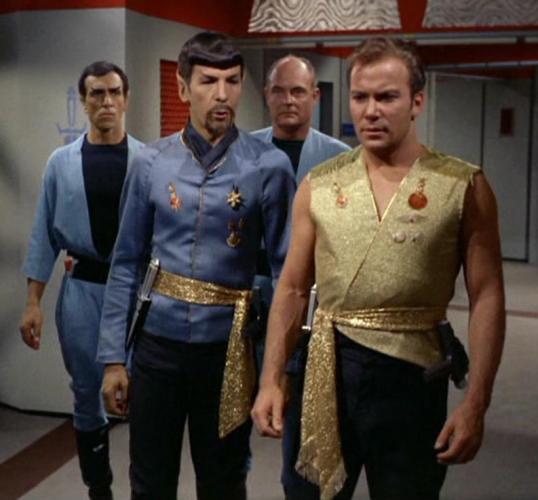
Happy Horrorthon!!! We are back in the eeeeeeeeevil Star Trek universe! Why is it evil? Obviously, it’s because they have beards and follow strict capitalist principles with a healthy dose of militarism.

Before I get into the story, I want to write that David and Scott Tipton do a good job of not having the mirror universe characters seeing themselves as villains.  This may seem obvious, but it’s actually very common – especially in comics.  For example, Stan Lee once had Magneto lead a group of mutants with the moniker of Brotherhood of Evil Mutants.  I get that the X-Men thought they were evil, but why would Magneto?

This volume: Through the Mirror brings our Mirror Universe to the Next Generation universe our youth for supplies and plunder.  Bearded Picard is faced with blockades from rival species in his universe and needs materiel and plunder to fuel his war machine in order to bring the Terran Empire back to its former glory before Emperor Spock made them go all drum-circle kumbaya…bleh.

My main complaint with the Volume Two is actually in the first installment.  It opens with Worf investigating the theft of precious minerals from a mining colony in the “good universe”.  He sees the thief and nearly catches him.  This is a recurring issue with volume 2; the story should be only from the perspective of the mirror universe characters.  There is simply too much of the “good universe”.  They also have the “Good Universe” find an Andorian Ship that has been attacked by Evil Picard after the fact.  WHY?  Show us the Evil Planning, Show us the Pirate Picard attack, Show us why they believe they are justified.  We bought the book; therefore, we are invested in these anti-heroes.   The story could be great if we just get to bathe in their villany.  Don’t judge them.  This is their code.  This is their society.  They don’t see themselves as evil and neither should we.  We can only judge them as evil if they violate their own code of morality not ours.  This isn’t our universe.  The good universe should be treated like MSG a little is … ok… too much and you vomit.

Back to the story, Pirate Picard lures the good enterprise into a trap, hoping to seize it.  They fail, but they failed too much.  It should’ve been more of a draw with a push to the evil universe. Scott and David – the evil guys are your heroes.  They need to win at least a bit.  You can have a close game, but don’t have them get their ass kicked because it makes it too much of a Good Next Gen story.  The other knock is that they left Evil Barclay behind, dragging us back unnecessarily into the good universe.  You are thwarting them waaaaay too much.

It’s time for Evil Picard to kick some ass, but it in a good way.  Is it just for wealth for Pirate Picard?  I don’t think so.  In this universe, the Terrans see themselves as Superior like the British or Roman Empire.  Therefore, when the Klingons and Cardassians took back a lot of the Empire they likely took many Human captives as slaves.  This must be disgustingly unacceptable to Pirate Picard or any Terran Empire member.  Have them liberate a planet, rescuing Human captives.  From their perspective, they are not only NOT EVIL, but good because they are reasserting rightful human dominance to their universe.   If you have to, make some propaganda posters with Pirate Picard.  Make it personal for Pirate Picard.  Maybe Picard’s brother joined the fleet and was captured?  Make it personal! Go for it!  Have Pirate Picard risk it all: mutiny, the ship, the Terran Empire to liberate and rescue his brother and nephew Robert.  It would be epic!!!!! You have an unending depth that you can give Pirate Picard.  Give him his version of humanity.

This volume was ok, but they are not fulfilling some great story potential here.   This could be a great way to reboot the series.  Just remember: They Don’t Consider Themselves Evil.


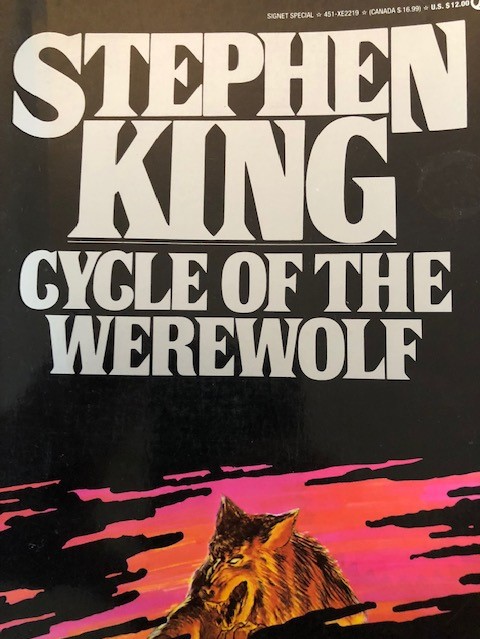
Cycle of the Werewolf, Book Review by Case Wright


cw1.jpg

Happy Horrorthon!!!! We are already in week 2 and we are makin’ it work!!!  Cycle of the Werewolf is very 1980s Stephen King.  It clocks in at 100+ pages and moves briskly.  In comparison, The Stand was 1000 pages and one chapter was actually from a Golden Retriever’s point of view….really.  If you ever watched old movies on Showtime, you’ll remember this story as “Silver bullet” starring Corey Haim.  The movie was actually fairly close to the book, except no Gary Busey.

The book takes place over the twelve months of the calendar year and I almost did this post as Twelve Days of Christmas song, but with werewolves….it could’ve worked!  The first six months follow the werewolf killing on every full moon in Maine.  As usual in Stephen King’s books the people of Maine are total dirt bags of all varietals: blowhard dirt bags, wife-beating dirt bags, racist dirt bags, and drunken dirt bags.  In short, the townsfolk could all use some killing.

The month of July comes and the story shifts to Marty, a handicapped child, who really loves the 4th of July.  As in the movie, Marty gets a bunch of fireworks from his Uncle and uses them to make the werewolf purblind.  We learn the werewolf is the town Baptist preacher.  As the months progress, Marty starts sending the preacher poison pen letters urging him to kill himself and signs his name to provoke a final confrontation.  The confrontation is a bit anticlimactic because Stephen never really fleshed out the story and the final battle is no different.  There is no close game or near run thing…nope…werewolf comes into the house, leaps at Marty, and Marty kills the werewolf dead. Boom.  That’s it.  It is fun to read these old Stephen King stories; he’s clearly still flexing his creative muscles and not totally sure of himself.

Have a spooky night.

Book Review: The Children by Charles Robertson


Wow, look at all of those creepy kids on the cover of this book!

They really do look like an insufferable pack of brats, don’t they?  If nothing else, this cover confirms that children can be creepy, especially when they all go to the same private school and they all have the same grim expression on their face.

First published in 1982, The Children opens with a series of mysterious deaths.  The richest man in the world dies on an airplane.  His lawyer is killed on another airplane.  A network anchorman and his one night stand are gunned down in his apartment, by an 11 year-old.  A private investigator is pushed off of a subway platform while a bunch of children watch.  There’s something weird about those kids.

The covers describes The Children as being “a novel of terror” but, unfortunately, after a strong opening, it gets bogged down with two characters — glamorous anchorwoman Shelley James and hard-boiled columnist Mark Chandler — investigating the murders and rather inevitably falling in love.  I think a part of the problem is that we know that the children are evil before Shelley and Chandler and it takes the two of them so long to figure out what we already know that it’s difficult not to get annoyed with them.  In fact, after the initial murders, it’s another 200 pages or so before the book actually returns to the involvement of the children and, even then, the payoff is nowhere as exciting as you may have hoped.

Like 666 and The Rapture, The Children is another book that I ended up reading because I came across it in Grady Hendrix’s Paperbacks from Hell.  While I can’t really recommend The Children to anyone else, I will definitely recommend that, if you haven’t already read Paperback from Hell, that you order a copy today!

Book Review: The Dead Man’s Kiss by Robert Weinberg


Way back at the end of August, in anticipation of the TSL’s Horrorthon, I went down to my local Half-Price Books and I explored their collection of old horror paperbacks.  Among the books that I pulled off the shelf was The Dead Man’s Kiss by Robert Weinberg.

I randomly opened the book and I found myself reading about a woman named Sarah having sex with a resurrected Egypitan sorcerer.  I flipped to another part of the book and suddenly, I was reading about a bunch of Neo-Nazis working with a resurrected Egyptian sorcerer to overthrow the U.S. government.  I flipped through the book again and suddenly, I was reading about two wisecracking cops discussing how weird it was that they had gone from chasing Neo-Nazis to chasing a resurrected Egyptian sorcerer.

In short, it sounded like a weird book so I bought it and I read it.

And you know what?  It is a strange book.  Published in 1992, it tells the story of Jambres, a priest in ancient Egypt who was punished for a crime that he didn’t commit.  Somehow, this led to his soul being split in half and, now that he’s convinced a bunch of Neo-Nazis to resurrect him, he’s determined to bring the two halves together and then rule the world.  Unfortunately, the only way that Jambres can walk around the modern world is by entering someone’s body through their mouth.  This may kill the host but it gives Jambres a body and a set of memories to use.  The only problem is that the body starts decaying as soon as Jambres enters it, so he and the white supremacists are constantly having to search for a new body for him to inhabit.

While Jambres and the Nazis are wondering around Chicago, they’re being pursued by two unflappable cops.  Also on the case is a former MOSSAD agent, who has been assigned to protect the mild-mannered museum worker that Jambres has targeted for death.  It all leads to love, of course.  Love and death.

The plot of Dead Man’s Kiss has a make-it-up-as-you-go-along feel to it.  It’s ludicrous but likable, complete with bizarre dialogue and improbable plot twists.  The book may not make too much sense but it does make for an entertaining 250 pages.

Star Trek: The Next Generation, Mirror Broken- Review By Case Wright


eu1

Happy Horrorthon!!! This review is going to be a deep dive into eeeeeeevil nerdism.  I understand that not everyone reads this site is a techie nerd, BUUUUUUT I think we have a healthy plurality. Nothing is better than to merge an evil universe with my love of Star Trek.

I’m going to give brief recap of the Star Trek Mirror Universe.  There’s a parallel universe in Star Trek that basically capitalist/imperialist.  In that timeline, humans are aggressive and conquered the Vulcans.  You can tell they are evil because they are avaricious and have beards- Think if Seattle/Portland went less drum circle and went more Roman.  It’s common to kill your superior to advance in the chain of command, it’s totally capitalist, and more fun in some ways because it’s a lot less model UN and much more Model Viking.

The evil universe never appeared in the Next Generation, but it did appear in Star Trek: The Original Series and then the second tier properties of Enterprise, Deep Space Nine and Voyager.  In those second tier properties, they set up a timeline that when the “Good Kirk” encouraged Spock to be reformist, it worked.  Too bad for Earth because the Empire got attacked by the other Alien Races we conquered and now Humans are pushed back to their solar system and will likely to be conquered.

Where there’s life, there’s hope.  In this comic, the writers Steven and David Tipton imagine if Jean Luc Picard was an uncompromising badass who is determined to bring the Terran Empire back to its former glory. How does he do this besides being really JACKED? Picard sets out to steal the Galaxy Class Enterprise.  This creates a great heist story, but it’s also super fun because it explores all of the old characters from the Next Generation and I mean ALL! There are character that were all but extras in Next Generation that are featured in the background of the book.  There are so many interesting takes on our old heroes.  Barclay is cunning, Data is experimenting with Borg-technology, and Geordie has his paramour from Next Gen, but she’s an alcoholic.  It’s so fun to go down this rabbit hole.

Back to the story, Picard assembles our familiar crew and seizes the Galaxy Class Enterprise for his own.  He could just take off and be rich, but he doesn’t.  Through some cool maneuvers, Picard decimates the Klingons and Cardassians …..nooooooo not the ones with large posteriors …. the ones with the krinkly heads.  Anyway, they go on war rampage and look like they might actually get to restore the Terran Empire!

TERRANS UNITE!

TEee

EV3

Book Review: Frankenstein: The First Two Hundred Years by Christopher Frayling


If you’re a fan of horror and more specifically the several different versions — both literary and cinematic — of Frankenstein’s Monster, Frankenstein: The First Two Hundred Years is a book that you simply must own.

It’s really two books in one.  The first half of the book deals with the original creation of Frankenstein.  It goes into a detail about not only the famous night and game that led to Mary Shelley writing Frankenstein but it also details everything that not only influenced Shelley’s imagination but which led to the world becoming fascinated by her creation.  How you react to this section of the book will largely depend on how interested you are in history.  Me, I’m an unapologetic history nerd so I loved it.

The second part of the book is a visual history of the Monster through the years, featuring everything from his many film appearances to his use in advertisements and political cartoons to his appearances in various comic books.  It’s not just a collection of pictures, though.  It’s also a testament to the power of Mary Shelley’s creation and how the Monster has come to be a universal figure, one who has been adopted by every culture and ideology.

Christopher Frayling is a witty and engaging writer, which helps to get through some of the denser sections of the first half of the book.  His love for the Monster comes through every page, which makes Frankenstein: The First Two Hundred Years a perfect celebration of the world’s most famous reanimated body.

Book Review: Rapture by Thomas Tessier


Like 666, Rapture is a novel that I read after coming across the cover in Grady Hendrix’s Paperbacks From Hell….

“Ah!” you’re saying, “so this is all Grady Hendrix’s fault!”

Well, kind of but not really.  Unlike 666, Rapture was actually a well-written and legitimately frightening book.  I mean, I probably wouldn’t have ever heard of this book if it wasn’t in Paperbacks from Hell but it’s not like anyone owes me an apology for inspiring me to read it or anything.

Anyway, Rapture deals with a guy named Jeff.  Jeff grew up in Connecticut but then he left for California, where he made a fortune in computers and suffered through one bad marriage.  Now, he’s nearly 40 and he can’t escape the feeling that maybe something is missing from his life.

When Jeff’s father dies, Jeff returns to Connecticut and accidentally on purpose runs into Georgianne.  Jeff grew up with Georgianne.  They were best friends in high school but they were never more than friends.  Now, years later, Jeff thinks that was a missed opportunity.  In fact, he soon convinces himself that he and Georgianne were meant to be together.  The only problem is that Georgianne is happily married and has a teenage daughter, Bonnie.  In fact, as Jeff observers, Bonnie looks almost exactly the same way that her mother did at that age….

It looks like Jeff is going to have to murder a few people if he wants to find true love.  Jeff turns out to be surprisingly skilled when it comes to killing people.  Either that or the police are just totally incompetent.  (Rapture was written in 1987, which might explain some of Jeff’s success.  If it was written today, DNA, texting, and social media would have rendered the entire story implausible.)  But is Jeff really as clever as he thinks he is?

While I was reading Rapture, I kept thinking that it would make a good Lifetime miniseries.  (I then checked the imdb and I discovered that Rapture apparently was turned into a made-for-TV movie in 1991.)  It’s a shamelessly sordid little tale, one that is all the more disturbing because Thomas Tessier tells almost the entire story from Jeff’s twisted point of view.  Though Tessier wisely resists the temptation to use a first person narrator, he still puts you in the head of a madman.  It’s more than a little icky.  At the same time, it’s undeniably effective and creepy.

In fact, I would say that it’s time for Lifetime to remake Rapture.  Pair it up with the latest episode of YOU.  It’ll be great, I promise!

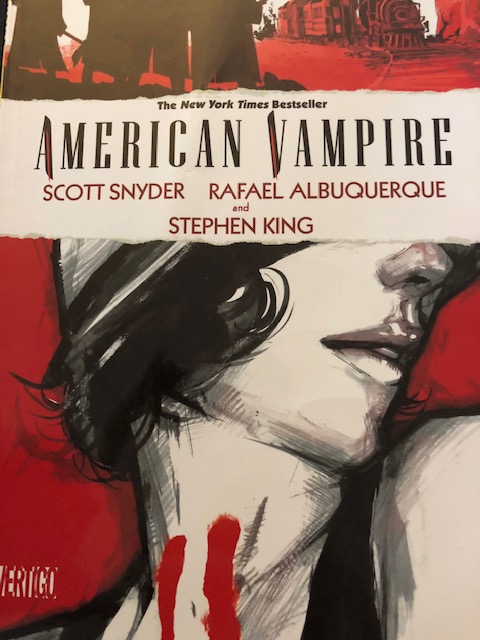
American Vampire – Review by Case Wright


av1

I got my computer back!!!! Happy October Horrorthon!!!

In every sport or endeavor, we can think of our stars: the paragons.  Stephen King is an unquestioned master of horror.  In comics, Scott Snyder looks down from that pyramid as well.  I’ve had the pleasure of meeting Scott Snyder a few times and you would never guess that he was the greatest comic book author in a generation.

I went up to Scott at the Emerald City Comic Con to have him sign my trade paperback.  He was surprised because my trade was not rare at all, but I wanted him to know that I loved his art so much that I wanted it signed, regardless of worth.  Because of that, he took out time to talk to me even though there was a line of autograph hounds.  Stephen King, on the other hand, I have no idea what’s he’s like in real life.  I have a hunch that he’s like most people I have known from Maine: DIY, tough, and fair.

American Vampire was a Supergroup: both King and Snyder wrote this book with the beautiful art of Rafael Albuquerque.  They took the genre of the Vampire and, much like the theme in the story, they made it evolve.  The result was a trio of interconnected revenge stories with wonderfully flawed heroes and anti-heroes.  The artists forced you to root even for Skinner Sweet – a man who thinks he’s not only above the law, but beyond it.  Skinner Sweet typifies the American Id: dangerous, violent, and oddly fair within his code.

The book opens with two struggling starlets in the 1920s Hollywood: Pearl and Hattie.  Pearl is all-in with the art; whereas, Hattie is more of the hack opportunist.  They are staying in a cheap apartment complex where a mysterious stranger hangs around.  Pearl is invited to Hollywood party where it turns out she is the main course for a host of hungry vampires.  Near death, the mysterious stranger finds her dying and he makes her like him: An American Vampire.  A vampire, unlike the relics of europe, he can walk in daylight and has few if any weaknesses.   When Pearl rises to her new undead life, she goes on a rampage of revenge to destroy those who stole her humanity.  Yes, I just got chills too!

The story flashes back to the old west where a lawman, Book, has captured Skinner Sweet, but not for long.  He busted out in an awesome train attack by his gang.  This is where we learn about the haughty European vampires and how they are arrogant, weak, and in our way.  Sweet tells Book that he sent poison to his wife, engendering Book’s revenge story against Sweet.  During the train attack, Sweet is turned into a Vampire and when he eventually rises Sweet and Book are sent on a collision course of revenge against the other.

There’s more revenge in this book than a Sicilian novel.  It must be burned into my Italian DNA to love these revenge stories, but there’s more to it that my accident of birth.  Revenge stories tap into the universal of what makes us human.  We’ve all been wronged and we have all wondered what it would be like to mete out own justice and live by our own law.  Skinner Sweet is not as much evil as he is part of civilization; he’s the American ID of our rugged individualism.  Pearl’s character is part of society, but must seek out her own revenge because as a vampire, she is unable to use society to bring her justice.  As the story unfolds, it’s clear that Pearl and Skinner Sweet are the most honest in their quest for revenge because at times Block uses his badge to hide behind his vendetta.  In all three stories, the vendettas are so satisfying and pure.  This book is rage distilled to its purest form.

Book Review: Night of the Ripper by Robert Bloch


As you might guess from the title, Night of the Ripper is set in London in 1888.  A shadowy figure is haunting the foggy alleyways of Whitechapel, savagely murdering prostitutes, terrifying the public, and leaving the police baffled.  In the taunting letters that he writes to the authorities, he says that his name is Jack.

Jack the Ripper, to be exact.

With both high and low society demanding an end to the murders, can the respected and determined Inspector Abberline discover the true identity of Jack the Ripper and bring his reign of terror to an end?  Helping him out will be an American doctor named Mark Robinson.  Robinson is an expert in a developing science called psychology but will that be enough?

*sigh*

This 1984 novel from Robert Bloch is an unfortunate misfire.  I say that as someone who has spent a countless amount of time reading about the murders and all of the identified suspects.  (Back in March, when Jeff and I were in London, we went on one of those Jack the Ripper walking tours.  It was wonderfully creepy!)  A century after his crimes, Jack the Ripper continues to fascinate us because, not only was he the first widely identified serial killer, but it also appears that he got away with it.  The police may have speculated that Jack was a disgraced lawyer who committed suicide after the murder of Mary Kelly but they never actually presented any evidence to back that up.  Over the last 130 years, countless people have been accused of being Jack the Ripper, everyone from an anonymous Russian doctor to Lewis Carroll to the son of Queen Victoria.  Solely based on the fact that she didn’t care much for his paintings, Patricia Cornwell wrote an entire book arguing that the artist Walter Sickert was the murderer.  In all probability, Jack the Ripper was an anonymous nobody but he’s become such a huge figure in the popular imagination that it’s difficult for many to accept that he was probably just a sexually dysfunctional loser who hated women.  Instead, elaborate conspiracy theories are pursued and films like Murder by Decree and From Hell are produced.

Bloch’s novel features plenty of prominent Victorians, though none of them are identified as suspects.  Oscar Wilde, Joseph Merrick, Conan Doyle, and Robert Lees all show up and then quickly disappear from the story.  When Bloch does eventually reveal the identity of Jack the Ripper, he turns out to be a minor character who was first introduced just a few chapters previously.  It’s a bit of a letdown.

Actually, the whole book is a letdown.  It comes across as if it was written in haste and Bloch’s attempt to give the story some gravitas by opening the final few chapters be describing ancient torture methods doesn’t really have the effect that I presume he was going for.  It’s a disappointment because, after all, this is Robert Bloch that we’re talking about.  Bloch not only wrote Psycho but he also wrote Yours Truly, Jack the Ripper, one of the best short stories ever written about Jack.

Read the short story but avoid the novel.  And if you ever get a chance to take a Jack the Ripper walking tour, do it!

Book Review: The Killer Inside Me by Jim Thompson


Lou Ford is 29 years-old, the deputy sheriff of a town in Texas that’s so small that Fort Worth is viewed as being the “big city.”  Lou is friendly.  Lou appears to be popular among the citizenry.  Lou has a sweet and wholesome girlfriend named Amy.  Lou speaks in a cheerful clichés and seems to be content with his reputation for being a dependable but slightly slow-witted good ol’ boy.

Of course, we know the truth about Lou.  We know the truth because Lou tells us.  In Jim Thompson’s 1952 novel, The Killer Inside Me, Lou narrates his story to us.  Underneath his friendly exterior, Lou is an ice-cold sociopath who is proud of the fact that he could literally beat someone to death if he wanted to.  He speaks in clichés only because he’s mocking his listeners and even Amy is ultimately expendable to his plans.  Most disturbing of all, Lou knows that he’s a sociopath.  He even reads a book on the subject.  He knows but he doesn’t care.

Lou has plans, most of which involve blackmailing a local construction magnate.  His partner in his blackmail scheme is the local prostitute, Joyce Lakeland.  Lou’s been having an affair with Joyce and, as far as Lou knows, she’s the only person who is aware of his true nature.  Lou’s solution to that problem is to not only frame Joyce for murder but to also beat her into a coma.  While Lou waits for Joyce to die, he’s busy covering his own tracks and committing additional murders.  Through it all, Lou struggles to keep everyone else in the world from catching a glance of the killer inside of him.

The Killer Inside Me may be over 60 years old but it’s still one of the most intense and disturbing portraits of a sociopath ever written.  Secure that he will be forever protected by his status as a member of law enforcement, Lou Ford feels free to pursue every sadistic whim that pops into his head.  Jim Thompson traps us in Ford’s mind but interestingly, the best parts of the book are the parts that suggest that Ford may not be correctly interpreting what’s happening around him.  Towards the end of the book, it starts to become evident that Ford may not have been as clever as he insists that he is and we’re force to consider that we just spent several chapters taking the word of a sociopath.

You may be tempted to watch the 2010 film version instead of reading the book.  Don’t do it!  The book is a hundred times better and the movie totally screwed up the ending.