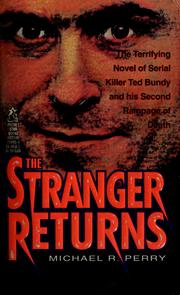
Horror Book Review: The Stranger Return by Michael R. Perry


On January 24th, 1989, Ted Bundy — then America’s most notorious serial killer — was executed by the state of Florida.  Before he died, he confessed to all of his crimes and then gave an interview where he blamed it all on an addiction to pornography.  It was all a part of a scheme to avoid the electric chair but it didn’t work and he was put to death while thousands stood outside the prison and cheered.

Or was he?

The 1992 novel, The Stranger Returns, suggests that Bundy — who was once as notorious for his ability to escape custody as for his murderous rampage — escaped one last time.  A duplicate was sent to the electric chair while Bundy made his escape.  I know that probably made no sense when you read it in this review.  It really doesn’t make much sense in the book either.  But I guess things had to start somewhere.

Now believed to be dead, Bundy is free to change his identity, romance a young mother, and once again resume his murderous ways.  Only one man suspects that Bundy may have cheated the executioner, the father of one of his victims.  While he tries to get someone to listen to his theory about Bundy being alive, Bundy continues to move across the landscape like a dark shadow of death.

Earlier this year, it seemed like the entire nation briefly went Bundy crazy.  There was a documentary on Netflix.  Zac Efron starred in a movie.  It seem like almost every true crime show around did at least one episode on Bundy this year.  30 years after his execution, Ted Bundy was trending on twitter, a macabre testament to the power of celebrity.

I found myself thinking about Bundy’s morbid fame as I read The Stranger Returns.  The book was well-written and it was a quick read but it was still a bit troublesome that the book was essentially a novel starring Ted Bundy.  Too often, the book treated him like some sort of Hannibal Lecter-type character whereas Bundy was actually, by most accounts, an impotent drunk who was never as handsome, charming, or intelligent as he is frequently made out to be.  What is this power that a loser like Bundy holds over the popular imagination?

The Stranger Returns is a testament to that power.  I mean, how many other real-life serial killers have starred in a novel?  That’s usually an honor reserved for vampire hunters like Abraham Lincoln.  To be honest, I probably would have liked this book better if it had been about someone who thought he was Ted Bundy as opposed to being Ted Bundy himself.  In fact, I probably would have enjoyed the book if it had featured Bundy’s ghost or if Bundy had used some other supernatural check to come back to life.  But making Bundy into some sort of criminal genius was just a bit too icky for me.

Incidentally, I found this book in my aunt’s paperback collection.  According to her, she found the book being sold in the “true crime” section of Half-Price Books.  Fortunately, it’s not true crime.  Ted Bundy is dead and good riddance.
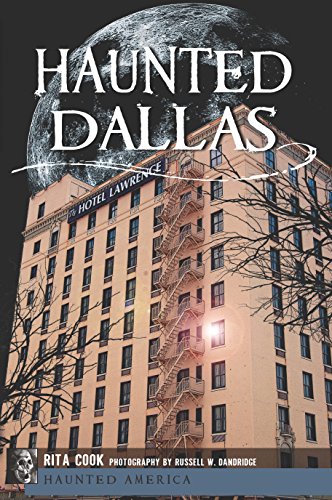
Book Reviews: Haunted Dallas and Haunted Fort Worth by Rita Cook


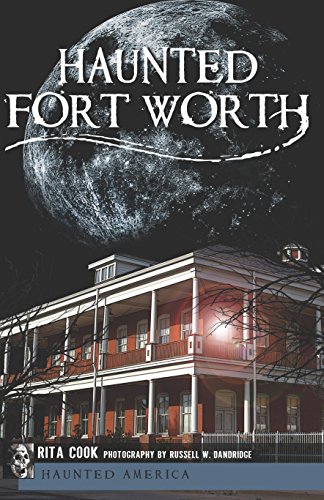
If you’re planning to go ghost hunting in the DFW metropelx, Haunted Dallas and Haunted Fort Worth (both of which were written by Rita Cook and published in 2011) are two good guides for your hunt.  Both books list various locations in both cities that are reputed to be haunted, some of which — like the Hotel Adolphus — I had heard about it and some of which — basically any location in Fort Worth — were new to me.

One thing that I really appreciated about these books is that both Dallas and Forth Worth got their own separate volume.  Far too often, people — especially people who come down here from up North — tends to assume that Dallas and Ft. Worth are just one big city.  They are two very separate cities, each with their own unique history and feel.  If Dallas is Texas as imagined by Andy Warhol, Ft. Worth is Texas as imagined by John Ford.  Not surprisingly, Dallas seems to be haunted by the wealthy while Ft. Worth is haunted by rough and tumble outlaws.

Admittedly, neither book goes into as much details as one might hope.  Instead, they give the basics of each legend and/or haunting and then they allow your imagination to do the rest of the work.  But, if you’re just starting your search for Texas ghosts, these books are good place to begin!

(For the record, I don’t believe in ghosts but I do think it’s fun to search.)

Book Review: Shadow of Evil by Greye La Spina


Direct from my aunt’s paperback collection, it’s the story of Portia Differdale and her aunt Sophie!

The time is the 1920s.  Sophie has come to Brooklyn, in order to live with the recently widowed Portia.  Portia, unfortunately, is having some issues with her neighbors.  Portia’s late husband was an occultist and, now that he’s died (more or less a victim of his profession), she’s decided to continue on his work.  Needless to say, the local gossips aren’t particularly happy about that.  Personally, I would love to live next door to an occultist, just because I would always some place to send any spirits who showed up in my house.  “Really, you’re undead?” I would say, “Head on next door.”  Sadly, I guess that’s just not the ways things were done in Brooklyn back in the day.

Anyway, Portia is lucky enough to have a potential new suitor.  His name is Owen and Sophie thinks that he would be the perfect new husband for Portia!  Portia, for her part, agrees.  However, it turns out that someone else has her eyes on Owen, as well.  Princess Irma Andreyevna Tchernova is wealthy, beautiful, and charming.  The uninhibited and flirtatious Princess Tchernova soon appears to have all the men in the community under her spell, including Owen!  None of them seem to find it odd that the Princess has an oddly silent servant or that she owns several wolves.  Not even the fact that the Princess eats nothing but meat strikes anyone as odd….

Except, of course, for Portia.  It doesn’t take long for Portia to figure out that there’s something sinister about the Princess but will she be able to save Owen from her grasp?  Read the book to find out!

Greye La Spina was born in 1880 and stared writing horror fiction in the early 20th century, at a time when it was considered somewhat scandalous for a woman to even write fiction, much less horror.  Shadow of Evil was originally published over the course of three issues of Weird Tales in 1925.  It was then reprinted, in paperback form, in 1966.  The cover at the top of this post (and which my sister shared earlier this month) is from the 1966 edition.  Since that time, the book has been occasionally reprinted.

It’s a fun read.  La Spina was a lively and entertaining writer and she tells this tale with the right mix of melodrama and satire.  La Spina obviously loves her unconventional characters and the story is as much about their desire to be independent from the conventions of society as it is about any paranormal activity.  It’s got everything — intrigue, romance,humor, scares, thrills, and a wonderful atmosphere.  It’s an enjoyable story and, if you can track down a copy, one that’s worth reading.

Halloween Book Review: The Twilight Zone Companion by Marc Scott Zicree


Up until a few years ago, every episode of the original Twilight Zone was available on YouTube.

That always made me really happy in October because, really, what better way to end each day of the Halloween month than by watching a classic episode of The Twilight Zone, right?  To Serve Man, The Monsters Are Due On Maple Street, It’s A Good Life, that episode with William Shatner freaking out on the plane and that other one with the guy entering his bedroom only to discover a lion waiting to eat him, these were all great episodes to watch in October!

Sadly, once Hulu started carrying Twilight Zone, all of the old episodes got yanked off of YouTube.  And now that the Twilight Zone is on Netflix, there’s no way the show will ever show up YouTube again.  We can still watch the episodes, of course.  Even if you don’t have Netflix for some reason, SyFy does regular marathons of the original show and, of course, there’s the Jordan Peele revival for those who watch old episodes of the Twilight Zone and say to themselves, “This is good but I just wish it was a little more heavy-handed.”

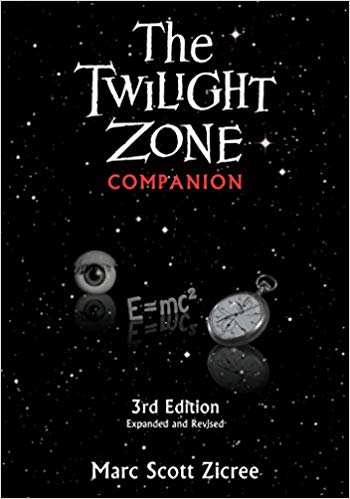
Well, I may not be able to embed any episodes this October but I can recommend that you order Marc Scott Zicree’s The Twilight Zone Companion, which is an indispensable guide to the original show.  Every episode is covered, with credits, plot synopsis, and anecdotes about the production.  Since a lot of important directors, actors, and writers did at least a little bit of work on Twilight Zone, the anecdotes are all very interesting and very much worth reading.  Even more importantly, Zicree takes a look at the life of Twilight Zone creator Rod Serling and also some of the key people involved behind the scenes.  The tragic story of Charles Beaumont will move you to tears.

So, if you’re a fan of the original show, you need this book!  Order it and enjoy!

Book Review: Lucio Fulci: Beyond The Gates: A Tribute To The Maestro by Chas Balun


Three years ago, I was really happy to discover that TCM was showing Lucio Fulci’s classic slasher, The House By The Cemetery.

Finally, I said, the maestro is getting some respect!

It’s the same feeling that I had when I recently came across both Zombi 2 and The Beyond playing on Showtime.  Sure, there’s a huge difference between one of your movies appearing on Showtime or Cinemax and being a respected filmmaker.   I mean, Uwe Boll’s movies are on all the time.  But still, just the fact that Fulci’s films were being shown meant that there was a chance that others would see them for the first time and maybe — just maybe — that person would get it.  That person would watch Fulci’s films and they would understand why horror fans like me continually describe him as being one of the best and most important filmmakers of all time.

Indeed, when it comes to Fulci, you either get it or you don’t.  When he died in 1996, Fulci was reportedly living in poverty and, despite all of his past cinematic successes, was struggling to find the financial support necessary to keep making films.  Sadly, he did not live to see his films rediscovered by horror fans like me.  Today, I’d say Fulci is still an underappreciated filmmaker but, slowly but surely, the Cult of Fulci is growing.  If nothing else, the current zombie movie boom would never happened without the efforts of both Lucio Fulci and George Romero.

Lucio Fulci: Beyond The Gates is a short, 79-page booklet that was published in 1996, immediately after Fulci’s death.  It’s really less a book than an extended essay written by a fan named Chas Balun.  The book, which covers Fulci’s filmography and pithily defends his work against his detractors, was really written mostly for Fulci fans.  It’s a booklet that we can read and laugh to ourselves as we say, “Can you believe those people who really don’t get it?”  As such, it’s probably not the book to give to someone who isn’t already a fan.  But, for those of us who already get it, it can be a fun read.  At the very least, it’s an important historical document as a tribute to the director that was written directly after Fulci’s death.  It’s the loving eulogy that Fulci deserved.

It’s also a bit of a collector’s item.  If you go on Amazon right now, you’ll find that copies in “new” condition are going for $100.  Used copies are going for $70.94.  I found my copy at Half-Price Books in Dallas and I paid $1.50 for it.

Book Review: The Vampyre by John William Polidori


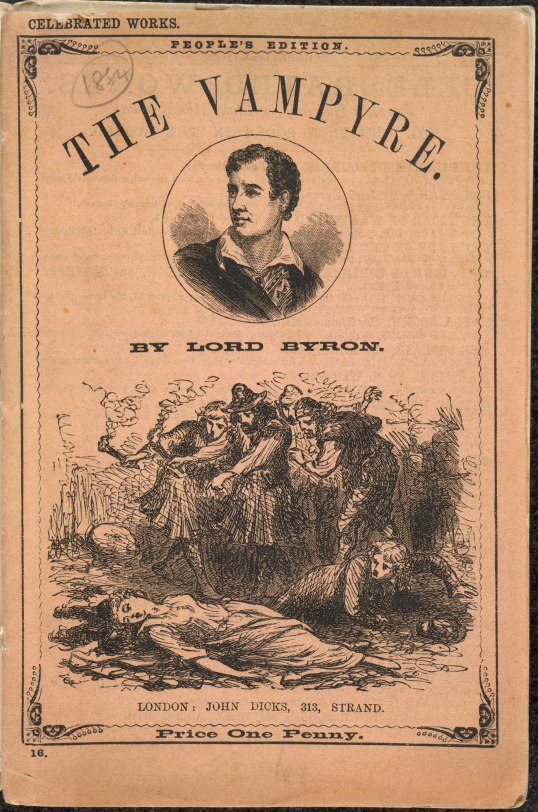
Though The Vampyre was often erroneously attributed to Lord Byron, it was written by John William Polidori

First written way back in 1816, The Vampyre is a story about an amazingly naive young gentleman named Aubrey who becomes friends with the mysterious Lord Ruthven.

Everything about the enigmatic Lord Ruthven would seem to suggest that he’s a vampire but Aubrey never figures that out while he and the nobleman travel across Europe.  Even after an inkeeper’s daughter dies of a vampire attack shortly after telling Aubrey about vampires (and, also, immediately after the sudden arrival of Ruthven), it still doesn’t occur to Aubrey that there might be something strange about Lord Ruthven.  When Lord Ruthven is mortally wounded by bandits, he makes Aubrey swear an oath that he will not tell anyone about Ruthven’s death for a year and a day.  Aubrey promises to keep the oath.

Now, apparently, back in the 19th century, people took those oaths very seriously because, even after Lord Ruthven shows up alive once again and now claiming to be the Earl of Marsden, Aubrey can’t tell anyone that he saw Ruthven die.  Even after Ruthven starts to court Aubrey’s sister with the obvious intention of draining her blood, Aubrey still cannot bring himself to break his oath.  Is it because oaths were really that important or is it that Aubrey himself is as in thrall of Ruthven as his sister?

John William Polidori was a physician and a writer, as well as a contemporary and friend to Mary Shelley, Lord Byron, and Percy Shelley.  The Vampyre was conceived and written as a part of the same contest that saw Mary Shelley write Frankenstein.  Though Polidori’s story is understandably overshadowed by Mary Shelley’s (and, it must be said, Polidori was nowhere near as good a writer as his famous friends), it’s still historically significant as the first “romantic” vampire tale.  It’s the story from which so many others have sprung.

Many have also speculated that the story was based on Polidori’s friendship with Lord Byron, with Polidori represented by the unstable Aubrey while the self-centered but charismatic Lord Ruthven was perhaps meant to be a stand-in for Byron himself.  This may be true or it may not.  (When it comes to Byron, the Shelleys, and Polidori, it’s always perhaps a bit too tempting to read too much between the lines.)

The Vampyre is a historically important piece of work so, if you’re a fan of vampires, you have to read it.  Flaws and all, we owe much to Lord Ruthven and John William Polidori.


Book Review: David Warbeck: The Man and His Movies by Raymond J. Slater and Harvey Fenton


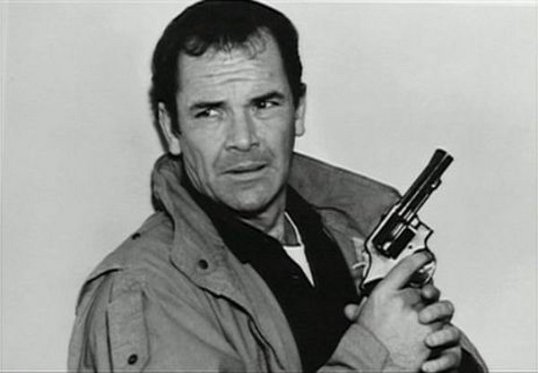
David Warbeck

Anyone who is a fan of Italian exploitation films will knows the name and the face of actor David Warbeck.  Warbeck was the handsome, rugged, and surprisingly likable New Zealand-born actor who went from studying at London’s Royal Academy of Dramatic Arts to appearing in films that were directed by everyone from Russ Meyer to Antonio Margheritti to Lucio Fulci.  He played a small but pivotal roles in Sergio Leone’s A Fistful of Dynamite and then went on to star in The Beyond, The Black Cat, The Last Hunter, Rat Man, and so many others.  While his films may never have been critical favorites at the time of their release (though several have been positively reevaluated), Warbeck’s movie did well enough at the box office that he was even considered for the role of James Bond,  Warbeck was one of those actors who was consistently good, regardless of the quality of the film in which he was appearing.

Sadly, Warbeck passed away in 1997, before many of his films were rediscovered.  It’s a shame because — as the commentary track that he and Catriona MacColl recorded for The Beyond shows — he was a charming raconteur who had a way with a story.  Fortunately, in 1996, Warbeck did sit down and gave a lengthy interview to Jason J. Slater, in which he discussed his career and shared many anecdotes about his life as an international exploitation superstar.  That interview is at the center of a short but interesting book called David Warbeck: The Man And His Movies.

The book not only features the interview with Warbeck but it also takes a detailed look at his filmography, reviewing some of his more interesting (and, in some cases, infamous) films.  The reviews are well-written by people who obviously love these often underappreciated films.

If you’re a fan of Italian exploitation, this book is simply a must-have.  Admittedly, it’s not an easy book to find.  I ordered a copy off of Amazon and it wasn’t cheap.  But it was worth it!

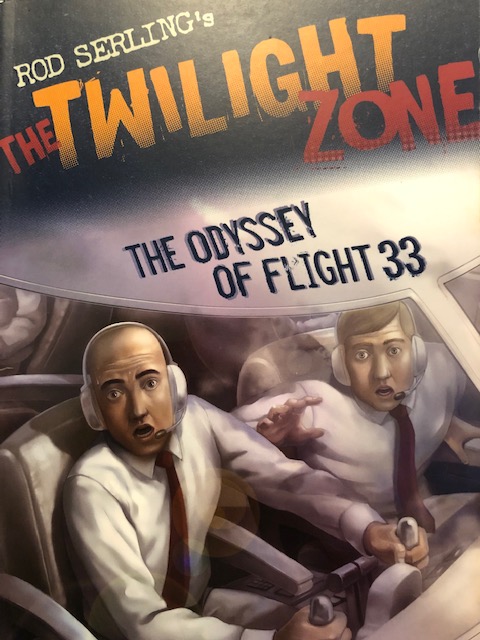
The Odyssey of Flight 33, Comic Review, by Case Wright


tw3

Yes, they have comic versions of The Twilight Zone! I really enjoyed this and I know that some of you are like….hmmm is this horror? Yes… Yes, it is. No further questions!  Besides, we have a Twilight Episode to discuss.  The Twilight Zone always leaned more into horror IMO.  The Outer Limits was all about teaching you a moral lesson, but TTZ was all about the scare factor.

I enjoyed this format too.  Face it, a lot of the TTZ episodes don’t hold up amazingly well.  It’s the truth….Deal With It!  The book has all the components of a good TTZ episode: the setup of perceived normality that takes a terrible left turn.  There aren’t many things more normal or boring than air travel.  The flight is just a typical run to La Guardia and the passengers appear very normal as well: the chatty passenger, the braggy passenger, and the emotionally unstable passenger.

These archetypal passengers pull us into the story much like the Stephen King stories do. Stephen’s characters are your neighbors and these passengers are too.  But, something isn’t right is the friendly skies! They feel hit a pocket of air and their speed goes into the thousands of miles per hour and whammo – they start time traveling! They arrive in 1939 and don’t stop because they want to get back to their own time- So no killing Hitler for these time travelers.  Then, they arrive in the Cretaceous and decide not to land because Jurassic Park is so five minutes ago, but then they arrive in the future.

This one troubled me a bit.  They are low on fuel and the future has cable and they can’t screw up time.  Really, they could just try to make a go of it in their new time.  No one seemed like things were that amazing for them in the present.  I mean, why not just land? You’d at least make a living on the talk show circuit. The comic ends with ambiguity.  They are low on fuel and lost in time.

I would recommend checking these issues out.  They’re a lot of fun and have a good creep factor.


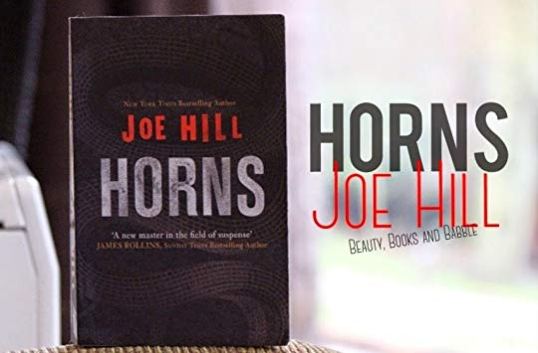
Horns, Book Review, By Case Wright


horns

Horns.  What if you woke up and realized? Gee Whiz, I’m a demon! Well, that’s exactly how it was for Ig Perrish in Horns.  One day he was the pariah of his town because everyone believed he murdered his girlfriend and the next day he’s got budding horns with magical demon powers!

Ig is loathed by everyone for being a rapist and murderer.  There was only one problem: he didn’t do it.  The lab that would’ve exonerated him with DNA evidence caught fire, leaving him as the likely suspect, but no physical evidence to convict or exculpate.  His town and greater world hates him forever.

The horns start growing out of his head and give him powers to cause people to indulge and confess their darkest desires.  When he uses the horns, people can see the horns, when he’s done, they’re no longer visible. He goes through the town getting people indulge and confess.  He slowly realizes that xxxxxxxx was the killer.  Ha! No spoilers! The killer figures out that Ig has discovered his identity so they begin a cat and mouse game that goes all the way to the climax.

The book elicits a visceral response because it deals with the key concepts of human existence: Betrayal, love, revenge, and envy.  There are quite a few of the other deadly sins on display in the book as well.  The only knock that I give the book is that it really obvious very early on who the real killer is.  Nope, still not spoiling!

Is it worth reading? Yes. There is also a very fine audiobook with a voice actor  who does a very good job.  I highly recommend that as well.  You can check out the trailer review for Horns by Arleigh here!

Horror Book Review: Monster by Christopher Pike


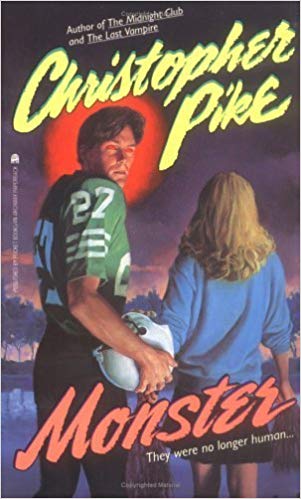
“They were no longer human…” the cover of 1992 first edition of Christopher Pike’s Monster announces and indeed, they’re not!  That cover, I should add, makes the book look a lot more light-hearted than it is.  It makes it look like it’s some sort of sci-fi comedy about a demonically possessed football player when there’s actually very little about this book that could be considered light-hearted.

This book is dark.  Like, seriously, dark.

It opens with popular high school student Mary Carlson walking into a party while carrying a shotgun.  She blows away a football player named Todd and then a cheerleader named Kathy and then she points the gun at her own boyfriend, Jim.  Fortunately, the new girl at school, Angela, manages to distract Kathy just long enough for Jim to take off running into the woods.  Mary goes chasing after him but she gets arrested before she guns him down as well.  It’s probably a good thing that Jim survived because, without him, how would the football team ever win another game?  After all, the team sucked just last season before all of the players and the cheerleaders suddenly got super strong!

Anyway, Mary says that she was shooting her friends because they were no longer human and, according to her, the three of them have been picking up people and killing them in a warehouse.  Police Lt. Nguyen doesn’t believe her but Angela feels a bit of an obligation to investigate Mary’s story.  And really, it’s the least she can do considering that she promptly starts flirting with Jim right after Mary’s arrested.

It quickly becomes obvious that something strange has happened to all of the school’s athletes and cheerleaders.  Maybe it has something to do with the mysterious crater from which the town gets its drinking water.  Angela notices that Jim tends to eat everything in sight, including a raw hamburger.  After she and Jim make out and she ends up getting some of his blood on her, she soon finds that she’s eating everything in sight.  Is it possible that some sort of monster has not only taken over Jim but is now taking over Angela as well!?

Yes, it is.  That’s bad news for Kevin, who is Angela’s BFF and who is totally in love with her even though she only views him as being a very good friend.  Oh, poor Kevin!  Kevin is one of the few wholly sympathetic characters in the book and he still ends up with a broken neck.  Like I said, this book is dark!

It all ends on an appropriately dark note and I guess that’s the important thing.  This book was written in 1992 and, at the time it was written, it was probably meant to be a metaphor about the dangers of having unsafe sex, as Angela is infected after fooling around with Jim.  Reading it today, though, it feels more like a commentary on just unsafe school has become over the past decade.  Mary Carlson, blowing away her friends because they’re “not human,” brings to mind so many recent gun-related tragedies.  It’s a bit difficult to read.

Anyway, Monster is a seriously dark book but still an effectively macabre story.  Nobody was as skilled at traumatizing young readers as Christopher Pike!