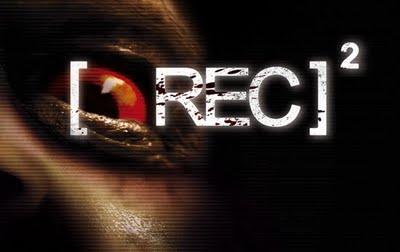
I wasn’t that too big a fan of the first film ([REC]) and definitely not a huge fan of the American remake which got renamed, Quarantine. The “in-the-moment” video footage made popular by films such as The Blair Witch Project and Cloverfield really stretched the need to suspend one’s disbelief while watching the original Spanish-language film and it’s American remake. But then again I seem to be in the minority when it comes to not liking those two films.
With the popularity of both films having made its studios profits it didn’t come as a surprise to see a sequel greenlit by the original Spanish studio with the original filmmakers, Jaume Balaguero and Paco Plaza, returning. The sequel is to take place immediately after the events of the first film. From the trailer that has been released of the film the same camera-style as the first film remains, but (if I’m to go by how the trailer was put together) this sequel may actually capture my interest. There’s a sense of this sequel looking like a live-action survival-horror FPS game. I’m sure the sequel won’t just be trying to be like a video game, but the trailer sure makes the sequel seem more interesting and just a bit more energetic.
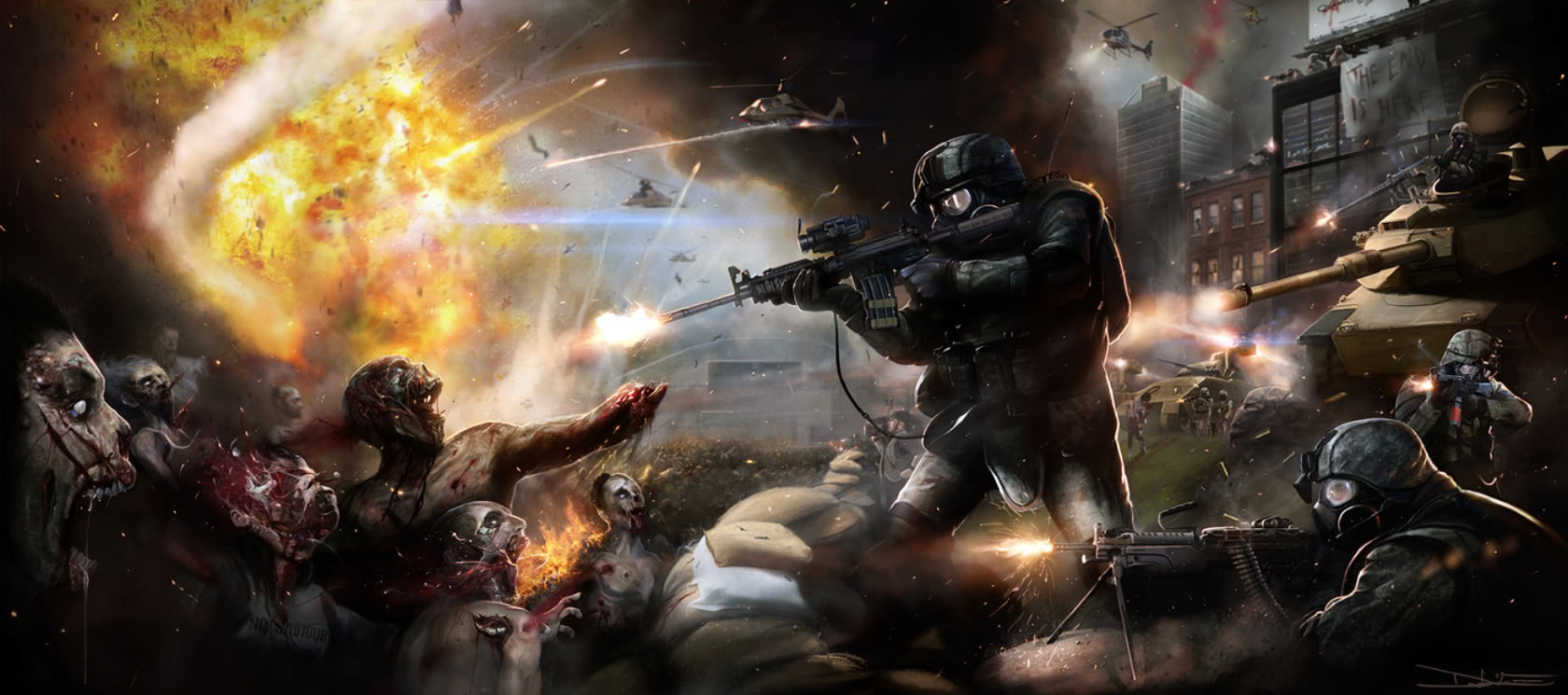
I was one of many who heard about Max Brooks’ satirical guide book The Zombie Survival Guide: Complete Protection from the Living Dead. Being a huge fan of George A. Romero’s Dead series of films and just the zombie subgenre in general, I was intrigued by the release of this guidebook. From the first page to the last I was impressed, entertained, and hooked on Brooks’ serio-comic take on how to survive a zombie outbreak. One section of the book which really caught my interest and has remained a favorite to reread over and over was the final one which details the so-called “historical” instances of past zombie outbreaks throughout history. From as far back as Ancient Egypt and Rome up to the late 1990’s. My only gripe about that section of the book was that it was all-too-brief. I felt that it could’ve been made longer and even would’ve made for a fine book on its own. Maybe I wasn’t the only one to have wished for such a thing to happen for it seems that Brooks himself might have thought the same thing. His latest book in his trip through the zombie genre is titled World War Z: An Oral History of the Zombie War and it takes the final chapter of his previous book and expands on it. But instead of using past “historical events” to tell his story Brooks goes into the near future to describe what would happen if the zombies ever did bring the human race to the brink of extinction and how humans finally learned how to fight back and take back the world.
World War Z is a fictional account of a worldwide outbreak of the living dead in the near future and judging from some of the descriptions of places and events in the beginning of the book it won’t be too far in the future. WWZ is done in an interview-style format with each chapter consisting of first-person interviews of individuals who lived through the Zombie War from its initial outbreak to it’s final battles and mop-up operations. The sampling of survivors interviewed range from soldiers who fought the losing battles in the early going of the war when lack of information, outdated tactics, and illogical reactions to the zombie outbreak contributed to humanity almost losing the war. These soldier survivors explain how humanity became its own worst enemy when it came to protecting its own and combating the growing ranks of the zombies. Some of the mistakes were unavailable as information on how to combat the zombies were far and few and even then most were unreliable. Some mistakes on the other hand many today would consider as unconscionable as war-profiteers and those willing to keep a hold on their own power and who would sacrifice their own people to keep it so.
There’s also the regular people who survived the war and who made great contributions during the dark days when humanity were pushed into isolated and fortified pockets of resistance as everywhere around them the zombie army grew exponentially. Some of these people were just children when the outbreak first began as rumors and unsubstantiated news reports. It’s the words of those children now adults that show how war and conflict really takes the biggest toll on the smallest and helpless. One could substitute the wars in Iraq, Afghanistan, The Balkans and even Africa in lieu of Brooks zombie war and this book would still resonate. There’s a particular entry of how children left to their own devices to try and survive alone in the wild with zombies all around have turned feral to the point that their capacity to learn and develop into adulthood has become stunted or even halted permanently.
Battle of Yonkers
Brooks’ novel also puts in little veiled references to the events occurring now in the real world. There’s mention of the unpopular war in the Persian Gulf as having a detrimental effect on the morale of troops once they returned home and how this helped make the initial fight to stem the tide of the zombies a losing proposition from the outset. There’s also mention of Iran as having acquired a nuclear arsenal and how this leads to an incident early in the Great Panic of the zombie outbreak that speaks volume of what could happen if unstable states acquire weapons of mass destruction. Brooks’ also gives a prescient look into a near future where the US and Europe stop being the economic superpowers of the world and step aside for the economic juggernaut that is China and India. All these inferences of today’s geopolitical and economical events mirrors what might just come into fruition.
The interview format really gives the book a sense of realism despite the outrageous and fantastical nature of the book. As I read the book I was reminded of Stephen A. Ambrose’s books on the men and women who fought during World War 2. Ambrose also used interviews and personal accounts to make up the bulk of his books like in Citizen Soldiers and Band of Brothers. Having a personal take on the events gave his books more emotional impact and really brought the emotions of the conflict to those who never experienced it. The same could be said about Max Brooks’ World War Z. Even though the novel was speculative fiction from beginning to end it still made the reader think of how such an event, if it ever came to pass, could be so tragic, disheartening but in the end uplifting as it once again shows that humanity could still pull itself together through all its petty misunderstandings to survive. On a more stylistic point, Brooks’ novel shares some similarities to Theodore Judson’s sci-fi epic Fitzpatrick’s War. Judson’s book also tries to chronicle a future war which was shaped by religious and ideological forces. Where Judson goes way into the future of an alternate Earth, Brooks smartly stays to a more foreseeable future that readers of his book would most likely see happen; hopefully a much brighter and less-zombified one.
Brooks’ decision to forgo the usual linear and narrative style for this book also allowed him a certain bit of freedom to introduce one-shot characters in addition to those who appear regularly. In a more traditional novel such one-shot characters would seem useless and even unnecessary, but in this interview format it makes more sense since it’s really just a collection of personalities trying to describe their own take of the Zombie War they lived through. Some people I know who have read the novel have said that there’s little or no talk of love and relationships in World War Z. I, for one, was glad that Brooks didn’t try to force certain “interviews” where it talks of survivors finding love and relationships during the outbreak, through the war and all the way to the mop-up. This book chronicles tales of survival and horror. As much as a tale of love would’ve been a change of pace to all the death and horror in the interviews it would’ve been too drastic a change of pace. I would think that the last thing that most people would have in their minds when trying to survive day-to-day, if not hour-to-hour would be to stop for a moment and have sex, cuddle or other less-than survival behaviors.
All in all, Max Brooks’ World War Z: An Oral History of the Zombie War takes a serious look at a fictional and fantastical premise and event with a serious eye. The book manages to be tragic and terrifyingly spot-on about how the world governments today could fail when confronted by such a horror of tremendous proportions. Unlike his more satirical first book on the zombie subject, World War Z shows the flaws and failings of humanity and how it almost led to its extinction, but it also shows humanity’s stubbornness in the face of total annihilation and how it could come together in cooperation to not just survive but take back the world. In times of extreme adversity man can be brought to his knees but also show his resilience. A great novel and one that deserves reading from not just fans of the horror and zombie subgenre, but those who enjoy taking a peek into what could be, no matter how outrageous.
When Tarantino and Rodriguez first created their ode to all things grindhouse with Planet Terror and Death Proof they also put out a word to their directing buddies who enjoyed the same things to make fake trailers to begin and break between the two films. They also created a contest where fans could create their own fake grindhouse trailer and the winner gets added to the dvd release. The winner of this contest was one aptly titled, Hobo With A Shotgun. While the trailer was ok it did introduce me to filmmaker Jason Eisener.
He has know followed up Hobo With A Shotgun with a horror shortfilm that has become the darling of the film festival circuit. His 16-minute short film is titled Treevenge and I will say that it’s one of the most original and inventive piece of storytelling and filmmaking of the year. This little shortfilm is why horror has its place in the filmmaking community as a way for aspiring filmmakers to get their creative juices flowing. This little gem of a film is also why I also love film in general. Little jewels like this make going through the awful films worthwhile.
For the complete uninterrupted short film click: Treevenge
I consider these the best and greatest science-fiction films of this closing decade. Some of the films in the list could be labeled as being hard scifi while some definitely have their roots in the pulp storytelling traditions of the 1950’s scifi publications and novels. Some could be considered horror while others more action or comedy. In the end, they all have a basis in the traditions of science-fiction as their common denominator. They will not be in any particular order since I couldn’t truly determine which one deserved to be top on the list or which was just 20th. In my eyes they are all equally great in their own way.
Do you agree with the choices? Do you think another film belongs on the list and, if so, which one? I’m interested to know what your favorite sci-fi films of the last 10 years happen to be.
“Everything is backwards now, like out there is the true world, and in here is the dream.” — Jake Sully
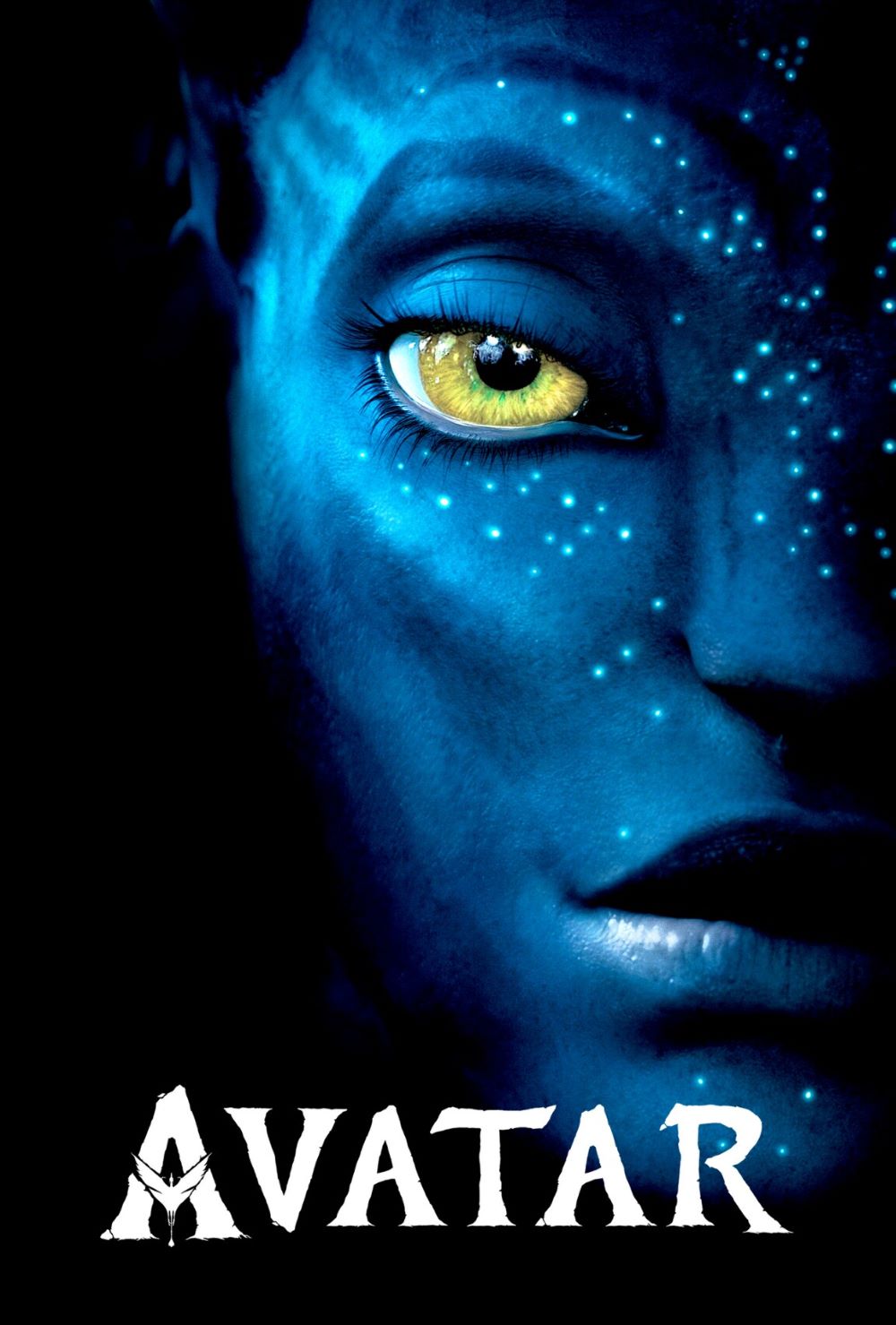
When was the last time a film became an experience for you—not just a story that made you think, but one that swept you up and immersed you completely? The most hyped film of 2009, and likely of this decade, was such an experience for me. James Cameron’s Avatar, a project over fifteen years in the making, more than lived up to the hype that followed it from the earliest production leaks.
Avatar is not the greatest film ever made, nor does it revolutionize filmmaking the way Technicolor did in the late 1950s and early 1960s. What Cameron has accomplished is providing a blueprint for how filmmakers can bring audiences closer to the stories they tell. Stories and ideas once considered unfilmable due to technological limitations are now within reach. Avatar is an experience that should be seen, regardless of whether one embraces its story. The narrative is not original—some may be reminded of an Oscar-winning film directed by Kevin Costner or an animated feature with “Gully” in the title. While the lack of originality is noticeable, the story works within the context of Cameron’s vision. Clichéd and hackneyed dialogue aside, it serves the film well. Cameron’s writing may not rival that of Kaufman or Mamet, but he knows how to tell a simple story and keep the audience engaged.
With that flaw acknowledged, I haven’t felt this way about a film—nor even the best I’ve seen this year—since the first time I watched The Fellowship of the Ring or, before that, Spielberg’s Jurassic Park. Only a few films truly sweep me into their world and hold me there. It didn’t matter that Avatar wasn’t the second coming of Rashomon or this generation’s Citizen Kane. What I watched, I fully bought into. The world of Pandora, imagined by Cameron and brought to life by WETA Digital and ILM, felt real. The detail, clarity, and dedication in its creation gave me hope that creative boundaries once thought uncrossable are now being stepped over.
While the film is also available in 2D for theaters without 3D capabilities, it must be seen in 3D, ideally in IMAX 3D. Cameron’s use of the new “emotion capture” cameras he helped develop achieves a level of CGI photorealism that avoids the “Uncanny Valley” effect seen in films like The Polar Express, Beowulf, and A Christmas Carol. The groundbreaking “mo-cap” technique, refined by WETA Digital for The Lord of the Rings trilogy, convinced Cameron it was time to make Avatar as he envisioned. The Na’vi are now the most realistic CGI characters ever put on screen, surpassing even Gollum. Cameron demonstrates that the limit of CGI use is not quantity, but how it is implemented. Lucas, Bay, and others who have misused CGI have much to learn from Cameron’s achievement.
It took a few minutes to adjust to the 3D effect, but once my eyes adapted, the film’s magic took hold. The distinction between CGI and live-action scenes blurred and eventually disappeared. Even the best CGI-heavy films sometimes break immersion, but Avatar never did. This total immersion helped me overlook the story’s familiarity and, for some, its ordinariness.
Despite the material, the performances ranged from good to excellent. The villains, while written one-dimensionally, were played with enough conviction to be believable. Giovanni Ribisi’s corporate weasel, a clear echo of Burke from Aliens, was cartoonish in motivation, but Cameron is not known for deep, well-rounded characters. The standout was Stephen Lang as Colonel Miles Quaritch. His scenery-chewing performance was riveting, stealing the film from Sam Worthington’s “hero on a journey.” While Lang’s performance may not win awards, it stands as one of the year’s most memorable, joining the ranks of characters audiences love to hate.
Some may think I’ve joined the Cameron fan club, but I can’t explain why I love this film despite its flaws: the familiar story, clichéd dialogue, and one-dimensional characters. Is Avatar just a technical and visual marvel? Yes, and more. Does the CGI and bombastic climax overshadow the storytelling? No, it actually propels the story forward, much like Jake Sully’s own fragile legs.
In the end, my love for Avatar comes down to the experience it provided—a rare occurrence in modern cinema. Cameron didn’t make a perfect film, nor one better than sliced bread. But he created a filmgoing experience that will be remembered decades from now, much like the first time audiences saw Star Wars and believed in Jedi and space battles, or Superman and believed a man could fly. Cameron’s Avatar made me believe in Pandora, a place I hope to visit, or at least experience through his eyes. I’m eager to see what he—and other filmmakers inspired by his work—will create next.

 Through the Shattered Lens