I am what you would call an avid gamer. I’ve been playing video games since I was a wee lad and marveled at the Atari 2600. I moved from that system through the many systems after it to my current one which is my Xbox 360.
I’m an equal opportunity gamer in that I will play any type of game at least once no matter the genre. In the end, the one genre which I will always gravitate towards and I consider my first gaming love are role-playing games. I especially have a special place in my heart for Japanese role-playing games. It’s music from one of those Japanese role-playing games where I have chosen the latest “song of the day”.
The latest song chosen is from the Konami-published role-playing game series called Suikoden. This particular song comes from the third game in the main series, Suikoden III, and is the opening theme for the game. The song’s title is “Transcending Love” and is one of my favorite piece of game music ever produced. The song even gets a well-animated anime opening sequence which shows characters and events from the game but doesn’t show too much about who they are and what the plot of the game is all about.
The song is part of a soundtrack which includes several Japanese game music composer that figuring out who was responsible for this particular song would be difficult to do. I’ve decided to just credit all of them for what I consider one of the best game opening themes and music ever composed.
So, we’ve finally reached the season finale of a very short inaugural season of Frank Darabont’s tv adaptation of Robert Kirkman’s critically-acclaimed and very popular comic book series, The Walking Dead. AMC ordered an initial 6-episode for this season which made setting up the world for the non-fans of the comic book a top priority. This could be seen in the first five episodes as each one explained the rules of this new post-apocalyptic world and how it has changed how people have now begun to behave.
The tv series has stayed mostly loyal to its comic book source, but some divergence from the source material has caused some grumblings amongst the comic book’s legions of fans. It doesn’t matter to them that the comic book’s creator has been ok with the changes and actually an active participant with said changes. These changes have been somewhat minor in the show’s five episodes but as episode five rolled to an end we got a major departure to the source material. Rick has taken his band of survivors back to Atlanta where the CDC (Center for Disease Control) is headquartered at. This never happened in the comic book and it’s inclusion to the story has driven many a fan of the source material batshit crazy.
They ask why make the changes, both minor and major, to a story that was already full of story-arcs, subplots aplenty and enough characters down the line that new ones weren’t needed. I can’t blame them for asking such questions for I, too, are a major fan of the comics right from the very beginning. But these changes is exactly why the story being told by this tv adaptation look and seem fresh to me. The end of the last episode was such a major departure that I can now honestly say that I have no idea what Darabont and Kirkman have in store for Season Two. It’s that element of the unknown and the surprise of not knowing what’s around the corner why I don’t rail against these changes. If I wanted a page-by-page, panel-by-panel adaptation then I’d rather just bring out the comics and re-read them for the umpteenth time.
Now we get to the season finale and whether the major change will actually improve or just ruin the series.
I must say that I was guarded in my optimism about this major departure and the inclusion of the CDC. What I’ve liked about some of the best zombie stories ever put on film or on paper is that the zombie apocalypse never truly gets a definite explanation as to how it began or what caused it in the first place. This season finale episode titled “TS-19” seemed like Darabont’s attempt to try and explain the cause of the zombies and who or what let it loose in the first place. Very bad zombie stories try to over-explain and end up tripping over themselves in the process and thus ruining the experience.
With “TS-19” we get Dr. Edmund Jenner (Noah Emmerich), last surviving researcher in the CDC, give a brief explanation as to the process of when a person goes from living to dead to reanimated corpse. While the fancy computer-enhanced imagery seemed to explain much it really doesn’t. It just scientifically showed what everyone already knew. They still don’t know if it’s a viral or bacterial disease or if it’s even a disease at all. Even Jenner doesn’t discount Jacqui (one of those new characters added in that fans of the comics railed against) mentioning that it could be the wrath of God. The sequence even answers viewers’ question about how long it takes for a recently dead to return back as a “walker”. The answer to that is that they don’t know.
This episode highlighted how ineffectual the very institutions people depended on for help, security and safety when the zombie apocalypse finally hit critical stage. We see this in the show’s cold start prologue as we go back in time to see the final moments at the King’s County Hospital where a comatose Rick Grimes was being kept at for observations. Shane, his partner and best friend, sees the brutal solution the military has for those either infected but alive and/or unwilling to vacate the hospital as it began to be overrun by the “walkers”.
This sequence answered questions about why the military was so inefficient. It’s also a damning condemnation about the rigidity of such a major governmental institution unable to adapt to an ever-changing situation where the enemy didn’t sleep, didn’t stop to rest or wasn’t afraid about being fired on. This was an enemy that was conducting the true meaning of “total war” on a people who were already on the ends of their last rope. The fact that their solution only swelled the ranks of those they fought just showed how doomed the world is when something this apocalyptic occurs without warning and without a means to fully understand and combat.
Even Jenner doesn’t know what made the zombie apocalypse begin and the source of what scientists thought was something they could find a cure for. This ambiguity needed to be shown to stop question from the audience about the “why’s” and “how’s” and instead get the series back onto the road where survival and holding onto their humanity remains their ultimate struggle.
This episode does get them back onto that lonely road with some deciding to stay as the facility began a countdown towards a final decontamination. We get also get a nice scene between Jeffrey DeMunn’s Dale and Laurie Holden’s Andrea that should make fans of the comics happy. The same goes for showing just how ineffectual Rick has been as their leader as every decision he has made has put the group in danger. It shows Rick’s intractable belief in doing the right things and holding on to the vestiges of civilized behavior could be just a front to give his wife and son hope that things will be better. This episode shows Rick that what’s better is to stay for that final decontamination instead of going back on the road where only death and suffering will await him and his group. Jenner’s comment that was heard was like a prophetic announcement that Rick will regret going back out.
So, we finally end Season One of The Walking Dead and have a very long wait (hopefully AMC make the decision to air Season Two not on October but at least a month sooner, if not a couple of months.) til the series picks up again with the convoy of survivors headed to parts unknown. Parts unknown not just for the characters in the series but for fans of the comic book as well. Here’s to hoping that while Darabont and Kirkman uses the comic book as the main path for the series moving forward that they also deviate from it from time to time if there’s a good story to tell on those small paths and tributaries.
Extras
* “Dude, you are such a buzzkill.” – Glenn finally gets backhis witty ways as he reacts to Shane’s questioning of Jenner during a celebratory dinner.
* “Man, I’m going to get shitfaced drunk, AGAIN.” – Daryl’s reaction to Jenner’s news that there may be no one left anywhere.
* I found it quite ironic that of all the people to hold out the longest as the rest of the world gave up it would be the French.
* There was quite the Lost In Translation moment towards the end as Jenner whispers something into Rick’s ear before the group bolted to escape. Theories on what already has odds on Lori’s physical situation after the tests Jenner gave the group.
* As a military nut I smiled at the use of the acronym H.I.T. to literally mean a hit of a high-impulse thermobaric high explosive. That’s what I call a hit.
* Scene as Rick tries to plead with Jenner to let them go one can see Daryl still axing away at the blast doors.
* “The world runs on fossil fuel. How stupid is that!” – Jenner pointing out that places still doing research to find a solution failed because the power grids which run on fuel stopped due to lack of it.
* “This is what takes us down. This is our extinction event.” – Jenner finally voicing what everyone in the show has been avoiding and should give a clue as to the true meaning of the show’s title.
* The episode ends with a Bob Dylan song, Tomorrow Is a Long Time, that was very appropriate.
The Italian horror cinema scene has always been dominated by such names as Mario Bava, Dario Argento and Lucio Fulci. Their films became Italy’s contribution to horror cinema and one cannot find a fan of the genre who don’t hold these three gentlemen in high regard. Other names of the Italian horror scene were not as well-known beyond the most hardcore horror fans and some just don’t deserve to be in the same company as the previously mentioned trio. One filmmaker who should be part of their company is one Michele Soavi. He rose through the ranks as an actor at first before moving on to becoming assistant directors for mentors such as Joe D’Amato and Dario Argento. The latter would become a major influence in Soavi’s work and would help produce some of his films. One of those Argento would end up producing for Soavi is the 1989 supernatural horror film, The Church (known in Italy as La Chiesa).
The Church wasn’t one of Soavi’s best films, but it was still one of the better horror films to come out of Italy during the waning years of the 80’s when Italian horror began a slow decline. Starring a very young Asia Argento (hard to believe that a career which began with reports of nepotism would turn out to be a successful one in and out of Italy) and an Italian-American actor named Tomas Arana (people would know him best as the ambitious Quintus in Ridley Scott’s Gladiator), the film starts off with a cohort of Teutonic Knights who destroy and kill a town suspected of witchcraft. The bodies of all killed soon get dumped into a mass grave and sealed with a huge metal cross and prayers to keep the evil that was done from ever coming out.
The beginning does have a somewhat ambiguous tone to it as we the audience don’t know if the villagers were indeed evil. Soavi definitely leaves that up in the air until the final third of the film kicks in and most of the horror scenes appear to satisfy gore fans. The knights destroying the village was well-staged and executed with some cool kill-scenes and effects.
It’s the middle reel where the film slowed down to the point that could lose the more casual horror fan. We get the usual non-believer researcer (Arana) who stumbles upon the ancient cross sealing the mass grave beneath the church that had been built over it down the centuries. Even this researcher and another knows that they should leave it alone, but being the scientists one of them proceeds to unseal the find with the reasoning that pursuit of knowledge should triumph over supersitition. Thus, the church becomes the scene of demonic possessions of various individuals. First, the initial researcher who opens unseals the cross then the parents of Asia Argento’s character before moving on to churchgoers who become trapped in the church after some demonic force seals all exits.
The rest of the film once that church seals itself is one person either getting killed by those possessed by the demons escaping from the sealed grave or someone getting possessed. This third act actually has a touch of Fulci’s nightmarish-style and less of Argento’s more dream-like quality. There’s a beautiful scene of Tomas Aranas’ character made-up to be some verdigrised-bronze angel statue, wings and all, embracing a very naked young woman that looked straight out of a Luis Royo painting. Another scene where regular Soavi actor Barbara Cupisti was shown in sexual congress with a demonic being that should give more than a few people nightmares despite being framed and shot in a beautiful manner.
The final nightmare scene of beauty which pushes The Church over into Fulci territory is when a mass of naked, muddied bodies of all those possessed entwine and writhe to form the likeness of a demon’s head. This sequence alone was worth watching through the much slower middle section of this film and Soavi’s eye for staging and lighting the scene made it look like something out of the pages of Dante Alighieri’s Divine Comedy.
One could say that The Church just didn’t live up to the usual quality one expected out of a Michele Soavi film after a he made the excellent giallo-slasher film Stage Fright just two years prior. This second full-lenght feature by Soavi showed him still honing his talent as a filmmaker which would finally culminate five years later in one of the best Italian horror films and one of the best films in the zombie subgenre with his Dellamorte Dellamore. Plus, even when he’s not on top of his craft like with The Church it is still worth a watch and better than the stuff released by his contemporaries like Bruno Mattei.
Funny how certain films in the US get a change in how they’re titled for the overseas market.
A couple weeks ago the first trailer for Jonathan Liebesman’s alien invasion film, Battle: Los Angeles, was posted and it certainly looked a tad better than this year’s big alien invasion flick, Skyline. They share not just the type of film it wants to be but the location as well. Both are set in Los Angeles and both seem to be CGI-heavy affairs. Where the Brother Strause’s film was so bad that it was good this film from Liebesman looks to marry alien invasion with Black Hawk Down for a much more down in the ground action.
This new teaser trailer is the international version and it shows a bit more of the action we’ll be seeing in this film. There is one little change which I find more than just a tad bit amusing. When the teaser finally ends we don’t see the title as Battle: Los Angeles, but instead we get the more international sounding World Invasion: Los Angeles. I guess the studio thinks the film will do better overseas by making it sound like the invasion is global instead of local the way the original title has it.
Fret not fellow Americans! The voiceover does say, after listing cities both in the US and around the globe, that we cannot lose Los Angeles thus….USA! USA! USA!
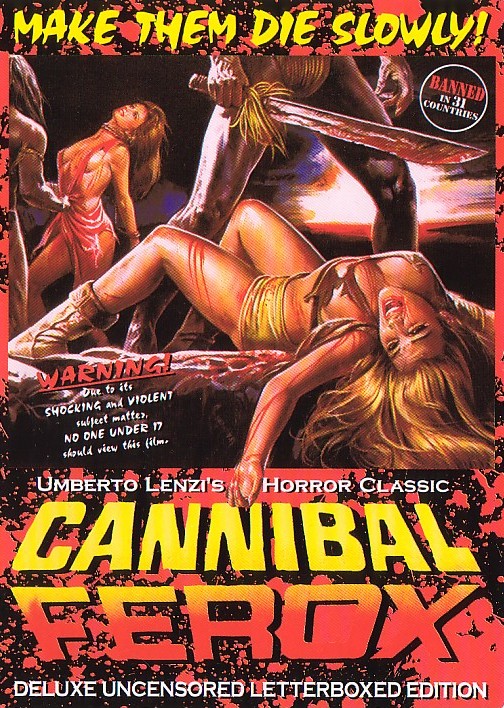
It’s time we got back to another edition of “The Daily Grindhouse” and this time we go into the lovely and wholesome fun that was the European cannibal subgenre which became popular from the mid-1970’s right up to the early 1980’s. The granddaddy and best of this subgenre will forever be Ruggero Deodato’s Cannibal Holocaust. That film help bring about the flood of cheap copies and knock-offs with each one trying to one-up Deodato’s masterpiece by amping up the violence and gore to try and get banned in as many countries as possible. One of these knock-off’s is Umberto Lenzi’s Cannibal Ferox aka Make Them Die Slowly.
It stars one of the heavyweights of Italian exploitation and grindhouse in Giovanni Lombardo Radice. It pretty much borrows part of the plot of Cannibal Holocaust then adds in a liberal helping of drug-dealers, mobsters and emeralds. Lenzi’s flick dumps the “found footage” style Deodato used for his film and instead goes a more traditional style. This lessens the impact of Lenzi’s film and definitely adds to fuel from critics and detractors who saw nothing of value in this film.
I wouldn’t say that Cannibal Ferox has no redeeming value whatsoever for it is an interesting flick. Gorehounds and lovers of this particular brand of grindhouse cinema have a special place in their heart for this flick with special mention going to the several kill sequences that occur throughout the film. Lead actor Radice gets the most elaborate and gruesome fate in this flick and I would say in most in the subgenre. No wonder in an interview years later he would regret ever filming this flick.
Oh yeah, Lenzi one up’s Deodato’s on-screen killing of a live turtle by doing a pig instead.
Like I said earlier, lovely and wholesome fun for the whole family.
This is definitely stretching the definition of entertainment but one just has to watch the brave little Akita as it confronts the sinister bowl of evil. Watch how it falls back on it’s ninja and samurai training (Akita’s are originally from Japan and were used as guard dogs during the Feudal Era of Japan when samurai and warlords ruled the land) and begins to sneak towards it hoping to catch it by surprise.
It even tries to confuse it by pretending it’s about to attack with one of it’s deadly paws only to pull said paw of destruction back.
Yeah, this is one brave pup who is probably huge by now and can probably destroy his enameled nemesis by his bark alone.
Season One of The Walking Dead is just days away from concluding. The show has been a runaway hit for AMC. It’s ratings since the pilot premiered on Halloween night has tripled the numbers posted by AMC’s other critically-acclaimed hits like Mad Men and Breaking Bad. It’s showrunner in Frank Darabont with veteran Hollywood producer Gale Anne Hurd the show had the firepower to allow a basic cable network to take a chance on a tv series based on a long-running comic book series about survivors in a post-zombie apocalypse world.
With Season 2 already approved for a 13-episode pick-up the only question now is whether the show will be able to take the foundations laid by Darabont and his writers this first season and continue to improve on the product. This question may have just taken on a certain significance as Deadlinehas reported that Frank Darabont has fired all the writers of this first season and plans on writing the second season by himself with freelance writers being brought in to work on each episode’s scripts.
For a show that has garnered great reviews from critics and fans alike, not to mention ratings that it’s sister shows on the network could only wish for, this change in how the upcoming season would be written might just put the shadow of worry over it’s growing legion of fans.
For some, this news might seem like a panic move designed to placate the vocal minority of blog reviewers who have pointed out how the show’s writing didn’t pass muster after a powerful pilot episode. How the series’ first season seem to have a Jekyll and Hyde tone to it. One episode being great then the next just so-so. Could the negative criticism (some justified and others just criticism for criticism’s sake) have reached the heads of AMC and the show’s producers and a decision for a change was made off the cuff.
This report, if confirmed by Darabont and the network as true, does mean Darabont becomes the sole writer for the show with hired freelancers doctoring finished scripts then it could be a blessing for the show moving forward. There will now be a singular voice that will dictate how the show goes forward. Some will think this may just ruin the quality of the show not having a staff of established writers on-board like the first season had, but it’s those very same writers who the show’s detractors have been blaming for the show’s missed opportunity to create a brave new show on tv.
Also, it’s not such a rare thing to have a show written by one individual and for a series that’s really one long story with some very complicated subplots thrown. Having that one writer could keep things from getting too confusing. It could also solve the up and down nature of the episode quality.
AMC, hasn’t stated that the show will not have a staff of writers. There’s a chance that Darabont will hire both freelance and series writers to help smooth the transition from Season One to Season Two. The good thing is that the network and the producers pretty much have 11 months to decide on exactly how to proceed.
We’ve now come to the penultimate episode of The Walking Dead‘s first season. If there’s been one thing about this tv adaptation — of the Robert Kirkman comic book series which it’s based on — has proven it’s that the show is willing to go off the reservation when it comes to following the source material. The show has made some interesting storytelling and character choices right from the start. Scenes which occur later in the comic book have been moved up and combined with others. New characters, both recurring and disposable ones, have been introduced to the original numbers from the book.
Some of these changes have been welcomed by old fans of the book, but there’s a vocal minority who don’t see why there’s a need for such changes and additions. To new fans whose experience with this franchise has been just through the show the changes don’t mean a thing. They’re coming into this fresh and with open eyes. For long-time fans this need to watch this show with open eyes instead of clutching at the strict canonical material that are the books it would be a hard time going. I’m one of those who have been reading the books since the beginning and for the most part I’ve accepted these changes. Even the major departure introduced to end this episode I find quite interesting and with guarded optimism that it will lead to a surprising season finale and set-up season two properly.
We begin the show the very morning after the zombie attack on the camp which ended the previous episode. The survivors are cleaning up the bodies of both the “walkers” put down and those people they lost. The scenes showing how both Carol deals with her abusive husband’s corpse and how Andrea deals with her younger sister Amy were quite powerful in their own way. In one scene, we see an abused and beaten down wife taking out her anger and relief on the source of her problems with a pickaxe. In another, we see an older sister remembering past regrets of never being there for her much younger sister despite promises to do so. The scene with Andrea goes against much of what most zombie survival aficionados would do, but it brings to light just how much the Andrea loved her sister and even if it means seeing her come to a semblance of life just one more time to say her goodbyes she would do it. Knowing what she would need to do in the end just made her tearful final goodbye that more powerful.
The third farewell doesn’t happen until 3/4’s of the way into the episode (though we do see Morales and his family go their own way. Going to miss him going for the fences with that baseball bat) and involves Jim. An injury incurred from the fight during the night leaves him and the group with a problem that gets resolved in one of the more poignant scenes in this series, so far. As Morgan Jones from the pilot episode instructed Rick the “walkers” and their bites are a death sentence. The two competing leaders of the group in Rick and Shane want to solve their Jim problem using different methods. Rick wants to take the group to the one place he thinks could still help Jim and that’s the CDC near Atlanta. While Shane, with enthusiastic support from Daryl, wants to put Jim down before he becomes a dangerous liability.
In a scene reminiscent of a similar one from Romero’s original Dawn of the Dead, Jim makes the final and ultimate decision about his life. The goodbyes made by everyone to Jim after he’s made his decision to be left behind was very heartbreaking. Jim might have been a secondary support character but the last couple episodes have fleshed out his character enough that we care what happens to this man who has lost everything and thinks his predicament will reunite him with those he has lost.
The growing schism between best friends Rick and Shane gets a few more nails added to it as we see Shane gradually losing his command of the group. The group looks to be gravitating towards Rick as their leader now and even the wildcard in Daryl seem to look to Rick for the answers. The scene between the two as they patrol the woods near the camp definitely widens the gulf between the two even if Rick looks to be unaware of what’s really going on with Shane. The sudden appearance of ever stalwart and ever watchful Dale sure thinks something is amiss.
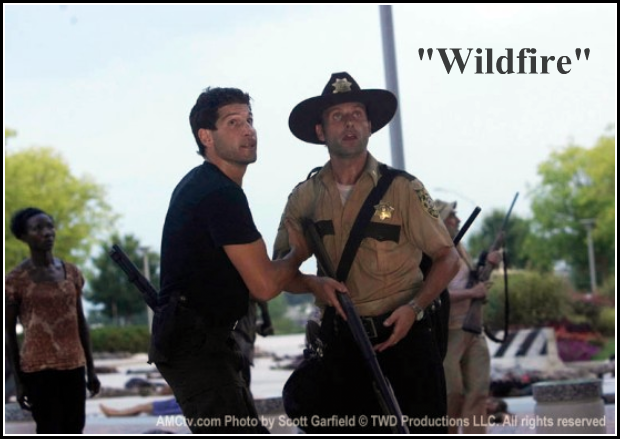
It’s the final ten minutes of the show where we finally know why the episode was titled “WildFire”. In another departure, one that would be called huge by fans of the comic books, we see the lone surviving researcher within the CDC sending video reports on what’s being called “Wildfire” and how research on the so-called “disease” has remained useless with no answer in sight.
The whole entire sequence reminds me of the early parts of Stephen King’s own apocalyptic epic novel, The Stand, as scientists desperately try to stem the tide of the approaching apocalypse to no avail. It’s little subtle references to other apocalyptic stories and tales like this which keeps some of the changes and departures from the source material bearable and, at times, even welcome.
It’s this major departure that will send some long-time fans of the comic book apoplectic. The vocal minority will definitely get even louder as to why Darabont and the writers are messing with the timeline and the stories in the original comic book. As one of those fans I should be screaming just as loudly, but the zombie and apocalyptic genre fan in me actually like how this show has gone off the beaten path of the original source material.
If they had stayed word-for-word and panel-for-panel true to the comic book then there’s no surprises to be experience. Knowing how everything unfolds right from the start could get boring even if it is about something read and re-read with love. There’s still no guarantee that the final pay-off of this particular major detour from the comic book will end in a good way, but the possibility of not knowing how this story-arc will end this first season is both exciting and tense-inducing. It could succeed in the best way, but also fail in an epic one. Either way the path now is not set in stone and everything moving forward will be undiscovered country.
Extras
* Quote of the night: “I think tomorrow I’m gonna blow my brains out, I haven’t decided. But tonight, I’m getting drunk!” – nameless CDC researcher.
* For once Glenn doesn’t have a witty quip or remark which just highlights the somber mood of this episode.
* There’s still no news on the whereabouts of one Merle Dixon though he gets name-dropped a couple times.
* A sneaking suspicion that Merle will not appear again this season, but may in the next or later ones.
* Bear McCreary’s score and choices of music for the episode the best in the series, so far to date. Especially, the use of John Murphy’s Adagio in D Minor from the sci-fi drama Sunshine which was recently used in Kick-Ass.
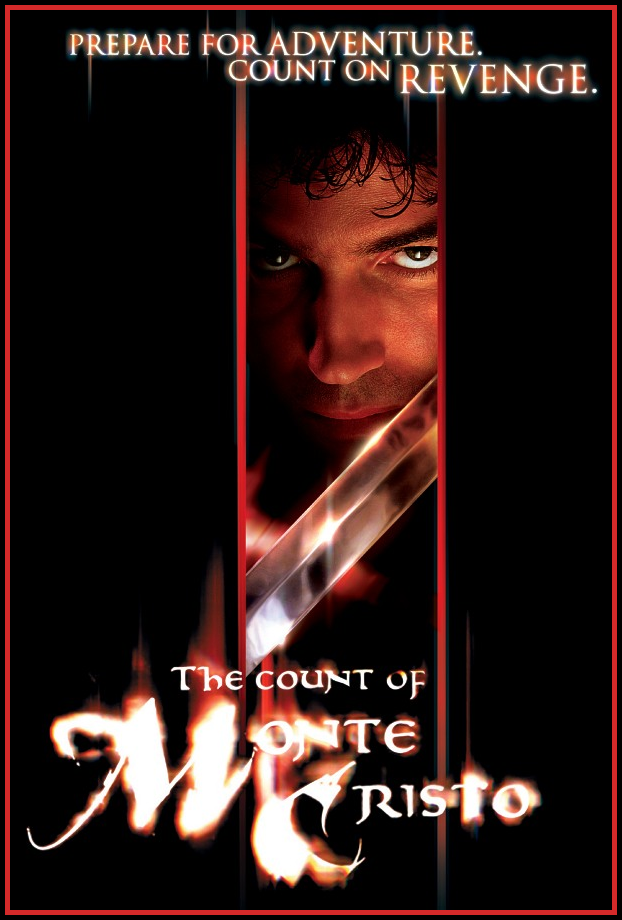
In what has become an unofficial ritual for myself whenever my birthday rolls around I always end up watching a film from 2002 that flew under the radar of most people. While it made modest box-office returns it wasn’t the head-turning blockbuster that some of its producers hoped it would turn out to be. It’s a romantic adventure piece by Kevin Reynolds and for readers of classic literature they’d recognize the title of the film, The Count of Monte Cristo. A film loosely based on the classic novel of adventure, revenge and redemption by French author Alexandre Dumas. The film ends up being a fun, thrilling throwback to films of an era which had marquee stars such as Errol Flynn and Basil Rathbone.
The story is one known well enough. It’s a tale of a man, Edmond Dantès wrongly accussed of a capital crime and imprisoned in the Alcatraz-like prison Chateau d’If through the machinations of three individuals: his best friend Fernand Mondego, first mate Danglars and the ambitious deputy prosecutor Villefort. Dantès spends the next several years in Chateau d’If under the cruel and sadistic eyes of it’s warden, Armand Dorleac (played by Michael Wincott with his usual flair for sadism). It’s while Dantès has started to contemplate suicide after rejecting God for the pain and suffering he has had to endure that he has a fortuitious meeting with another guest of Chateau d’If. It’s this relationship between Dantès and Abbé Faria (Richard Harris in the mentor role he had begun to play in his later years) which take up the bulk of the first third of the film.
Dantès tells him of the circumstances which led to his imprison in Chateau d’If and the thoughts of vengeance on those responsible for his predicament. Faria tries to turn him from his dark path, but seeing how determined his young friend seems on journeying down its twisted path he agrees to teach him how to become adept at being a noble, finances and in swordcraft in exchange for help in digging themselves out of their prison. Taking several more years to complete the education Dantès needs to exact his revenge it ends at the death of Faria and his mentor’s final gift to his student. The location of a treasure so vast that Dantès could retire to a life of peace and contemplation or fund his plans of vengeance.
The middle section of the film shows Dantès finding the treasure and remaking himself through his newfound wealth as the Count of Monte Cristo to better insinuate himself amongst the wealthy and noble-born his targets mingle in. With the help of a bandit whose life spares after a duel in Jacopo (Luis Guzman) the plans Dantès has worked on for years begin to bear fruit as he manipulates and fools Fernand, Villefort and Danglars into his confidence to better see to their downfall. It’s during this time he meets his former fiancee Mercedes (played by the ridiculously beautiful Dagmara Dominczyk), now Countess Mondego after being told of Edmond’s execution earlier in the film, and Fernand’s son Albert. The circumstances of how his former love having had a child and married to one of the men who had conspired against him brings a new complication to Dantès plans.
The last third of the film shows the culmination of Dantès and his elaborate plans to bring about the downfall of all those who had wronged him. While the plans, at times, strain the bonds of disbelief at actually having fooled and worked against his enemies the way the film makes the audience root for Dantès to succeed helps. This is a Dantès who comes off as noble despite being of commoner origins who we stand behind and support in his plans of vengeance. With the amount of wealth at his disposal it’s not too difficult to put oneself in the same shoes and not think of vengeance as well to strike a balance.
It’s a testament to the direction of filmmaker Kevin Reynolds that the film and it’s story never bogs down despite a story with many elaborate plots and secondary characters introduced midway. The fact that the film only borrows some of its complexity from an even more labyrinthine novel shows how the filmmakers actually had to simplify the story as to not make it so complex that it loses the bulk of its audience.
The Count of Monte Cristo also benefit from a strong cast led by Jim Caviezel in the titular role with Guy Pearce playing his former friend and betrayer Fernand Mondego and James Frain as the prosecutor Villefort. Caviezel plays his role as Dantès and as the Count of Monte Cristo as two different people with distinct personalities. There’s Dantès the earnest sailor who just wanted to get back to his love, Mercedes and then there’s the sophisticated and ruthless Count whose machinations would lead to the destruction of lives and reputations. It’s a mystery why Caviezel hasn’t become the star he surely was in the making and this film showed that he had the talent to become one of the industry’s new leading men. I blame Mel Gibson in casting him as Jesus in The Passion of the Christ for having put a curse on Caviezel.
Guy Pierce in the role of Fernand plays the conniving and remoreless villain role to the hilt. With an overbearing and effete noble bearing to his performance it was a character written to inspire hatred not just in its main protagonist but in the audience as well. Pearce knows what his roles represent and has fun playing up the role as main heavy.
Richard Harris as the priest Faria did his usual great work as the elder mentor to a younger man. It was a role he began to be known for starting with Ridley Scott’s Gladiator right up to his final mentor role as the wizard Dumbledore in the Harry Potter film franchise. It’s hard to explain to people that Harris was not always this wise and mentoring father figure, but one who played roles where he’d play womanizers, charming cads and roguish rebel.
The Count of Monte Cristo ended up being more fun than it should be with enough complexities in its storytelling that the film doesn’t dumb down too much the story it was adapted from. To be honest the only way one could truly adapt Dumas’ novel of revenge and redemption is through a long-form tv series. It is just that complex with so many characters that a film adaptation would just be too long or just unnecessarily crowded with characters the audience would care to know. It’s a good thing that the film by Kevin Reynolds was still able to keep to the spirit of the original source while whiling away the story down to its basic core.
It’s a film that plays like a throwback to the swashbuckling films from Hollywood of the 30’s and 40’s and it wouldn’t be too difficult to see Caviezel in the roles Errol Flynn once inhabited. There’s very little special effects in the film which adds more to this sense with swordfight scenes as expertly choreographed as any of the past. The Count of Monte Cristo, for some reason still unknown to me, continues to be the one thing that keeps airing on my birthday and the fact that it’s such a fun and thrilling film that I continue to watch it everytime my day of days roll around. Can’t wait for next year.
Cigarette Burns was John Carpenter’s episodic contribution to the Showtime series, Masters of Horror. This 13-episode horror anthology thought up by Mick Garris (a fellow horror director best known for adapting Stephen King stories) which includes eleven other directors known for their work in the horror genre.
John Carpenter works off of a screenplay that posits an interesting premise about an infamous film that caused the audience it was shown to the first time to go homicidal. The story itself involves a man known in the film community as someone who can find and hunt down any copy of film no matter how rare. Norman Reedus (he of Blade II, The Boondock Saints) plays the cinephile who takes on the job to hunt down a copy of this infamous film titled Le Fin Absolue Du Monde. His client was played with relish by resident weirdo Udo Kier. Really, Kier could be given any role and he’ll add his brand of idiosyncracy and weirdness to the part. In Cigarette Burns he plays an obsessive fan of the rare film to the hilt. His contribution to the the climactic ending will bring a smile to gorehounds everywhere. Alas, it’s Kier’s performance that’s the highlight of the acting in Cigarette Burns. Reedus’ performance as Kirby Sweetman the cinephile leaves much to be desired. The screenplay itself was already average, but with genuine ideas that could be explored if the acting could raise it beyond its C-grade pedigree, but Reedus wasn’t up to it.
Carpenter’s directing really can’t be faulted for the major flaws in the screenplay and in his lead’s performance. It’s not early Carpenter, but his work in Cigarette Burns was much better than what he’s done in his last couple films. In fact, this tv show entry in Carpenter’s body of work resembles one of his more underrated films. I am talking about his ode to Stephen King and H.P. Lovecraft with In the Mouth of Madness. Instead of a book influencing the sanity of the reader, its a film that does it instead. A film that may or may not have divine origins that doesn’t just turn its viewers homicidal but bend their sense of reality.
I think with a better cast and a screenplay that’s worked on a bit more by its writers, Cigarette Burns could’ve been a great episode in the Masters of Horror anthology or, better yet, become a full-fledged feature film. Instead, it’s just a very good work from Carpenter with great gore sequences (courtesy of KNB EFX), but brought low due to a very rough screenplay and a lead actor in Norman Reedus who seemed stoned, drunk or both throughout his entire performance. It’s not something great, but a good showing from Carpenter that said he’s not as washed-up as many seem to be calling him.




 Through the Shattered Lens