BlizzCon 2013: World of Warcraft: Warlords of Draenor


After a one year hiatus, BlizzCon is back. As I watched the opening ceremonies and subsequent World of Warcraft panel yesterday, I couldn’t help but draw parallels to another RPG powerhouse all but forgotten in the western world today: Squaresoft. The series of marketing failures that sent Square spiraling towards bankruptcy in the early 2000s felt eerily close at hand as Blizzard Entertainment unrolled one new project announcement after another yesterday in Anaheim.

Square’s troubles from a western perspective began in 1999. They had, prior to that year, released a handful of non-RPG titles in North America–I remember purchasing shmup Einhänder and enjoying Kenichiro Fukui’s soundtrack if nothing else–but these were Easter eggs not marketed to Square’s traditional fan base. In 1999, Square ported and pushed Ehrgeiz. It was a fighting game marketed specifically for RPG fans, incorporating popular Square franchise characters such as Sephiroth and Cloud Strife, and it was the first Square release in North America that I knew about and did not buy. I thought the game was a really cool idea at the time, but that didn’t change my fundamental disinterest in fighting games.

Next came Final Fantasy VIII. The game was definitely a short term marketing success, but it divided Square’s fan base unlike ever before, because it focused on aspects of the game that fans were traditionally disinterested in. It was the first Final Fantasy title to feature really impressive graphics, it introduced a highly developed card-based mini-game, it reenvisioned a lot of elements of the battle system, and it replaced a traditionally heroic cast with none-too-glamorous introverts. These features drew an audience, but they dulled the interest of loyal series fans who loved the epic tragedies and encompassing global struggle-styled plots of games gone by.

Last came The Spirits Within. Square decided to release a movie geared towards their newer fan base. They had no experience in this field, their diehard fans had already lost interest, and their new fans had no loyalty to the company. It flopped, really badly, and whatever the financial statements of Square Enix say, they never fully recovered their foothold in the western market. They found themselves desperately grasping to reel in a fan base that was too broad to take interest in any single product, until they ultimately faded into obscurity in every market. This can be seen in the fact that most Final Fantasy IX fans disliked Final Fantasy X and vice versa.

I say all of this because it is painfully relevant today. Here are two obvious reasons:

BLIZZARD ANNOUNCED A FIGHTING GAME

This isn’t nearly as misguided as Ehrgeiz. As I understand it, Heroes of the Storm will be styled after DotA, not traditional fighters. (The BlizzCon feed for HotS is hopelessly lagging on me, so I can’t confirm much.) But the idea of duking it out with your favorite characters from Blizzard’s three major franchises is only going to succeed if the gameplay drastically outclasses other games of its genre. They aren’t going to draw fans by letting you play as Kerrigan or Thrall, because most Blizzard loyalists are not convinced by the company’s character development. I would also argue that, following the massive hype and disappointment of Diablo III, Blizzard fans aren’t going to be very compelled by a new title beyond their franchises of choice that is not a wholesale break from what we’re used to. Heroes of the Storm will be free, and that is a huge plus, but it is going to have to be really freakin good to make it off the ground. As was the case with Square’s Ehrgeiz, the franchise card isn’t going to hold much weight in this field of play.

BLIZZARD ANNOUNCED A MOVIE

Yes, Warcraft: The Movie is under production. More will be revealed about this project at 1pm PST Saturday on the Main Stage, but absolutely nothing good can possibly come of it. Like The Spirits Within for Final Fantasy, it will only interest a small portion of the Warcraft fan base and hardly anyone beyond. Blizzard has never been a promising plot engine, and their cinematics are hopelessly cliche. It’s not like there’s any precedent for failure along the console to cinema highway, but I give Blizzard’s shot at turning a profit here about one in zero.

WARLORDS OF DRAENOR OVERVIEW

Now, I’ve claimed that Blizzard does not keep fans based on plot and character development. Am I right? Well, I’ve certainly known WoW players who cared about the plot, but they form a minority in my experience. That’s not to say that I or any other WoW fan would not love to see a really awesome plot. It’s to say we won’t get one. This is something Blizzard is particularly bad at, and it’s not the reason we play their games. That is one of the reasons World of Warcraft: Warlords of Draenor concerns me. The hour and a half of feature coverage yesterday focused heavily on the game’s plot and characters. Blizzard staff went on at length about the progression forward from Mists of Pandaria and the various NPCs you will encounter. In a comically self-defeating slide, they summed it up like this:

That’s all the more a Blizzard plot has ever really amounted to, and it’s why no one cares. Looking beyond the attempted plot hype, what else does Warlords of Draenor have to offer?

SETTING

WoW 6.0 will take place in Outlands, utilizing another weak time-travel plot device to set the zone prior to its cataclysmic restructuring as experienced in The Burning Crusade. Shattrath will now be an independent Draenei city, and the alliance and horde will have their capitals in Shadowmoon Valley and western Blade’s Edge Mountains respectively. These will be known as Karabor for alliance and Bladspire Citadel for horde, and the Blade’s Edge Mountains themselves will not yet exist as such. Their memorable spikey peaks having formed during Draenor’s later destruction, they will be separated into a western, mountainous winter zone (Frostfire Ridge) and an eastern desert (Gorgrond). Shadowmoon Valley will here be a lush land of forests and meadows, not a desolate fel-ridden waste, and Karabor will be the site of what later becomes Black Temple. There will be seven zones in all: Nagrand, Shadowmoon Valley, Tanaan Jungle (Hellfire Penninsula), Talador (Terokkar Forest), Frostfire Ridge (western Blade’s Edge), Gorgrond (eastern Blade’s Edge), and a new zone–Spires of Arak. None of these seem, in my opinion, to offer much of a unique flavor. That is somewhat inevitable, since Outlands is not an unfamiliar world.

The world will loosely resemble Outlands, and like most WoW continents, it will form an image when viewed as a whole:

GARRISONS

Garrisons were described at BlizzCon as “the [Valley of the Four Winds] farm times one thousand“. A garrison is a full town which you can build inside any zone within Draenor, and which you can move from one location to the next. Like the farm, a garrison will involve setting actions into motion which will occur over night (anywhere from a few hours to a full week), but the payout will be much higher. You’ll gain NPC followers who quest and raid for you to bring home epic gear, you’ll be able to tap into other professions beyond your main ones, you can pick and choose what buildings are constructed (armory, stables, etc), and you’ll be able to customize the garrison’s appearance any way you like as it grows. You can even hang a boss’s head from your front gates!

Sounds pretty cool, right? I think it’s riddled with problems. First of all, Blizzard reps claim: “This isn’t a cottage in a far away instance corner that doesn’t actually exist in the world. This is your ability to actually build a base almost as you do in the RTS games, in the actual world, that you’ll be able to see as you fly through the zones. You’ll be able to see it as you go by it. You’ll be able to invite your friends to come and see it if you want to.”

That is horribly misleading. Under the current developmental scheme, your garrison will exist for you and you alone. It’s true, like they said, that it will be smack in the middle of any map you care to put it in, and that it will be visible from afar, but it will be entirely isolated from all other players. It is a solitary bastion in an MMO world. No one will be able to see it (unless you invite them, presumably to role play); no one will be able to attack it; no one will ever know it exists. As such, it’s not much different from the average farming game on your cellphone. The only real reward is the production payout, whatever that may be. Let’s look at a few:
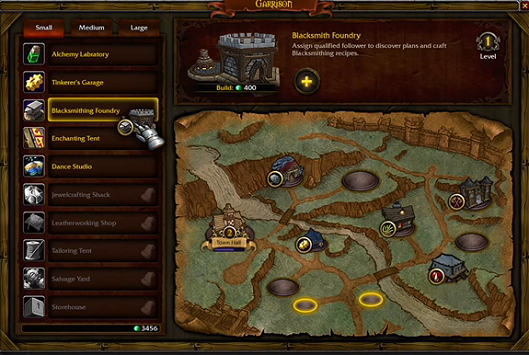
You can choose which buildings to include.

Ok, but what are buildings good for? An inn and stables aside, all buildings in WoW are used almost exclusively for profession and class trainers. But at level 100 you won’t need a class trainer, and Mists of Pandaria drastically nerfed the amount of time and energy necessary to max out a profession, so much so that grinds which once took a month or upwards of 100k gold can now be accomplished in an evening for petty change. (I think that was an awesome improvement in MoP. Don’t get me wrong.) Unless Blizzard invent new uses for these buildings, they will have none. Or if they add such features as transmog, upgrading, and reforging, then Karabor and Bladespire Citadel will be ghost towns. The screen shot Blizzard offered showed the blacksmith being used to learn new patterns. If that’s anything like the daily leatherworking and tailoring pattern rewards in MoP, it will be pretty useless.

It allows access to mats/It farms for you while you’re offline.

What does it farm? Blizzard have still yet to introduce any sort of access to solid gear outside of raiding or valor/conquest points. If this gear isn’t up to par, it will be a waste of time. Does it farm mats? If it’s anything like the Valley of the Four Winds farm in MoP, this will be a completely useless feature unless the mats are BoP. There is a reason you only farm Motes of Harmony in MoP: non-binding general profession mats always have and always will be the domain of bot farmers. You might not like them, but your auction house could not exist without them. They are what make ore and herbs affordable on your server, and the farm system alternative to gathering in MoP has never paid out in time spent to profit earned.

It gives you access to professions you don’t have.

MoP’s profession grind nerf still necessitates six toons at 85 to max everything out, so this could definitely come in handy, but at what cost? The more Blizzard takes away from the auction house, the more inflation will rise.

You can win trophies, and hang your enemies heads upon pikes at the castle wall! Yarrrgh!

The first note I jotted down while watching this BlizzCon session was “wtf is the point of building a castle in an mmo that is not mmo?” That pretty well sums it up. The whole purpose of a trophy case is to brag to other people about your accomplishments.

The bottom line is this: Blizzard couldn’t have given every player in the game a Garrison that existed out there in the real, massive multiplayer world, because it would have been a spam-ridden nightmare. But they could have given one to say, every level 25 guild with at least 20 exclusive active accounts, and they could have taken this in all sorts of promising directions, ranging from pvp sieges to player-made home cities instead of another Shattrath or Dalaran. But they didn’t. Instead, we all get a bigger farm.

GRAPHICS

This is actually pretty sweet. Blizzard is making a massive graphic overhaul to all races in the game, and will now offer visuals competitive with new MMOs on the market.

BOOST TO 90

In an attempt to lure back old players, Blizzard if giving every account a free boost to level 90 for one toon at any level. This is a pretty nice deal, but it could have some unintended consequences. I for one will be employing it as that long-awaited character transfer I was always unwilling to pay money for. By-by dying low population server, hello Sargeras, Kil’jaeden, or Kel’Thuzad. Expect this feature to increase urban migration and server balance polarization.

CROSS-SERVER ITEMS

Blizzard is increasing the types of items that will be available cross-server. In addition to mounts and battle pets, you will now be able to access BoA leveling gear heirlooms on any toon, anywhere. It’s about damn time, I think. They are also making tabards and toys account wide, which is just silly.

DUNGEONS & RAIDS

Warlords of Draenor will launch with 7 dungeons and 2 raids containing a total of 16 raid bosses. Only 4 of the 7 dungeons will be available below level 100, for maximum alt leveling boredom. Upper Blackrock Spire (UBRS) is getting a remake, and the level 100-only dungeons will have non-heroic versions in order to “help players prepare for heroic mode”. … Since no one would voluntarily run non-heroic dungeons at level cap, I interpret this to mean “expect more tedious grinding before you are eligible for real gear.” The reason behind this move is incomprehensible, as no one who is unready for heroic dungeons for reasons other than gear is any less unready for regular dungeons. They are called “noobs”, or “nubs” in some dialects, they are typically too disinterested in the finer details of the game to ever figure it out, and they will be carried by my epic hunter deeps. NEED that agi ring my DK friend! It will definitely help boost you over 10k dps!

Raids are getting a fourth tier. There will now be LFR, Normal, Heroic, and Mythic. LFR through Heroic will all be available under the relatively new and quite successful flex raiding system, and Mythic will be 20-man only. While this all sounds like a fine idea to me, the Blizzard reps did show once again how out of tune they were with the game they developed when they explained flex’s utility: We’ve all been in that annoying situation where a few dps or a healer bail in LFR right before a boss pull and we have to reenter queue and wait, they said. Flex will scale the LFR boss down so we can pull anyway!

Well, no, we haven’t. In fact, that never, ever, ever happens. DPS and healers are replaced in LFR in a matter of seconds. There is a 60 minute long queue line of them ffs. Long waits before boss pulls happen because TANKS leave, and you can’t rescale for that.

PVP

Blizzard is bringing back a world pvp zone, and it’s going to be a 24/7 battle rather than a timed instance. They compared it to classic Alterac Valley, and I’m pretty stoked about that. Unfortunately but necessarily, this is going to be a cross-server zone. That means that you’ll never form a collaborative relationship with your team mates, probably, but with a ton of servers reaching 90:10 faction polarization these days, I for one see no viable alternative.

In the world of arena, Blizzard is creating a separate ladder system called Trial of Gladiators. These ladder fights will only be available at certain dates and times, and they, rather than regular arena queues, will determine season champions. This was supposedly developed to eliminate late-night pairing exploitation, which I wholly intended to get in on to knock out some of my arena achievements, but I’m all for it. One really cool thing is that they’re eliminating gear for the event. You will be given the same premade gear set when you roll in, regardless of your ilevel or resilience, so victory will depend entirely on skill and class balance.

ODDS AND ENDS

Blizzard focused on a number of additional changes that Warlords of Draenor will offer, and most of them are complete rubbish that ought to just be quietly implemented on the next routine patch update.

* Battleground progression information — Blizzard are basically integrating PVP DBM into the game proper. But I’ve got an addon for that.

* Random favorite mount summoning — This will be an option. But I’ve got an addon for that.

* Enhanced bag sorting options — You will now be able to control which bags particular types of loot fall into. But I’ve got an addon for that.

* Battleground scores — You will now be able to see a conglomerate score of your performance in a battleground, incorporating traditional stats such as hks and damage done along with your involvement in objection completions. I am not very confident about Blizzard’s capacity to rate my performance, especially considering there are multiple strategies for winning just about any bg. This is also potentially really dangerous, because they suggested that there might be rewards for high scores. Does this mean that, even if you already have the Cap Five X achievement in a bg, you’re still encouraged to spam the hell out of the flag instead of fighting around it for a shot at the prize?

* Quest items will no longer be stored in bags — Yay!

* You can craft with items in your bank, not just your bag — Yay!

* Item stack caps raised from 20 to 100 — Yay!

But I fear that the few positive changes here and there aren’t going to make a difference in the big picture. Blizzard announced WoW 6 this BlizzCon, as expected, but they had very little to show for it. Plot and characters aren’t what keep us playing this particular game, the Garrison system is a single player entity isolated within an MMO world, and almost every other new thing they emphasized was astoundingly petty. There will be modest improvements here and there–to bag space, to raiding opportunities, to free server migration–but in previous expansions these would be afterthoughts. A lot of interface changes amount to nothing more than addon incorporation, but the players who don’t use say, a battleground objective addon, are probably oblivious to battleground objectives in the first place. The most depressing announcement towards this end was the ADVENTURE GUIDE. This is a menu like the Dungeon Guide, but designed for inexperienced players who don’t have a clue what’s going on. It will tell you what zone you ought to be questing in, where you can go for better gear (a dungeon. a raid. mmhmm…), what battlegrounds are available at your level, and so on. Did it ever cross Blizzard’s mind that the people who can’t figure out the dungeon finder or pvp menus aren’t going to figure out the adventure guide either? Obviously not, because the emphasis once again seems to be “hand more fine details to the players who don’t care and won’t read them.” I’m not trying to insult anybody here. My wife’s been happily bouncing around Eastern Kingdoms leveling gnome locks to 40 for a year now. There are players who want to “win” to the capacity that WoW allows, and there are players who just enjoy a little pew pew before they go to bed and have zero interest in learning more. Last I visited Blasted Lands, there was not a sea of confused level 60s unable to figure out how to walk into the Outlands portal. So just who do Blizzard think they’re helping with these improvements?

Has Blizzard lost touch with their fan base? Mists of Pandaria does not lead me to believe so, but the showcase for Warlords of Draenor looks bleak. With little more than a dime-a-dozen farming mini-game and new zones, dungeons, and raids to offer, I don’t know what I’m supposed to be looking forward to here. I don’t need a new class or a new race to keep me entertained–I’ll be a dwarf hunter until the day I quit–but I need something. Whatever that thing will be, it wasn’t revealed at BlizzCon.

But enough being a Negative Nancy. I’m off to watch Jaedong whoop ass in the Starcraft II World Championship Series Finals. For the swarm!

Ten Years #15: Alestorm


Decade of last.fm scrobbling countdown:
15. Alestorm (1,437 plays)
Top track (73 plays): Barrett’s Privateers, from Back Through Time (2011)
Featured track: Keelhauled, from Black Sails at Midnight (2009)

I tried to start a zombie metal band once, but when I asked some friends to give me a hand they all ran away… Erm, where was I going with this?

Oh yes, for your Halloween evening amusement: Pirate Metal!

I’ve actually listened to this band so much since picking up Captain Morgan’s Revenge in 2008 that they managed to climb all the way to 15th place in my decade-spanning last.fm charts. Alestorm might be the most delightful thing to ever happen to folk metal, pending a Nekrogoblikon follow-up as sweet as Stench (2011). Alestorm support their gimmick with a brilliant knack for catchy composition and a lyrics sheet guaranteed to entertain. Happy Halloween!

My friends, I stand before you
To tell a truth most dire
There lurks a traitor in our midst
Who hath invoked the captain’s ire

He don’t deserve no mercy
We ought to shoot him with a gun
But I am not an evil man
So first let’s have a little fun

We’ll tie that scoundrel to a rope
And throw him overboard
Drag him underneath the ship
A terrifying deadly trip

Keelhaul that filthy landlubber
Send him down to the depths below
Make that bastard walk the plank
With a bottle of rum and a yo ho ho

I will not say what he has done
His sins are far too grave to tell
It’s not my place to judge a man
But for them he will burn in hell

The sharks will dine upon his flesh
And Davy Jones will have his soul
Take his money and his hat
He won’t need them where he’s gonna go

But first lets tie him to a rope
And throw him overboard
Drag him underneath the ship
A terrifying deadly trip.

Keelhaul that filthy landlubber
Send him down to the depths below
Make that bastard walk the plank
With a bottle of rum and a yo ho ho

Ten Years #16: Falkenbach


Decade of last.fm scrobbling countdown:
16. Falkenbach (1,418 plays)
Top track (84 plays): Heathenpride, from En Their Medh Riki Fara (1996)
Featured track: Tanfana, from Tiurida (2011)

Happy Halloween! As you may have guessed, October 31st is our favorite day of the year here at Shattered Lens. I thought I’d celebrate with two entries in my Top 50 series that both happen to be particularly appropriate for the occasion. The first, coming in at 16th place with 1,418 listens over the past ten years, is the solo brainchild of Vratyas Vakyas: Falkenbach. A band I find some excuse to mention almost every October, Falkenbach have about as much of a right as Bathory or Enslaved to claim the invention of viking metal. While Vakyas certainly lacks the widespread influence attributable to Quorthon–only nine copies were supposedly ever made of the 1989 Havamal demo–he seems to have been a part of the movement from its very founding. Recording originally in Iceland and later settling down in Germany, Vakyas has dedicated his career as a musician to persistently refining a unique sound inseparable from the notion of viking metal.

“Viking metal” is a term I use sparingly. It marks, in my opinion, the transition of fringe metal bands away from reactionary Satanism and towards a more refined, pagan appreciation for pre-Christian European tradition. This process took the majority of the 1990s to fully realize, and many of the bands that most commonly receive a “viking” tag–Bathory, Enslaved, Falkenbach, Burzum–originated firmly within the spectrum of black metal. (The term “pagan metal” emerged in much the same manner further east, as Ukrainian and Russian black metal bands found similar cause to divorce Satanism.) Modern use of “viking metal” refers to little more than a lyrical theme, the transition to a folk aesthetic in black metal circles and beyond being at this point complete. “Pagan metal” seems to be the tag for any folkish band that still lies on the fringe, usually through heavy doses of black metal, provided they didn’t get dumped off in the “viking” bin first.

It would make a great deal of sense to me to lump the likes of Enslaved and Bathory into the “pagan” category where applicable, along with more recent acts like Moonsorrow, and abandon “viking metal” altogether. But if it is to persist, I find no band more appropriate for the title than Falkenbach. Much like Summoning, Falkenbach’s sound developed into an independent entity with no clear counterparts. From Ok Nefna Tysvar Ty (2003) onward, Vakyas’s sound has stood distinctly apart. The looping electronic woodwinds, acoustic guitar, mid-tempo beat, and chugging electric guitar in the sample track I’ve provided are all fundamental to the sound visible within the earliest available Falkenbach recordings and fully realized by 2003. But where Summoning has always defied classification, Falkenbach’s close ties to the onset of the viking metal movement seem to grant the term weight. It would be a bit silly to suggest that Falkenbach’s uniqueness is somehow more significant than the countless other innovative, folk-inspired metal bands of the 90s and 2000s, but his timing in history and lack of parallels, be they copycats or coincidental, has earned Vakyas a distinction beyond his impeccable song writing and sincere reverence for the old gods. Falkenbach is, for me at least, the closest thing to viking metal as a style of music that you will ever find.

Ten Years #18: Sigur Rós


Decade of last.fm scrobbling countdown:
18. Sigur Rós (1,358 plays)
Top track (84 plays): Ný Batterí, from Ágætis Byrjun (1999)
Featured track: Hún Jörð, from Von (1997)

I made the claim in my last entry that indie rock was the defining musical style of the past decade. If that came across as a bit of a slap in the face to post-rock, rest assured that I listen to far more of the latter than the former. I don’t feel, however, that post-rock is the sort of style or movement that can be limited to its era of origin. Sure, Mono-esque local bands were fairly abundant in the mid-2000s, but the acts that really rose to stardom under the moniker varied wildly in both sound and artistic attitude. I first heard mention of post-rock in 1999 or 2000 in dual reference to f#a#oo by Godspeed You! Black Emperor and Ágætis Byrjun by Sigur Rós. Flood by Boris, Those Who Tell the Truth Shall Die, Those Who Tell the Truth Shall Live Forever by Explosions in the Sky, Oceanic by Isis, and One Step More and You Die by Mono successively joined the ranks to form a label I found easy to ascribe and virtually impossible to define. Post-rock was and remains a manner of abandoning traditional song structure, sound, lyric, and aesthetic, while retaining standard instrumentation. It can be applied to musicians who predate the term, it can function as a prefix to virtually every established musical genre, and no single property need be present to make it complete. No two bands that have really forged successful careers employing it sound much alike; Sigur Rós’s sound is certainly unique among the ranks.

That being said, I want to talk about this particular feature song and its uniqueness in their discography. Most people who know anything about music have heard a little Sigur Rós by now, and they’ve probably heard the newer material. Von remains an obscurity that was seldom mentioned when Ágætis Byrjun was in its prime of popularity, let alone today. Make no mistake; Ágætis Byrjun blew my mind when I first heard it, and if my last.fm charts had begun two or three years sooner I suspect it would have a thousand more plays to its credit. But my favorite song in the world at the time was “Hún Jörð”. Forget what you know about this band, because you’ll find no peaceful resolution in these seven minutes. Beginning with a static sound that seems to simulate rain, “Hún Jörð” introduces a brief, looping melody so acutely fragile that the listener is instantly drawn to a peak, emotionally wrenched by a vision of something beautiful tottering on the brink of collapse. You want to reach out and hold the melody tight–pull it in–keep it safe–but as the song progresses, that glimmering light tips into the plunge. As the maniacal laughter mocks your helplessness and Jónsi literally screams at the top of his lungs, the song culminates with one of the most gut-wrenching experiences of loss that music is capable of conjuring.

Suffice to say, this is not standard Sigur Rós fare. I used to think the song had been inspired by “Climbing Up the Walls”, but Von was actually fully recorded well before Radiohead released Ok Computer. The vision seems to have been unique to the band, and I did not hear anything approaching it again until the advent of post-black metal a decade later. I don’t know what compelled a band so inclined towards the soft and beautiful to take this child and smash it on the rocks, but by 2013 Von is so thoroughly forgotten that I think most Sigur Rós fans will be in for a shocking surprise.

Ten Years #19: The Shins


Decade of last.fm scrobbling countdown:
19. The Shins (1,344 plays)
Top track (75 plays): Pink Bullets, from Chutes Too Narrow (2003)
Featured track: Gone For Good, from Chutes Too Narrow

When I leave my heavy metal tunnel vision behind and consider what properly ought to be regarded as the most significant musical movement of the first decade of this century, the answer ultimately resolves to indie rock. What that means is, of course, no clear-cut, formulaic sound, any more than grunge or classic rock constitute a style. Indie rock was a particular attitude towards music–a love affair between earth and sky that saw bands fundamentally rooted to rationality float among the clouds. It is unfortunate that my last.fm charts for that era could not make room for the likes of Built to Spill, Ted Leo & the Pharmacists, and The Fiery Furnaces, but those bands that did grind their way into my top 50 represent, I think, one of the finest eras music has to offer. I wouldn’t call The Shins my favorite indie rock band–I’ll reserve that title for an entry a little nearer the top–but I do think they orbit closer the core of what indie rock stood for than any band before or since them.

James Mercer’s genius rests foremost in his lyrics. From the opening lines of Oh, Inverted World on, his ability to paint the simple, mundane concerns of life in lush metaphor–“I think I’ll go home and mull this over, before I cram it down my throat. At long last it’s crashed; its colossal mass has broken up into bits in my moat.”–has defined the indie attitude. It’s permeated with a smug wit, perpetually aware of the trite contrivances of standardized rock that it revels in. Mercer knows his lyrics are extravagant, overreaching their subject matter, and the sort of tongue-in-cheek arrogance of it all is what makes the music so delightful. You can fall in love with it and laugh at the same time.

I chose “Gone For Good” to represent The Shins in this post even though it’s stylistically a bit out of character, because I think it perfectly captures what I love about this band. The lyrics are deliciously pretentious, paired with a comically simple tune that nevertheless successfully pleads for the same pretty appeal as Mercer’s more creative melodies. And now, in an era permeated with the same lack of awareness that tortured the 1980s, it’s a relieving reminder that every dark cloud over the landscape of creative expression is followed by a bit of wit and sunlight.

Untie me, I’ve said no vows.
The train is getting way too loud.
I’ve got to leave here my girl, and get on with my lonely life.
Just leave the ring on the rail for the wheels to nullify.

Until this turn in my head,
I let you stay, and you paid no rent.
I spent twelve long months on the lam.
That’s enough sitting on the fence for the fear of breaking dams.

It took me all of a year,
to put the poison pill to your ear.
But now I stand on honest ground, on honest ground.
You want to fight for this love, but honey you cannot wrestle a dove.
Baby it’s clear.

You want to jump and dance,
But you sat on your hands and lost your only chance.
Go back to your home town, get your feet on the ground, and stop floating around.
I found a fatal flaw in the logic of love and went out of my head.
You love a sinking stone that will never elope,
So get used to the lonesome, girl you must atone some.
Don’t leave me no phone number there.

Ten Years #20: Equilibrium


Decade of last.fm scrobbling countdown:
20. Equilibrium (1,323 plays)
Top track (104 plays): Prolog Auf Erden, from Sagas (2008)

At the end of 2008, I made the peculiar decision to rank Sagas only 6th on my albums of the year list. I knew at the time that it would long outlive the albums that trumped it–The Tallest Man on Earth’s Shallow Grave, Boris’s Smile, Waylander’s Honour Amongst Chaos to name a few–but I suppose I was prioritizing some sort of artsy aesthetic over direct appeal. That was silly. Sagas is the most badass, epic 80 minutes of sound you will ever hear, and it deserves all the glory. Since I don’t know German, I can’t really judge how the lyrics hold up against comparable masterpieces like Blind Guardian’s Nightfall in Middle-Earth and Turisas’s The Varangian Way, but musically it pretty much perfects every epic/symphonic trend in the world of folk metal. What you hear on the opening track, “Prolog Auf Erden”, is a pretty accurate summary of the full album; it’s an explosive, relentless drive through one of the most imaginative worlds metal has ever conjured.

I can’t say I am terribly experienced in Equilibrium’s broader discography. Turis Fratyr (2005) did not grab me quite so immediately, and at the time I was too caught up in enjoying Sagas to really engage it. Rekreatur (2010) had its merits, but I could never fully get over the change in vocalists from Helge Stang to Robert Dahn. Never a band to rush out the new releases, their fourth studio album is not expected until some time in 2014.

Ten Years #21: Emperor


Decade of last.fm scrobbling countdown:
21. Emperor (1,301 plays)
Top track (119 plays): I Am the Black Wizards, from In the Nightside Eclipse (1994)

I don’t know that I would call Emperor the most influential band in black metal, but Ihsahn and Samoth’s brainchild definitely ranks among the top 5. Without ever abandoning the sinister, aggressive atmospherics, nor dropping the tremolo guitar, blast beats and double bass, or shrill, shrieking vocals standard for the style, Emperor managed to infuse black metal with a level of technical expertise and creative song structure that appealed to listeners far beyond the isolated genre. Their progressive rock and classical flares drew in a broad fan base that never had the time for Bathory’s viking tendencies or Darkthrone and Mayhem’s bm in the raw. They were certainly one of the first black metal bands that caught my eye, at a time when their contemporaries just sounded like noise to me. It’s no wonder that at this point they’ve ascended to 21st on my decade-spanning last.fm chart.

Talent and attention did not necessarily go hand in hand in early 90s black metal. Mayhem’s music left a lot to be desired, and Burzum’s discography bears some major flops. Emperor are more the exception than the norm in that they achieved a fairly professional level of quality while actively participating in Euronymous’ circle of murder and arson. Part of that, I suspect, stems from Ihsahn’s ability to keep his hands clean in the midst of it. Ihsahn managed to say out of trouble–or at least not get caught–while Samoth, Faust, and Tchort were all doing time. Persistent similarities from In the Nightside Eclipse all the way to Ihsahn’s most recent solo works suggest that he might have done the lion’s share of the song-writing all along. (Their final album, Prometheus, was composed by him exclusively.) Whoever wrote it, the refreshing originality of Emperor’s discography has had significant consequences. They didn’t set the standard for what black metal in the 90s ought to sound like, though plenty of bands copied them. Rather, they set the standard for how the genre might progress. Emperor took a very formulaic split-off from thrash and demonstrated time and again that it could be one of the most diverse, open-ended genres of music on the market.

Horror Music


I suppose if I asked most people what music they identified with horror, John Carpenter’s “Halloween Theme” and Mike Oldfield’s “Tubular Bells” (The Exorcist) would come up first. After that, you’d get a lot of Rob Zombie and Glenn Danzig. So right off the bat, you’re looking at an enormous variety of sounds and styles connected mainly by association. While John Carpenter’s work was intentionally composed for the film in which it appeared, “Tubular Bells” was originally a 50 minute progressive rock opus that was anything but sinister or foreboding in its full form. Misfits was a goth punk band that happened to favor horror themes. White Zombie’s horror imagery was more a matter of crudeness and vulgarity in the spirit of GWAR; their sound was a frontrunner in the emergence of industrial groove metal, and the greatest “horror” associated with Rob was the countless terrible nu metal spinoffs. A couple of “top ten horror songs” lists I stumbled upon even list Bobby Boris Pickett’s “Monster Mash” and Richard O’Brien’s “Time Warp”. I mean, “Monster Mash” is a fun Halloween song, sure, but horror? Really? And the Rocky Horror Picture Show does make me want to vomit, but we have to draw the line somewhere.

Suffice to say, “horror” music is not a genre at all. Simply associating a song with a scene or theme is enough to relate them; Huey Lewis and the News will probably make me smile and think of Christian Bale chopping people to bits in his apartment for the rest of my life. But there are definitely certain musical attributes that conjure in us a less glitzy feeling of dread than Hellbilly Deluxe. That skittering cockroach beat in the background of Halloween is completely unnerving; Carnival music is way creepier than Stephen King’s It; Black Sabbath’s appreciation for diabolus in musica virtually invented heavy metal; and it took a firm dose of the blues in 1988 for Danzig to capture a sense of the sinister that Misfits could never convey.

I don’t believe that any particular musical formula is the coalescence of evil. The music we find most haunting is derived from association too, but it connects in more subtle ways than say, the fact that a particular song appears in a horror film or mentions witches in the chorus. The real deal distorts what comforts us, denies our sense of order, and pries upon our innocence. Through a musical medium as through any other, horror focuses on shattering the lens through which we perceive reality as an ordered, logical construct. It reminds us of the real nightmares in life while nullifying our means to counteract them. It takes us to the world of the child, where emotional extremes enhance our senses of comfort and terror alike.

The carnival tune and music box are prime targets, conjuring in our minds a time when fear was more potent. The brief piano loop, the simple hum, the monotone drone–these bring us to solitude and isolation through minimalism. Effective horror themes offer no comforting symphony or rock ensemble to encase us in a nuanced world. They surround us with something singular and far from warm, or with nothing at all. The wind chimes warn of a storm; when none is coming, the darkness is all the more unnatural. The cathedral bell, a sign of fellowship on a Sunday morning, also tolls for death. A twitch, a buzz, a repeated knocking, a bit of static–things that would otherwise annoy us–exploit the close connection between discomfort and tension.

Or else we can completely overwhelm the senses with noise that strips away the familiarity which typically diminishes extreme music’s effect, leaving us a nervous wreck. When Blut Aus Nord chose to employ programmed, industrial blast beats in their 777 trilogy, they effectively eliminated the one element of the music that would have sounded too familiar to disturb. Instead, the epileptic guitar finds companionship in a persistent, unnatural clatter designed to place us permanently on edge.

Other bands have found other means to the same end. Peste Noire’s unique “black ‘n’ roll” sound enlivens a standard formula for “evil” music with a pep and a grin, giving the brutalizer a human face in the spirit of medieval sadism. Sunn O))) are inclined to drone on for ages, developing a false sense of comfort before infusing their deep buzz with a caterwaul of shrill pitches and clattering chimes. (I actually had a guy start freaking out on me at work one day when “Cry For The Weeper”, which he didn’t even notice playing, hit the 3:55 mark.)

And lastly, we can’t forget the power of lyrics to render a song gruesome. The stereotypical lines of a black metal song–nonsense about necromoonyetis and an appeal to Satanism far less disturbing than the average Christian commentator on Fox News–are pure cheese, and they entertain us in a manner similar to your typical zombie flick. But when you first heard Smashing Pumpkin’s “x.y.u.”, you probably got a feeling more akin to Henry: Portrait of a Serial Killer.

Horror in lyrics is something a bit the opposite of horror in sound; it strikes us most deeply when we can be convinced that there is absolutely nothing supernatural about it. There are certainly a few exceptions–Townes Van Zandt’s tall tale in “Our Mother the Mountain” chills me to the bone–but generally speaking, the real atrocities committed throughout human history far exceed the limits of our imaginations. Vlad Tepes was worse than any vampire, and from Elizabeth Bathory and Ariel Castro to Hernando Cortes and Adolf Hitler, we are flooded by examples of direct personal cruelty and dehumanized mass slaughter. When a song manages to make us think of these individuals and events beyond the safety blanket of historical narrative, an authentic feeling or horror is hard to deny.