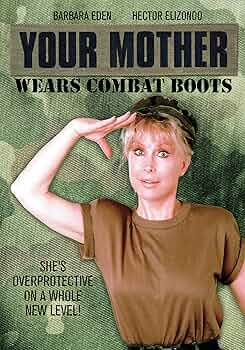
Your Mother Wears Combat Boots (1989, directed by Anson Williams)


Jimmy Anderson (David Kaufman) drops out of college and enrolls in the Army without telling his mother.  He wants to go through basic training and then do Parachute airbone training at Fort Benning, just like his father did before he died in Vietnam.  When Barbara Anderson (Barbara Eden) finds out what her son has done, she rushes down to Georgia to try to stop him.  When she discovers that Jimmy has already entered Fort Benning, Barbara assumes the identity of an AWOL trainee so that she can enter the base.  All she wants to do is track down her son and convince him to leave.  However, Sgt. Charlie Burke (Hector Elizondo) fully expects Barbara to complete her training and, in a few weeks time, to jump out of an airplane.

Probably the most interesting thing about this made-for-TV comedy is that no one seems to find it strange that a 58 year-old woman claims to have just completed basic training.  Barbara Eden looked great in this movie and she put a good deal of energy to going through all the usual Private Benjamin routines but she was still clearly too old to have ever recently enlisted in the Army and, even if she wasn’t in her 50s, the fact that she doesn’t know how to salute nor does she understand any of the basic army terminology used by Sgt. Burke should have been dead giveaways that she wasn’t who she was claiming to be.  That could have been funny if the movie had acknowledged Barbara’s age or maybe even had her act shocked that she was somehow getting away with her ruse.  Instead, the movie itself doesn’t seem to understand how strange it would be for a 58 year-old woman to show up for Parachute training.  The movie never finds the right balance between comedy and sentimentality but Barbara Eden gives it her all and the dependable Conchata Ferrell scores some laughs as a specialist who “eats recruits for breakfast.”

This film was directed Anson Williams, a.k.a. Potise from Happy Days. Ron Howard and Henry Winkler weren’t the only directors to come out of that show.

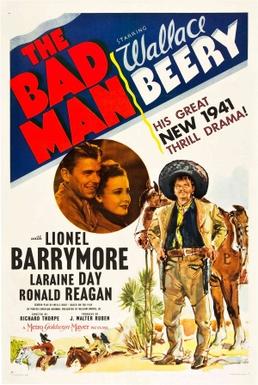
The Bad Man (1941, directed by Richard Thorpe)


Gil Jones (Ronald Reagan) lives on a ranch with his cantankerous uncle, Henry (Lionel Barrymore).  After their cattle are stolen by the notorious bandit Pancho Lopez (Wallace Beery), Gil and Henry are faced with the prospect of losing their ranch.  Banker Jasper Hardy (Henry Travers) wants to foreclose on Henry and take over the ranch but a businessman named Morgan Pell (Tom Conway) shows up and offers to pay the then-huge sum of $20,000 for the land.  Accompanying Morgan is his wife, Lucia (Laraine Day).  Lucia was Gil’s childhood love and Morgan fears that Lucia still loves Gil more than him.  Also in the mix is Gil’s comic relief best friend (Chill Wills), who has a crush on Hardy’s daughter (Nydia Westman).  Negotiations are interrupted when the flamboyant Lopez and his men return to the ranch and take everyone, but Gil, hostage.

This sepia-toned film is based on a stage play, one that had already been filmed twice.  It was Ronald Reagan’s first film for MGM and, when Reagan was running for President, he quipped that if he could survive acting opposite Wallace Beery and Lionel Barrymore than he could survive negotiating with Leonid Brezhnev.  The role of Gil is a typical Ronald Reagan role.  He’s good-natured and dependable and a little boring.  Because he once saved Lopez’s life, Lopez is willing to help him out with his problems.  Reagan is not bad in the role but he is overshadowed by Barrymore and Beery, two veteran actors who chew the scenery with gusto here.  Berry speaks in an exaggerated and not at all convincing Mexican accent while Barrymore bellows all of his lines.  Gil has so many different people yelling at him that it’s impossible not to feel sorry for him.  Morgan has ulterior motives for offering to buy the land and Tom Conway is a convincing villain.  Lopez helps out Gil and her uncle, saving not only their land but also plotting to bring Gil and Lucia back together.  It’s a stage bound mix of drama and comedy that doesn’t really work, though Beery and Barrymore are amusing and Ronald Reagan shows why he was cast in so many best friend roles.

Whether you’ll enjoy it will probably depend on how you feel about the cast because they’re really the only reason to watch.  If you’re a fan of Barrymore, Beery, or Reagan the film might work for you.  If you’re not, this stagey 70-minute western is probably not for you.

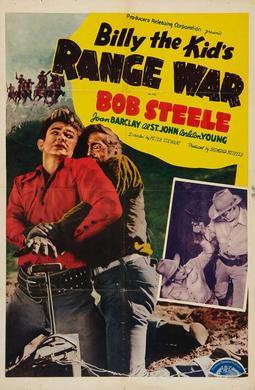
Billy The Kid’s Range War (1941, directed by Sam Newfield)


Billy the Kid was a big damn hero.

At least that’s the claim of Billy The Kid’s Range War, in which Billy (played by middle-aged Bob Steele) is a do-gooder with a comedic sidekick named Fuzzy (Al St. John) and a hankering to help Ellen Gorman (Joan Barclay) bring a new stagecoach line to town.  Williams (Karl Hackett) does want to the Gorman family to success so he hires Buck (Rex Lease) to dress up like Billy the Kid and ride a horse that looks like Billy the Kid’s and commit crimes, like killing Ellen’s father.  Framed for all those crimes that he didn’t commit and with his best friend (Carleton Young) ordered to arrest him, Billy decides to go under cover so that he can clear his good name.  Someone pretending to be Billy the Kid got him into this mess.  Now, Billy’s going to get out of it by pretending to be someone else.

The action is pretty standard for a B-western.  Mostly, it’s interesting to see a movie where Billy the Kid is actually a nice guy who gets framed.  No wonder a whole generation grew up with no idea about true history of the American frontier.  Sam Newfield directed a handful of Billy the Kid films and the capable Bob Steele starred in most of them but this is the only one that I’ve sat down and watched and it actually left me missing the production values of the Johnny Mack Brown films.  For fans of these type of westerns, there’s the promise of seeing familiar actors like George Cheseboro and Ted Adams doing there thing.  Even the outstanding character actor Milton Kibbee makes an appearance.  For those who do not like westerns, this film is not going to change their minds.

Despite the promise of the title, there is no range war in this movie.  There’s just Billy the Kid, trying to clear his good name.

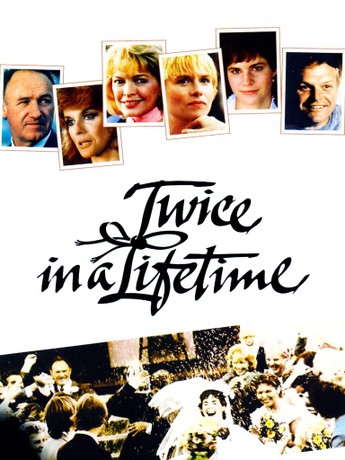
Twice In A Lifetime (1985, dir by Bud Yorkin)


Today, for obvious and tragic reasons, people everywhere have been thinking about their favorite Gene Hackman performances.  Hackman was an actor who always brought his all, even when he was appearing in a lesser film.  I think you could ask five different people for their five favorite Hackman performances and they would all give five different answers.  His performance as Lex Luthor in Superman and Superman II has always been one of my favorites.  Others will undoubtedly cite his award-winning performance as Popeye Doyle in The French Connection or his great work as Norman Dale in Hoosiers or his work in classic neo-noirs like The Conversation and Night Moves.  Let’s not forget his most unexpectedly great turn, as the blind man in Young Frankenstein.  Hackman gave so many great performances that some of them were for films that are not even remembered today.

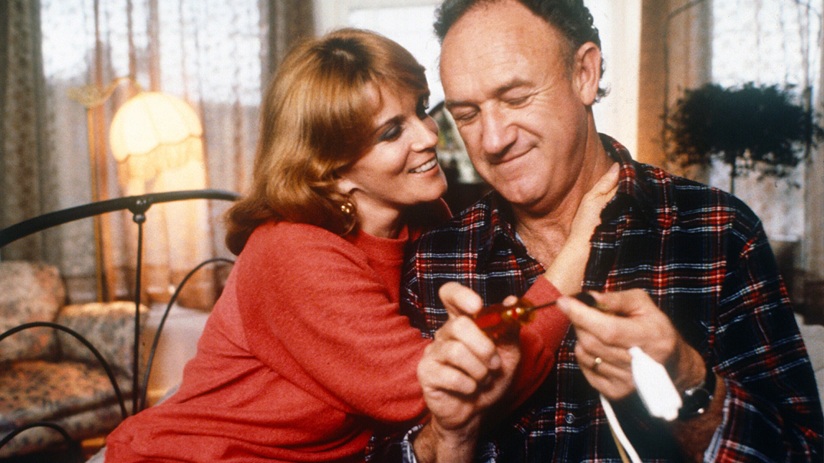
Twice In A Lifetime is one of those forgotten films but I think it features one of Hackman’s best performances.  He plays Harry Mackenzie, a steelworker who is married to Kate (Ellen Burstyn, made up to look frumpy) and who has two daughters (Amy Madigan and Ally Sheedy).  Harry is the type of everyman that Hackman excelled at playing.  He’s a hard worker, a good family man, and a good friend.  What no one, not even Harry realizes, is that he’s also having a midlife crisis.  On his 50th birthday, he goes out to the neighborhood bar with his buddies and falls for the new barmaid, Audrey (Ann-Margaret).  Harry ends up leaving his wife for Audrey, pursuing the spark that his marriage no longer gives him.  The movie follows Harry and Kate and their daughters as they adjust to their new lives and they plan for the younger daughter’s wedding.

Twice In A Lifetime was one of many 80s films that dealt with divorce and it has the same flaws that afflicted many of them.  These films, which were often made by middle-aged directors who had just gone through their own divorces, rarely played fair when it came to depicting why the marriage failed.  Twice In A Lifetime stacks the odds in Harry’s favor just by suggesting that Ann-Margaret would end up working at a bar frequented by steelworkers.  Harry has to choose between his plain and boring wife and Ann-Margaret.  That’s going to be a difficult choice!  The twist that Harry’s decision was ultimately the right thing for Kate doesn’t feel earned.

But damn if Gene Hackman isn’t great in this film.  Even though he was one of the most recognizable actors in the movie, Hackman is totally believable as both a steelworker and a man who worries that he’s destroyed his family.  It’s not just one moment or scene that makes this a great performance.  It’s the entire performance as a whole, with Hackman portraying all of Harry’s conflicted emotions both before and after leaving his family.  Hackman gives a performance that is more honest than the film’s script or direction.  The movie believes Harry did the right thing but Hackman shows us that Harry himself isn’t so sure.  Hackman captures the middle-aged malaise of a man wondering if his life is as good as it gets.  When the movie works, it is almost totally due to the emotional authenticity of Hackman’s performance.  Twice in a Lifetime may be a forgotten film but it’s also proof of how great an actor Gene Hackman really was.  There will never be another one like him.

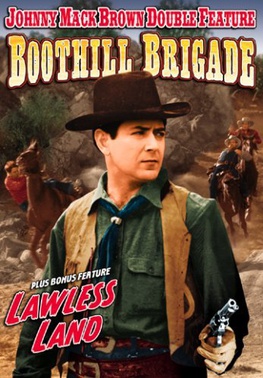
Boothill Brigade (1937, directed by Sam Newfield)


Rancher Jeff Reynolds (Frank LaRue) used to be one of the good guys on the frontier but he’s recently changed.  He fired all of his loyal ranch hands and instead hired a motely crew of outlaws.  He’s buying up land and evicting the squatters who have been living there.  About the only good thing he does is hire Lon Cardigan (Johnny Mack Brown) to be his new herd boss.  Lon is engaged to Reynolds’s daughter, Bobbie (Claire Rochelle).  With the help of Bobbie and comic relief cook Calico Haynes (Horace Murphy), Lon tries to figure out why Reynolds is now doing the bidding of the evil John Porter (Ed Cassidy).

The title is the most exciting thing about this movie, which is one of those old B-movies that puts the “creak” in creaky.  There’s surprisingly little gunplay but there is a lot of horse riding.  For a film that runs less than an hour, a surprising amount of it is just shots of people riding from one location to another.  The horses’ hooves sound impressive on the soundtrack but it’s not exactly exciting.  As always, Johnny Mack Brown is a convincing cowboy.  It’s a good thing he looks like he knows what he’s doing when he’s riding a horse!  The plot was standard B-western fluff.  Johnny Mack Brown appeared in a ton of westerns and almost all of them seemed to feature the same range war.  There are better Johnny Mack Brown movies out there.  This one is for completists only.

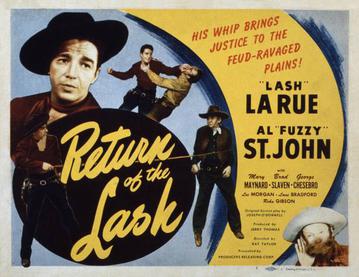
Return of the Lash (1947, directed by Ray Taylor)


There’s another range war brewing on the frontier.  Big Jim Kirby (George Chesebro) knows there’s plans for a new railroad so he wants to steal the land from the ranchers so he can make a fortune off a selling it.  Kirby calls in everyone’s mortgage, knowing they’ll never be able to pay.  Rancher Tom Grant (Buster Slaven) reaches out to Cheyenne Davis (Lash LaRue, a look alike for Humphrey Bogart)) and Fuzzy Q. Jones (Al St. John) for help.  Cheyenne raises the money but then he makes the mistake of trusting Fuzzy to deliver it.  Fuzzy takes a knock to the noggin and now, he’s got amnesia.  Where’s the money?

This is a standard B-western and you know the drill.  Big Jim’s henchmen don’t want that money to get paid.  Cheyenne is on the side of the angels.  Fuzzy provides comic relief.  Lash LaRue appeared in several B-westerns.  He never became as big a star as some of his contemporaries but he did have a gimmick that made him memorable.  Most westerns stars used guns.  LaRue had a bullwhip.  When LaRue was first offered the role of Cheyenne, he lied and said he could crack a whip.  After he struggled to teach himself, tiny production company PRC hired a professional trainer.  That was a huge expense for a poverty row studio but it paid off because LaRue became proficient with the whip and he had a surprisingly long career.  He was born Alfred LaRue.  The studio came up with the Lash nickname.  Many western stars, like Johnny Mack Brown, played characters who shared their name.  Lash almost always played Cheyenne Davis.

Lash LaRue’s movies were cheap and never that memorable.  In this one, Lash barely appears and most of the action is carried out by Al St. John as Fuzzy.  But Lash LaRue did play an important part in Hollywood history when he briefly came out of retirement to teach Harrison Ford how to crack a whip for a little film called Raiders of the Lost Ark.

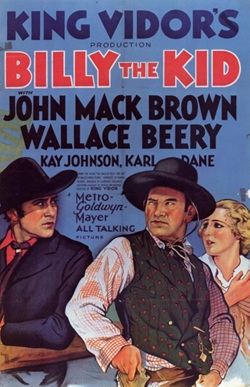
Billy The Kid (1930, directed by King Vidor)


In a frontier town, land baron William P. Donavon (James A. Marcus) finds his control challenged by the arrival of a English cattleman named John W. Tunston (Wyndham Standing).  Donavon orders his henchmen to gun down Tunston on the same day that Tunston was to marry the lovely Claire (Kay Johnson).  Tunston’s employee, an earnest young man named Billy The Kid (Johnny Mack Brown), sets out to avenge Tunston’s murder.  When Billy starts killing Donavon’s henchmen, it falls to Deputy Sheriff Pat Garrett (Wallace Beery) to arrest him.  When Billy escape from jail and rides off to be with Claire, Garrett pursues him.  Garrett is a friend of Billy’s and he knows that Billy’s killings were justified.  But he’s also a man of the law.  Will he be able to arrest or, if he has to be, even kill Billy?  Or will Garrett let his friend escape?

There were two silent biopics made about Billy the Kid but neither of them are around anymore.  This sound movie, directed by King Vidor, appears to the earliest surviving Billy the Kid film.  It’s a loose retelling of Billy’s life and his friendship with Pat Garrett and it doesn’t bother with sticking close to the established facts but that’s to be expected.  It’s an early sound film and, seen today, the action and some of the acting feels creaky.  Wallace Beery was miscast as Pat Garrett but I did like Johnny Mack Brown’s performance as the callow Billy.  The movie goes out of its way to justify Billy’s murders and it helps that Billy is played by the fresh-faced Brown.  King Vidor shows a good eye for western landscapes, a skill that would come in handy when he directed Duel In The Sun seventeen years later.

There are better westerns but, for fans of the genre, this film is important as the earliest surviving film  about one of the most iconic outlaws not named Jesse James.  It’s interesting to see Brown, usually cast as the clean-cut hero, playing a killer here.  The film’s ending is pure fantasy but I bet audiences loved it.

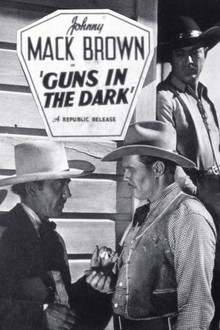
Guns In The Dark (1937, directed by Sam Newfield)


In Mexico, two American cowboys, Johnny Darrel (Johnny Mack Brown) and Dick Martin (Julian Madison) join a poker game to try to win some money and help out their buddy, Oscar (Sid Saylor).  When they discover that cantina owner Manuel Mendez (Ted Adams) has rigged the game, a fight breaks out.  The lights turn off.  In the darkness, several guns are fired.  When the lights come back up, Dick is dead.  Mendez convinces Johnny that he accidentally shot his friend in the fight.  Guilt-stricken, Johnny tosses aside his guns and returns to Texas.

Johnny has sworn that he will never shoot another gun but when he’s hired to work at a ranch owned by Joan Williams (Claire Rochelle), he finds himself in the middle of a range war between Joan and Brace Stevens (Dick Curtis), with Mendez also making an unwelcome return to Johnny’s life.  Even after Johnny discovers the truth about what happened that night at the cantina, he doesn’t pick up a gun.  Instead, Johnny fights the bad guys with lassos and plates.

Guns In The Dark is only 54 minutes long and it features actors who will be familiar to any fan of the old B-westerns.  Sidekcick Sid Saylor’s stuttering schtick gets old quickly but Johnny Mack Brown is as likable as always in Guns In The Dark and he comes across as being an authentic cowboy even when he’s not carrying a gun  Given that this film features even more horse chases than the typical Johnny Mack Brown b-western, it’s good that Brown is so convincing.  What isn’t convincing is how stupid Johnny Darrel is required to be in order for him to fall for Mendez’s lie in the first place.  I appreciated the change of pace from Brown just using a gun to stop the bad guys but I wish the reason behind it had been more convincing.  This isn’t one of Johnny Mack Brown’s more memorable westerns though, as always, it’s easy to see why he was one of the early stars of the genre.


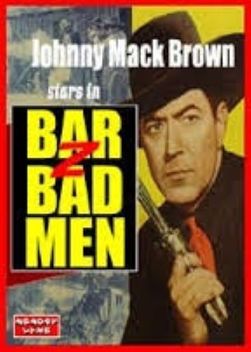
Bar-Z Bad Men (1937, directed by Sam Newfield)


After getting kicked out of town for shooting the place up during a night of friendly fun, cowboy Jim Waters (Johnny Mack Brown) drops in on his old friend, rancher Ed Parks (Jack Rothwell).  Ed has got a strange problem.  There are cattle rustlers about but instead of stealing Ed’s cattle, they’re adding cattle to Ed’s herd.  It’s an obvious scheme to try to create a feud between Ed and his neighbor, rancher Hamp Harvey (Frank LaRue).  Before Jim and Ed can solve the problem, Ed is gunned down.  Harvey is the number one suspect but Jim figures out the truth, that Harvey has been betrayed by one of his own employees and that all of this is a part of a scheme by Sig Bostell (Tom London) to take control of both ranches.

Bar-Z Bad Man is a B-western with a notably twisty plot as Bostell plays both sides against each other for his own benefit.  As usual, Johnny Mack Brown makes for a good and convincing western hero.  Whether he’s chasing someone on his horse or drawing his guns, Brown is always a convincing cowboy.  What makes this film interesting is that it opens with Johnny Mack Brown engaging in the type of behavior that most B-western heroes would never think of doing.  Shooting up the town and then getting exiled for his actions adds an element of redemption to Jim’s efforts to get to the bottom of Bostell’s schemes.  Or it would if Jim ever really seemed to feel bad about shooting the town up.  His excuse is that he was just having a good time.  Try to get away with that in the real old west, Jim!

Bar-Z Bad Men is a good B-western for those who like the genre.  The story is solid and Johnny Mack Brown is as convincing saving the west as he was shooting it up.


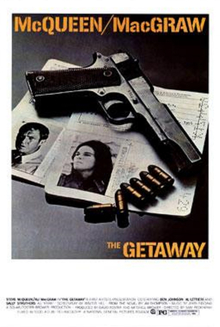
The Getaway (1972, directed by Sam Peckinpah)


Doc McCoy (Steve McQueen) is doing a ten-year sentence in a Texas state prison when he’s offered a chance at parole.  The only condition that Jack Benyon (Ben Johnson) gives Doc is that, once out of prison, Doc is going to have to plan and carry out a bank robbery with two other criminals, Frank (Bo Hopkins) and Rudy (Al Lettieri).  Desperate for his freedom and to be reunited with his wife, Carol (Ali MacGraw), Doc agrees.  On the outside, Doc carries out the robbery but it turns out that no one can be trusted.  With everyone double-crossing everyone else, Doc and Carol head for the border, pursued by the police, Rudy, and Benyon’s brother, Cully (Roy Jenson).

Based on a novel by Jim Thompson, The Getaway is a fast-paced and violent heist film.  It was on this film that Ali MacGraw and Steve McQueen first met and famously fell for each other.  Married to producer Robert Evans, Ali MacGraw left him for McQueen.  Their very real chemistry gives the film its forward momentum and it is so palpable that it doesn’t matter that the stunningly beautiful Ali MacGraw couldn’t really act.  Steve McQueen, on the other hand, is at his coolest in The Getaway.  McQueen was an actor who didn’t need much dialogue to say a lot and The Getaway features him at his tough and ruthless best.  Doc is not one of the good guys.  He’s a bad guy but not as bad as Rudy, Frank, Jack, and Cully.

As was typical of Peckinpah, The Getaway is full of small moments and details that make the movie’s world come to life.  While Doc and Carol flee across Texas, Rudy has a twisted loves story of his own with Fran (Sally Struthers, in a role that will surprise anyone who only knows her as Gloria Stivic).  Jack Dodson plays Fran’s kindly husband and gives a performance that reminds us of the human cost of crime.  Slim Pickens has a wonderful cameo as an old cowboy whose truck is hijakced by Jack and Carol.  Those who thought of Peckinpah as just being a director of violent thrillers often overlooked the moments of humanity that regularly emerged amongst all the bloodshed.

The Getaway was not given the critical acclaim it deserved when it was released but today, it’s regularly recognized as a career best for both Sam Peckinpah and Steve McQueen.