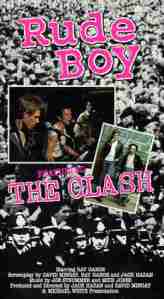
 London. 1980. Ray (Ray Gange) is an alcoholic who lives in a council block, one that is decorated by the type of racist graffiti that, years later, is still a distressingly common site in London. Ray spends his days working at a Soho sex shop and his nights drinking. One night, at the pub, he drunkenly shares his opinion that politics is all “bollocks.” The man that Ray is talking to is Joe Strummer of The Clash. Soon, Ray (whose sympathies make him a natural supporter of the National Front) is a roadie for punk rock’s most prominent socialists. “I’m watching you!” Mick Jones snarls at Ray. At another point, he yells at Ray to “Get off the fucking stage!” during a show. The perpetually drunk Ray struggles with even the slightest of duties but he loves The Clash, even though they seem to hate him.
Rude Boy is an odd one and, watching it, it’s not surprising to learn The Clash subsequently disavowed the movie. Whenever The Clash are off-stage, they simply do not come across well. For a proponent of world revolution, Mick Jones seems a little too comfortable with his role as a decadent rock star. Joe Strummer, one of the most incendiary political lyricists of all time, struggles to articulate his views whenever he’s not performing and is often reduced to mumbling clichés about the people’s struggle. Fortunately, the majority of Rude Boy is taken up by footage of The Clash performing, whether in the studio recording Give ‘Em Enough Rope or on tour or at a Rock Against Racism concert. The footage of The Clash performing is never less than amazing, though it is easy to see what Johnny Lydon meant when he complained that The Clash were so high energy and undisciplined that they always burned themselves out three or four songs into a show.
As for the rest of the movie, it was largely improvised, with only a few scripted scenes. While I think Rude Boy would have made a stronger statement if it had just been a straight concert film, its documentary style does capture the bleak lives of despair that inspired a thousand punk songs. Because of Rude Boy‘s uneven structure, the life of Ray the Roadie may not seem to add up to much, especially when compared to everything else going on around him.
Maybe that was the point.


 It’s High Noon in space!


 When I saw that Erin has picked
  Lisa asked me to review an old best picture nominee for today’s movie a day so I picked Here Comes The Navy, because hardly anyone has ever heard of it and I usually like old service comedies.
 The year is 1874 and James Otis (Charles Bronson) is traveling through the Dakota Territory. Everywhere that James Otis goes, someone tries to shoot him. This is because James Otis is actually the infamous Wild Bill Hickcock and everyone this side of Deadwood has a reason to want him dead. Hickcock has returned to the territory because he is losing his eyesight and he fears that he may be dying. Hickcock has been having nightmares about a giant albino buffalo and believes that it is his destiny to either kill it or be killed himself.
 At his Colorado ranch, journalist Hunter S. Thompson (Bill Murray) is up against a deadline. He has to finish his story about his friendship with the radical lawyer and activist, Carlo Lazlo (Peter Boyle). Thompson flashes back to the time that he covered a trial in which Lazlo defended a group of young men charged with possession of marijuana. When the men are sent to prison, Lazlo snaps and physically attacks the prosecutor. Later, Lazlo resurfaces during the Super Bowl and tries to convince Thompson to join him in fighting a revolution in Latin America. And finally, in 1972, Lazlo tracks Thompson down while Thompson is traveling with the Nixon campaign.
 When a federal surveyor disappears while checking out the ghost town of Waterhole, the U.S. Marshall sends Cheyenne Davis (Lash La Rue) and Fuzzy Jones (Al “Fuzzy” St. John) to investigate. It turns out that gold has been discovered around Waterhole, on land owned by the Trent Family. Bad guy Vance Sharpe (Jack Ingram) is trying to kill the last remaining Trents — Rodney (Steve Frost) and his daughter, Diane (Jennifer Holt) — so that he can claim the land as his own. As Cheyenne and Fuzzy investigate, there are plenty of shootouts, fist fights, and an out of control stagecoach. Since this is a Lash LaRue film, there is also a lot of exciting bullwhip action.
 Through the Shattered Lens