A Movie A Day #188: The War Game (1965, directed by Peter Watkins)


“Do you know what Strontium-90 is and what it does?”

That question is asked as part of a man-on-the-street interview in The War Game.  Despite a pledge by the Home Office to educate the British public on the possible effects of atomic war and nuclear fallout, the man being asked has no idea what Strontium-90 is.  For that matter, I have no idea what Strontium-19 is.  The War Game makes a good case that the only way anyone will ever understand that true horror of atomic conflict is to live through it but, by the point that we have no choice but to know what Strontium-90 is and what it does, it will be too late.

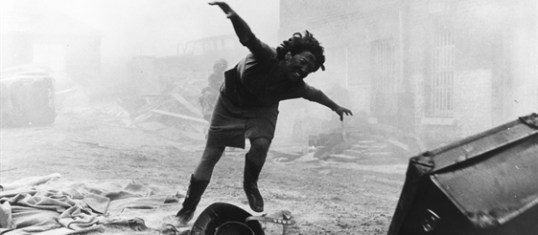
Clocking in at a brisk 50 minutes, The War Game is set up like documentary, though the majority of the film is staged.  (That did not stop The War Game from winning an Oscar for best documentary feature.)  Made at the height of the Cold War, The War Game suggested that not only was Britain not prepared for a possible nuclear attack but that the attack itself would be so devastating that was literally no way that it ever could be prepared.  Opening with interviews with typical Britons expressing both their ignorance about the longterm effects of an atomic war, The War Game proceeds to visualize what would actually happen if the UK ever did find itself attacked. When the bomb falls, most people are nowhere near a shelter.  (“Within this car,” the narrator says, “a family is buring alive.”)  Even for those who get to safety, it turns out that there is no shelter strong enough to protect its inhabitants from both physical and psychological damage.  The film ends with chilling scenes of London bobbies executing looters and British children saying that they never want to grow up.

The War Game was originally made for the BBC, which deemed the program to be to “upsetting,” refused to air it, and subsequently tried to bury it.  This attempt at censorship had the opposite effect, earning The War Game a theatrical release and exposing it to an even larger audience than would have seen it originally.  However, it would be another 20 years before the BBC allowed The War Game to air on television.  Though, especially for media-savvy viewers, the staged nature of this “documentary” is sometimes too obvious, The War Game is still a powerful and bleakly disturbing vision of an all-too possible future.
A Movie A Day #187: The Rainbow Man/John 3:16 (1997, directed by Sam Green)


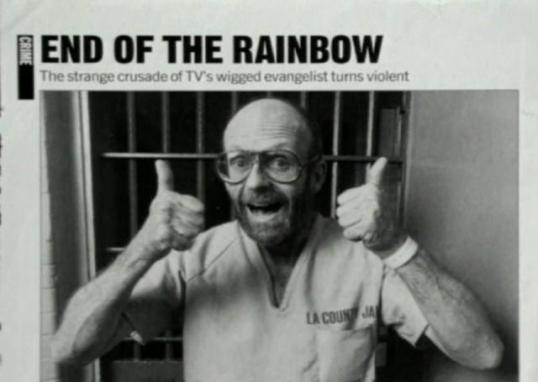
Who was Rollen Stewart?

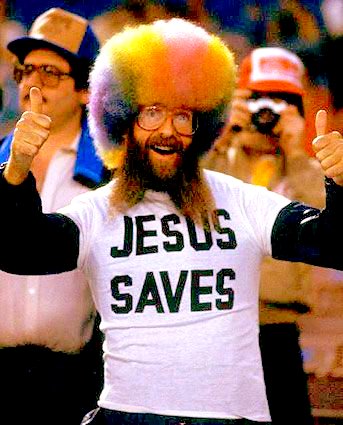
Briefly, he was a celebrity.  In the 1970s, he was inspired to start appearing at every sporting event that he could, wearing a leisure suit and a rainbow afro wig.  As the Rainbow Man, Rollen became a familiar face on television, even getting to appear in a beer commercial.  What no one knew was that, before he became the Rainbow Man, Rollen was the child of an abusive alcoholic and that he never emotionally recovered from the murder of his sister.

Rollen Stewart was also an aficionado of marijuana, which perhaps led to the next stage in his odd career.  While possibly high, Stewart became a born again Christian and he traded in his disco lifestyle for a hand-made signs and t-shirts reading John 3:16.  When his new religious persona proved to be far less popular than his Rainbow Man persona, Rollen decided that it was a sign that the end of not just his celebrity but also world itself was near.  He started to leave stink bombs in various churches and Christian bookstores.  (Because, according to him, “God thinks this stinks!”)  In 1992, Rollen entered a motel room, lit a joint, covered the windows with religious placards, and then took a hotel maid hostage.  He is currently serving a life sentence.

The Rainbow Man/John 3:16 is a documentary about the strange life and times of Rollen Stewart.  Along with plenty of footage at Rollen at the height of his fame, the documentary also includes footage of a visibly unstable Rollen in prison.  The documentary is 20 years old so I don’t know if Rollen still believes the world is about to end.  He comes up for parole later this year.

The documentary is only 48 minutes long.  I wish it had been longer because Rollen’s life was an interesting one.  His greatest tragedy is that this attention-seeker became famous before the advent of reality TV.  Today, he could have revived his career by appearing on Dancing With The Stars or I’m A Celebrity, Get Me Out Of Here.  Instead, he is just another inmate at California’s Mule Creek Prison.

A Movie A Day #186: Joysticks (1983, directed by Greydon Clark)


It’s Porky’s in an arcade!

Every gamer knows how accurate this is.

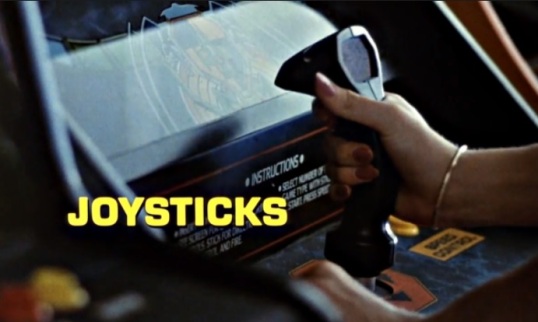
Jeff Bailey (Scott McGinnis) is the manager of the hottest (and only) arcade in town.  His grandfather owns the place and Jeff is everyone’s friend but he does not play any of the games.  When he was younger, he was caught getting it on with his girlfriend in an arcade.  She was sent out of town and Jeff was left so traumatized that he swore he would never touch another joystick.  However, he may have to go back on his pledge because the local evil businessman (Joe Don Baker) is determined to take over the arcade and he has recruited King Vidiot (Jon Gries) to help him do it.  In between Jeff getting laid and King Vidiot scheming, there are all the usual teen sex comedy hijinks.  Just like in real life, the arcade is perpetually full of hot, single girls wearing bikinis.  A hot dog gets stuck between a pair of breasts.   Pacman is played by a topless video game groupie.  Inevitably it all leads to a training montage and a showdown between Jeff and King Vidiot, with whoever gets the highest score at Super Pacman winning control of the arcade.

King Vidiot was the height of 80s fashion.

Joysticks is as dumb as it sounds but it is also a lot of fun, especially if you want to see what life was like before everyone had internet access and their own home gaming console.  The movie is full of classic games, from Pac-Man to Satan’s Hollow.  The best thing about the arcade is that the final video game duel is played with giant, floor-mounted joysticks.  I’m not sure they would work well in real life but they look extremely cool.

Check out those joysticks!

For those wondering, at no point does Joe Don Baker play Pacman during Joysticks.  If he had, the end result would have been a classic for all time.

Grab that joystick, Joe Don. You know you want to.

Joysticks?  I wonder if that title was supposed to have a double meaning.

Arcade Life, 1983

A Movie A Day #185: Emperor of the North Pole (1973, directed by Robert Aldrich)


Emperor of the North Pole is the story of depression-era hobos and one man who is determined to kill them.

The year is 1933 and Shack (Ernest Borgnine) is one of the toughest conductors around.  At a time when destitute and desperate men are riding the rails in search of work and food, Shack has declared that no one will ride his train for free.  When Shack is first introduced, the sadistic conductor is seen shoving a hobo off of his train and onto the tracks.  Shack smiles with satisfaction when the man is chopped in half under the train’s wheels.

A-No.1 (Lee Marvin) is a legend, the unofficial king of the hobos.  A grizzled veteran, A-No. 1 has been riding the rails for most of his life.  (The title comes from the hobo saying that great hobos, like A-No. 1, are like the Emperor of the North Pole, the ruler of a vast wasteland).  A-No. 1 is determined to do what no hobo has ever done, successfully hitch a ride on Shack’s train.  He even tags a water tower, announcing to everyone that he intends to take Shack’s train all the way to Portland.

If A-No. 1 did not have enough to worry about with Shack determined to get him, he is also being tailed by Cigaret (Keith Carradine), a young and cocky hobo who is determined to become as big a legend as A-No. 1.  Cigaret and A. No. 1 may work together but they never trust each other.

Like many of Robert Aldrich’s later films, Emperor of the North Pole is too long and the rambling narrative often promises more than it can deliver.  Like almost all movies that were released at the time, Emperor of North Pole attempts to turn its story into a contemporary allegory, with Shack standing in for the establishment, A-No. 1 representing the liberal anti-establishment, and, most problematically, Cigaret serving as a symbol for the callow counter culture, eager to take credit for A-No. 1’s accomplishments but not willing to put in any hard work himself.

As an allegory, Emperor of the North Pole is too heavy-handed but, as a gritty adventure film, it works wonderfully.  Lee Marvin is perfectly cast as the wise, no-nonsense A-No. 1.  This was the sixth film in which Marvin and Borgnine co-starred and the two old pros both go at each other with gusto.  Carradine does the best he can with an underwritten part but this is Borgnine and Marvin’s film all the way.  Marvin’s trademark underacting meshes perfectly with Borgnine’s trademark overacting, with the movie making perfect use of both men’s distinctive screen personas.  As staged by Aldrich, the final fight between Shack and A-No. 1 is a classic.

Even at a time when almost every anti-establishment film of the early 70s is being rediscovered, Emperor of the North Pole remains unjustly obscure.  When it was first released, it struggled at the box office.  Unsure of how to sell a movie about hobos and worrying that audiences were staying away because they thought it might be a Christmas film, 20th Century Fox pulled the movie from circulation and then rereleased it under a slightly altered name: Emperor of the North.  As far as titles go, Emperor of the North makes even less sense than Emperor of the North Pole.  Even with the title change, Emperor of the North Pole flopped at the box office but, fortunately for him, Aldrich was already working on what would become his biggest hit: The Longest Yard.

Keep an eye out for Lance Henriksen, in one of his earliest roles.  Supposedly, he plays a railroad worker.  If you spot him, let me know because I have watched Emperor of the North Pole three times and I still can’t find him.


A Movie A Day #184: A Letter From Death Row (1998, directed by Bret Michaels)


Songwriter Michael Raine (Bret Micheals) moved to Nashville from Philadelphia, searching for a new life.  Instead, he ended up convicted of murder and sentenced to death.  Michael says that he is innocent but the police have a video tape of him smothering his girlfriend with a pillow.  Michael says it was just a sex game.  He was in the bathroom, testing out his karate moves, when someone else broke into the house and smothered the victim for real.
In prison, Michael is interviewed by Jessica Foster (Lorelei Shellist), who says that she is working on a book that has nothing to do with her other job as chief adviser and mistress to the governor of Tennessee (Swan Burrus).  Meanwhile, another prisoner on death row, a former priest named, I’m not joking, Lucifer Powers (Drew Boes), claims that he has been framed by the governor and only Michael can help him get justice.

A Letter From Death Row not only starred Poison frontman Bret Michales but it was directed, produced, written, and scored by him as well.  If it sounds like a vanity project, it is.  It was also apparently a passion project.  Michaels had something important to say, though I doubt anyone could guess what it was from watching this movie.  Making a movie as incoherent as A Letter From Death Row requires real commitment.  Just check out the scene where the sadistic prison guards make Michael remove his false teeth before allowing him to speak to Jessica.  A less committed director would have cut this scene, just because it was unnecessary and did not add anything to the movie.  Not our Bret.  He knew it was important to show the world that he could act like a man with no teeth.

Like Michaels’s other film, No Code For Conduct, both Martin and Charlie (or Charles, as he insisted on being called at time) Sheen are giving co-star billing in A Letter From Death Row.  However, Martin is only on screen for 90 second and Charlie’s role as a police officer is literally a case of blink and you’ll miss him.  The rest of the cast was made up of local Tennessee actor and it shows in their frequently stiff performances.  Radio talk show host Phil Valentine is especially bad as Raine’s defense attorney.

I would not call A Letter From Death Row a good film but, even if it is for all the wrong reasons, it is still more interesting and watchable than No Code For Conduct.  As opposed to the blandly serviceable work that he did on No Code For Conduct, Bret Michaels embraced his pretentious inner film school grad for A Letter From Death Row.  Dutch angles, extreme closeups, black and white flashbacks (or are they flashforwards?), oversaturated color, and random slow motion are all used to tell this incredibly pointless story.  Michaels not only divides the movie into chapters (complete with titles like “The Famous Final Scene”) but also includes scenes of himself writing and reading the movie’s script.  Bret directs the Hell out of this movie and, if nothing else, the contrast between his ambition and the actual results makes the movie as watchable as the typical train wreck.

Though maybe not for the reasons intended, A Letter From Death Row ain’t nothin’ but a good time.

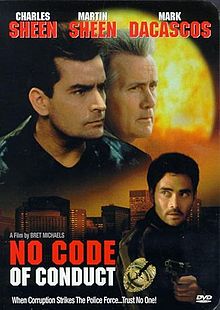
A Movie A Day #183: No Code of Conduct (1998, directed by David Lee…sorry, Bret Michaels)


From the strange period of time in which Charlie Sheen wanted people to call him Charles, comes this generic action movie.
Detective Jake Peterson (Charles Sheen) is a loser.  Even though his father (Martin Sheen) is the chief of police, Jake is so bad at his job that he has been assigned to work in the evidence locker.  His wife (Meredith Salenger) is always yelling at him for being a neglectful father.  The only person who likes Jake is his partner (Mark Dascasos, who is wasted) and partner’s never live for long in cop movies.  When Jake discovers that evil businessman Julian Disanto (Ron Masak) is plotting to smuggle Mexican heroin into Arizona, he has a chance for redemption but it will not be easy because Disanto is not only working with a corrupt DEA agent (Paul Gleason, of course) but he also has a band of psychotic henchmen.

This predictable and not very exciting action film is interesting for two reasons.  First of all, it was directed by the poor man’s David Lee Roth, Bret Michaels.  At the time, the future star of Rock of Love and Celebrity Apprentice winner was best known for being the lead singer of the most boring hair metal band of the 80s, Poison.  It is always interesting when someone who found fame as something other than a filmmaker tries his hand at directing.  Sometimes, the results can be surprisingly good and sometimes, the result is No Code For Conduct.  Michaels and Sheen (who co-wrote the script) may have been trying to pull off an homage to the action films of their youth but No Code For Conduct has more in common with the work of Uwe Boll than the work of William Friedkin.

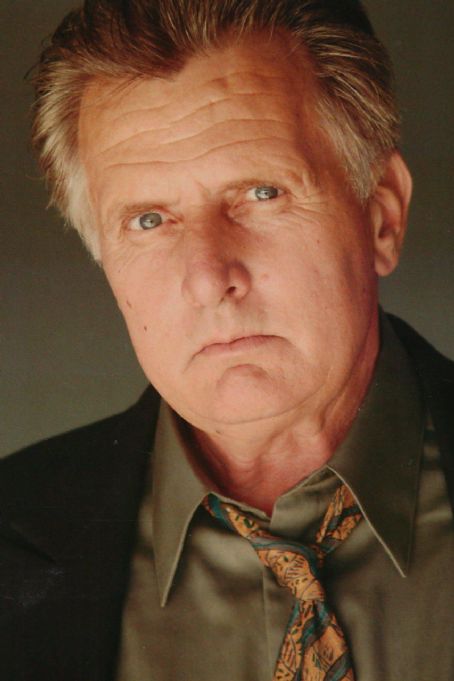
The other interesting thing about No Code for Conduct is that, even though “Charles” and Martin are top-billed, it is actually a four Sheen/Estevez movie.  Renee Estevez briefly appears as a cop while Martin’s brother, Joe Estevez, is in charge of the police motor pool.  If No Code For Conduct is an act-off between the members of the Sheen/Estevez clan, Joe emerges as the clear winner.  Charlie does his wide-eyed intense thing.  Martin goes through the movie with a “the shit I do for my son” air of resignation.  Renee is not around long enough to make an impression.  But Joe?

Joe Estevez is the man!

Joe Estevez, the only Estevez that matters

A Movie A Day #182: FM (1978, directed by John A. Alonzo)


Hey, California!  Are you ready to soft rock!?
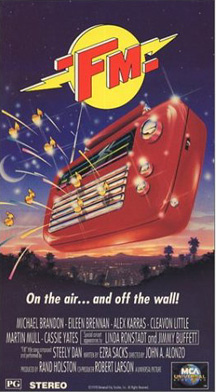
That is the question asked by FM, a movie about rock that tries to stick it to the man with some of the safest, least revolutionary music ever recorded.

FM is centered around Q-Sky, an FM radio station in Los Angeles.  Because the laid back station manager (Michael Brandon) allows his DJs to program their own music with little commercial interruption, Q-Sky has become one of the most popular radio stations in California.  The corporate suits, though, demand that Q-Sky play less music and air more commercials, especially one that is specifically designed to get mellow Californians to join the Army.  When Brandon refuses, he is fired.  Outraged, Q-Sky’s motley crew of DJs (who include Martin Mull, Cleavon Little, Eileen Brennan, and even former football great Alex Karras) barricade themselves in the station and lead a protest by playing their music without commercials.

That would all be well and good except that the DJs spend most of their time playing songs by such noted rockers as Jimmy Buffett, Billy Joel, and REO Speedwagon.  A major set piece of the film is Q-Sky’s attempt to secretly broadcast a Linda Ronstadt concert that is being sponsored by a rival station.  At a time when Johnny Rotten was still singing Anarchy in the UK,  Q-Sky’s idea of rebellion was to go from Bob Seger to James Taylor with limited commercial interruption.

The always reliable Martin Mull is always good for some laughs and this was the only movie directed by award-winning cinematographer John A. Alonzo so, if nothing else, FM always looks good.  With its ensemble cast and episodic narrative, FM tries hard to be an Altmanesque satire but, ultimately, it fails because the revolution is not going to sound like The Doobie Brothers.

(Even though The Doobie Brothers clearly rock.)

“Who likes The Doobie Brothers?”

Because Michael Brandon looked like Gary Sandy and Martin Mull possessed a passing resemblance to Howard Hesseman, some reference books state that FM was the inspiration for WKRP in Cincinatti.  However, the first season of WKRP was already in production before FM was released to theaters and FM was such a financial flop that it is doubtful it inspired anything.

Add to that, while Venus Flytrap probably could have made it work, Dr. Johnny Fever would never have fit in at Q-Sky.  Johnny’s frequent acid flashbacks would have unnerved the mellow Q-Sky vibes.  Herb Tarlek, on the other hand…

“It must be a struggle to match the belt with the shoes.”
“Sometimes, I can’t do it.”


A Movie A Day #181: Guilty As Sin (1993, directed by Sidney Lumet)


When wealthy playboy David Greenhill (Don Johnson, doing a one-note Michael Douglas impersonation) is accused of throwing his wife out of a window, there’s only one lawyer who he wants to defend him.  Jennifer Haines (Rebecca De Mornay) may have just won a huge case but it is obvious that the only reason that David wants her on his team is because she’s sexy as Hell and David has an obsessive streak.  Still, despite the misgivings of her boyfriend (Stephen Lang) and her mentor (Jack Warden), she takes the case, convinced that she is the only attorney smart enough to be able to get David acquitted.

It becomes very obvious that David is not only probably guilty but that he might be a serial killer as well.  Not only does he start to turn up everywhere that Jennifer goes but, protected by attorney/client privilege, he starts to tell her all of his dark secrets.  Jennifer finds herself trapped into defending an obviously guilty client, one who appears to be setting her up to be his next victim.  Even when he fails to pay her for her services, the trial judge refuses to allow Jennifer to quit the case.

Back in the 90s, Guilty As Sin used to frequently show up on late night HBO and Cinemax.  I always watched because I had a crush on Rebecca De Mornay and I bet I was not alone as far as that’s concerned.  Late night cable is where Guilty As Sin belongs, which makes it strange that this weak and implausible movie was directed by Sidney Lumet.  One of the legitimately great American directors, Lumet directed several classic courtroom thrillers over the course of his career.  Guilty As Sin is not one of them.  This is probably the most impersonal film that Lumet ever made.  Other than the presence of Lumet favorite Jack Warden, there is nothing about Guilty As Sin that would lead anyone to think that it had been directed by the same man responsible for 12 Angry Men, Dog Day Afternoon, Network, or Prince of the City.

Fortunately, though Guilty As Sin was one of his Lumet’s last films as a director, it was not his final film.  Released in 2007, Lumet’s final film was a crafty thriller called Before The Devil Knows Your Dead, which showed that, at the age of 83, Lumet was still one of the greats and that Guilty As Sin was just a minor bump in an otherwise brilliant career.

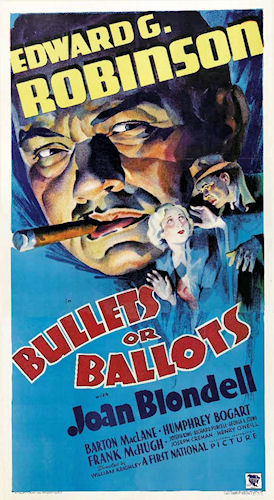
A Movie A Day #180: Bullets or Ballots (1936, directed by William Keighley)


Johnny Blake (Edward G. Robinson) was one of the toughest cops in New York City, until he punched out his new captain (Joe King) and was kicked off the force.  That punch was witnessed by racketeer Al Kruger (Barton McLane).  Kruger has long wanted to get Blake to join his organization and, with Blake now out of work, Kruger makes an offer.  Blake goes to work for Kruger, much to the consternation of Kruger’s second-in-command, Bugs Fenner (Humphrey Bogart).  Bugs says that anyone who was once a cop will always be a cop.  Bugs is right.  Blake is working undercover, trying to expose and take down the mob from the inside.

Bullets or Ballots is an entertaining if predictable gangster film from the 1930s.  After making his career playing bad guys, Robinson makes the transition to the side of law and order without losing any of his trademark attitude.  Bogart plays one of the many remorseless killers that he played before Casablanca reinvented him as a hero.  Bullets or Ballots may be predictable but it’s impossible not to enjoy watching Robinson and Bogart snarl hard-boiled insults at each other.

Second-billed Joan Blondell does not have much screen time but her role is still an interesting one, as a tough businesswoman who runs a numbers racket with her former maid (played by Louise Beavers).  I would have enjoyed seeing a full movie just about Blondell’s character but she mostly takes a back seat to Robinson and Bogart.

Unfortunately, unlike Little Caesar, The Public Enemy, and Scarface, Bullets or Ballots was made after Hollywood started to enforce the infamous Production Code and, as a result, Bullets or Ballots never reaches the gritty, violent heights of those earlier films.  Still, fans of Robinson, Bogart, and Blondell will find much to enjoy here.

A Movie A Day #179: Heavy Metal Parking Lot (1986, directed by Jeff Krulik and John Heyn)


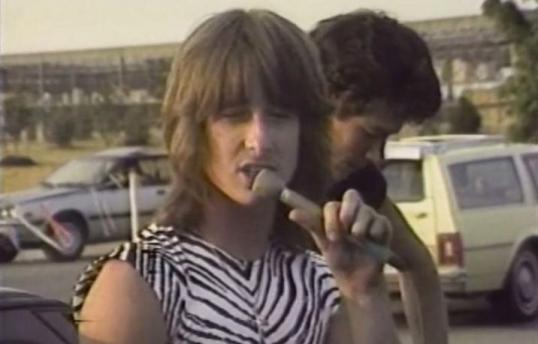
Everyone remembers the Zebraman.

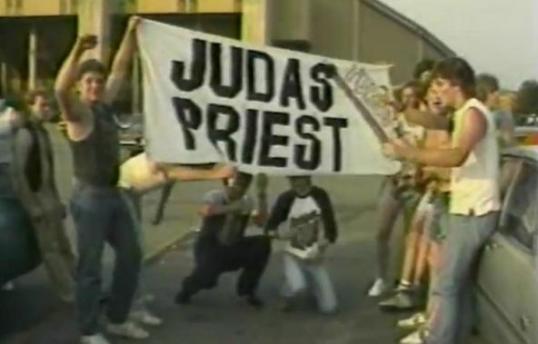
In 1986, two aspiring filmmakers, Jeff Krulik and John Heyn drove down to the Capital Center in Landover, Maryland and interviewed several Judas Priest fans (and, to be fair, a few lost souls who were there for Dokken) who were tailgating in the parking lot, before a concert.  Some of them were drunk.  Some of them were stoned.  Some of them were posers and some of them were genuine metalheads.  The end result was a 17-minute documentary called Heavy Metal Parking Lot.  In the days before YouTube, bootlegged VHS copies of this film made Heavy Metal Parking Lot into an underground classic.

In 17 minutes, Krulik and Heyn introduced viewers to several different fans.

There was this guy, who said his name was Graham, “as in gram of dope!,” and who had strong feelings about the legalization of drugs:

There was Michelle, who said she came from Mayberry, USA:

There were these people, who looked like the cast of every 80s teen comedy ever made:

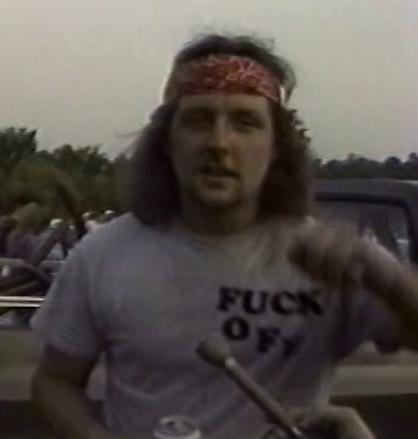
There’s the Fuck Off Guy who says he plans to “get fucked up, drink a few beers, you know.”

There’s even this loser:

But the one that everyone remembers is Zebraman, a young man wearing a zebra-print jumpsuit who, fueled by alcohol, shares some thoughts on punk rock:

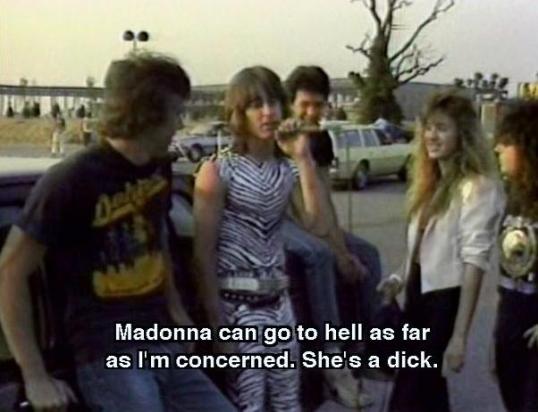
He followed up with some thoughts on Madonna:

13 years later, in 1999, Krulik and Heyn tracked down the famous Zebraman for a “Where Are They Now” update.  When they found him, living in a nice house in the suburbs, they discovered that not only did he not know that he had become an underground cult star but that he also no longer listened to heavy metal.  Zebraman described himself as being a country music fan:

Zebraman, grown up.

Both Heavy Metal Parking Lot and Heavy Metal Parking Lot Alumni: Where Are They Now? can be viewed on YouTube.