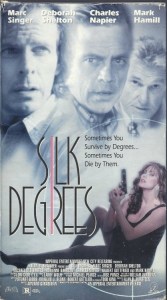
 Actress Alex Ramsey (Deborah Shelton) may have become a star as a result of playing the lead role in a cop show but she still worries that her show is not realistic enough. When a fight with her director (Gilbert Gottfried) leads to her walking off the set for the hundredth time, Alex stumbles across a real-life murder. Now being chased by terrorists and gun smugglers, Alex is forced to go into hiding. FBI agent Baker (Marc Singer) is assigned to protect her but how can he hide one of the most famous women in America, especially one who does not appreciate being told what to do? Making things even worse, there is a traitor in the bureau. Shelton is going to have to use all of her tv crime-fighting skills to survive.
Though it featured enough Deborah Shelton nudity to win it a place in the regular Skinemax rotation, Silk Degrees is basically a standard 90s direct-to-video action film but it has a cast that will be appreciated by any B-move fan. Along with Body Double‘s Shelton, Beastmaster’s Marc Singer, and everything’s Gilbert Gottfried, Silk Degrees also features Charles Napier as Singer’s boss, Mark Hamill as Singer’s partner, and Katherine Armstong as a duplicitous femme fatale. The main villain is played by singer Michael Des Barres. Even Adrienne Barbeau shows up in a tiny role! Silk Degrees is not a great movie but with a cast like this, it does not have to be.
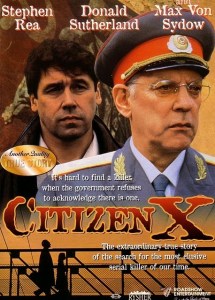 How do you solve a crime in a society that refuses to admit that crime exists?
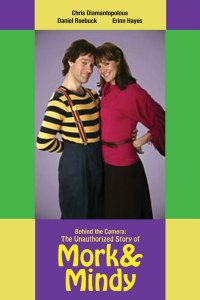 The year is 1978. A television producer named Garry Marshall (Daniel Roebuck) teaches America how to laugh again by casting Pam Dawber (Erinn Hayes) and a hyperactive stand-up comedian named Robin Williams (Chris Diamantopoulos) in a sitcom about an alien struggling to understand humanity. Despite constant network interference, the show makes Robin a star but, with stardom, comes all the usual temptations: lust, gluttony, greed, pride, envy, wrath, and John Belushi.
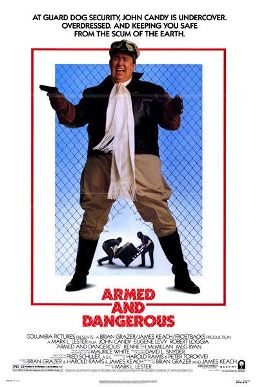 John Candy and Eugene Levy make a great team in the underrated comedy, Armed and Dangerous.
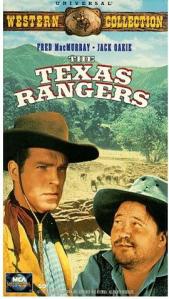 Sam (Lloyd Nolan), Jim (Fred MacMurray), and Wahoo (Jack Oakie) are three outlaws in the old west. Wahoo works as a stagecoach driver and always lets Sam and Jim know which coaches will be worth holding up. It’s a pretty good scam until the authorities get wise to their scheme and set out after the three of them. Sam abandons his two partners while Jim and Wahoo eventually end up in Texas. At first, Jim and Wahoo are planning to keep on robbing stagecoaches but then they realize that they can make even more money as Texas Rangers.
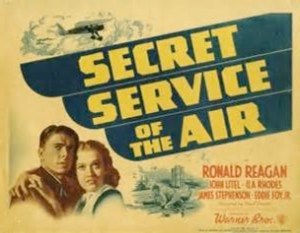 When a secret service agent’s investigation into a supposed counterfeiting ring instead leads to him discovering a plot to smuggle illegal aliens into the United States via airplanes, the agent ends up plummeting several hundred miles to his death. Realizing that they need someone who can go undercover and infiltrate the smuggling ring, the Secret Service recruits Lt. Brass Bancroft (Ronald Reagan). Bancroft is a war hero who is now a commercial airline pilot. He is also good with his fists, has an innate sense of right and wrong, and a sidekick named Gabby (Eddie Foy Jr., giving a very broad performance as the movie’s comic relief). But before Brass can win the trust of the smugglers, he will have to establish a firm cover story and that means allowing himself to be arrested on fake charges. In order to save the day, Brass will have to first survive prison.
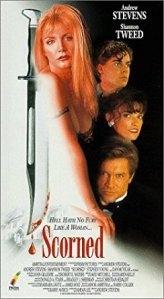 “In an hour, I promise, you’ll be able to beg in two languages.” — Patricia (Shannon Tweed) in Scorned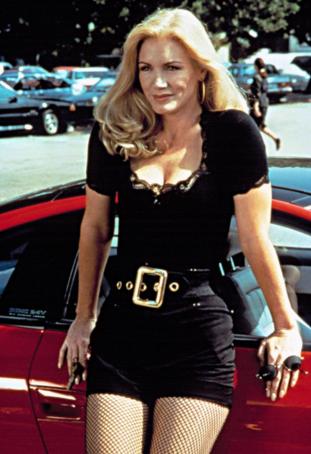
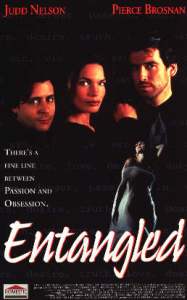 There has been a car crash in Paris and now, David (Judd Nelson) is in the hospital, slowly recovering. In flashbacks, it is revealed that David is an American writer who came to France after his first novel flopped. He came to see his best friend, a womanizing photographer (Roy Dupuis), and ended up meeting and falling in love with the beautiful model, Annabelle (Laurence Treil). Even as he worked on his second novel, he was consumed with jealousy over Annabelle. Why was she sneaking off to a château owned by a mysterious and decadent businessman named Garavan (Piece Brosnan)? Any why, while he is in the hospital, is his second novel published and credited to someone else?

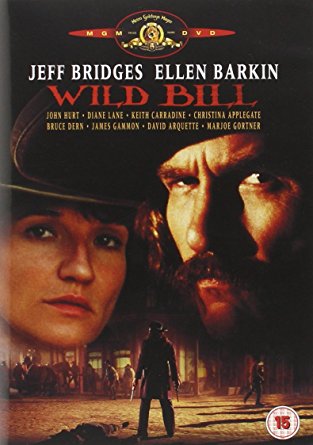 The year is 1876 and the legendary Wild Bill Hickok (Jeff Bridges) sits in a saloon in Deadwood and thinks about his life (most of which is seen in high-resolution, black-and-white flashbacks). Hickok was a renowned lawman and a sure shot, a man whose exploits made him famous across the west. Thanks to his friend, Buffalo Bill Cody (Keith Carradine), he even appeared on the New York stage and reenacted some of his greatest gun battles. Now, Hickok is aging. He is 39 years old, an old man by the standards of his profession. Though men like Charlie Prince (John Hurt) and California Joe (James Gammon) continue to spread his legend, Hickok is going blind and spends most of his time in a haze of opium and regret.
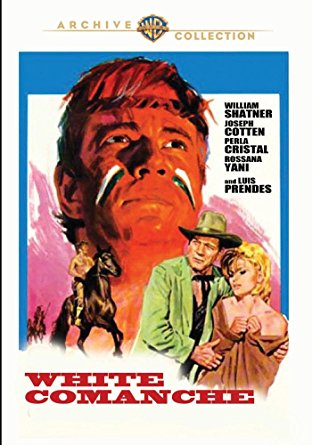 Johnny Moon (William Shatner) is a half-breed. His father was white and his mother was a Comanche. Johnny was raised Comanche but he now lives as a white man. He is a good and law-abiding citizen but he has a problem. Johnny has a twin brother named Notah (played, of course, by William Shatner) and, hooked on peyote, Notah keeps holding up stagecoaches, killing white men, and raping white women. Sick and tired of people constantly trying to lynch him, Johnny contacts Notah and demands a final showdown. At the same time, Johnny refuses to tell anyone about Notah’s existence so everyone still wants to kill Johnny. The only person who realizes that Johnny and Notah are not the same is one of Notah’s victims, a showgirl named Kelly (Rosanna Yanni). She sees that good Johnny has blue eyes while bad Notah has black eyes.
 Through the Shattered Lens