Hulk Hogan, RIP.
Hulk Hogan, RIP.
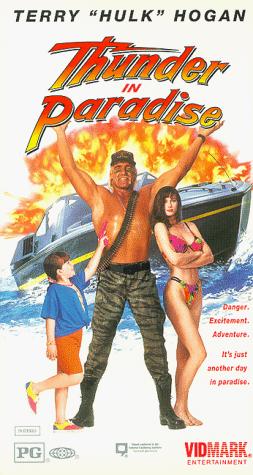 R.J. “Hurricane” Spencer (Hulk Hogan) is a former Navy SEAL who now lives in Florida and makes his living with his superboat, Thunder. Spencer’s best friend, Bru (Chris Lemmon), is also his business partner. There’s nothing that Spencer and Bru can’t do. This movie starts with Spencer taking the boat down to Cuba so he can rescue the family of a dissident and bring them back to Florida. It ends with his using his boat to save the lives of his wife (Felicity Waterman) and his stepdaughter (Robin Weisman) from some treasure hunters who have made the mistake of kidnapping them. Spencer’s marriage is one of convenience. His wife needed a husband to get her fortune and he needed a rich wife to keep his business going. His father-in-law (Patrick MacNee) doesn’t trust him but Spencer’s a top-notch American hero.
Though it was initially released direct-to-video, Thunder in Paradise was actually a pilot for a syndicated television show that started a few months later. Both the film and the show were from the producers of Baywatch and it shows with the emphasis on the beach, the bikinis, the corny humor, and the cartoonish villains (led, in this case, by Flash Gordon himself, Sam Jones). Of course, it’s a Hulk Hogan movie so none of that is really a negative. Hogan might be playing Hurricane Spencer but he’s really playing himself and there’s enough self-aware humor to make Thunder In Paradise entertaining in a way that No Holds Barred definitely was not. (I liked that, during a fight on another boat, there just happened to be a wooden chair sitting on the deck that Hogan could break across his opponent’s back.) Chris Lemmon and Hulk Hogan are a surprisingly good team (Lemmon’s brain provide a needed contrast to Hogan’s bawn) and Carol Alt is on-hand as the owner of a beach bar. Naturally, a handful of Hogan’s fellow wrestlers shows up as well, Brutus Beefcake, Jim “The Anvil” Neidhardt, Giant Gonzalez, Jimmy Hart, and others. As a fan of The Avengers, I was happy to see Patrick MacNee, even if his character was just a typical distrustful father-in-law.
Corny, silly, dumb, and more fun than it probably should be, Thunder In Paradise is an entertaining product of its time.
Hulk Hogan has died and for people of a certain age and generation, a part of their childhood has died as well. While the full details are still coming out, it has been confirmed that he passed due to cardiac arrest. He was 71 years old.
Here’s Hulk Hogan tossing around Sylvester Stallone in Rocky III.
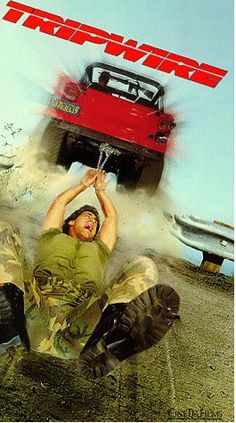 Terrorist Josef Szabo (David Warner) and his team (including Viggo Mortensen, Charlotte Lewis, and Sy Richardson) attempt to hijack a train that’s carrying weapons that they can use in their plans for world conquest. Renegade ATF agent Jack DeForest (Terence Knox) catches them in the act and, in the resulting crossfire, Szabo’s son is killed. Now looking for revenge, Szabo kidnaps Jack’s estranged wife (Meg Foster) and Jack’s son. Even though his supervisor (Yaphet Kotto) claims that Jack is dangerous and out-of-control, fellow ATF agent Anne (Isabella Hofmann) teams up with Jack to rescue his family.
This is a well-done B action movie, featuring villains who have more depth than usual and an interesting opening sequence that plays out with almost no dialogue. Terence Knox is not the most exciting of heroes (he was better served by television than the movies) but the supporting cast makes up for his character’s blandness. Where also can you see Meg Foster, David Warner, Yaphet Kotto, Viggo Mortensen, and Tommy Chong (!) all in the same movie? The mountainous Utah setting gives the film a modern western feel and, though this may be a direct-to-video B movie, the cast gives it their all. Tripwire is cinematic fast food, quick and just satisfying enough to leave you happy.
This was actually the second video that was filmed for this song. The first video was deliberately surreal and Ozzy felt that it didn’t represent what the song was about. Samuel Bayer was selected to direct the second video on the basis of his direction of the video for Nirvana’s Smells Like Teen Spirit.
Rest in peace, Ozzy.
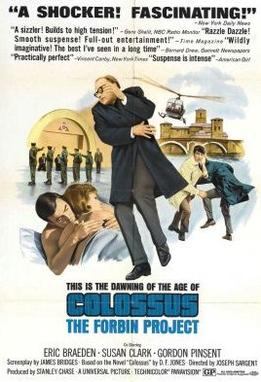
Deep in a complex that is hidden away in the Rocky Mountains, Dr. Charles Forbin (Eric Braeden) has put together and programmed a computer called Colossus. A super computer, Colossus has been designed to control the nuclear arsenal of the United States and its allies. Colossus will not only keep America safe but it was also remove the chance of human error or human hesitation. No longer will two men sitting in a silo with a key have to make the decision whether to obey the orders coming from the commander in chief. No longer will people have to make the split-second decision that could plunge the world into war.
To Forbin’s surprise, the Soviet Union has developed their own super computer, called Guardian. Colossus asks to be “linked” to Guardian and the Russians agree to allow it as a gesture of good will. What no one realizes is that both computer systems have become sentient and that they soon decide that humans cannot be trusted to not destroy themselves and the planet. To Forbin’s horror, Colossus starts to take over the world.
Based on a novel by Dennis Feltham Jones, Colossus was originally filmed in 1968 but it wasn’t released until 1970. The film looks dated with its gigantic computer but it feels prophetic with its storyline about an AI taking over the world and deciding that it knows better than its makers. Director Joseph Sargent adroitly mixes science fiction with Bond-style intrigue as Charles Forbin tries to reason with his creation and both the CIA and the KGB try to take down the computers. The film even tosses a bit of 70s-style paranoia, with both the American and the Soviet governments trying to keep the public from discovering that the supercomputers are trying to take over the world.
Colossus: The Forbin Project is an intelligently written and thought-provoking science fiction film. Eric Braeden does a great job as Charles Forbin, the engineer who goes from being arrogant and cocky to desperate to finally defiant as his creation slips out of his control. William Schallert, so often cast as a nice father figure, turns in a good performance as the head of the CIA as does Susan Clark, cast as a colleague who has to pretend to be Forbin’s mistress just so she and Forbin can talk and plot without being monitored by Colossus.
Colossus is a smart sci-fi film that is more relevant than ever.

We all knew it was coming but this one still hurts.
Ozzy Osbourne, RIP.
All aboard! Hahaha
Crazy, but that’s how it goes
Millions of people living as foes
Maybe, it’s not too late
To learn how to love, and forget how to hate
Mental wounds not healing
Life’s a bitter shame
I’m goin’ off the rails on a crazy train
I’m goin’ off the rails on a crazy train
I’ve listened to preachers,
I’ve listened to fools
I’ve watched all the dropouts
Who make their own rules
One person conditioned to rule and control
The media sells it and you live the role
Mental wounds still screaming
Driving me insane
I’m goin’ off the rails on a crazy train
I’m goin’ off the rails on a crazy train
I know that things are going wrong for me
You gotta listen to my words, yeah, yeah
Heirs of a cold war,
that’s what we’ve become
Inheriting troubles,
I’m mentally numb
Crazy, I just cannot bear
I’m living with something that just isn’t fair
Mental wounds not healing
Who and what’s to blame
I’m goin’ off the rails on a crazy train
I’m goin’ off the rails on a crazy train

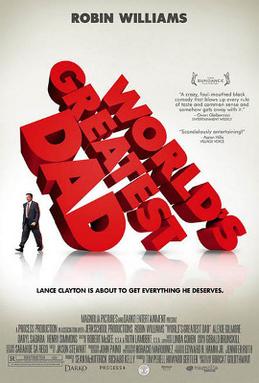 Lance Clayton (Robin Williams) is an English teacher who has a rotten teenage son named Kyle (Daryl Sabara). Some teenagers go through a rebellious phase. Some teenagers are troubled because of how they were raised or a recent trauma. Some teenagers are misunderstood. Kyle is just a disrespectful and stupid jerk who seems destined to do nothing his life. He’s the type of fifteen year-old boy who uses his phone to secretly take upskirt pictures of his Dad’s girlfriend while they’re all out for dinner.
Those upskirt pics prove to be the last thing that Kyle sees as he’s looking at them where he dies in a case of autoerotic asphyxiation gone wrong. Lance impulsively stages Kyle’s death to look like a suicide, both to preserve Kyle’s dignity and his own. Lance, a frustrated writer, composes a suicide note and signs it with Kyle’s name. When the note is leaked to the press, Kyle is hailed as a sensitive young man and becomes a hero to the former classmates who used to hate him. Lance goes on to forge and publish a journal, which he claims was written by Kyle. Kyle is hailed as a hero and Lance as the “world’s greatest dad.” Lance enjoys the fame, until he doesn’t.
World’s Greatest Dad is a dark comedy, one that has the courage to often be downright unpleasant in its portrayal of how Kyle’s memory is idealized after his death. It also features one of Robin Williams’s best performances. Almost every performance that Williams gave had at least a hint of sadness to it. In this film, he plays one of his saddest characters, a well-meaning teacher who cannot understand how his son has become such a jerk. By writing the journal, Williams is not only deceiving the rest of the world but also himself. He’s recreating Kyle as the son that he wanted as opposed to the one he got. It’s one of Williams’s most emotionally honest and open performances.
For obviously reasons, it’s not easy to watch Williams playing such a depressed character, especially one who staes a suicide but the film really does show what a great actor Robin Williams could be. In the end, his talent is what we should remember and celebrate.
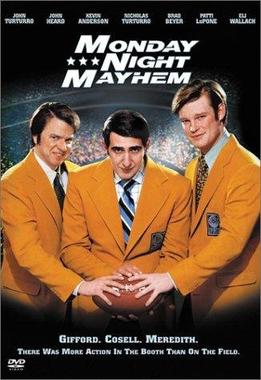 In the late 1960s, television coverage of football is dull and boring. The games are played during the day and the announcers have no personality. An executive at ABC named Roone Arledge (John Heard) changes all of that by convincing the NFL to start scheduling games for Monday night. Arledge launches Monday Night Football, a broadcast that puts the viewers at home in the stadium. Arledge explains that he wants cameras everywhere. He wants the sidelines and the stands to be mic’d up. And he wants announcers who will make the game interesting. He picks an experienced radio announcer named Keith Jackson (Shuler Hensley), former Dallas quarterback Don Meredith (Brad Beyer), and finally an egocentric, loquacious, and opinionated sports reporter named Howard Cosell (John Turturro). The straight-laced Jackson only lasts a season and finds himself overshadowed by Meredith’s good ol’ boy charisma and Cosell’s eccentricities. Arledge brings in Frank Gifford (Kevin Anderson) as a replacement and changes both sports and television forever. Monday night football becomes huge but so do the egos of the men involved.
Based on a non-fiction book by Bill Carter, Monday Night Mayhem is a look at the early days of Monday Night Football, with most of the attention being given to the mercurial Howard Cosell. As a work of history, it’s pretty shallow. There’s a lot of montages set to familiar 70s tunes and there’s plenty of familiar stock footage. Beyer and Anderson do adequate impersonations of Meredith and Gifford without really digging for much under the surface. Monday Night Mayhem is dominated by John Turturro’s performance as Howard Cosell. Turturro doesn’t look like Cosell and he really doesn’t sound that much like Cosell but he does capture the mix of arrogance and bitterness that made Howard Cosell such a memorable and controversial announcer. In its breezy manner, the film hits all the well-know points of Cosell’s life and career, from defending Mohammad Ali to considering a run for the Senate to trying to reinvent himself as a variety show host to the controversy when he was though to have uttered a racial slur during one of the games. I wish the film had a bit more depth but John Turturro’s committed but bizarre performance keeps it watchable.
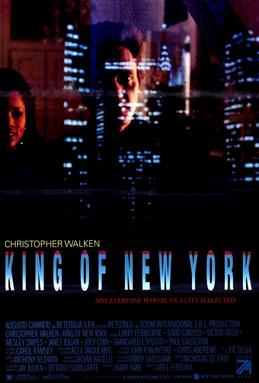 Drug kingpin Frank White (Christopher Walken) has been released from prison and is again on the streets of New York City. Frank might say that he’s gone straight but, as soon as he’s free, he’s partying with his old crew (including Laurene Fishburne, Steve Buscemi, Giancarlo Esposito, and others). While Frank’s agent (Paul Calderon) goes to all of the other city’s gangsters and explains that they can either get out of Frank’s way or die, three detectives (Victor Argo, David Caruso, and Wesley Snipes) make plans to take Frank out by any means necessary. Meanwhile, Frank is donating money to politicians, building hospitals, and presenting himself as New York’s savior.
King of New York is the epitome of a cult film. Directed by Abel Ferrara, the dark and violent King of New York was originally dismissed by critics and struggled to find an audience during its initial theatrical run. (It was lumped in with and overshadowed by other 1990 gangster films like Goodfellas and Godfather Part III.) But it was later rediscovered on both cable and home video and now it’s rightly considered to be a stone cold crime classic. Walken gives one of his best performances as Frank White and that’s not a surprise. The film was clearly made to give Walken a chance to show off what he could do with a lead role and Walken captures Frank’s charisma and humor without forgetting that he’s essentially a sociopath. Walken gives a performance that feels like James Cagney updated for the end of the 80s. What’s even more impressive is that all of the supporting characters are just as memorable as Walken’s Frank White. From Laurence Fishburne’s flamboyant killer to David Caruso’s hotheaded cop to Paul Calderon’s slippery agent to Janet Julian’s morally compromised attorney, everyone gives a strong performance. (I’m usually not a Caruso fan but he’s legitimately great here.) They come together to bring the film’s world to life. Everyone has their own reason for obsessing on Frank White and his return to power. I’ve always especially appreciated Victor Argo as the weary, veteran detective who finds himself trapped by Caruso and Wesley Snipes’s impulsive plan to take down Frank White. Frank White and the cops go to war and it’s sometimes hard to know whose side to be on.
Director Abel Ferrara has had a long and storied career, directing films about morally ambiguous people who are often pushed to extremes. Personally, I think King of New York is his best film, a portrait of not just a criminal but also of a city that combines the best and the worst of human nature. The action is exciting, the cast is superb, and Frank’s justifications for his behavior sometimes make a surprising amount of sense. Thought there’s occasionally been speculation that it could happen, there’s never been a sequel to King of New York and it doesn’t need one. King of New York is a film that tell you all that you need to know about Frank White and the city that he calls home.
 Through the Shattered Lens