Peter Fonda, Rest In Peace


Peter Fonda has died from complications due to lung cancer.  He was 79 years old.

As an actor, Peter Fonda never got as much respect as the rest of this family.  Unlike his sister or his father, he never won an Academy Award, though he was nominated for two of them (one for writing Easy Rider and another for starring in Ulee’s Gold).  During the late 80s and the 90s, he was better known for being Bridget Fonda’s father than for the majority of the films that he appeared in during that time.  While the rest of his family was appearing in prestige pictures and working with directors like Fred Zinnemann, Sidney Lumet, William Wyler, Francis Ford Coppola, and Quentin Tarantino, Peter Fonda spent most of his career appearing in B-movies.  But today, many of those B-movies are more fondly remembered than the big films that he missed out on.

Peter Fonda made his film debut in 1963, playing the romantic lead in Tammy and the Doctor.  Fonda hated the film and often called it Tammy and the Schmuckface.  After that less-than-stellar beginning, Peter went on to find his groove as a lifelong member of the Hollywood counterculture.  In the classic biker film, The Wild Angels, he played Heavenly Blues and let the world know that all he wanted to do was “get loaded and have a good time.”  In The Trip, he played a disillusioned television director whose world is turned upside down by acid.

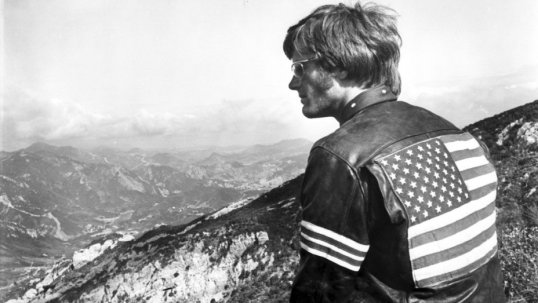
And then there was Easy Rider.  In this seminal independent film from 1969, Peter played Wyatt, a.k.a. Captain America.  Wyatt was the biker and drug smuggler who went “searching for America and couldn’t find it.”  This was Peter Fonda’s most famous role.  Along with acting in the film, he also produced it and co-wrote it.  (He was also responsible for keeping Dennis Hopper under control.  Or, at least as under control as anyone could keep Dennis Hopper in 1969.)  The role made Peter Fonda a symbol of rebellion, an American icon riding across the desert with the American Flag literally on his back.  Today, we still debate what Wyatt meant when he said, “We blew it.”  Peter Fonda, himself, later said that he was delivering the line as himself and not as Wyatt because he was convinced that Easy Rider would be a career-ending flop.

In the 70s and 80s, Fonda continued to play rebels.  His subsequent films were never as successful as Easy Rider, though many of them are still entertaining.  Peter made his directorial debut in 1971, with The Hired Hand, an elegiac and thoughtful Western in which Peter co-starred with another cult icon, Warren Oates.  Years later, Fonda would be among the many celebrities who made a cameo appearance in The Cannonball Run.  Of course, Peter played a biker and he got to fight Jackie Chan.

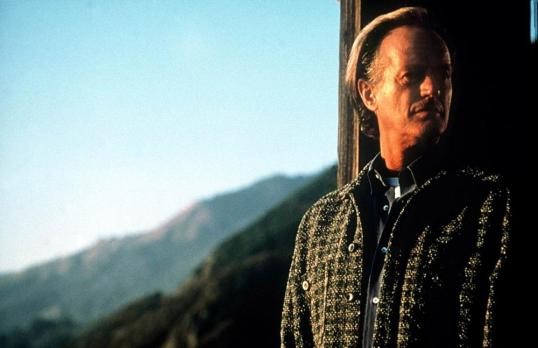
In the 90s, Peter Fonda played a lot of old hippies in many forgettable films.  However, in that decade, he also gave two of his best performances.  In The Limey, Fonda played the music producer who Terrence Stamp holds responsible for the death of his daughter.  And, in Ulee’s Gold, Fonda played a cantankerous bee keeper who finds himself taking care of his two granddaughters.  It was a role that many could imagine having once been played by Henry Fonda.  For Ulee’s Gold, Peter was nominated for an Oscar.  He lost to his co-star from Easy Rider, Jack Nicholson.

Peter Fonda continued to work up until his death.  With his passing, America loses another screen icon and a man who epitomized an era.  Rest in Peace.
Music Video Of The Day: Pop Muzik by M. (1979, directed by Brian Grant)


“I was looking to make a fusion of various styles which somehow would summarise the last 25 years of pop music. It was a deliberate point I was trying to make. Whereas rock and roll had created a generation gap, disco was bringing people together on an enormous scale. That’s why I really wanted to make a simple, bland statement, which was, ‘All we’re talking about basically (is) pop music.”

— Robin Scott, on Pop Muzik

Before adapting the persona of M., Robin Scott attended Croydon College with Malcolm McLaren (who would later manage the Sex Pistols) and released a folk album called Woman From The Warm Grass.  Scott eventually walked away from his folk roots, turning instead to electronic music.  Pop Muzik, which was written from the perspective of a DJ, was arguably the first new wave hit and this music video was extremely popular during the early years of MTV.

The video was the first to be directed by Brian Grant, who was a BBC producer at the time.  Working with a £2000 budget, Grant created a video that was revolutionary for the time.  (In the late 70s, music videos were mostly just straight performance clips.)  The success of Pop Muzik led to Grant becoming one of the busiest music video directors around.  Grant went on to direct videos for The Human League, The Fixx, Squeeze, Duran Duran, and many others.  If you were a New Wave group, Brian Grant probably directed at least one video for you.

I searched but I could not find the names of the two models who appeared in this video.  Does anyone reading this know?

Enjoy!

Music Video Of The Day: City of Crime by Dan Aykroyd and Tom Hanks (1987, directed by Marty Callner)


“They didn’t have enough confidence in the material that they had to try and hook kids in with some disco thing.”

— Gene Siskel on Dragnet (1987)

In 1987, Dragnet was released into theaters.  Based on the classic television series, Dragnet was a comedy that featured Dan Aykroyd as straight-laced Sgt. Joe Friday and Tom Hanks as his new partner, Det. Pep Streebeck.  Perhaps realizing that they had spent $20,000,000 making a movie about a show that most teenagers had never heard of, Universal Pictures decided to promote the film by having Aykroyd and Hanks rap about fighting crime.

The end result was City of Crime and this music video.  Collaborating with Aykroyd and Hanks on this song are former Deep Purple and Black Sabbath vocalist Glenn Hughes and famed guitarist Pat Thrall.  This video was directed by Marty Callner, who is best-known for doing videos for Aerosmith and Poison.

Enjoy!


Music Video Of The Day: Dreamworld by Midnight Oil (1987, directed by ????)


One of the most popular bands to ever come out of Australia, Midnight Oil is known for their energetic protest songs.  In Dreamworld, which was the last single to be released off of Diesel and Dust, Midnight Oil protested what they viewed as being the destruction of Queensland’s heritage under Premier Joh Bjelke-Petersen.

Belke-Petersen, who served as premier from 1968 to 1987, remains a controversial figure in the history of Australia.  He was viewed by many as being a corrupt authoritarian who held onto power by disenfranchising urban voters.  At the same time, during the time that Belke-Petersen was premier, Queensland underwent significant economic development.

Unfortunately, much of that development involved demolishing many of Queensland’s best-known historical locales.  Among those was the Cloudland Dance Hall, which had previously hosted Buddy Holly in 1985 and, years later, Midnight Oil themselves.  The song, itself, was named after Queensland’s Dreamworld theme park, which can be spotted briefly in the song’s music video.

Enjoy!

Video Games Are Not To Blame


When I was growing up, I used to love to play Castle Wolfenstein and Doom.  While playing those games, I fired every weapon that I could get my hands on and I killed a countless number of Nazis and demons.

In real life, I have never shot anyone nor have I ever been tempted to.

Later on, I discovered the Grand Theft Auto games.  While playing those games, I’ve stolen a countless number of cars and I’ve run down a lot of people.  Most of them I didn’t mean to run down.  Everyone knows how difficult it is to go in reverse when you’re playing Grand Theft Auto.

In real life, I have never stolen car and I’ve never never run anyone over.  Nor have I ever been tempted to.

That’s because I’ve always known that video games are not real life.  Even when I was a kid, I understood that if someone died in real life, they wouldn’t just respawn and continue playing the game.  I would say that’s true of 99.9% of all gamers.  As for the .1% that doesn’t understand the difference, they have problems that started long before the played their first game.

Whenever there’s a mass shooting or any other traumatic act of public violence, people demand to know how it could have happened.  Video games are always a convenient scapegoat.  Many video games are violent and gamers are easy targets for the media to pick on.  But this idea that little Johnny was perfectly normal until he played Call of Duty or Fortnite is ludicrous and everyone knows it.  When I hear about a school shooter who spent hours playing a violent video game, I don’t care about which game he was playing.  Instead, what I want to know is where were his parents while he was doing this?  Too often video games are blamed because no one wants to admit that they either ignored all of the obvious red flags or they didn’t have the courage to confront what they knew was happening.

Video games are not to blame and neither are gamers.  Using them as a scapegoat is not going to solve a thing.  People with a propensity for violence are always going to seek out ways to be violent.  Banning video games isn’t going to make that type of person any less violent.  It’s just going to inspire him to find a new way to express whatever it is that’s going on inside his head.

Until we get serious and stop looking for easy targets to blame, the shootings like we saw this weekend are going to continue and they’re going to keep getting worse.  Solely blaming video games — as if a mass-produced game is somehow more responsible for an individual’s actions than the individual himself — is not a serious response and anyone doing it is not a serious person.

Music Video Of The Day: Super Freak by Rick James (1981, directed by ????)


Today is the 15th anniversary of the death of Rick James.  Our music video of the day is for James’ biggest U.S. hit and his best-known song, Super Freak.

James shot this video during the early days of MTV, hoping that the network would put the video into its steady rotation and help the song become a hit.  However, MTV rejected the video.  In the early 80s, MTV was notorious for rejecting music videos from black artists.  However, Carolyn Baker, who was then director of acquisitions for the network, later said that, “It wasn’t MTV that turned down ‘Super Freak.’ It was me. I tuned it down. You know why? Because there were half-naked women in it, and it was a piece of crap. As a black woman, I did not want that representing my people as the first black video on MTV.”

(The first black group to get a video on MTV would be Musical Youth with Pass the Dutchie in 1982.  A year after that, Michael Jackson destroyed what was left of MTV’s color barrier with the success of his videos for Thriller.)

Even without the support of MTV, Super Freak went on to become Rick James’s biggest hit.  The song’s distinctive bassline was later sampled by MC Hammer’s U Can’t Touch This.  James had to sue to get credited for the sample.  Rick James would later receive his only Grammy when U Can’t Touch This won for Best R&B Song in 1991.

Enjoy!

Great Moments In Comic Book History: Crisis on Campus


This has always been one of my favorite Spider-Man covers.  Credit for it goes to John Romita, Sr.

This issue of The Amazing Spider-Man came out in 1969, at the height of the student protests that rocked campuses across America.  Since Spider-Man was a student at Empire State University at the time, it makes sense that he would eventually be drawn into the protests.  In typical Marvel fashion, Spider-Man ended up supporting both the protesters and the police who later busted them.  Spider-Man felt the protesters had a right to protest but that the police were also necessary to maintain the peace.  Of course, in the end, the Kingpin would use the distraction of the protests to steal an ancient tablet, leaving the students to take the blame.

This cover perfectly captured the ambiguous place of both Spider-Man and Marvel in the counter culture.  Spider-Man may appear to be with the protesters but it’s also not a coincidence that he’s swinging above them, indicating that Spider-Man was both a part of the counterculture and yet above it all at the same time.  At a time of intense national polarization, Marvel manged to pull off the balancing act of supporting both sides at the same time.

Is Spider-Man a part of the protest or is he the one being protested?  It all depends on what you want to see.

The Amazing Spider-Man Vol. 1 #68 (January, 1969)

“Crisis On Campus!”

  • Writer: Stan Lee
  • Penciler: John Romita Sr. and Jim Mooney
  • Inker: Jim Mooney
  • Letterer: Sam Rosen
  • Editor: Stan Lee
  • Cover Artist: John Romita, Sr.

Previous Great Moments In Comic Book History:

  1. Winchester Before Winchester: Swamp Thing Vol. 2 #45 “Ghost Dance” 
  2. The Avengers Appear on David Letterman

Music Video Of The Day: Funk Dat by Sagat (1994, directed by Kurt and Bart)


Today’s music video of the day comes from the Baltimore-born rapper and producer, Sagat.

There’s actually two versions of this song.  The first one, which was released in 1993 and which is still played in the clubs on The Block to this day, was called Fuk Dat and was a list of things that annoyed Sagat in ’93 and which are still annoying today.  That version became a club hit but, when it was time to release the song commercially, it was obvious that the song would need a title that wouldn’t get radio stations fined by the FCC.  Hence, Fuk Dat became the slightly cleaner Funk Dat.

The music video for Funk Dat was filmed on the streets of New York.  The video features not only Sagat but also a really cool kid who has it up to here with the radio playing the same five songs over and over again.  This video achieved perhaps its greatest exposure when it was featured on an episode of Beavis and Butthead.  This song was also played on one of MTV’s dance shows on the 90s.  The dancers would all shout, “Funk dat!” in unison but everyone knew what the song was actually saying.

Enjoy!

Music Video of the Day: Visions of Paradise by Mick Jagger (2002, directed by Dave Meyers)


Yesterday was the 76th birthday of Sir Michael Phillip Jagger so it seems appropriate to give him today’s music video of the day slot.  Visions of Paradise was the first video off of Mick Jagger’s fourth solo album, Goddess in the Doorway.

This video was directed by Dave Meyers, who is one of those music video directors who seems to have worked with everyone.  If you look over the list of videos he’s directed, you’ll see everyone from Master P to Kid Rock to Pink and Taylor Swift.

Enjoy and keep rocking, Sir Mick!

Music Video of the Day: And The Beat Goes On by The Whispers (1979, directed by ????)


The Whispers were first formed 1964 but they had to wait 16 years before scoring the first top 20 hit in both the U.S. and the UK with And The Beat Goes On.  This song was co-written by Leon F. Sylvers III, Stephen Shockley, and William Shelby.  Sylvers felt that the song had little potential to be a hit.  The Whisperers felt differently and they turned out to be correct.

As befits an old school song, this is an old school video, a simple performance clip of the band doing what they did best.

And The Beat Goes On is another song that I have fond memories of listening to while stealing cars in Vice City.  If you haven’t been chased by a police helicopter while listening to And The Beat Goes On then what were you doing back in 2002?

Enjoy!