Everything You Know About Vampires Is Wrong: Night Hunter (1996, directed by Rick Jacobson)


Forget everything you know about vampires!

Did you think that vampires could only go out at night?  Wrong.  They can run around in broad daylight.

Did you think that you needed a cross or a stake to kill a vampire?  Wrong.  You can break their necks or use a shotgun.

Did you think that we get new vampires by vampires biting their victims late at night?  Wrong.  Vampires can only breed during a solar eclipse.

Did you think that there’s thousands of vampires hiding out across the world?  Wrong.  There’s only seven left.

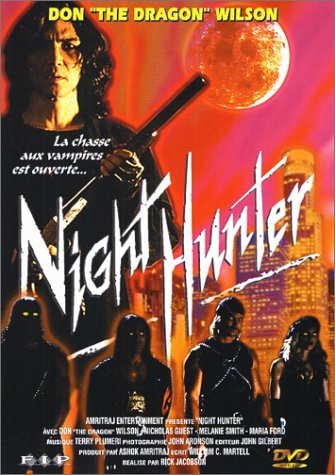
That’s the idea behind Night Hunter, which stars Don “The Dragon” Wilson as Jack Cutter.  Cutter’s grandparents were vampire hunters.  His parents were vampire hunters.  Cutter was destined to be a vampire hunter.  And now that he’s the only member of his family left alive, he is determined to wipe out the last few remaining vampires.  Jack has two problems.  The first is that the police don’t believe in vampires so they just think that Jack is going around Los Angeles and killing random people.  The second is that a solar eclipse is rapidly approaching and, if the vampires breed, all of Jack’s work will be for nothing.  Accompanied by a plucky tabloid reporter named Raimy (Melanie Smith), Jack searches for the king of the vampires.  Not coincidentally, Raimy looks just like the woman that the king once loved over a hundred years ago.

For a direct-to-video vampire film, Night Hunter’s not bad.  Wilson may not have been a great actor but he was one of the best kick boxers in the world and this brings a verisimilitude to Night Hunter‘s action scenes that most direct-to-video action films couldn’t hope to duplicate.  Rick Jacobson directed the majority of Wilson’s films and, in Night Hunter, he keeps things moving along at a steady pace.  Night Hunter doesn’t waste any time getting to the vampire action and it never pretends to be anything more than what it is.  Best of all, the film’s got Maria Ford as a French vampire named Tourneur who says things like, “I will not await vengeance, the hunter will die!”

When I first watched Night Hunter, I thought that it was a rip-off of Blade but Blade actually came out two years after Night Hunter.  Unless Don “The Dragon” Wilson (who co-produced) was a fan of Tomb of Dracula, the similarities between the two films are probably coincidental.  While Night Hunter may not be Blade, it’s still pretty damn cool.

Video Game Review: The Count (1979, Adventure International)


You have just woken up in a bed in a Transylvanian castle.  Why are you there?  You’re on a mission.  What type of mission?  It’s Transylvania and the game is called The Count.  You figure it out.  You’ve got three days to figure out how to kill Count Dracula or you’ll suffer a fate worse than death.  Make a mistake and you might become a vampire during the night.  Try to leave the castle early and you’ll get torn apart by the angry villagers.

The Count is a very early text adventure game, one of the many that was created and designed by Scott Adams in the days when having a personal computer was considered to be a luxury instead of a necessity.  The Count has everything that you would usually expect from an Adams game: minimalist descriptions, silly humor (“The signs says ‘POSITIVE NO SMOKING ALLOWED’ signed Count Dracula.”), and puzzles that often take more than one run-through to solve.  It also has a simple two-word parser that, for modern players, might require some getting used to.

Historically, The Count is important because it was one of the first games to have a fixed time limit.  Timed challenges have always been my downfall, as anyone who has ever watched me play any of Spider-Man‘s side missions can tell you.  Solving The Count is not as challenging as catching Howard’s pigeons but it will still probably require a replay or two.

Like all of Scott Adams’s game, The Count has been adapted for other Interactive Fiction interpreters and can be downloaded for free..  The 1982 re-release, which came with graphics, can be played at the Internet Archive.


Straight From The Direct-To-Video Film Vault: Laser Moon (1993, directed by Douglas K. Grimm)


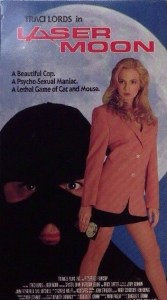
Like so many straight-to-video thrillers from the 90s, Laser Moon opens with a serial killer.  This one stalks women whenever there’s a full moon.  His weapon of choice appears to be a laser pointer but it’s supposed to be a real laser.  When late night DJ Zane Wolf (Harrison le Duke, doing a barely passable Eric Bogosian impersonation) starts getting phone calls from a man claiming to be the killer, Detectives Barbara Fleck (Traci Lords) and Vincent Musso (Bruce R. Carter) get involved.

If you’ve ever wondered what would happen if you mashed up Talk Radio with the type of movies that used to play regularly on late night Cinemax, the end result would probably be better than this.  Oh, don’t misunderstand.  Laser Moon tries it’s hardest to be something more than just another low budget, direct-to-video thriller.  Zane Wolf claims to be a cynic and he smokes a cigarette right in front of a “no smoking” sign.  (I have pictures of myself doing the exact same thing in high school.  Take that, evil sign!)  When the killer calls Zane Wolf’s show, the discussion involves all sorts of philosophical issues but the problem is that neither one of them has much to say.  Zane is a cardboard nihilist, the type who can’t come up with anything more profound than telling his listeners to “do what you’re afraid to do.”  “You walk alone,” he tells another caller.  Why are people listening to this guy again?

Traci Lords is miscast as a police detective but she still gives the best performance in the film, showing once again that there was more to her as an actress than just her notoriety as a former underage porn star.  Laser Moon may be one of her worst films but at least it ends with a twist involving the use of holograms.  That’s not something you see every day.

Video Game Review: Vampiric Tower (2000, Mike Behrens)


Vampiric Tower is a simple but addictive puzzle game that I found on the Internet Archive.

In this game, you are a purple haired vampire in a ten-story, fifty-room tower.  Your goal is to go through each room and collect all of the vials of blood.  Only after all of the vials have been collected will the door to the next room open.  At first it’s simple:

Things get more complicated with each room that you enter.

For instance, in the room above, there’s plenty of blood but there’s also objects in the way.  Fortunately, you can turn into a bat and fly over the obstacles but there’s only so many times that you can transform and you always have to return to your “human” form if you want to collect the blood.  You can push the obstacles out of the way but, if you’re not careful, you can very easily ended up locking yourself into a corner.

Each room has more obstacles than the last and you’ll have to be smart about how you use your transformation powers if you’re going to get all of the vials.

You’re also not alone in the tower.

Those jack o’lanterns may not look dangerous but get in their line of sight and they’ll kill you.

Vampric Tower is a simple puzzle-solving game but it’s also very addictive.  No sooner have you managed to figure out how to escape one room than you find yourself in an even more elaborate and dangerous location.  How quickly can you make it through the vampiric tower?  Play the game to find out!

Cinemax Memories: Raw Nerve (1991, directed by David A. Prior)


Raw Nerve opens with a serial killer haunting Mobile, Alabama, using a pump action shotgun to shoot women in the face while they’re wearing red high heels.  Race car driver Jimmy Clayton (Ted Prior, brother of this film’s director) has been having visions of the murders so he goes to the police and offers to help them out.  Unfortunately for Jimmy, neither Detective Ellis (Jan-Michael Vincent!) nor Captain Gavin (Glenn Ford!!) believe in psychic phenomena so they toss Jimmy’s ass in jail.  While Ellis’s ex-wife, Gloria (Sandahl Bergman!!!), tries to prove that Jimmy’s innocent, Jimmy’s mechanic (Randall “Tex” Cobb!!!!), takes an unhealthy interest in Jimmy’s teenage sister, Gina (TRACI LORDS!!!!!).
As you can tell from reading the paragraph above, the main thing that this film has going for it is a cast full of recognizable B-actors.  Though none of them are really at their best, Raw Nerve is still your only chance to see Glenn Ford, Jan-Michael Vincent, and Sandahl Bergman all sharing scenes together.  Unfortunately, despite all of the famous names in the cast, Ted Prior got the most screen time and he really didn’t have the screen presence to pull off either the role or the film’s loony final twist.

The best thing about Raw Nerve is that it features both Randall “Tex” Cobb and Traci Lords.  Lords was a legitimately good actress, even if her past as a pornographic actress made it impossible for her to get the type of roles that she really deserved.  Lords doesn’t get to do much in Raw Nerve but she does her best to make Gina into a real character instead of just a generic victim.  Meanwhile, Randall “Tex” Cobb is a marvel as a biker who is never seen without a beer in his hand.  When Cobb eventually leaves the movie, you miss him.

Raw Nerve was one of the many low-budget thrillers that came out in the 90s.  Like many of these films, Raw Nerve was directed by David A. Prior and released by Action International Pictures, which shared both an acronym and a sensibility with American International Pictures.  Though films like Raw Nerve may not have been great art, they were entertaining if you came across one of them on Cinemax.  Where else were you going to see Tex Cobb and Jan-Michael Vincent battle it out at two in the morning?

Video Game Review: Wolfman (1988, CRL Group)


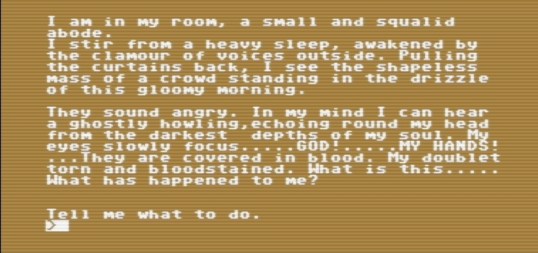
In Wolfman, you are David.  You wake up one morning in your tiny bedroom and you realize that something bad has happened.

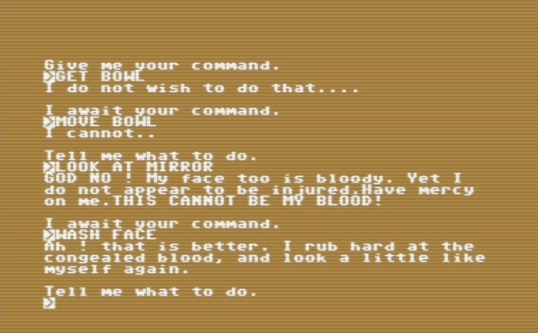
A few commands later and you discover that you are covered in blood.

You are a werewolf!  You’ve already killed and you know that it’s going to happen again unless you find a cure for your condition.  For the rest of this challenging text adventure, it is up to you to figure out how to get out of town and find the cure.  Along the way, you will have to find ways to fight off your urges to kill.

Assuming that you get David out of the village, the game will switch gears and you’ll play from the viewpoint of Nadia, a young woman who falls in love with David and who, for David to continue on his journey and ultimately be cured of his condition, has to spend the night with David without becoming his latest victim.

If you pull that off, the game then switches back to being told from David’s point of view as he attempts to solve the final few puzzles that will lead him to the cure.

Wolfman is one of the many horror-themed text adventures that were written by Rod Pike in the 1980s.  Though the majority of the game is text, there are some graphics, mostly still shots of the werewolf’s victims.  In 1988, the graphics were considered shocking enough to get it an 18 certificate from the British Board of Film Censors.

The first challenge of playing a game like Wolfman today is getting into the right mindset to play a 1980s text adventure.  The game’s vocabulary and list of commands is impressive for 1988 but still extremely limited when compared to what we are used to today.  I spent several turns trapped in my bedroom and growing increasingly frustrated until I finally realized that the game considered “look” and “examine” to be two very different commands.

Once you get passed that, though, it’s an engrossing, well-written, and challenging game, one that puts you right into the mind of both a werewolf and one of his potential victims.  It’s available at the Internet Archive.  And, if you’re like me and you usually have to cheat to solve the puzzles in games like this, a walk-through is available here.

Music Video of the Day: Now You’re Gone by Whitesnake (1990, directed by Wayne Isham)


“I remember shooting the video with Wayne Isham in front of a sold out crowd at the Spectrum in Philadelphia, unfortunately it received minimal airplay as MTV was changing its format… still, I think it’s one of the best videos we’ve done…”

– David Coverdale on Now You’re Gone

Whitesnake was one of the top bands of the 80s but, by the time they released this video, their popularity was in decline as both rap and grunge eclipsed hair metal.  Now You’re Gone is one of Whitesnake’s best songs but, when it was first released, it barely charted in the United States.  Shortly after this video, Whitesnake broke up.  After a 1994 reunion, the band officially reformed in 2002.  Here I Go Again is now used in motorcycle insurance commercials, proving the circle of life.

The video for Now You’re Gone was filmed in Philadelphia, before and during an afternoon show.  It’s one of Whitesnake’s best videos, though the presence of Tawny Kitaen is missed.

Enjoy!

Music Video of the Day: Tragic Comic by Extreme (1993, directed by Paris Barclay)


Tragic Comic was a third third and final single to be released off of Extreme’s third album, III Sides to Every Story.  This was Extreme’s last single to crack the UK Top 40, reaching #15.

The video for Tragic Comic features Extreme’s lead singer, Gary Cherone, trying to have the perfect date with his neighbor and failing in almost every way.  Even when things look like they’re finally going right, she ends up falling down an elevator shaft.  Unfortunately, I have not been able to find the name of the actress who played Cherone’s neighbor in this video.

As for Gary Cherone, he is probably best known for being Van Halen’s third lead singer.  Cherone joined the band in 1996, replacing Sammy Hagar.  He stuck with Van Halen for three years, recording one album with the band.  Though Van Halen III was a success by most standards, it still didn’t sell as much as previous Van Halen albums and Cherone and the band amicably parted ways in 1999.  If nothing else, Cherone is probably the only person to ever leave Van Halen on relatively good terms.

This video was directed by Paris Barclay.  Today, Barclay is best-known as an Emmy-winning television director.  Among the shows that he’s worked on:  NYPD Blue, ER, The West Wing, CSI, Lost, The Shield, House, Law & Order, Monk, Numb3rs, City of Angels, Cold Case, Sons of Anarchy, The Bastard Executioner, The Mentalist, Weeds, NCIS: Los Angeles, In Treatment, Glee, Smash and The Good Wife, Extant, and Manhattan, Empire, and Scandal.  Barclay also served two terms as the president of the DGA.

Enjoy!


Music Video Of The Day: Feeling That Way by Journey (1978, directed by ????)


Like many Journey songs, Feeling That Way went through several different versions before it became the song that was eventually released.

It started out as an instrumental called Velvet Curtain that stayed on the shelf because the band wasn’t satisfied with the results.  Eventually, while the band was recording their third album, keyboardist Greg Rolie pulled it off of the shelf, wrote some lyrics, and renamed the song Please Let Me Stay.  In that form, the song nearly appeared on the Next album but, because the band was again not fully satisfied with the end result, it eventually went back on the shelf.  It would remain there until Steve Perry joined the band.  Perry rewrote the lyrics, added a new chorus, and the song — now called Feeling That Way — finally appeared on Journey’s fourth album, Infinity.

Like most early music videos, the video for Feeling That Way is a performance clip, featuring the band doing what they did best.

Enjoy!

Music Video of the Day: Wheel In The Sky by Journey (1978, directed by ????)


Wheel in the Sky started out as a poem, written by Diane Valory, the wife of Journey bassist Ross Valory.  The poem was re-written by the band’s second lead singer, Robert Fleischman, and guitarist Neal Schon worked out the melody while the band was driving from show to show.

Though Fleischman may have written the lyrics, he had left the band by the time the song was recorded for the Infinity album.  Fleischman’s replacement was Steve Perry, who would go on to become Journey’s best-known (though not final) lead singer.  Wheel in the Sky would be the first Journey single to be released after Perry joined the band and it was also the first first single to chart, reaching #57 in the United States.  It remains one of their most popular songs and it’s also one of the few songs to have been performed by every iteration of Journey.

As was Journey’s style, the video for Wheel In The Sky is a performance clip.  As Steve Perry put it when discussing their later video for Separate Ways, the members of Journey were proud to be musicians and not actors.

Enjoy!