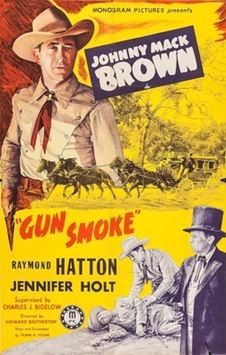
Gun Smoke (1945, directed by Howard Bretherton)


On the frontier, a stagecoach has been overturned and both the passenger and the driver have been killed by outlaws.  The passenger was Hinkley, an archeologist.  Who would want to kill a harmless archeologist?  That’s what Marshals Nevada Jack McKenzie (Johnny Mack Brown) and Sandy Hopkins (Raymond Hatton) set out to discover.  While Nevada Jack asks questions in the nearby town, Sandy disguises himself as a medicine man.

It all links back to an old Indian site that is said to be full of gold relics.  Jane (Jennifer Holt), the daughter of Hinkley’s partner, reveals that the only other person who knows the location of the site is an old Indian named Shag (Dimas Sotello).  Jack and Sandy have to try to track down Shag before he’s found the gang that killed Hinkley.

Yes, it’s another Johnny Mack Brown western.  Despite the title, this has nothing to do with the television series that featured James Arness and Amanda Blake.  Gun Smoke is still a solid western, featuring a determined performance from Johnny Mack Brown and some memorable villains from the usual poverty row western stock company.  Once again, Frank Ellis shows up as a henchman, though the identity of the main villain is actually a little more interesting than was typical for these films.  Johnny Mack Brown is a little more serious than usual, throwing punches with authority.  For fans of B-westerns, Gun Smoke is an above average entry in Johnny Mack Brown’s seemingly endless filmography.

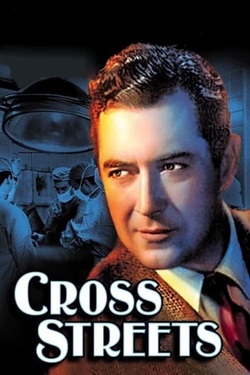
Cross Streets (1934, directed by Frank R. Strayer)


Having graduated from medical school, Dr. Adam Blythe (Johnny Mack Brown) is finally ready to marry his glamorous fiancée, Ann (Claire Windsor).  However, when Ann learns that Adam is going to have to spend years as an lowly paid resident, she ditches him and instead marries Dr. Jerry Clement (Niles Welch).  Blythe, heartbroken, becomes an alcoholic and, after a disastrous operation that leaves a patient dead, Blythe ends up on skid row.  Twenty years later, Blythe is spotted by his old friend Mort (Kenneth Thomson).  A self-made millionaire who dropped out of college, Mort takes Blythe to their 20-year reunion and talks him up as a brilliant surgeon.  When Blythe is pressured into performing a delicate piece of surgery, he is offered a position as the head of the college’s new research wing.  Blythe, meanwhile, meets and falls in love with June (Anita Louise), a young woman who reminds him of Ann.  It turns out that the resemblance is not a coincidence because June is Ann’s daughter!  Ann wants Blythe back and, when she discovers that Blythe is in love with June, she threatens to tell everyone that Blythe is actually June’s father!  All of the secrets and lies lead to the type of  sudden and tragic ending that only a pre-code film could get away with.

Cross Streets is a 65-minute soap opera that features Johnny Mack Brown in a non-western role.  Brown gives a likable performance but he’s less convincing when he has to be bitter.  One reason why Brown was such a successful B-western star is that he always came across as if he had never had a moment of self-doubt in his entire life.  Dr. Adam Blythe is all about self-doubt so he feels miscast in the role.  Claire Windsor is more convincing as the vampish Ann.  The movie has its slow spots and the plot requires a healthy suspension of disbelief but the ending still packs a punch.

Cross Streets is not easy to find but there is a not-great upload available on YouTube.

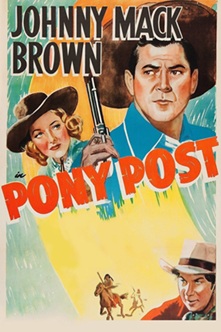
Pony Post (1940, directed by Ray Taylor)


In the days of the Old West, Griff Atkins (Stanley Blystone) manages a Pony Express station but, because of his gambling debts, he actually encourages the Indians and the outlaw Richard brothers (John Rockwell and Ray Teal) to attack the Pony Express riders and steal their horses.  Major Goodwin (Tom Chatterton) tries to put a stop to all this by firing Griff and putting Cal Sheridan (Johnny Mack Brown) in charge.  Griff and the Richard brothers continue their outlaw ways and eventually, the head of one of the relay stations is killed in one of their raids.  While the dead man’s daughter, Norma (Nell O’Day), investigates the murder, Cal works to bring peace the line and falls in love with Goodwin’s daughter, Alice (Dorothy Short).  Meanwhile, aspiring Pony Express rider Shorty (Fuzzy Knight) tries to invent a trampoline system that will help him to mount a horse.

No matter how bad things get in the west, you can always count on Johnny Mack Brown to bring some order and to get it done in less than an hour.  Johnny Mack Brown was always a good hero and that’s the case here.  Eventually this film has all of the horse riding and tough fighting that fans of the genre expect from these westerns but, for a short movie (it only runs for 59 minutes), it still seems to take a while for it to really get going.  The first half of the movie is more about Fuzzy Knight singing songs and trying to become a rider than it is about anything else.  I usually enjoy Fuzzy’s antics but, like the B-western themselves, they are definitely an acquired taste for most viewers.

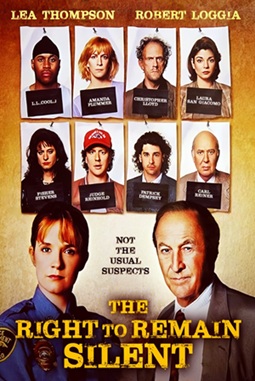
The Right To Remain Silent (1996, directed by Hubert de La Bouillerie)


It’s one very busy night at a police station.  Everyone who is brought in from off the streets has the right to remain silent but no one exercises it.  Rookie cop Lea Thompson listens to everyone’s stories.  LL Cool J is the documentarian who thought it would be smart to put on Klan robes and a hood and try to infiltrate a demonstration undercover.  Patrick Dempsey is the drunk who killed a kid.  Carl Reiner comes in and confesses to mercy killing his wife.  Christopher Lloyd is homeless.  Fisher Stevens is a trans streetwalker.  Judge Reinhold, I don’t even know what he was supposed to be.  Reinhold actually plays two characters in this film and he’s miscast in both roles.  Amanda Plummer is a pizza delivery person who shoots someone in self-defense.  No one asks for a lawyer.  No one lies about what they did.  Instead, they just talk and talk and talk and talk some more.  Thompson listens while Robert Loggia, as the chief, growls about donuts.

The Right To Remain Silent is based on a play and that is its downfall.  Instead of being a story about a rookie cop and her first night on the job, it’s just a collection of rambling stage monologues.  Some of the actors, like Carl Reiner and Christopher Lloyd, do okay.  Most of them still seem to be acting for the folks sitting in the back row.  It ultimately doesn’t add up too much because the stories are too predictable to make much of an impression.  Everyone in this film had the right to remain silent and I wish they had exercised it.

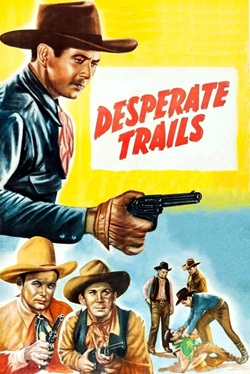
Desperate Trails (1939, directed by Albert Ray)


The frontier town of Denton has become lawless, plagued by murders, robberies, and cattle rustling.  The town’s sheriff (Russell Simpson) just cannot seem to bring peace to the streets.  That’s because the sheriff is secretly responsible for all the crime.  He’s working in cahoots with the town banker (Clarence Wilson) and he’s sets his sights on taking over a ranch owned by Frances Robinson.  As was so often the case with B-westerns, it all comes down to stealing someone else’s land.

The federal government sends Marshal Johnny Mack Brown to bring some order to the town.  Working undercover, Brown gets hired as Robinson’s ranch and he quickly chases off all of the bad ranchhands,  He brings his friend, singing cowboy Bob Baker, onboard to work as the ranch foreman.  With Fuzzy Knight providing comic relief, Brown sets out to thwart the next stagecoach robbery and to expose the evildoers of Denton.

This was the first western that Brown made with Universal Pictures.  Bob Baker, who had previously been the star of the studio’s B-westerns, was demoted to second lead and, eventually, he quit making films for Universal all together.  Unlike Baker, who was angry at being demoted, Fuzzy Knight was always happy to provide sidekick duty and would go on to co-star in all of Brown’s Universal westerns.  From the start, Brown and Knight had the chemistry that made them a good B-movie team.

Desperate Trails is a typical B-western but, as always, Brown elevates things with his performance.  From the minute that Brown rides into town, he screams authenticity.  He’s pretty tough in this film, which includes a scene where he coolly takes care of a gang of outlaws with just one rifle.  The best performance here comes from Russell Simpson, who gets angrier and angrier as the film goes on and all of his plans fall apart.

For fans of the B-western genre, Desperate Trails has a lot of entertainment to offer.

Retro Television Review: Homicide: Life on The Street 4.2 “Fire Part Two”


Welcome to Retro Television Reviews, a feature where we review some of our favorite and least favorite shows of the past!  On Sundays, Lisa will be reviewing Homicide: Life On The Street, which aired from 1993 to 1999, on NBC!  It  can be viewed on Peacock.
Guest reviewer alert!  I’m filling in for Lisa on the Homicide beat this week.  Let’s take a look at the second episode of the fourth season.

Episode 4.2 “Fire Part Two”

(Dir by Nick Gomez, originally aired on October 27th, 1995)

Continuing from where the previous episode ended, Pembleton, Bayliss, and Kellerman investigate the second warehouse fire.  Another victims has been found burned to a crisp in the fire.  Her dental records identify here are Bonnie Nash, a teenage girl.  The positioning of her body indicates that, unlike the first victim, she was already dead when the fire was set.

Pembleton continues to dislike Kellerman and gets especially annoyed when Kellerman announces that he’s decided to quit smoking.  Bayliss is suffering from a degenerative disc and spends more time complaining about the pain than actually investigating the case.  It’s Kellerman who solves the case and tricks chemistry teacher Gavin Robb (Adam Trese) into confessing.  While in the box with him, Kellerman plays good cop and even tells Robb that he’s free to leave after Robb denies being the arsonist.  As Robb stands, Kellerman whispers, “Why did you kill the dog?”

Without thinking, Robb replies, “I didn’t know it was there.”

(Of course, there was no dog there.)

Realizing his mistake, Robb confesses.  Bonnie was one of his students.  Having decided to kill her, Robb set the first fire to fool everyone into thinking that there was a serial arsonist on the loose so that the arsonist would be blamed when Bonnie’s body was found in the second fire.  The first death was an accident.  The death of Bonnie was premeditated.  When asked why he killed Bonnie, Robb replies, “That’s my personal business.”

Giardello invites Kellerman to join Homicide.  At first, Kellerman refuses because he doesn’t think he’s smart enough to be a member of the murder police.  But after visiting his father at his dead-end job in a distillery, Kellerman changes his mind.

Meanwhile, Kay and Munch both study for the sergeant’s exam.  Kay makes it to the exam and probably aces it.  Munch can’t find his lucky socks and misses it.  I would have missed it too.  You can’t do anything without the lucky socks.

This episode was an improvement over the previous episode.  Last episode, Kellerman came across as being a cliche, the hot-headed cop who has a problem with authority.  This episode, Kellerman was more likable and also a lot less cocky.  That he’s insecure about whether or not he can keep up with the other homicide detectives makes him a very relatable character.  It would have to be intimidating to find yourself suddenly working with someone like Frank Pembleton, who is always portrayed as being the best of the best.

As I mentioned last week, Reed Diamond was originally a controversial addition to the cast.  At the time, many critics said the show was selling out by casting an actor who didn’t look like Ned Beatty or Jon Polito.  Reed Diamond and Mike Kellerman would both prove themselves, leaving little doubt that they belonged.  Later, Homicide would make some bad casting decisions.  (Five word: Jon Seda as Paul Falsone.)  But Reed Diamond, with this episode, steps up and shows that he can keep up with the rest of the squad.
 

A Scene That I Love: Kneel Before Zod from Superman II


The great British actor Terence Stamp passed away today.  He was 87 years old.

Stamp appeared in many great films and gave several noteworthy performances.  However, for those of us of a certain age, he will always be General Zod, the villain who nearly defeated Superman and who ordered the President to kneel before him.  From 1980’s Superman II:

Terence Stamp, RIP.

Guy Pearce Goes To The Old West In The Trailer For Killing Faith


After years of being an underrated actor, Guy Pearce finally got his first Oscar nomination earlier this year for The Brutalist.  He didn’t win but at least it reminded people of the fact that he’s a damn good actor.  Will Killing Faith also remind people of that?  The trailer below features both Pearce and another underrated actor, Bill Pullman.

Emma Thompson and Judy Greer Try To Survive In The Trailer For Dead of Winter


Emma Thompson and Judy Greer aren’t the first names that come to mind when you think of survival horror but maybe (?) that will change after the release of Dead of Winter.  The trailer finds Thompson alone in a frozen Minnesota landscape, apparently trying to escape her grief.  As you can see in the trailer, she’s not alone for long.

June Squibb Moves To Manhattan In The Trailer For Eleanor The Great


Scarlett Johansson is making her directorial debut with Eleanor The Great, a film that stars 95 year-old June Squibb as Eleanor Morgenstein, an elderly woman from Iowa who moves to Manhattan after a devastating loss and who gets involved in the lives of Chiwetel Ejiofor and his daughter.  Though it’s not obvious from the trailer, the reviews from Cannes indicate that Eleanor is not quite who she claims to be.

Many actors have tried their hand at directing, often with mix results.  Ron Howard enjoyed directing so much that he gave up acting.  Kevin Costner made his debut with a bang and he’s been struggling to match it ever since.  Robert Redford is a far more interesting director than actor.  You could probably make the same argument about Warren Beatty, Sean Penn, and Jon Favreau.  But then there are countless other actors who directed one forgettable film and then quit.  How will Scarlett Johansson’s debut play out?  Watch the trailer and try to judge for yourself.