Game Review: Electric word, “life” (2020, Lance Nathan)


Electric word, “life” is an entrant in this year’s Interactive Fiction Competition.  Right now, because it’s October, I’m just playing the horror and Halloween-themed entries but all sorts of different games have been entered in this year’s competition and I look forward to playing all of them in November.

Electric word, “life” takes place at a Halloween party in 1999 but it’s not really a horror game.  There are elements of the supernatural in the game but the game is more about memories and grieving than it is about the paranormal.  Your roommate is throwing a Halloween party and, realizing that your flat is full of strangers, you’re looking for a way to either escape or at least find some peace and quiet.  Then, suddenly, your friend Andy shows up but there’s something different about him.

Like most games designed with Twine, Electric word, “life” is more a short story than a traditional game.  You point and click to move the story along and to get extra details.  There are a few choices you can make but they all appear to eventually lead to the same conclusion.  Luckily, it’s a very well-written and emotionally-effective story.  I especially liked the amount of detail that Lance Nathan went into when it came to recreating Halloween, 1999.  Everything from the Matrix costumes to the music playing at the party felt spot-on.  Playing the game, you feel like you really are at that party, listening to strangers chat each other up and wondering how you’re going to clean up the mess afterwards.  When Andy arrives, you’re as relieved as the narrator to see a friend and when Andy reveals his secret, it’s an emotional moment for both the player and the narrator.

Electric word, “life” is a simple but rewarding work of Interactive Fiction.  It can be played by clicking here.
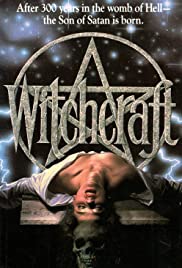
Witchcraft (1988, directed by Rob Spera)


In this low-budget movie, Grace (Anat Topol), her husband John (Gary Sloan), and their newborn son, William, move in with John’s mother, Elizabeth (Mary Shelley).  It’s only supposed to be temporary but Grace soon comes to feel as if Elizabeth never wants her or her son to leave.  Even though John supposedly owns “half of Massachusetts,” he’s clearly not willing to stand up to his mother and, at times, it seems like he’s closer to her than he is to his own wife.

Meanwhile, Grace is haunted by visions of a puritan couple being burned at the stake.  When the local priest has a vision of his own and sees William’s crib surrounded by super-imposed flames and he tells Grace that William needs to be baptized as soon as possible, Grace suspects that something strange is happening.  When the priest ends up hanging from a tree in the backyard, Grace knows that witchcraft must be afoot.

Obviously influenced by both Rosemary’s Baby and The Amityville Horror, Witchcraft isn’t terrible but it’s not very good either.  For a low budget film, the acting is surprisingly adequate and Elizabeth’s creepy mansion is a good location for a cheesy horror movie.  The film’s plot, though, is predictable.  You will guess what’s going on long before Grace does.  What’s strange is that the film is full of references to things that supposedly happened but which we didn’t see.  For instance, Grace says that she had a vision of the priest hanging before she actually saw him.  That’s the way things usually happen in a film like this but how come we didn’t get to see that vision too?  How come Grace doesn’t mention it to anyone until after the priest is actually dead?  Did the movie run out of money before they could shoot the scene?  Did it just slip someone’s mind to include the scene in the film?  What’s going on?

The most amazing thing about Witchcraft is that this forgettable film was a big enough hit on video that it got a sequel.  And not just one sequel.  As of right now, there have been fifteen sequels to Witchcraft, each one of which is a direct sequel to the one that preceded it.  (There are 18 films in the Amityville franchise but few of those films share a direct connection beyond the use of the word “Amityville” in the title.)  Compared to the later films in the Witchcraft franchise, the first one is pretty tame.  Later installments would play up the sex to such an extent that they became notorious for it.  The first Witchcraft discreetly fades to black whenever Grace and John are in the mood.

Witchcraft is forgettable but, as the first entry in an apparently unkillable franchise, it’s an important landmark in direct-to-video history.

Game Review: The Pinecone (2020, Joseph Pentangelo)


The Pinecone is one of the entrants in this year’s Interactive Fiction Competition.  In this work of flash fiction, you’re waiting for the school bus to arrive.  It’s another cold and boring morning.  You’re running late but so is the bus.  It’s while you’re waiting for the bus that the goats arrive.  How you react to the goats will determine whether or not you make it to school.  That my sound simple but there’s more to it than just standing to the side while they walk by.  You never now where a goat might show up.

This is a brief but well-written and frequently funny game.  Because of movies like The Witch, I was expecting the goats to act in a certain and more sinister way.  While they didn’t (and this is not a horror game, despite the presence of goats), the game still did a good job of showing why you wouldn’t necessarily want to mess around with a goat.  Towards the end of the game, there is a literal laugh out loud moment involving a goat and a school bus.  The game’s worth playing just for that.

The Pinecone is simple but it’s also a game that rewards being replayed.  Unlike a lot of Twine works, your decisions really do affect the outcome of the game.  Making the correct choice early on in the game will give you more options later on.  Making the wrong choice will lead to your options being limited and you missing school.

It’s not a difficult game but it probably does help to know something about goats before playing The Pinecone.  After you’ve done research, The Pinecone can be played here.

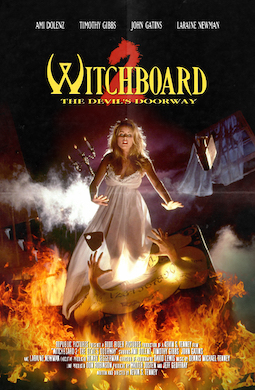
Cinemax Friday: Witchboard 2: The Devil’s Doorway (1993, directed by Kevin Tenney)


Moving out of her boyfriend’s home because he doesn’t support her desire to become an artist, Paige (Ami Dolenz) rents a large studio apartment in Los Angeles.  When she finds a Ouija Board in the closet, she plays around with it and is contacted by a spirit named Susan.  Susan claims that she used to live in Paige’s apartment and someone in the building murdered her.

The good news is that talking to Susan inspires Paige to start painting and investigating Susan’s death not only brings Paige closer to her cop boyfriend (Timothy Gibbs) but it also allows her to make friends with her landlady Elaine (Laraine Newman!) and a photographer named Russel (John Gatins).  The bad news is that Susan is a vengeful spirit and soon people start dying.  One man is taken out in a boiler room explosion.  Another is taken out by an axe. Trying to drive isn’t easy when Susan decides she wants to be your co-pilot.  If Paige solves Susan’s murder, will that bring peace to Susan or is Susan too obsessed with killing to stop even if her killer is brought to justice?

Witchboard 2 isn’t bad.  Both director Kevin Tenney and the Ouija board return from the first film and Ami Dolenz does a good job in the role of the naïve young woman who gets possessed by spirits beyond the grave.  The daughter of Monkees drummer Mickey Dolenz, Ami Dolenz appeared in several direct-to-video horror films and thrillers in the late 80s and early 90s and she had a refreshing naturalness about her as an actress.  She could be both sexy and innocent without ever seeming like she was trying too hard to convince you that she was either.  (Everyone who watched a lot of late night Cinemax in the 90s developed a crush on Ami Dolenz at some point and anyone who says otherwise is lying.)  Kevin Tenney surrounds Dolenz with an engaging cast of eccentrics, the most memorable one being Larraine Newman of Saturday Night Live fame, who provides the same sort of spacey comic relief that Kathleen Wilhoite provided in the first film.

Though Witchboard 2 is modest in its goals and its execution, it’s still a good chiller for an October night.

Game Review: Baby Face (2020, Mark Samples)


In this work of Interactive Fiction, the recent death of your mother forces you and your father to come to terms with Babyface, a semi-legendary bogeyman who haunted you in the past and who may still be living in his old house, watching as people walk by.

Babyface is more of a short story than an actual game.  There are things for you to click in order to move the story forward but there really aren’t any decisions for you to make.  If you’re looking for a traditional IF experience, with you explore locations on your own and it’s up to you to figure out what the clues mean and how to solve all the puzzles, Babyface is not it.

Instead, it’s a story that puts you right in the head of the main character.  Even though you don’t really control her actions, you still see the story through her eyes.  It’s both well-written and well-designed (using Twine) and it uses both audio and photographs to create and maintain a spooky atmosphere.  Inspired by a nightmare, this story does a good job of capturing dream logic and keeping the player off-balance.  It may not be a traditional game but it is a good read for fans of horror.

Babyface has been entered into the 2020 Interactive Fiction competitionIt can be experienced here.

Spider-Man: The Dragon’s Challenge (1979, directed by Ron Satlof)


This, the final of the three Spider-Man “feature films” that were basically edited episodes of the Spider-Man TV series, finds Peter Parker (Nicholas Hammond) in Hong Kong.  Spider-Man having adventures in Hong Kong sounds like it should be fun and the 2nd half of this “movie” was filmed on location but, even with all those elements (and a young Ted Danson in a small role), Spider-Man: The Dragon’s Challenge is just dull.

Min (Benson Fong) is a rich Chinese businessman who stands to be appointed to a position in the Chinese government but only if he can prove that he didn’t sell secrets to the U.S. during World War II.  Min needs to find three Marines who can clear his name.  Because Min is an old friend, J. Jonah Jameson (Robert F. Simon) assigns photographer Peter Parker to help Min track the men down.  Why would Jameson give that responsibility to Pater Parker?  I don’t know.

Min’s granddaughter, Emily (Rosalind Chao), thinks that Peter is a coward because he always disappears whenever Min is attacked.  It’s a good thing that Spider-Man always mysteriously shows up whenever Peter isn’t around because otherwise, Min would be in a lot of trouble.  It turns out that a steel baron named Mr. Zeider (Richard Erdman) wants to stop Min from clearing his name because Min would stop Zeider from getting a big construction contract.

Eventually, Peter, Min, Emily, and a former marine who can clear Min all end up in Hong Kong, where Spider-Man gets to fight kung fu masters and hopefully save the day.

Spider-Man: The Dragon’s Challenge has all the elements to be an enjoyably cheesy 70s adventure film but it fails because it’s not really a movie.  It’s just two episodes of a TV show that have been edited together and, with the exception of a few of the fight scenes in Hong Kong, there’s nothing cinematic about it.  As opposed to the previous two Spider-Man “films,” Nicholas Hammond just seems bored in this outing and the scenes with Rosalind Chao scolding Peter for being a coward are too much like Lois Lane complaining about Clark Kent never being in the same place as Superman.

Spider-Man: The Dragon’s Challenge also misses the opportunity to bring in any members of Spider-Man’s gallery of wonderful villains.  How hard would it have been to replace Mr. Zeider with Wilson Fisk?  The Silver Samurai could have at least made an appearance.  Instead, Spider-Man’s just fighting another corporate villain.  It’s a wasted opportunity.

The two episodes that make up this film were also the final two episodes of the Spider-Man TV show.  Despite the fact that CBS was constantly moving the show around on the schedule and that the second season only featured 7 episodes, the series still got good ratings.  However, CBS apparently feared that, by airing not only Spider-Man but also The Incredible Hulk and Wonder Woman, it would run the risk of becoming known as a “comic book” network.  Since the Hulk and Wonder Woman both got good ratings and, unlike Spider-Man, had the support of the critics, they were allowed to remain while Spider-Man was given the boot and canceled in 1979.  That’s a strong contrast to today, when most exec would probably sell their first born to get a chance at some of the Marvel action.

After this, it would be another 23 years before Spider-Man again appeared on a movie screen, this time in the form of Tobey Maguire.  While Nicholas Hammond would never again play Spider-Man, one fan of his time on the show was director Quentin Tarantino, who later cast Hammond as director Sam Wanamaker in Once Upon A Time In Hollywood.

Game Review: Vampire Ltd (2020, Alex Harby)


One of the best Interactive Fiction games that I’ve played recently, Vampire Ltd. is described as being “a corporate espionage adventure (with vampires in it).”

Taking place in a world where vampires are not only known to exist but where they often become rich and powerful businessman, Vampire Ltd. has the player take on the role of Nero Brashov.  Nero is a former aristocrat, a current vampire, and a failed businessman.  But the failure is not your fault.  You were cheated by your business partner, Hadrian.  Now, Hadrian is on the verge of unveiling something that he calls the Moonlite and you’re determined to get revenge by sneaking your way into his corporate office and destroying the machine.

The only problem is that you’re a vampire and you can’t enter unless someone invites you in.  Can you convince someone to do that?

A clever and very detailed mix of horror and corporate espionage, Vampire Ltd. is a frequently hilarious text adventure in which you alternate between dealing with the realities of corporate life and your desire for revenge.  While the puzzles are not excessively difficult, they do require a little work to figure out but the game comes with a walk-through for those who might get lost.

Vampire Ltd. is a game that benefits from being played more than once.  There’s a lot that your vampire can do.  It’s not necessary to do all of it to win the game but it’s still rewarding to replay and discover all of the different things that can happen.  Fortunately, the game ends with a series of suggestions of things that you might want to try when you play a second or third time.

Vampire Ltd. is an entry in this year’s Interactive Fiction Competition It can be played here.

Spider-Man Strikes Back (1978, directed by Ron Satlof)


When three college students decide to prove the folly of the nuclear arms race by stealing enough plutonium to make a nuclear bomb of their own, it’s up to Spider-Man (Nicholas Hammond) to sort them out!  He better do it quickly, too, because the police suspect that the plutonium may have been stolen by a grad student named Peter Parker.

However, Spider-Man is not the only person who wants that bomb.  The evil Mr. White (Robert Alda) also wants the bomb, though he’s not planning on using it to make the case for world peace.  Instead, he plans to blackmail the government into giving him a fortune in gold.  Now, Parker not only has to clear his own name but he has to keep Mr. White from blowing up Los Angles while, at the same time, preventing a nosy reporter (Joanna Cameron) from figuring out that he’s really Spider-Man.

Spider-Man Strikes Back was released as a feature film in Europe and was advertised as being a sequel to Spider-Man.  Gullible audiences who paid money to see it ended up sitting through a two-part episode of the Amazing Spider-Man TV show, albeit one that was edited into a 90-minute movie and which didn’t have stop for commercial interruption.

Spider-Man Strikes Back highlights exactly what went wrong with the first attempt to do a live action version of Spider-Man.  There were several members of Spider-Man’s regular rogues’ gallery who could have stolen that bomb and threatened Los Angeles.  It sounds like a typical Sinister Six plot.  Even the Kingpin, on a bad day, might be tempted to get in on that action.  Instead, the villain is a bland arms dealer named Mr. White.  CBS reportedly refused to use any classic Spider-Man villains because they wanted to keep the show grounded in reality but the minute Spider-Man crawled up a skyscraper for the first time, the network should have forgotten about trying to keep it real.

To repeat what I said in my review of Spider-Man, Nicholas Hammond is miscast as everyone’s favorite webcrawler.  Hammond is likable but he doesn’t come across as being at all insecure and it’s Spider-Man’s insecurities that distinguished him from other comic book heroes.  Spider-Man Strikes Back also suffers because it’s clear that much of the Spider-Man footage was reused from the pilot film.

I still enjoyed watching Spider-Man Strikes Back, though.  When I was a kid, Spider-Man was my favorite and, even in something like this, it’s still fun to watch him climbing up buildings and webbing up crooks.  Though there’s nothing cinematic about Spider-Man Strikes Back and it’s clearly just an extended episode of a TV show, I still liked that the climax took place in an preserved old west ghost town.  That was just strange enough to work.

Though Spider-Man Strikes Back was not as successful at the European box office as Spider-Man, it still did well enough that one more feature film would be crafted from the Spider-Man TV show, Spider-Man: The Dragon’s Challenge.

Game Review: The Brutal Murder of Jenny Lee (2020, Daniel Gao)


Jenny Lee was only seventeen years old when she was brutally murdered, beaten to death with her own saxophone.  Now, seventeen years later, you have been sent into the past to investigate her murder.  A disembodied voice follows you everywhere you go, sometimes offering up hints but sometimes reprimanding you if you find clues to a solution that the voice doesn’t want to hear.  The voice makes it clear that you have a limited amount of time to solve the murder and when that time expires, so will you.  When you’re not investigating, you’re in limbo, where you can move in every direction but you can never escape.  Or can you?

This work of Interactive Fiction is actually two mysteries in one.  The first is the mystery of who murdered Jenny Lee.  The other is the mystery of who you are and why you’ve been sent to the past.  Neither is an easy mystery to solve and, fortunately, the game does have a walk-through for those who just want to find out what’s going on in the most straight-forward way possible.  However, it’s best to play this game without using the walk-through so that you can fully immerse yourself in the world that it creates.  Not everything you see in the game is going to be relevant to solving the mystery.  Like all good detective stories, there are red herrings.

The best advice I can give you for what to do while playing The Brutal Murder of Jenny Lee is to write things down.  A lot of the game’s clues involve remembering either directions or passcodes.  Making the right or wrong decision when going either north, south, east, or west be can be the difference between a good ending and a bad ending.

The Brutal Murder of Jenny Lee is an entry in this year’s Interactive Fiction Competition.  It, and all of the other entries, can be played here.

Music Video of the Day: Hot For Teacher by Van Halen (1984, directed by Pete Angelus, David Lee Roth, and Rick Friedberg


Eddie Van Halen, rest in peace.

We take a small break from our annual Horrorthon to present, for your approval, the type of music video that most bands probably couldn’t get away with today, at least not without running the risk of getting cancelled on twitter.  Hot For Teacher is both a song and a video that epitomizes both the 80s and Van Halen.

The video follows Waldo over the course of his first day of school.  Waldo’s voice is provided by the one and only Phil Hartman.  Hartman would join the cast of Saturday Night Live two years later, appearing on that show for ten years and then co-starring on Newsradio.  He was also an unofficial cast member of The Simpsons, providing the voices of both Lionel Hutz and actor Troy McClure.  Hartman was one of the of the funniest men to ever live.  His 1998 murder is still something that I have a hard time accepting.

The teachers are played by models Donna Rupert (she’s the Chemistry teacher) and Lillian Muller (she teaches physical education).  While the stripping teachers were considered to be controversial in 1984, what was even more controversial was a brief scene of the members of the band grabbing their crotch during the “so bad” chorus.  When the video originally aired on NBC’s Friday Night Video, the crotch-gabbing was covered by a black censor box.

In 1985, during the Al Gore-inspired Senate hearings on obscenity in rock music (or “porn rock,” as Al Gore called it), the video for Hot For Teacher was cited as being a particularly bad influence on young listeners and viewers.  The members of the committee took a break from the testimony of Tipper Gore and Frank Zappa to watch the video.  After the video ended, U.S. Senator Paula Hawkins of Florida testified, “Much has changed since Elvis’ seemingly innocent times. Subtleties, suggestions, and innuendo have given way to overt expressions and descriptions of often violent sexual acts, drug taking, and flirtations with the occult.”  Unfortunately, there doesn’t appear to be any record of Senators Ernest Hollings and Strom Thurmond thought about the video.  Van Halen continued to rock long after all the members of that committee had either retired or been voted out of office.

Enjoy!