Welcome to Late Night Retro Television Reviews, a feature where we review some of our favorite and least favorite shows of the past! On Thursdays, I will be reviewing Highway to Heaven, which aired on NBC from 1984 to 1989. The entire show is currently streaming on Tubi and several other services!
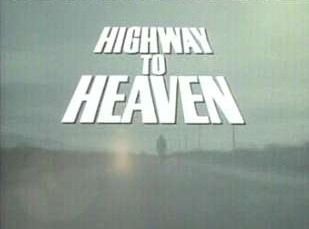
This week, we start the fourth season of Highway to Heaven. This episode features orphans and dogs! I feel the tears coming….
Episode 4.1 “Man’s Best Friend Part One”
(Dir by Michael Landon, originally aired on September 16th, 1987)
Oh, this episode made me cry and cry.
Why? Well, for a couple of reasons….
First off, Jonathan and Mark got new jobs working at a kennel. Many of the dogs at the kennel had been abandoned by their owners and Ms. Lil (Fran Ryan) took care of them all, rather than taking them to the pound. And listen, I’m not a dog person. I’m a cat person. We all know this. But seriously, those dogs were adorable!
A Siberian husky named Jake gets lost. After running across the interstate (gasp!), he finds himself alone at night. Coyotes approach. (OH NO!) Suddenly, Jonathan appears and turns into a lion, scaring the coyotes off. (*sniff* *sniff* I’m okay.)
Every few days, Lil takes the dogs down to the local orphanage — (OH MY GOD!) — and lets them play with the orphans. Jake, now a part of the kennel crew, begs young Alex (Danny Pintauro, who had a much worse experience with a dog in Cujo) to play with him. Alex is shy and introverted but Jake quickly becomes his best friend. Alex starts to come out of his shell and says that he knows he’ll never be separated from Jake. For the first time in his young life, Alex is happy.
(Oh dear.)
The local media does a story on Lil and her dogs. They take a picture of Alex and Jake. The next morning, a young girl named Jenny (Elisabeth Harnois) sees the picture and recognizes Jake. For the past month, she’s been desperately looking for Jake!
(This isn’t good….)
Jenny and her grandfather (William Schallert) pick Jake up from the kennel. Jonathan has to go to the orphanage and tell Alex that his best friend is no longer going to be visiting him.
(Sorry, give me a minute.)
Alex is depressed. Jake is depressed. Jonathan shows at Jenny’s home and asks if Alex can come and visit Jake. Jenny and grandpa say yes. (YAY!)
Suddenly, three dreaded words appear on the screen: “TO BE CONTINUED”
What!? No, there’s no need to continue. Alex and Jake have been reunited, let’s end the story here….
This episode was Highway to Heaven at its most earnest, manipulative, and effective. Not only did it feature orphans but also an adorable dog and William Schallert as a genial authority figure. There was also a subplot about Jenny’s parents trying to have another child with a surrogate and I’m sure that has something to do with that promise of “TO BE CONTINUED.”
Nothing better happen to the dog!
 Through the Shattered Lens
Why Torah views the new testament and koran as avoda zara. The definition of abomination!
Israel only accepted two commandments at Sinai before we feared that we would surely die and therefore demanded that Moshe receive the rest of the Torah. What’s the “rest of the Torah”, not just the 611 commandments within the language of the Written Torah but all the halachot capable of rising to the sanctity of time-oriented tohor commandments from the Torah itself! Herein defines the intent of the 1st Sinai commandment … to obey the revelation of HaShem לשמה.
LORD, not the Name revealed in the 1st Sinai commandment – and therefore LORD comes under the 2nd Sinai commandment. The same apples to God, Yahweh, Jesus or Allah etc.
The day of Shabbat approaches, but this tohor time oriented commandment does not rest at one day of not doing מלאכה/work but all the rest of the six days of not doing forbidden עבודה on the 6 days of “shabbat”. Raising positive and negative commandments – which do not require prophetic mussar as their k’vanna to tohor time-oriented commandments which do require prophetic mussar as their k’vanna – as learned in the first Book of the Written Torah – בראשית.
This first word of the Torah בראשית, it contains both a רמז, meaning words
within words, ראש בית, ברית אש, and ב’ ראשית; but more – it contains a סוד: the idea of tohor time-oriented commandments which includes all the halachot contained within the Talmud! Hence the Gra taught the kabbalah that בראשית contains all the commandments of the Torah. Torah, by definition includes all the Halachot of the Talmud, according to the B’HaG’s Hilchot Gadolot, a commentary that Pre-Adamites – the Creation of Adam and the Garden.
The next three Books of the Written Torah contain תולדות commandments; positive and negative commandments – that do not require k’vanna – as do tohor time-oriented commandments. What distinguishes a tohor time-oriented commandment from תולדות commandments and halachot contained within the Talmud? A tohor time-oriented commandment requires the dedication of the Yatzir Ha’Tov, which breathes tohor spirits from within the heart. The בנין אב/precedent by which Torah common law\משנה תורה/ learns בכל לבבך\כם within the kre’a shma as publicly taught by Rabbi Yechuda Ha’Nasi, in one of his Mishnaot within the mesechta of ברכות, the concept of עבודת השם – the key יסוד (which contains סוד) of doing mitzvot לשמה, a person must dedicate tohor middot (( The revelation of the 13 tohor middot revealed to Moshe at Horev 40 days after the substitute theology known as the sin of the Golden Calf )), by sanctifying one or more tohor spirits, which breathes within the Yatzir Ha’Tov within the heart.
JeZeus when asked by his disciples, he did not understand this fundamental and basic kabbalah/סוד. He taught his disciples: “Our Father who lives in Heaven …” Wrong. Tefillah a matter of the Yatzir Ha’Tov within the Heart; based upon the common law precedent learned from the Brit cut between the pieces by Avram. Dedicating a spirit does not compare to blowing air from the lungs as expressed through the precedent of blowing the Shofar. Its not the blowing of the shofar, as a positive commandment, that elevates this toldah commandment unto a time-oriented Av tohor commandment!
But rather the affixation of t’keah, tru’ah, and sh’varim to the positive toldah commandment of blowing the shofar, wherein a person remembers the oaths sworn by the Avot with the purpose to create יש מאין the chosen Cohen people. Herein defines how blowing the shofar raises from a secondary toldah commandment to an Av tohor time-oriented commandment. All tohor time-oriented commandments which remember the oaths the Avot Avraham Yitzak and Yaacov, as their k’vanna; ( ONE in the opening p’suk of kre’a shma. ), to serve HaShem לשמה through the elevation of Written Torah toldot secondary commandments AND Talmudic halachot mitzvot unto Av time-oriented commandments.
Because both the gospels and new testament never teach this fundamental סוד\יסוד Jews recognize JeZeus as a false messiah. M0-0-Ham-Madd referred to JeZeus as a prophet. Despite the heretic Rambam’s validation of Islam, neither it nor Xtianity bases their judicial courts strictly upon the revelation of Torah common law. Its this fundamental and most basic of errors which exposes both JeZeus and Moo-Ham-Madd as Av tumah false prophets. The Rambam’s statute law halachic code compares to how rabbi Natan validated Sabbatai Zevi as Moshiach.
The gospel also narrative very much resembles the style of rabbi Natan’s validation of Sabbatai Zevi – the Ottoman mystic. The Pauline replacement theology famously known for its “Original Sin & expulsion of Adam from the Garden” false paradigm, served to subvert the core oath alliance acceptance of Torah curses. Specifically, that the worship of avoda zarah results in g’lut/exile of the chosen Cohen people. Both Xtianity and Islam ignore the chosen Cohen People – the central them of Torah blessings of the oath brit alliance. Just as Paul’s doctrine of “Original Sin” replaced and subverted the Torah curse of g’lut/exile.
Raising Torah commandments from static positive & negative commandments to dynamic Oral Torah time-oriented commandments – elevates static statute law fixed ritual Greek/Roman fossilized toldot commandments, to dynamic Oral Torah living commandments – which requires k’vanna. Neither the imaginary man – Roman fiction – JeZeus, nor the false prophet M0-0 – Ham – Madd, both failed to gasp the primacy of Torah tohor time-oriented commandments, specifically expressed through these Prime examples of tohor time-oriented mitzvot – Shabbat and tefillah. These two examples of Av tohor time-oriented commandments, specifically remembers the 3 oaths sworn by Avraham Yitzak and Yaacov wherein they cut an oath brit which creates the chosen Cohen people, in all generations – throughout time – through the sanctification of tohor time-oriented commandments.
Both of these counterfeit religions introduce a perversion of the tefillah דאורייתא known as קריא שמע. This tefillah from the Torah requires tefillen which permits a chosen Cohen Jew to swear a Torah oath which specifically remembers the 3 oaths sworn by Avraham Yitzak and Yaacov wherein they cut an oath brit which creates the chosen Cohen people, in all generations – throughout time – through the sanctification of tohor time-oriented commandments. Therefore the last word ONE, does not testify to belief in Monotheism – an Av tumah avoda zarah belief system – but rather that a Jew, in any generation wherein he lives accepts the 3 oaths sworn by the Avot as ONE within his living and breathing Yatzir Ha’Tov.
The theology of monotheism, it defines Avoda Zarah far more clearly than does the worship of wood or stone idols. Therefore the last word ONE of the kre’a shma, does not testify to belief in any silly theology a monotheism Universal GOD. This nuanced comprehension and grasp of the k’vanna of the term “avoda zara”, defines the 2nd Sinai commandment far more clearly than does the worship of wood or stone idols.
Torah “faith” understood as the righteous pursuit of justice as exercised through lateral common law משנה תורה courtrooms. The false notion of faith as belief in a false Roman propaganda of messiah; this mythology designed to promote Civil War among the Jewish people themselves; or M00-Ham-Madd’s strict monotheism belief as Allah the Universal God of Sinai — both a directly mirror duplication of the sin of the Golden Calf substitution “One True God” theology.
The accurate Sinai revelation, simply not contained in the fraudulent new testament and koran avoda zarah abominations. Avoda zara not limited to the erroneous idea of “worship of false gods or idols. Rather vertical courtrooms wherein the State bribes through salaries the Judges and Prosecuting Attorneys of these loathsome ‘Star Courts’-courtrooms, best defines avoda zara. The Torah concept of faith explicitly learns from Paro’s decision to withhold straw and his vertical court ruled the Israelites – guilty for not meeting their Par’o imposed quota of brick production. When Yitro rebuked Moshe for his failure to establish common law courtrooms, these two precedents define Torah faith. They serve as examples just as did Shabbat and Teffilah precedents employed to define time-oriented commandments from the Torah.
A tiny mustard seed does not define Jewish faith; the righteous pursuit of judicial common law justice defines Torah faith. This Sinai revelation, not contained in the fraudulent new testament and koran avoda zarah abominations. Avoda zara not limited to the erroneous idea of “worship of false gods or idols. Rather vertical courtrooms wherein the State bribes through salaries the Judges and Prosecuting Attorneys of these loathsome courtrooms, herein perhaps best describes the abstract term: avoda zara.
The Torah concept of faith explicitly learns from Paro’s decision to withhold straw and his vertical “Star-court”, which dutifully obeyed Par’o and ruled the Israelites as guilty for not meeting their Par’o imposed quota for slave brick production. When Yitro rebuked Moshe for his failure to establish common law courtrooms, these two precedents most essentially – they also define Torah faith. The Av tumah avoda zara religions of Xtianity and Islam by stark contrast, define faith as belief in one God. Justice has nothing to do with what a person believes touching how theology utterly and totally corrupts and perverts Common law lateral courtrooms dedicated to make fair restoration of damages inflicted by Party A upon Party B among the chosen Cohen people — with the purpose to restore TRUST among our people — on par with bribery of Justices. Hatred without Cause, this three word clause defines avoda zarah according to the Talmud.
The revelation of the Torah at Sinai, only the 12 Tribes of Israel stood at Sinai and accepted the Torah. Therefore the revelation of the Torah at Sinai reveals a local Tribal God, not some theological Universal God, which all Humanity can worship as the false prophets JeZeus and M00-Ham-Madd declared though their treif belief systems of faith.
The precedent examples of time-oriented commandments, of Shabbat and tefillah, serve as models for all other tohor time-oriented Av Torah commandments. This type of Primary Torah commandment applies equally to all the rest of the Torah commandments and the halachot of the Talmud. The concept of “fulfillment of commandments”, does not compare to the gospel narrative which argues that JeZeus fulfilled all the words of the prophets!.
That abomination perverts, to this day, the revelation of the Torah at Sinai. Rather, in order to fulfill a Torah commandment, this requires that a person elevates the status of positive and negative secondary commandments raised to the status of tohor time-oriented Primary commandments. This same concept of “fulfillment of commandments” applies equally, across the board, to all Halachic mitzvot contained within the Talmud and Midrashim. To “fulfill the words of the prophets” entails grasping the mussar commanded within a particular sugya of T’NaCH prophetic “mussar” common law, and employing this prophetic “mussar” as the Aggadic warp k’vanna of observance of positive, negative weft – commandments and halachot – contained within the loom of Torah common law justice.
The Av tumah avoda zara religions of Xtianity and Islam both define faith as belief in one God. Alas, justice has nothing to do with what a person theologically believes. Specifically touching theology, if a judge permits theology to prejudice the pursuit of justice, this corrupt judge\”theology” – no different than the judge who accepts bribes. Torah faith, as defined through the example of the precedent – Av tohor Primary time-oriented – Common law lateral courtrooms – dedicated to make fair restoration of damages inflicted by Party A upon Party B among the chosen Cohen people. This Primary commandment concept shares no common ground with much later theological belief systems creed paradigms. The pursuit of righteous justice, dedicated to a simple singular purpose — to restore TRUST among our people. Hatred without Cause, this three-word clause, defines avoda zarah, according to the Talmud.
The revelation of the Torah at Sinai, only the 12 Tribes of Israel stood at Sinai and accepted the Torah. Therefore the revelation of the Torah at Sinai reveals a local Tribal God, not some Universal God, which all Humanity can worship — as the false prophets JeZeus and M00-Ham-Madd declared.
The precedent example time oriented commandments – Shabbat and tefillah – they merely serve as token models, for all other tohor time-oriented Av Torah commandments. These Primary Source commandments apply equally to all the rest of the Torah secondary source commandments and the halachot within the Talmud.
The concept of “fulfillment of commandments”, does not compare to the gospel narrative which argues that JeZeus fulfilled the words of the prophets!. That abomination perverts to this day the revelation of the Torah at Sinai. Rather, in order to fulfill a Torah commandment, this requires that a person elevates the status of positive and negative, secondary source-commandments raised to the status of tohor time oriented commandments Primary source commandments. This same concept of “fulfillment of commandments” applies equally, across the board, to all Halachic mitzvot contained within the Talmud and Midrashim. To “fulfill the words of the prophets” entails grasping the mussar commanded within a particular sugya of T’NaCH prophetic “mussar” common law and employing this “prophetic-mussar” as the k’vanna of observance of positive, negative commandments and halachot secondary sources raised to Av tohor Primary source commandments.
LikeLike