Film Review: Gold (dir by Anthony Hayes)


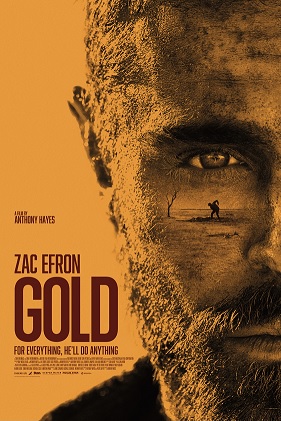
If you’ve ever wanted to see Zac Efron covered in flies, Gold is the film for you!

Actually, I’m being perhaps a bit more snarky than I should be.  Gold is actually a pretty good movie and Zac Efron deserves a lot of credit for trying something different.  That said, when all is said and done, I think the thing that most people will remember about this movie will be the flies.  Efron plays a character who spends several days stranded in the desert.  As we all know from watching any of the films that Clint Eastwood made with Sergio Leone, the desert is full of flies and there’s nothing they like more than to land on the blisters on someone’s sun-baked face.  So, it makes sense that Efron spends the majority of the film dealing with flies.  Of course, he also has to deal with feral desert dogs, a mysterious stranger who may or may not exist, and a freak dust storm.

Gold takes place in the near future.  Gold was filmed in Australia and, in many ways, it seems to take place in the same cinematic universe as the first Mad Max.  It’s the early days of a dystopia, when there’s still enough comforts around for people to pretend that things can still be normal.  People still watch television.  They still drive cars.  They still use telephones.  There’s still some sort of government that is supposedly in charge of things.  Society still exists but all around are clues that it is in the process of collapsing.  Things are on the verge of changing and they won’t be for the better.

Zac Efron plays Virgil, a man who wants to go to some place known as the Compound.  Keith (played by Anthony Hayes) has been hired to drive Virgil through the desert.  From the start, Keith and Virgil don’t get along.  Keith gets angry at Virgil for wasting water.  He gets even angrier when Virgil turns up the air conditioning in Keith’s truck and causes the motor to overheat.  However, when Keith and Virgil come across a giant gold nugget in the desert, they become reluctant partners.  When Keith heads to another town to get an excavator so they can dig up the gold, Virgil remains in the desert.  His job is to guard the gold, though one has to wonder who he thinks he’s guarding it from.  Virgil is literally in the middle of nowhere.

Keith leaves Virgil with a set of instructions of how to survive in the desert.  However, within hours of Keith leaving, Virgil starts to lose it.  He doesn’t have enough water.  He doesn’t have enough food.  Keith has taken the truck so it’s not like Virgil could go anywhere, even if he was willing to abandon the gold.  There are feral dogs all around.  There are flies on Virgil’s face.  And there are other scavengers in the desert as well….

There’s really not much of a story to Gold.  Virgil waits in the desert and loses his mind, all because he’s not willing to surrender that gold.  He’s a victim of his own greed, which admittedly is not the most original idea in the world.  (Consider the case of Fred C. Dobbs, for instance.)  That said, you do have to admire Efron’s willingness to allow himself to look absolutely terrible on screen.  From the flies to the dust storm to the scorching sun, the film goes out of its way to destroy Efron’s good looks but there’s a bigger meaning to it beyond Efron’s well-known desire to be taken seriously as an actor.  With each fly and speck of dust that lands on Efron’s face, Gold reminds the viewer that the desert will always win.  The desert and the animals that call it home don’t care about gold and they certainly don’t care about their prey.  In the desert, it’s all about survival.  Civilization may collapse but the desert will remain forever.

Visually, there’s a harsh beauty to Gold.  The desert is both frightening and fascinating at the same time and the scenes of Efron frame against the landscape really do drive home the film’s point.  One way or the other, the desert will always win.

What Could Have Been: George Hamilton as Travis Bickle?


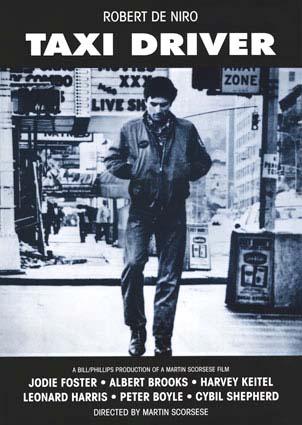
I was recently reading the IMDb trivia page for Martin Scorsese’s 1976 film, Taxi Driver. 

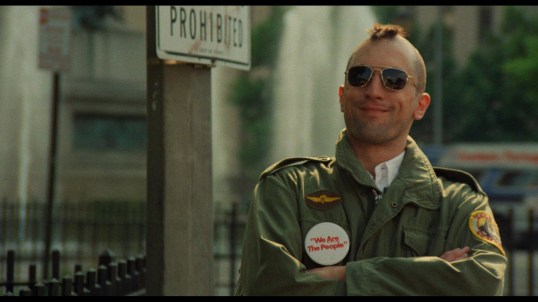
Taxi Driver is often held up as the being the ultimate New York horror story as well as being the quintessential Martin Scorsese/Robert De Niro collaboration.  In fact, the film is so identified with Scorsese, De Niro, and screenwriter Paul Schrader that it is easy to forget that it actually took a while for Scorsese and De Niro to become involved with the project.  Quite a few different directors showed interest in Schrader’s script before Scorsese signed on.  And, even though the role will always be associated with him, De Niro was not the only actor considered for the role of Travis Bickle.

That’s what brought me to the IMDb trivia page.  I wanted to see who else was considered for the role of Travis.  Here’s the list that I found: Jeff Bridges, Jack Nicholson, Dustin Hoffman, Warren Beatty, Burt Reynolds, Ryan O’Neal, Peter Fonda, Al Pacino, Jon Voight, Robert Blake, David Carradine, Richard Dreyfuss, Christopher Walken, Alain Delon, James Caan, Roy Scheider, Paul Newman, Marlon Brando, Martin Sheen, Elliott Gould, Alan Alda, and George Hamilton.  That’s quite a list!  And. for the most part, I don’t buy it for a second.

Don’t get me wrong.  It is known that Al Pacino was sent the script before Scorsese came on board.  And Scorsese himself has said that he offered the role to Dustin Hoffman.  (Hoffman says he turned down the role because Scorsese’s intensity freaked him out.)  Jeff Bridges was also a possibility and, if you read Schrader’s script and force yourself to forget about De Niro’s performance, you can actually imagine Bridges in the role.  I could also imagine a youngish Martin Sheen in the role.  He had just played Charlie Starkweather in Badlands so one can imagine him being considered for Travis.  Peter Fonda and Robert Blake seem possible as well.  Even David Carradine.

But some of the other names on that list …. Alain Delon?  Paul Newman?  Alan Alda?  GEORGE HAMILTON?

This George Hamilton?

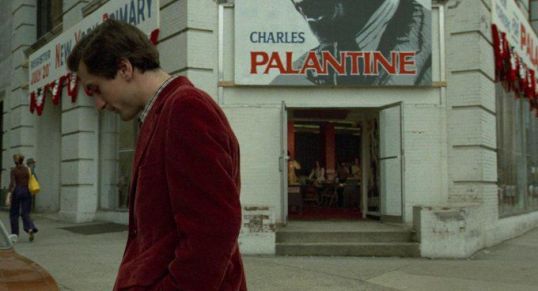
Listen, I like George Hamilton.  He’s a good comedic actor.  And I know that there were a lot of directors who took a look at Paul Schrader’s script and I also know that some of Travis’s most iconic moments — like the whole “You talkin’ to me?” scene — were improvised by De Niro and were not in the original script.  Taxi Driver could have gone in a lot of different directions.  But I’m just going to say right now that there is no way that George Hamilton was ever considered for the role of Travis Bickle.  It’s totally possible that Hamilton was considered for another role in the film.  I could imagine him as the presidential candidate, Charles Palantine.  I could also imagine him in the role of Tom, Palantine’s campaign manager.  Perhaps he was offered one of those roles and someone, reading that George Hamilton had turned down Taxi Driver, got it into their head that he was considered for Travis.

Or maybe …. someone just made the whole thing up.  I enjoy the IMDb trivia pages but I’ve come across a lot of information that simply is not true.  Despite what the page for the original Halloween says, I refuse to believe that John Belushi was considered for the role of Dr. Loomis.  For that matter, I also refuse to believe that Bill Murray was a runner-up for the role of Han Solo in Star Wars.  Sorry, IMDb trivia people.  I just don’t buy it.

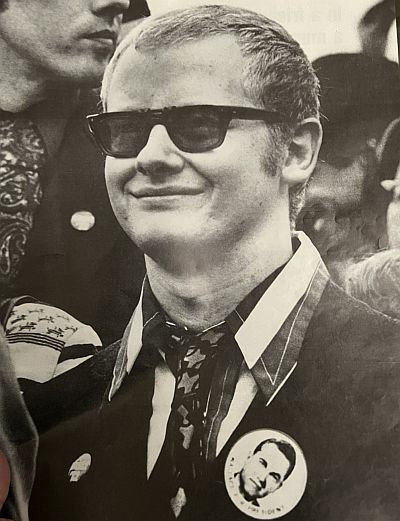
Arthur Bremer

Here’s what we do know.  Paul Schrader was originally inspired to create the character of Travis Bickle by Arthur Bremer, a non-descript 21 year-old Midwesterner who, in 1972, shot and nearly killed presidential candidate, George Wallace.  After the shooting, police turned up a diary in which Bremer wrote about his desire to be someone.  According to Bremer, he shot Wallace not as a political act but because he wanted to be famous.  Schrader later said that, while writing the script, the story became less about Bremer and more about Schrader’s own social isolation.

The script was optioned by the production team of Tony Bill and Julia and Michael Phillips.  They had just recently produced the Oscar-winning The Sting.  Originally, Tony Bill wanted to make his directorial debut with the film.  That was when the script was sent to Al Pacino.  Pacino turned down the role, reportedly because he didn’t want to work with a first-time director.  (Tony Bill, a former actor, later directed several films, most of which appeared to be taking place in a totally separate universe from Schrader’s vision of urban Hell.)

The script was eventually read by Brian De Palma, who voiced an interest in directing the film.  DePalma’s choice for the role of Travis Bickle?  Jeff Bridges.

Today, it might be hard to imagine the affable, laid-back Jeff Bridges as Travis Bickle but, if you read the script, it’s easy to see why De Palma considered him for the role.  Travis was written as being someone from the middle of the country, someone who was out-of-place in New York City.  Travis was meant to be lost in New York.  (Though Travis does say that he’s from the midwest in Scorsese’s film, Robert De Niro himself remains the prototypical New Yorker.)  At least initially, Bridges would have been a bit less obviously unstable than De Niro.  As good as Taxi Driver is, it always seems a bit strange that Betsy would agree to go out with De Niro’s Travis but it’s a bit easier to believe that she would take a chance on Jeff Bridges, with his charming smile and likable manner.  Bridges’s descent into madness would have been all the more devastating because he was such an outwardly affable presence.  I’m not saying it would have worked but I can still see what De Palma would have been going for in his version of Taxi Driver.

That said, De Palma did not make Taxi Driver.  He instead decided to do Carrie.  A young Steven Spielberg briefly showed interest in Taxi Driver (the mind boggles) before decided to do Jaws instead.  Eventually, after being introduced to Schrader by De Palma, Martin Scorsese agreed to direct the film.  After getting turned down by Dustin Hoffman, Scorsese offered the role to De Niro.

As for the rest of the cast, Rock Hudson would have been an interesting choice for the role of Sen. Palantine but he turned down the script because he was busy with a television show.  There was also some talk of casting former New York Mayor John Lindsay in the role but, in the end, the role was given to a writer named Leonard Harris.

The role of Tom was originally offered to Harvey Keitel.  Because Keitel wanted to play the pimp, Albert Brooks ended up as Tom.  Because there wasn’t much to Tom in the script, it was felt that, as a comedian, Brooks could bring some sort of life to the character.  Indeed, Brooks reportedly improvised the majority of his lines.

Despite the fact that producer Julia Phillips wanted to cast Farrah Fawcett in the role, Martin Scorsese selected Cybil Shepherd for the role of Betsy.  If you believe the IMDb, Meryl Streep was offered the role but turned it down.  (If I sound skeptical, it’s because Streep hadn’t even made her film debut at the time that Taxi Driver went into production.)  Glenn Close, Jane Seymour, and Susan Sarandon auditioned for the role.  Mia Farrow reportedly wanted the role but was turned down by Scorsese.

As everyone knows, Jodie Foster played the 13 year-old prostitute, Iris, in Taxi Driver.  A man named John Hinckley, Jr. was so obsessed with Foster’s performance that he went the same route as Travis Bickle and attempted to assassinate the president in an effort to impress her.  Foster, however, was only picked after Scorsese saw several up-and-coming actresses.  Reportedly, due to the success of The Exorcist, Linda Blair was seriously considered for the role.  Tatum O’Neal was also considered, after winning her Oscar for Paper Moon.  Scorsese came close to casting Melanie Griffith but then Tippi Hedren read the script and nixed the idea.  Among the others who supposedly read for Iris: Mariel Hemingway, Jennifer Jason Leigh, Heather Locklear, Kristy McNichol, Carrie Fisher, Ellen Barkin, Kim Basinger, Geena Davis, Michelle Pfeiffer, Brooke Shields, Debra Winger, Rosanna Arquette, Bo Derek, and Kim Cattrall.

Finally, actor George Memmoli was injured on the set of another film, which led to Scorsese playing the passenger who talks to Travis about murdering his wife.

In the end, the right director and the right cast were selected and Taxi Driver became a classic of urban paranoia.  Still, it’s always fun to play What If.  On Earth-2, someone is watching Jeff Bridges, Rock Hudson, Jane Seymour, and Melanie Griffith in Brian De Palma’s Taxi Driver.  And, on Earth-3, George Hamilton is polishing his Oscars and thinking about how playing Travis Bickle changed his life.

4 Shots From 4 Films: Special Nicholas Ray Edition


4 Or More Shots From 4 Or More Films is just what it says it is, 4 shots from 4 of our favorite films. As opposed to the reviews and recaps that we usually post, 4 Shots From 4 Films lets the visuals do the talking!

Director and screenwriter Nicholas Ray was born 111 years ago today, in Galesville, Wisconsin.  He would go on to become one of the most influential American directors of all time, making independently-minded films that celebrated rebels and iconoclasts.  The directors of the French New Wave loved him and for good reason.

Today, we celebrate the life and legacy of Nicholas Ray with….

4 Shots From 4 Nicholas Ray Films

In A Lonely Place (1950, dir by Nicholas Ray, DP: Burnett Guffey)

Johnny Guitar (1954, dir by Nicholas Ray, DP: Harry Stradling)

Rebel Without A Cause (1955, dir by Nicholas Ray, DP: Ernest Haller)

Party Girl (1958, dir by Nicholas Ray, DP: Robert J. Bronner)

Music Video of the Day: Everything Counts by Depeche Mode (1983, directed by Clive Richardson)


The video for this fan favorite was shot around what was then West Berlin.  (This was before the wall came down.)  Clive Richardson had also directed the video for Just Can’t Get Enough and the band turned to him, after previously working with Julian Temple, because they felt that Richardson could visually toughen up their image and help the band move away from the more self-consciously artsy style that Julian Temple had attempted to go with.  The end result was a video that quickly went into regular rotation on MTV and a song that proved to be one of Depeche Mode’s most enduring hits.

Enjoy!

Lisa Marie’s Week In Television: 7/31/22 — 8/6/22


Yes, I watched a lot of old TV shows this week.  I was doing some work around the office and the retro channels always seem to keep me focused.

Here are this week’s thoughts on what I saw!

Allo Allo (Sunday Night, PBS)

Fortunately, the attempted execution of Rene and Edith failed and they were safely returned to Nouvion.  Unfortunately, before they got back to their café, the Resistance attempted to run the business and thoroughly screwed things up.  Meanwhile, realizing that the war not going particularly well for them, the German occupiers made plans to leave France and perhaps relocate some place with a warmer climate.  While all of this went on, Officer Crabtree continued to wish everyone a “Good Moaning,” because Officer Crabtree was a professional.

The Bachelorette (Monday Night, ABC)

This week’s episode was extremely awkward to watch, with Rachel feeling insecure when compared to Gabby and the bachelors themselves not being particularly sensitive about the situation, but at least Meatball was given a second chance.  Seriously, this entire franchise will be redeemed if Rachel ends up getting engaged, even if it’s just temporarily, to Meatball.

Better Call Saul (Monday Night, AMC)

I am so worried about what’s going to happen to Jimmy/Saul/Gene!  During this week’s episode, we flashed back to Saul first meeting Walt and Jesse and then we flash forwarded to Gene treating Buddy and Jeff in much the same way that Walt used to treat Jesse.  Especially after Gene’s phone call to Kim, I’m starting to worry that Gene is becoming just as self-destructive as Walt was at the end of Breaking Bad.  Considering that there’s only a few episodes left before this show ends, that’s not a good development for those of us who are hoping that Jimmy/Saul/Gene gets some sort of a happy ending.

Big Brother 24 (Everyday, CBS and Paramount+)

I’m writing about the latest, surprisingly entertaining season of Big Brother at the Big Brother Blog!  This week, Nicole was voted out and proved to be as delusional on her way out and she was on her way in.  Even after Julie Chen explained to her why she had been targeted and voted out, Nicole still didn’t get it.

The Challenge (Wednesday Night, CBS)

This week, yet another former member of Big Brother 23‘s Cookout was eliminated.  Azah is out of the game, leaving Kyland as the last member of the Cookout standing.  Considering what happened when Kyland was voted out of the Big Brother House, it somehow seems cosmically appropriate that he’s managed to survive the Challenge while the other members of his former alliance have been eliminated.  That said, I hope Derek X. wins the show.

CHiPs (Weekday Afternoons, Charge TV)

I watched two episodes of this 70s motorcycle cop show on Monday.  Both episodes were pretty much the same.  There was a big accident on the freeway.  There was a lot of motorcycle cop action.  There was some pretty California scenery.  The bass-driven theme song is the main thing that I remember about the two episodes.  The show was bland but the music was great.

Diff’Rent Strokes (Weekday Afternoons, Rewind TV)

Diff’Rent Strokes is one of those old sitcoms that I’ve heard a lot about but I’ve never really watched, just because everything I’ve ever heard about it just made it sound like a pretty stupid viewing experience.  That said, I did need some background noise on Monday so, when I saw that the show was now on Rewind TV, I decided to catch two episodes.

In the first episode, old Mr. Drummond attempted to go camping with his new stepson but things got complicated when his stepson’s biological father also decided to tag along.  In the second episode, Mr. Drummond decided to do the Undercover Boss thing by working in one of his factories.  He discovered that he wasn’t popular with his workers and that he needed to pay them more.  Surprisingly, no one saw through his disguise, despite the fact that it only consisted of a fake mustache that didn’t even match his hair color.  It was all pretty dumb.  For a rich man, Mr. Drummond lived in a really boring penthouse.  Like seriously, if you’re that rich, update your décor.

Family Ties (Weekday Afternoons, Rewind TV)

I used two episodes of this very 80s sitcom for background noise on Monday.  On the first episode, Elyse (the mother of the family at the center of the show) was struggling with her conscience about whether or not she should fire a recently divorced but extremely annoying employee.  It was kind of obvious that Elyse needed to fire her but Elysa was a former hippie and, as a result, had no idea how to wield authority.  On the second episode, an impossibly young Michael J. Fox had to babysit his bratty younger sister.  He took her to a poker game.  She got annoyed with being treated like an afterthought and wandered off.  Luckily, everything worked out in the end and lessons were learned all around.

Fantasy Island (Monday Morning, GetTV)

I watched two episodes of the original Fantasy Island on Monday morning but I have to admit that I was half-asleep during both of them.

The first episode featured two fantasies.  In the serious fantasy, a jazz trumpeter went back in time to New Orleans so that he could play with his idols.  In the comedic fantasy, a woman and the two men who were in love with her got stranded on an island in the Bermuda Triangle.  The goofier of the two men was played by football player Joe Namath.  His performance here was better than his performance in C.C. and Company but not by much.

In the second episode, the main fantasy dealt with a private detective who wanted to solve a case with Humphrey Bogart.  The guy playing Bogart did a passable imitation.  The other fantasy featured Michelle Phillips as a woman who wanted to be “the most famous equestrian in history.”  She thought this would mean that she would be famous but instead, the Island took her words literally and she was transformed into Lady Godiva.  First off, why did the island take her words literally when it didn’t do that for anyone else?  And secondly, is Lady Godiva really the most famous equestrian in history?  Oh well, the important thing is that everyone learned a lesson.

Full House (Sunday Evening, MeTV)

I watched two episodes of this show on Sunday and I’m sure I lost at least two brain cells as a result.  The first episode featured Uncle Joey auditioning to be the voice of a cartoon chipmunk or something like that.  Frankie Avalon was the episode’s special guest star.  Remember Frankie’s cameo in Casino?  “I have 8 children.  It was my pleasure.”  This was followed by an episode in which Aunt Becky told Danny that DJ was sneaking out of the house to hook up with her boyfriend.  DJ got mad and said, “I thought you were my friend!”  Poor DJ.  I don’t blame her for wanting to escape the Full House.

Ghost Whisperer (Weekday Mornings, Start TV)

I watched an episode on Monday.  Melinda was (understandably) concerned that Aiden was now seeing and talking to ghosts.  When the ghost of a girl who had recently died of Leukemia insisted on taking Aiden on a journey through town, Melinda had to track them down and find out what the girl wanted.  Fortunately, since this was Ghost Whisperer and not Medium, things worked themselves out.

Hart to Hart (Monday Morning, GetTV)

In this very 80s detective show, a fabulously rich married couple (played by Robert Wagner and Stephanie Powers) traveled the world, spent a lot of money, and occasionally solved mysteries.  Their loyal chauffer was Max, played by the gravelly voiced Lionel Stander.

I watched two episodes of Monday morning.  In the first episode, the Harts were taking part in a car race in Greece.  A Greek tycoon wanted to kill off Jonathan Hart so that he could take over Jonathan Hart Industries.  Fortunately, he didn’t succeed.  If he had, I imagine they would have had to change the title of the show.  The second episode featured a mysterious woman who claimed to Jennifer Hart’s half-sister.  Needless to say, Jonathan did some investigating and it turned out that there was more to the story.

Anyway, the two episodes that I saw were kind of dull plotwise but I did enjoy the show’s shameless celebration of money and glamour.  It was all very 80s.

Inspector Lewis (YouTube)

I watched an episode with my TV Mysteries friends on Tuesday night.  A buried body was discovered.  Hathaway and Lewis investigated.  Lewis was in a notably cranky mood in this episode and even dismissively referred to one woman as being “Miss Marple.”  My theory is that Lewis had a drinking problem.  Usually, Hathaway was able to cover for him but this week, Lewis just lost control.

King of the Hill (Hubi)

Early Friday morning, I watched the episode in which Hank and his undefeated softball team took an exhibition game against the Ace of Diamonds and His Jewels just a bit too seriously.  “Believe to achieve.”

Kojak (Monday Morning, GetTV)

Kojak is a show from the 70s, about a bald homicide detective who calls people baby and who sucks on lollipops.  Kojak was played by Telly Savalas, who was also Blofeld in On Her Majesty’s Secret Service and the Devil in Lisa and the Devil.

The episode that I watched on Monday morning was the first episode that I had ever actually seen of this show, though I had read about it in the past.  In this episode, Ruth Gordon played a psychic who had been having dreams in which she saw women being murdered.  Luckily, Kojak was there to eventually capture the killer.  Neither Gordon nor Savalas were particularly subtle performers and, in this episode, they both seemed to enjoy competing to see who could best steal every scene that they shared.  Add to that, the killer was played by Andy Robinson, who also played Scorpio in Dirty Harry.  It was kind of entertaining to watch.

Magnum P.I. (Weekday Mornings, Charge TV)

On Monday, I watched an episode of the original 80s Magnum, P.I.  Magnum’s friend T.C. was in a coma.  Magnum had to figure out why T.C.’s helicopter crashed.  Luckily, the mystery was solved and everyone survived.  The Hawaiian scenery was lovely.

Medium (Weekday Morning, Start TV)

On Monday’s episode, Allison had a dream about a courtroom shooting and also discovered that she wasn’t the only psychic offering up her abilities to the legal system.

Mike Judge’s Beavis and Butt-Head (Paramount+)

I watched the first two episodes of this show on Thursday night, immediately after the Nicole eviction on Big Brother.  I laughed and I cringed.  Beavis and Butt-Head don’t look like they use deodorant so that worries me.  You can read Jeff’s review of the show here!

Open All Hours (Sunday Night, PBS)

It’s been a few months since I last watched Open All Hours.  I checked it out this week.  Arkwright was cheating his customers and Granville was consumed with resentment.

Traffik (DVD)

I watched Traffik on Wednesday and Thursday and I wrote about it here.
A Perry Mason Mystery: The Case Of The Wicked Wives (1993, directed by Christian Nyby II)


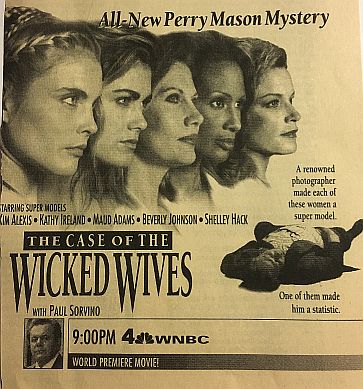
Famed fashion photographer David Morrison (Eric Braeden) has fallen on hard times but things are looking up.  The American Museum of Art wants to do a retrospective of his work.  He just has to get the permission of his current wife, Dee (Kathy Ireland), and his four ex-wives (Shelley Hack, Kim Alexis, Maud Adams, and Beverly Johnson).  All of them are super models who owe their careers to David but four of them hate his guts and Dee isn’t happy when she sees evidence that he has been cheating on her.  When David turns up dead, Dee is arrested.  She claims that she’s innocent but the prosecution is sure that they have an airtight case.

This sounds like a case for Perry Mason!

However, Perry’s out of town so it falls to Perry’s never previously mentioned best friend, Tony Caruso (Paul Sorvino), to solve The Case of the Wicked Wives!  With the help of Perry’s tireless associates, Della Street (Barbara Hale) and Ken Malansky (William R. Moses), Caruso works to solve the case and prove the Dee is innocent.  He also prepares many pasta dinners and frequently sings.

So, where was Perry?  As everyone knows, Raymond Burr played Perry Mason for 9 seasons in the 50s and the 60s.  20 years after the show aired its final episode, Burr returned to the role in a series of highly rated, made for television movies.  Unfortunately, Burr died in 1993 with several movies left to be filmed.  In his will, Burr specifically requested that production on the remaining films continue so that the cast and crew wouldn’t lose their jobs.  Since the role of Mason obviously could not be recast that soon after Burrs’s death, it was decided that the remaining movies would feature guest lawyers.  Enter Paul Sorvino.

The Case of the Wicked Wives was the first Perry Mason film to be made after Burr’s death.  As his replacement, Tony Caruso has much in common with Mason, including the ability to make the guilty confess in open court.  Unlike Mason, Caruso is also obsessed with cooking elaborate spaghetti dinners and singing operatic arias.  This movie came out just a year after Sorvino left Law & Order to specifically pursue his opera career.  Sorvino sings a lot in The Case of the Wicked Wives, sometimes in court.  Unfortunately, a love of singing and pasta are the only two personality traits that are really given to Caruso.  Through no fault of Paul Sorvino’s, Caruso is never as compelling a character as the coolly calculating Mason.  Mason could trick anyone into confessing through perfectly asked questions.  Caruso is more into courtroom stunts that would get most lawyer disbarred.

Because the mystery itself is a dud, the main reason to watch The Case of the Wicked Wives is for the wives.  Who wouldn’t want to keep Kathy Ireland from being wrongly convicted?  All of the wives get at least one big moment to shine and tear up the scenery.  You’ll guess who the murderer is long before anyone else in court.

Game Review: Rock, Paper, Scissors! (2022, William Moore)


As is explained in the description of this interactive fiction game, you are a contestant in the biggest Rock, Paper, Scissors! tournament in history.  I did not even know that there was such a tournament!  While the crowd watches, no doubt spellbound, you and an opponent challenge one another to a battle of who can cover rock, cut paper, and blunt scissors!

That’s the entire game.  It’s just Rock, Paper, Scissors over and over again.  Sometimes you win.  Sometimes you lose.  Sometimes, you tie.  It says something about the way that interactive fiction works that this is one of the more addictive games that I’ve played this year.  You don’t get anything for winning.  As far as I can tell, the tournament goes on until the player decides to stop playing.  But I will be damned if I didn’t get caught up in whether or not I would be able to pick the right hand gesture.  By typing “rules,” you can command that the rules be displayed so you can see how and why your opponent picked whatever it is that they picked during each round but I preferred to keep the game mechanics a mystery.

It did take me a few turns to figure out how to actually initiate the game with the opponent.  The version of the game that I played did not understand the commands “play” or “challenge.”  Eventually, I got  frustrated and wrote “Hit Opponent,” because violence is always the last resort while trying to guess the verb while playing interactive fiction.  It turned out that was exactly the right command.

Play Rock, Paper, Scissors!

Book Review: Mafia: The Government’s Secret File On Organized Crime


If you are a writer and you’re currently working on a novel or a script about the Mafia in the late 50 or early 60s, you simply must include a character based on Usche Gelb.  Gelb was born in Austria in 1897 and apparently came to New York City when he was just a teenager.  Between 1913 and the 60s, he was arrested multiple times and charged with everything from disorderly conduct to felonious assault to perjury to federal narcotics conspiracy.  According to the FBI, despite not being Italian, he was a powerful figure in the Mafia and served as a liaison with various international drug cartels.  He also worked as a machinery salesman and as a florist.  He and his wife Ethel lived on West End Avenue and spent their summers at Tenaha Lake.  His nickname was King Gelb.

You might also want to include a character based on Joey Caesar (real name: Joseph Divarco), who owned a glassware distribution but who was secretly one of the top men in the Chicago Outfit.  Or maybe Sam Giacana, who took over Capone’s organization and eventually ended up getting murdered in his own kitchen.  Don’t forget Luigi Fratto, the crime boss of Des Moines, Iowa who was so confident in his position that he flashed a big grin for his mugshot.  And certainly, be sure to remember Joe Civello, who ran the Dallas mob and who had the look of a weary accountant whose only client was being audited.

All of these people (and more) are profiled in Mafia, a fascinating book that contains the over 800 organized crime dossiers that the Treasury Department put together in the late 50s and 60s.  Some of the gangsters profiled have familiar names.  Meyer Lansky, Mickey Cohen, Lucky Luciano, Johnny Rosselli, Carlos Marcello, Vito Genovese, and Joseph Valachi are all included.  Even more interesting to me, though, are the less well-known gangsters.  All of them were prominent within their organization but most of them managed to hide in the shadows of history.

For history nerds and true crime buffs, it makes for interesting reading.  Almost all of the men profiled in the book came from blue collar backgrounds.  Many of them were immigrants.  The great majority were from Italy but Germany, France, Austria, and the United Kingdom are all represented as well.  When they weren’t committing crimes, many of them worked as salesmen.  Some were truck drivers.  Many of them were union reps.  A large number either worked at or owned small taverns.  Many of them had been arrested for violent crimes but most of them also had families and vacation homes and everything else that was held up as being a part of the American dream in the 50s and 60s.  Most people probably wouldn’t give these men a second look but, secretly, they were among the most powerful people in their city and state.

It’s hard not to become fascinated with the people in this book.  Enough details are provided in the government’s sparse reports that you get a clue for who they were but enough is left vague to reward those of us with an active imagination.  Why, for instance, was John Daneillo nicknamed “Baldy” when his mugshot shows that he had a full of head of hair?  Who nicknamed him Baldy and did it have anything to do with his day job as a construction worker?  And why did Lucky Luciano give Patsey Matranga, an olive oil salesman who was a known narcotics smuggler despite having never been arrested once in his life, an old Oldsmobile?  Was it a sign of friendship or something else?  Maybe Luciano was just sick of looking at the car.  These are the type of questions that are raised by reading the dossiers within Mafia.  They’re just waiting for creative reader to answer them.