The TSL’s Horror Grindhouse: The Giant Gila Monster (dir by Ray Kellogg)


The 1959 film, The Giant Gila Monster, takes place in a small Texas town, where everyone’s either a drunk, a law enforcement officer, or a teenager who wants to go the sock hop. In fact, the teens are so enthused about the sock hop that it takes them a while to notice that two of their friends are missing! What happened to Pat and Liz!?

Well, as we already know what happened because we saw it at the start of the film! Pat and Liz were parked at the ravine, making out in Pat’s car, when they fell victim to a giant Gila monster! Though, if we’re going to be honest …. the monster actually isn’t really a Gila monster. It’s just a really big lizard that was filmed wandering over around a miniature set. It moves very slowly and it sticks out its tongue at the camera. It’s a nice looking lizard but it’s no Gila monster. No matter, though! What’s important is that it’s big, it’s dangerous, and it’s making its way towards the town!

Anyway, the teens eventually figure out that their friends have disappeared and they try to appeal to the town’s useless sheriff to help them find them. The sheriff doesn’t really seem to care though. He’s got an entire town of drunks to deal with. So, it looks like the teens are going to have to save the town themselves!

The Giant Gila Monster is a pretty silly film. It’s a little over 70 minutes long and it’s obvious that the majority of the budget was spent on the cars that the various teenagers drive. It was an independent production, made to be sold to drive-ins around the South. Teenagers in 1959 probably watched the film and honked their car horns whenever the monster showed up. The script is bad, the actors are bad, the direction is bad, but you know what isn’t bad? The fake Gila Monster is actually kind of cute. I mean, we’re told that we shouldn’t like it and that it’s responsible for killing a lot of people but who cares? Whenever it shows up, slowly lumbering its way across the countryside, it’s hard not to admire the determination of the Gila Monster. Though the actors often seem to be confused by their dialogue, the lizard is obviously having the time of its life. Go, Lizard, go!

The Giant Gila Monster is one of those independent 50s monster movies that are pretty much impossible to resist. To its credit, the film does have a sense of humor about itself. It is meant to be a comedy, though most of the laughs are unintentional. And, as I said before, vintage car lovers will enjoy seeing some of the roadsters that pop up in this film. Even with all the classic cars, though, the big lizard in the main attraction. It walks around the miniature desert set as if it owns the place. The star is the monster and that’s really the way things should be.

Finally, The Giant Gila Monster was filmed outside of Dallas.  Apparently, the film was funded by none other than Gordon McLendon, who is best-known for founding Dallas’s first talk radio station, KLIF.

A Blast From The Horror Past: Georges Méliès’s The Monster


For today’s blast from the past, we have a film that has often been described as being France’s first horror film.

The Monster is 2-minute silent film from 1903.  Directed by the pioneering French filmmaker, Georges Méliès, The Monster tells the story of an Egyptian prince who brings the dead body of his wife to a sorcerer who apparently likes to hang out in front of The Sphinx.  The sorcerer attempts to bring her back to life and, as so often happens in any film directed by Georges Méliès, things don’t quite go as planned.

In my opinion, this is one of the most charming of Georges Méliès’s surviving films.  From the simple but crudely effective camera trickery to the nicely surreal Sphinx in the background, The Monster is a chaotic delight.

Retro Television Reviews: One World 2.2 “Flushed With Love” and 2.3 “How Neal Got His Groove Back”


Welcome to Retro Television Reviews, a new feature where we review some of our favorite and least favorite shows of the past!  On Fridays, I will be reviewing One World, which ran on NBC from 1998 to 2001.  The entire show is currently streaming on Tubi!

The Cast of One World

One world, we’re living in one world….

Episode 2.2 “Flushed With Love”

(Directed by Mary Lou Belli, originally aired on September 18th, 1999)

“I love men who work with their hands,” Marci says, “Plumbers, sculptors, hitchhikers….”

Yes, hitchhikers are notoriously sexy and cool.

Marci is saying this because she and Sui are competing to see who can get a date with the totally hot plumber who has shown up to fix the house’s pipes.  There’s no water coming through the pipes.  Earlier, that interrupted Ben’s shower and he was forced to come down to the kitchen while wearing a towel.  “Whoooooo!” the audience responded.

While Marci and Sui compete for the plumber’s attention, Cray, Neal, and Ben try to fix the van that their father has just given them.  The van is …. well, it’s frightening.  It has shag carpeting.  “Chick Mobile” is painted on the back of it.  It features a beaded hippie curtain between the driver’s seat and the back of the van.  Does it have a strobe light?  It really looks like it should have a strobe light.  Is that van a’rocking?

Marci ends up getting the date with the plumber, who says that he likes the way that Marci’s eyes light up whenever “you talk about your childhood trauma.”  My eyes do the same thing!  Woo hoo!  Sui freaks out over her “younger” sister dating an old guy (there’s only a year difference between them) and the plumber does turn out to be a bit too aggressive.  Marci says that she hates her sister but, fortunately, things work out in the end.

Anyway, the van stuff was kind of silly and a little creepy but the Marci/Sui storyline reminded me of my relationship with my sisters and Alisa Reyes and Michelle Krusiec did a good job of portraying Marci and Sui’s complicated feelings towards each other.  So, this episode gets a solid B.

Episode 2.3 “How Neal Got His Groove Back”

(Directed by Mary Lou Belli, originally aired on October 2nd, 1999)

This episode is all about having a job.

Neal, the smartest kid in the house, quits high school so he can work with a tech millionaire who is obviously based on Bill Gates but who is, for some reason, headquartered in Miami instead of Silicon Valley.  Unfortunately, Neal discovers that he doesn’t like working 24 hours a day and he misses school so he quits his job.  The audience applauds, little knowing that, in just a few years, Silicon Valley would start to make millionaires and billionaires out of all sorts of dropouts.

Meanwhile, Sui gets a job playing with Ben’s band but it turns out that they just want her to stand on stage and look cute.  Sui is initially annoyed that she won’t be allowed to sing but eventually, she realizes that it’s just as much fun to make money for doing nothing.  It’s a good lesson.

At the start of this episode, it’s revealed that Mr. and Mrs. Blake use report cards to determine which one of their kids will get good food and which one will have to settle for whatever’s left.  That’s kind of messed up.  Some people are just better test-takers than others.

This episode gets a C for failing to predict the tech boom.

Horror Scenes That I Love: The Diner Scene From Mulholland Drive


From 2001’s Mulholland Drive, here is a scene that literally made me jump the first time I saw it.  Personally, I think this is the scariest moment that David Lynch ever directed.

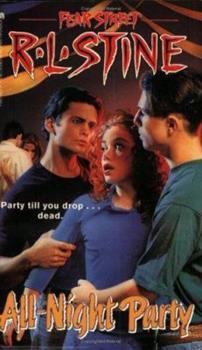
Book Review: All-Night Party by R.L. Stine


You may remember that, when I reviewed R.L. Stine’s The OvernightI commented that it seemed odd that Fear Lake would have an island sitting in the middle of it and I even wondered if this was a location that Stine used frequently or if it was just something that he randomly tossed into the book.

Well, 1997’s All-Night Party features yet another group of teens spending a long night on Fear Island so I guess that answers my question.  Fear Island is real!  And apparently, it’s a dangerous place.  This is the second book that I’ve read about an act of violence taking place on Fear Island.  Both books not only featured people getting attacked on the island but they also both featured people randomly falling down hills and stuff while walking around the island.  The island is not safe!  Maybe it’s time bulldoze the cabin and build a barrier around the island or something.  Of course, that’ll never happen because that would require too much commitment from the adults of Fear Street.  I’m not all that sure that the parents of Fear Street really care that much about any of their children.  I mean, someone gets murdered every week and yet, no one ever seem to move.  Instead, almost every book seems to start with a new family moving in!  The Shadyside High School yearbook has got to be 75% in remembrance ads.

As for All-Night Party, it’s perhaps the laziest R.L. Stine book that I’ve ever read, which is really saying something when you consider that R.L. Stine wasn’t exactly known for the great care that he put into coming up with his plots and characters.  This is a novel that, for all I know, could have been written by a computer program.

The plot involves a group of teens who decide to throw an all-night party at a cabin on Fear Island.  They’re celebrating Cindy’s birthday.  Cindy is kind of a bitch and after she assures everyone that she hates their presents, she’s murdered in the kitchen.  Who committed the murder?  Was it Patrick, the member of the group who has a big blood stain on his shirt and who keeps getting caught in obvious lies?  Or is the escaped lunatic that Patrick swears is on the island with them?  Or was it someone else in the party, like the seemingly creepy kid who is actually nice and nerdy or maybe the temperamental rebel who has long hair and drives a motorcycle.  This answer is so obvious that it will totally blow your mind when your realize how little effort was put into creating any sort of suspense.

The book feels a rushed and uninspired.  It was published in 1997 and it’s probably not a coincidence that it was one of the last of the original Fear Street books because it’s obvious that either Stine or his ghostwriter were just going through the motions at this point.  To be honest, the solution is so obvious and the plotting is so lazy that I nearly threw the book across the room after I finished with it.

Oh well.  What can you do?  It’s Fear Island.

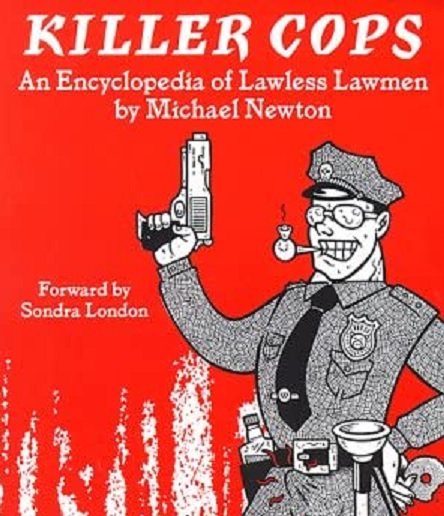
Non-Fiction Book Review: Killer Cops by Michael Newton


The late Michael Newton was quite a prolific author, publishing a total 357 books, which included 258 novels and 99 nonfiction books.  His novels were largely pulp paperbacks, the types with the covers that my sister often features here on the Shattered Lens.  His non-fiction was largely made up of encyclopedias concerning unsolved crimes, serial killers, conspiracies, and that sort of thing.  I own quite a few of this encyclopedias.  He was a good writer with a good knowledge of the macabre.

Killer Cops takes a look at men and women who took an oath to uphold the law but who then turned around and committed the worst crime of all.  Some of the people profiled in this book were serial killers who hid their crimes behind the badge.  Some were cops were just snapped one day.  Some were obviously crooked while others had spotless records.  Some of them were punished for their crimes.  Some of them are still revered for being justice to the frontier.  It makes for interesting and disturbing reading.  For the aspiring horror, thriller or crime fiction writer, Killer Cops is full of potential inspiration.   If there’s an overriding theme to the book, it’s that those in authority should be held to a higher standard and that certainly includes the police.  The killer cops portrayed in this book thought they could hide behind the badge and the uniform and, sadly, a few of them were right.  Newton warns against idealizing or blindly trusting anyone in authority, saying that it’s the individual’s action that matter more than the uniform they wear or the badge that they carry.

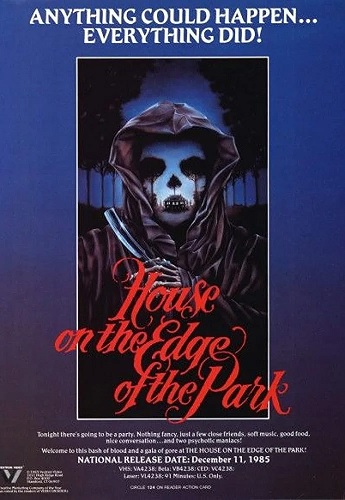
International Horror Film: House On The Edge of the Park (dir by Ruggero Deodato)


Or is it House Of The Park On Edge?

When this Italian thriller was first released in the United States in 1980, the film’s title was mistranslated by whoever put together the film’s American trailer.  In Italy, it was known as La casa sperduta nel parco.  When it was released in the United States, it was meant to be known as The House On The Edge of the Park but the trailer famously referred to it as being….

That the trailer was sent out with the title incorrectly translated tells you a lot about the American grindhouse film scene.  If a similar mistake had been made a with a big studio production, someone would have lost their job and a lot of money would be spent to put together a new trailer.  In the world of the grindhouse, it was probably understood that people would come to the film regardless of whether they even knew what the title was.  According to the book Sleazoid Express, House on The Edge of the Park was very popular in the grindhouse theaters of New York’s 42nd Street, where audiences loved the violence, the nudity, and the misogynistic dialogue.
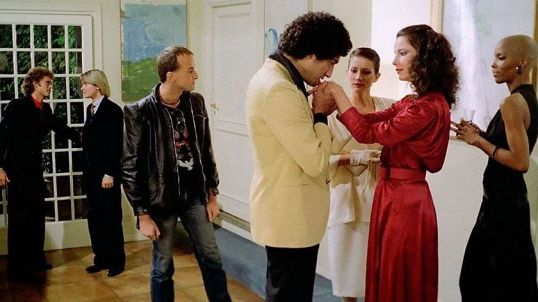
Today, House on the Edge of the Park is remembered for being the film that brought together Ruggero Deodato, David Hess, Giovanni Lombardo Radice, Christian Borromeo, Annie Belle, and Lorraine De Selle.  (The Anchor Bay DVD release featured interviews with Deodato, Hess, and Radice.  Radice and Deodato seemed a bit surprised and, at times, horrified that the film still had fans.  Hess seemed considerably less shocked.)  House on the Edge of the Park was the film that Deodato made after the subversive and satirical Cannibal Holocaust.  Though House on the Edge of the Park retains a subversive edge, it’s a much more straight forward movie than Cannibal Holocaust.  No one has ever mistaken House on the Edge of the Park for a documentary.
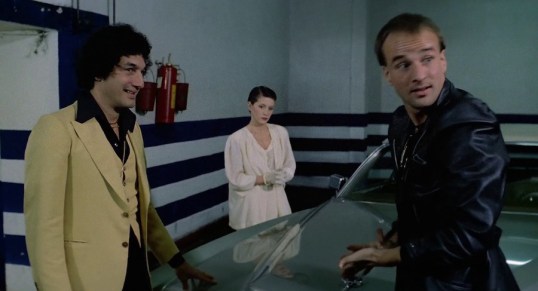
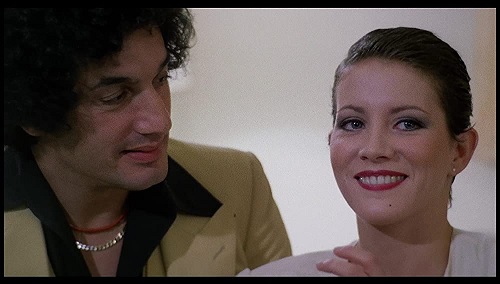
David Hess, who may have written songs for Elvis and Pat Boone but who is destined to always be remembered for his performance as Krug in Last House On The Left, plays Alex.  Alex owns a New York City garage.  Alex owns a canary yellow suit.  Alex likes to dance.  Alex is also a serial killer who, when we first see him, is forcing a woman (played by Hess’s wife, who is credited as Karoline Mardek), off the road so that he can assault and murder her.  As the film begins, Alex and his sidekick, Ricky (Giovanni Lombardo Radice, appearing in one of his first films and stealing the show with his demented energy) are getting ready to go “boogie.”  Two rich kids, Tom (Christian Borromeo, my blonde Italian horror crush) and Lisa (Annie Belle), pull into the garage.  Ricky fixes their car.  Tom and Lisa, whose white dress is to die for, are insistent that Alex accompany them to a party at a house …. a house on the edge of the park!
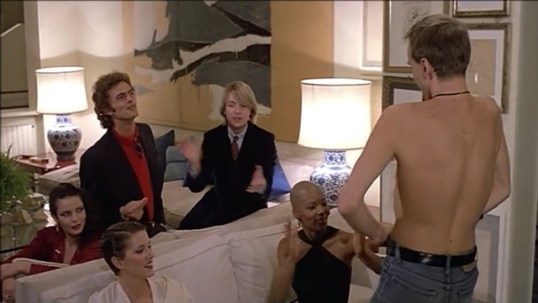
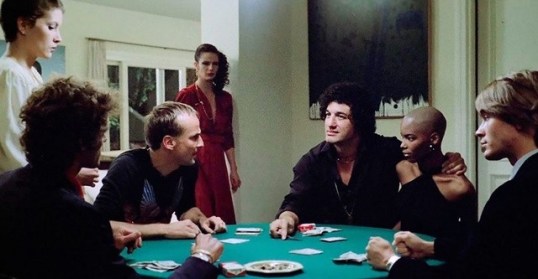
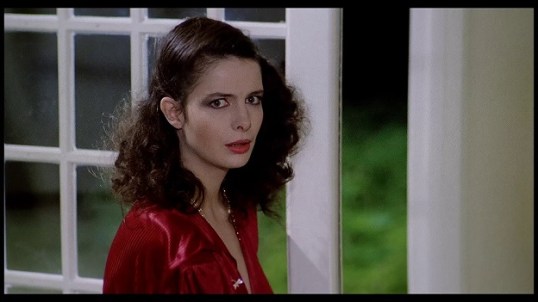
Already at the house are Gloria (Lorraine De Selle), whose red dress is to die for, and Howard (Gabriele Di Giulio), who is apparently Gloria’s boyfriend.  Also waiting at the house is Glenda (Maria Claude Joseph), who appears to just be hanging out because she has nothing better to do.  (There’s a lot of talk about boredom and ennui, amongst the rich young people of House on the Edge of the Park.)  When Tom and Lisa show up with Alex and Ricky, a very familiar class dynamic plays out.  Alex and Ricky are very blue collar.  Alex is earthy and says whatever pops into his head.  Ricky is dependent on Alex to tell him what to do and is also too slow to realize that the rich people are talking down to him.  Ricky is taunted into dancing and then into playing poker.  Ricky loses his money.  Alex discovers that the game is fixed.  Violence follows, with Alex holding the house hostage with the help of the increasingly conflicted Ricky.
Of course, it turns out that there’s a twist and that it wasn’t just coincidence that led to Tom and Lisa pulling into Alex’s garage.  Of course, the twist itself never really makes sense.  The entire film centers around Tom finding time to retrieve something from his office.  It takes him forever to do it because Alex keeps watching him and beating him up.  But there’s actually several moments in the film in which Alex is distracted and he even leaves Tom alone at one point.  You have to wonder just what exactly Tom was doing during all that time.
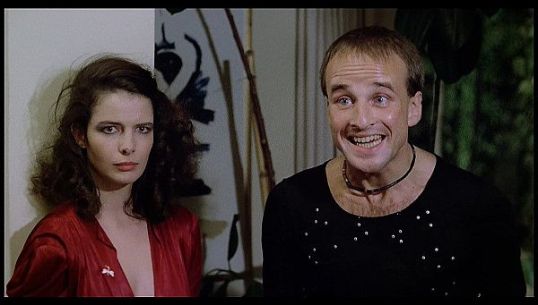
It’s a deeply misogynistic film, one that features an inexcusable scene in which Gloria and Ricky have consensual sex just a few minutes after Ricky tries to rape her.  (Even if you can see beyond the idea of the sophisticated Gloria falling for a rapist, who stops to have sex while there’s a madman threatening to murder all of your friends?)  Before the party turns violent, Lisa flirts with Alex and, at one point, even showers in front of him.  Her actions make even less sense once it is revealed that Tom and Lisa always knew who Alex was and what he was capable of.  Indeed, the film is sometimes so offensive that it feels almost like a parody of an offensive film.
And yet, there are things to appreciate about the film.  Deodato plays up the class warfare aspect of the story, with Tom and his friends initially condescending to Alex and Ricky, just to discover how little power they actually had once Alex got the upper hand.  Giovanni Lombardo Radice, Lorraine De Selle, Annie Belle, and Christian Borromeo all give good performances, even when their characters are required to do things that don’t make any sense.  David Hess is a force of malevolent nature as Alex.  The house is lovely and I especially liked the pool, though I would suggest changing out the water before taking a swim.  The location shots of late 70s New York are interesting to look at, especially if you’re a history nerd like me.  Riz Ortolani’s soundtrack will get stuck in your head.  I defy you to watch this film and not end up singing that “Do It To Me Once More” song.
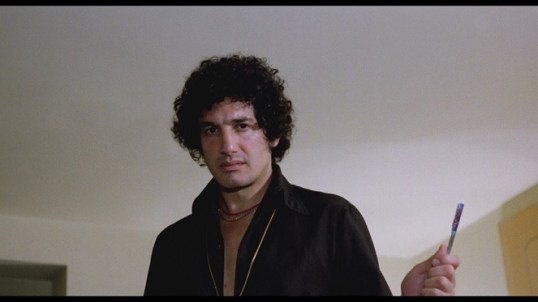
In the end, House on the Edge of the Park is not a film that I can really recommend, unless you’re a fan or a student of Italian horror.  In that case, you have to watch the film, if just because of the familiar faces in the cast and the fact that it was directed by Deodato.  Still, if anyone ever told me that this was their favorite film, I would probably immediately start eyeing the exit.  Towards the end of the movie, Gloria says that there has been enough violence and I agreed with her.  That said, violence against Alex is totally acceptable.
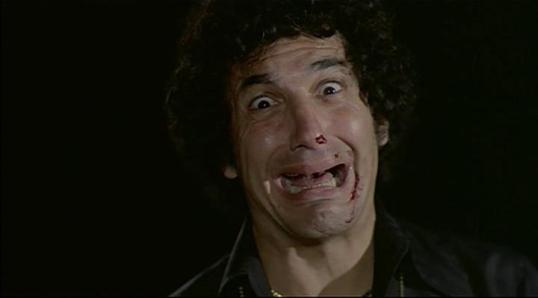
The film itself is destined to live forever as an internet meme, as a GIF of David Hess screaming in slow motion has recently become quite popular on Twitter.  There’s just no escaping the House of the Park on the Edge!
6 Shots From 6 Horror Films: 2000 — 2001


4 Or More Shots From 4 Or More Films is just what it says it is, 4 shots from 4 of our favorite films. As opposed to the reviews and recaps that we usually post, 4 Shots From 4 Films lets the visuals do the talking!

This October, I’m going to be doing something a little bit different with my contribution to 4 (or more) Shots From 4 (or more) Films.  I’m going to be taking a little chronological tour of the history of horror cinema, moving from decade to decade.

Today, we take a look at 2000 and 2001!

6 Shots From 6 Horror Films — 2000 — 2001

Shadow of the Vampire (2000, dir by E. Elias Merhige, DP: Lou Bogue)

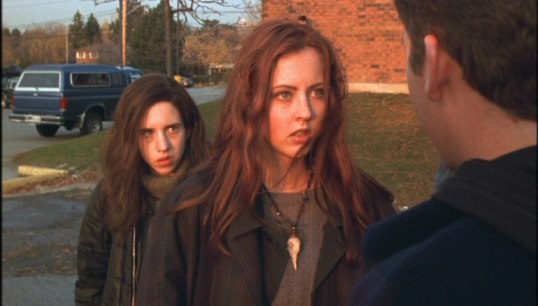
Ginger Snaps (2000, dir by John Fawcett, DP: Thom Best)

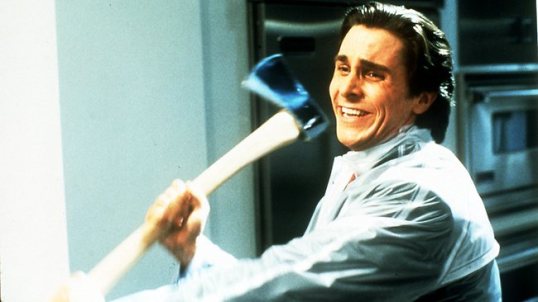
American Psycho (2000, dir by Mary Harron, DP: Andrzej Sekuła)

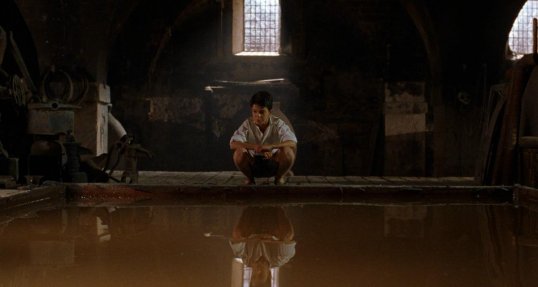
The Devil’s Backbone (2001, dir by Guillermo del Toro, DP: Guillermo Navarro)

The Others (2001, directed by Alejandro Amenabar, DP: Javier Aguirresarobe)

Mulholland Drive (2001, dir by David Lynch, DP: Peter Deming)

The Astros Are Two Wins Away From The World Series


I have a lot of friends who are Yankee fans so I’m not going to brag too much but it’s still a nice feeling to wake up and know that the Astros are two games away from going to the World Series!  Go Astros!

The Astros currently leads the ALCS, 2-0.  In the NLCS, the Phillies and the Padres are tied 1-1.  The Padres and Phillies will be playing tonight and I’ll be cheering for the Phillies!  What an amazing story they’ve had this season.  I’m looking forward to an Astros/Phillies World Series!

Good luck to all the teams still in the playoffs!

Horror Film Review: Dashcam (dir by Rob Savage)


Calm down, people.

Seriously, the amount of online hate that I’ve seen directed at the found footage horror film, Dashcam, is not only insanely over the top but it also proves (as if there was any proof necessary) that there are a lot of people out there who are incapable of understanding social satire.

Annie Hardy stars as Annie Hardy, a musician who hosts Band Car, the internet’s #1 Live Improvised Music Show Broadcast From A Moving Vehicle.  Yes, Annie Hardy is playing a fictionalized version of herself, which is something that many of this film’s critics don’t seem to understand.  (Or, more likely, they do understand that but they’re pretending to be obtuse for the clicks.)  In the film, which was shot at the height of COVID lockdowns, Annie grows tired of Los Angeles and hops a plane for London.  In London, she reunites with her former bandmate, Stretch (Amer Chadha-Patel) and proceeds to clash with just everyone that she meets.

The film’s version of Annie is outspoken about her politics, which is one reason why so many critics have gone after this film.  Annie is anti-lockdown.  She’s anti-government.  She has little use for virtue signaling activists.  She spends a lot of time going out of her way to annoy people who wear masks.  These are all things most of today’s movie heroes are not allowed to do but Annie’s attitude is, for better or worse, a fair reflection of how a lot of people were feeling at the height of the COVID era.  Despite what was often presented in the movies and on television, most people were not lighting their Fauci prayer candles and dutifully waiting for word from the CDC.  Most people were not the girl from that Walgreen’s commercial, smiling behind their mask as they rode their kick scooter to the neighborhood market so that they could pick up the latest organic fruit.  Most people were frustrated and pissed off and sick of having to pretend otherwise.

Annie’s trip to the UK is predictably a disaster and, because she live streams the entire experience, Stetch’s always-masked wife discovers just how much she and Annie disagree on politics.  This leads to a physical confrontation which leads to Annie stealing Stretch’s car.  You do have to feel a little bit bad for Stretch at this point.  Stretch works as a food delivery driver so, as annoying as Stetch can be, he does kind of need his car.  Annie decides to take on one of his deliveries herself, just to discover that the owner of a restaurant wants Annie to drive a sick and incontinent old woman named Angela to another location.  Despite her initial misgivings, Annie agrees.  Because Annie has been live streaming the entire time, Stretch is able to track them down.

Of course, it turns out that Angela is not quite what she seems and soon, Annie and Stretch find themselves having to deal with cults, demons, and a lot other things.  Quite a few people die along the way.  Except for a few times when the signal is lost, the entire event is live streamed and the film is worth watching twice just so you can read all of the comments from the people watching Annie and Stretch try to survive a night.  They provide a commentary not only on what’s happening to Annie and Stretch but also on the horror genre in general and the whole found footage idea in specific.  At the same time that I was getting annoyed with Stretch for being whiny, so were Annie’s fans.  While Annie and Stretch were running from Angela, a fight was breaking out in the comments over Annie’s politics.  A few people were concerned that Annie was going to get killed.  A few were claiming that it was all fake.  The majority were eager to see more blood.  Quite a few complained that any moment that Annie spent hiding from Angela was “BORING.”  One thing they all had in common was a need to try to turn everything that they were watching into either a commentary on politics or an ironic joke.  It was a perfect portrayal of online culture.

Both Annie and Angela are forces of chaos in Dashcam, perfect representations of how many people were feeling at the height of the COVID era.  (Angela wears a mask throughout the film.  At one point, the mask fills up with blood, which is perhaps as powerful a symbol of COVID horror as I’ve seen thus far.)  Annie’s a survivor because she refuses to rationalize everything that’s happening around her.  She embraces her anger and her annoyance with the world.  As a result, Dashcam is not just an effective found footage horror film.  It’s also a document of how many people viewed the world in 2021.  With so many now trying to rewrite the history of what actually happened during the COVID era, it’s important to have a film, like Dashcam, that reveals just how angry and paranoid people really were.  In its way, Dashcam is a valuable time capsule.

Annie Hardy is currently taking a lot of online abuse from trolls who can’t tell the difference between the film’s Annie Hardy and the real-life Annie Hardy.  That’s a shame because Annie Hardy is a natural when she’s onscreen and she gives a good performance.  Dashcam is currently on Hulu and it’s tempting to compare this film sharp combination of horror and commentary to the rather bland and painfully inoffensive Hellraiser reboot.  Hellraiser could have used Annie Hardy.