From 2013, an enigmatic opening for an enigmatic film:
From 2013, an enigmatic opening for an enigmatic film:
4 Or More Shots From 4 Or More Films is just what it says it is, 4 shots from 4 of our favorite films. As opposed to the reviews and recaps that we usually post, 4 Shots From 4 Films lets the visuals do the talking!
This October, I’m going to be doing something a little bit different with my contribution to 4 (or more) Shots From 4 (or more) Films. I’m going to be taking a little chronological tour of the history of horror cinema, moving from decade to decade.
Today, we take a look at 2013 and 2014!
6 Shots From 6 Films: 2013 — 2014

Only Lovers Left Alive (2013, dir by Jim Jarmusch, DP: Yorick Le Saux)

Under the Skin (2013, dir by Jonathan Glazer, DP: Daniel Landin)

The Conjuring (2013, dir by James Wan, DP: John R. Leonetti)

The Babadook (2014, dir by Jennifer Kent, DP: Radek Ładczuk)
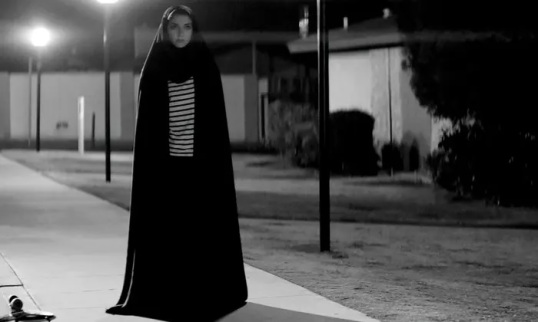
A Girl Walks Home Alone At Night (2014, dir by Ana Lily Amirpour, DP: Lyle Vincent)
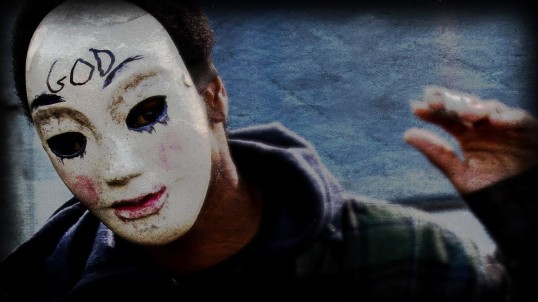
The Purge: Anarchy (2014, dir by James DeMonaco, DP: Jacques Jouffret)

First released way back in 1979, Prophecy is one of those films where a big evil corporation is selfishly polluting the environment and a group of noble Native Americans is convinced that a vengeful spirit of the forest has been awakened as a result.
We’re told that the vengeful spirit is named Katahdin and that it’s “as large as a dragon and has the eyes of a cat.” We’re also told, by someone who claims to have actually seen it, that the Katahdin is a combination of several different creatures, “a part of everything that is God’s creation.”
Sound pretty scary, right?
Well, it is until the bear itself actually shows up on screen. That’s when we find ourselves confronted with this:
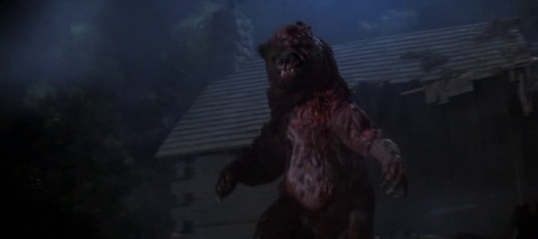
I mean, don’t get me wrong. He certainly is ugly. But he just looks so silly and …. well, fake.
The lesson here, and it’s an important one, is that you should never put your monster onscreen unless it can actually live up to all the hype. Take a lesson from Spielberg. When it became obvious that the shark in Jaws looked like a tin model, Spielberg made the decision to not show the shark. Instead, he gave us a lot of point of view shots and, by the time the shark did appear, audiences were so frightened that it didn’t matter whether it looked convincing or not. Prophecy makes the mistake of having its monster all over the place and it just doesn’t work.
Of course, once the EPA’s Dr. Robert Verne (Robert Foxworth) shows up with his pregnant wife (Talia Shire, who somehow went from The Godfather and Rocky to this), he discovers that one reason why the Katahdinh doesn’t live up to all the hype is because it’s just a mutant bear. It turns out that all that pollution led to some crazy results and now every logger, Native American activist, and camper in the area is in danger! Can Dr. Verne and a team of disposable, forgettable characters end the threat of Katahdinh!?
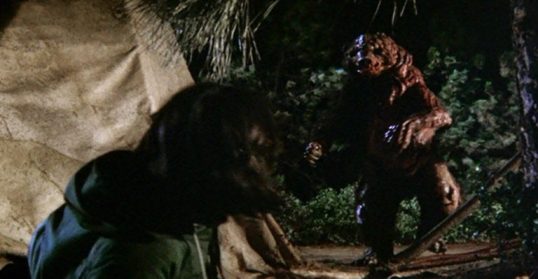
Prophecy is a big, dumb movie that’s never as much fun as you want it to be. There is one early scene that features a camper trying to hop away from Katahdinah while zipped up in a sleeping bag. That scene — which ends with one ruined sleeping back and lot of feathers floating around — is just demented enough to be kind of fun:
Otherwise, the entire film is slow-moving and rather dull. Part of the problem is that it was directed by John Frankenheimer, a major and important filmmaker who had entirely the wrong sensibility for this film. Frankenheimer was a legitimately great director (among his good credits: The Manchurian Candidate, Birdman of Alcatraz, Ronin, Seconds) but he takes the material too seriously. He spends so much time trying to sell the film’s environmental message that he forgets that the majority of the audience for a film like this isn’t watching because they want to become a better person. They’re watching for mutant bear mayhem! This is the type of film that needed to be directed by someone from the Roger Corman school of quick thrills and shameless shlock.
So, here are the twin lessons of Prophecy: know your audience and make sure your monster can live up to its reputation! Otherwise, you’ll just be known for that one scene with the exploding sleeping bag.
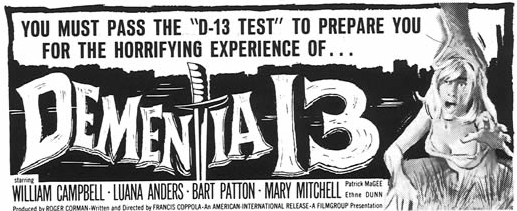
(I originally shared this film back in 2011 and 2019 — can you believe we’ve been doing this for that long? — but the YouTube vid was taken down both times! So, I’m resharing it today!)
For today’s excursion into the world of public domain horror, I offer up the film debut of Francis Ford Coppola. Before Coppola directed the Godfather and Apocalypse Now, he directed a low-budget, black-and-white thriller that was called Dementia 13. (Though, in a sign of things to come, producer Roger Corman and Coppola ended up disagreeing on the film’s final cut and Corman reportedly brought in director Jack Hill to film and, in some cases, re-film additional scenes.)
Regardless of whether the credit should go to Coppola, Corman, or Hill, Dementia 13 is a brutally effective little film that is full of moody photography and which clearly served as an influence on the slasher films that would follow it in the future. Speaking of influence,Dementia 13 itself is obviously influenced by the Italian giallo films that, in 1963, were just now starting to make their way into the drive-ins and grindhouses of America.
In the cast, keep an eye out for Patrick Magee, who later appeared as Mr. Alexander in A Clockwork Orange as well as giving a memorable performance in Lucio Fulci’s The Black Cat. Luana Anders, who plays the duplicitous wife in this film, showed up in just about every other exploitation film made in the 60s and yes, the scene where she’s swimming freaks me out to no end.
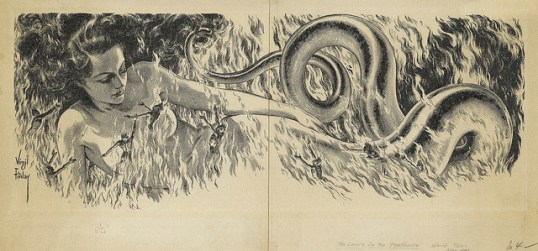
by Virgil Finlay
“Hope not ever to see Heaven. I have come to lead you to the other shore; into eternal darkness; into fire and into ice.”
— Dante

by Bernie Wrightson
When the moon is full.
This song is off of Iron Maiden’s 17th studio album, 2021’s Senjutsu. Directed by Swedish animator Gustaf Holtenäs, the epic music video for Stratego imagines an battle in ancient Japan. Thematically and visually, it goes along with the cover of the album, which featured Eddie dressed as a samurai and holding a katana.
Enjoy!
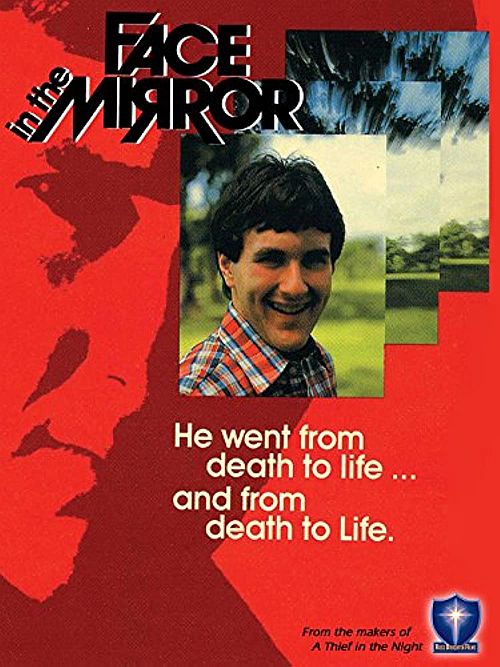
The 1982 film, Face in the Mirror, opens with a community in crisis.
A teenager named Danny DeMarco (played by Michael Mitchell) has been shot and is being rushed to the hospital. As we listen to the people who are following the ambulance to the hospital, it soon becomes clear that Danny shot himself and that the shooting occurred at a youth group meeting. At the hospital, Danny is sent to the ICU. He’s in a coma. The doctors are not sure whether he’ll ever come out of that coma.
The first half of the 65-minute film is dominated by flashbacks as people try to figure out what could have led to Danny shooting himself. Danny’s father remembers the time that he gave Danny a hard time for winning first place in a chess tournament. Though I think most parents would be proud to have a son who was actually good at playing a game that required a certain amount of intelligence, Danny’s father is unimpressed. Danny’s father was a jock in high school and he expects Danny to be the same. Chess? Why, that’s for wimpy youth group kids!
Speaking of wimpy youth group kids, the members of the youth group occasionally pause from the prayer to remember all of the times that they failed Danny. They remember their own hypocritical behavior and how they would give Danny a hard time whenever he pointed it out. They remember all of the times that Danny seemed to be confused about his faith and how they didn’t listen to his concerns. They remember the youth group meeting in which Danny suddenly pulled out a gun and, after calling out everyone else on their hypocrisy and saying that he didn’t really believe in God, he pointed the gun at his head. When another member of the group tried to grab the gun, it went off. While their parents dismiss Danny as just being “a crazy kid,” the members of the youth group confront the role that they all played in Danny’s depression….
The first 30 minutes of this film is surprisingly well-acted and the theme of teen suicide is sensitively handled … up until the point that the film insinuates that Danny wouldn’t be depressed or suicidal if he was really a Christian. I’ve known enough depressed but sincerely religious people to know that this is simply not the truth. It’s actually a rather dangerous message to send out, as it suggests that depression is somehow a personal failing as opposed to something that everyone, to some degree, is going to have to deal with at some point in their life.
The second half of the film is all about the efforts of Danny’s friends to sneak into his hospital room so that they can pray for him and hopefully get through to him, even though he’s in a coma. Again, the performances are sincere. However, tonally, this half of the film is a mess. There are some awkward moments of humor which really don’t seem like they belong in a movie about teen suicide. The dialogue also get a bit cringey, as often happens when teenage characters are written by screenwriters who obviously were quite a bit older than the people they were writing for.
Face in the Mirror was directed by Russell Daughten, Jr. Daughten also directed Nite Song and produced the Thief In The Night films. Like those films, Face in the Mirror is a sincere but flawed time capsule. The film’s tone is all over the place but I have to admit that I did kind of enjoy watching this grainy production with its amateur cast. What can I say? I have a weakness for low-budget indie films that feature a bunch of people who probably never made another film after this one. Like Nite Song, watching this film is like stepping into a time machine and traveling to a simpler, if not quite innocent, past. In the end, the film’s main message is that we should be aware that our words and our actions can hurt people without us even realizing it. That’s not a bad one.
The old west could be a dangerous and haunted place, as was revealed in this episode of HBO’s Tales From The Crypt! Outlaw Billy Quintaine (Neil Guintoli) enters a saloon and discovers that the spirits of his victims have been waiting for him!
This episode originally aired on August 1st, 1992. Along with being directed by The Omen‘s Richard Donner, it was written by Frank Darabont.
Enjoy!
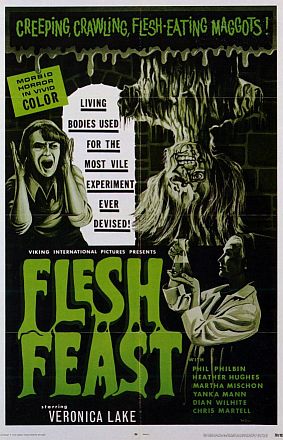
Oh, poor Veronica Lake.
In the 1940s, Veronica Lake was undoubtedly a star. She appeared in Preston Sturges’s classic comedy, Sullivan’s Travels. She played the femme fatale in a series of classic film noirs. She proved herself to be just as capable of playing comedy as she was playing drama. By wearing her hair down and often allowing it to fall over her right eye, she created the peek-a-boo hairstyle. She was briefly a star and a fashion icon but she also developed a reputation for heavy drinking and being difficult to work with. During World War II, the U.S. government actually requested that Lake change her hairstyle in order to decrease incidents of women, many of whom were working factories as a part of the war effort, getting their hair tangled in the machinery. Lake did so, cutting her long hair and going for a more practical look. Her career never recovered.
The years following her 1940s heyday would not easy ones for Veronica Lake. Along with multiple divorces, she also struggled with alcoholism and with the IRS. Lake spent much of the 50s in England. When she returned to the States in the 60s, she was arrested several times for public drunkenness and eventually took a job as a waitress to pay the bills. A news story about her life as a waitress renewed some interest in Veronica Lake, as did the publication of her memoirs in 1969. As so often happened with former stars who fell on hard times, she considered taking roles in the type of low budget films that she wouldn’t have even been offered when she was at the height of her fame.
That brings us to Flesh Feast.
In Flesh Feast, Veronica Lake is cast as Dr. Elaine Frederick. Living in a dilapidated mansion in Florida, Dr. Frederick believes that she has discovered the perfect way to not only look younger but to also reverse the aging process itself! It involves maggots, lots and lots of maggots. For just a few dollars, Dr. Frederick will apply maggots to your skin and, like magic, they’ll suck away the years. That may sound disgusting but, whenever the viewer is show Dr. Frederick working in her laboratory, it’s obvious that the maggots are instead grains of rice.
Dr. Frederick is approached by a group of South American neo-Nazis who want Dr. Frederick to use her maggots to make their leader young again. They refuse to tell her the name of their leader but you can guess who it is, right? I mean, he’s living in Argentina. He’s in hiding. The rest of the world thinks that he’s dead. He’s German. He used to be involved in the government …. oh, okay, I’ll tell you. It’s Hitler. The group wants Dr. Frederick to use her maggots to make Hitler young again. Dr. Frederick agrees but it turns out that she’s only interested in getting revenge!
There’s a lot of negative things you can say about Flesh Feast but it’s perhaps the only film to feature Veronica Lake laughing as a bunch of maggots eat Hitler’s face. Don’t get me wrong. It takes forever to actually reach that moment. There’s a whole subplot about a journalist trying to investigate Dr. Franklin’s experiments. As well, Dr. Franklin’s assistant is an undercover government agent and she keeps stumbling across dead bodies at inopportune times. The first 70 minutes of Flesh Feast are about as draggy and boring as any movie that I’ve ever seen. But, after all that, you get to see Veronica Lake kill Hitler. Some would say that’s definitely worth the price of admission!
Flesh Feast was Veronica Lake’s final movie. (She not only starred in the film but she co-produced it as well. Director Brad Grinter was also responsible for Blood Freak.) It was filmed in 1967 but not released until 1970, after the publication of her memoirs renewed interest in her career. Unfortunately, Flesh Feast didn’t exactly do well at the box office. Lake would die just three years later, at the age of only 50. But her films and her performances will live forever.
 Through the Shattered Lens