Last night, a group of friends and I watched the original 1983 film, Valley Girl. Someone mentioned this song while we were watching so here’s the closest that it ever got to having an official music video!
Enjoy!
Last night, a group of friends and I watched the original 1983 film, Valley Girl. Someone mentioned this song while we were watching so here’s the closest that it ever got to having an official music video!
Enjoy!
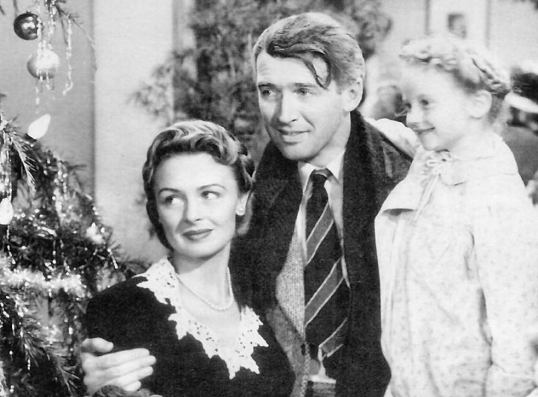
114 years ago today, James Stewart was born in Indiana, Pennsylvania. In honor of the birth of one of my favorite actors, here is a scene that I love.
From It’s A Wonderful Life:

by Freeman Elliott
I wonder which one is the good sister.
Vangelis, R.I.P.
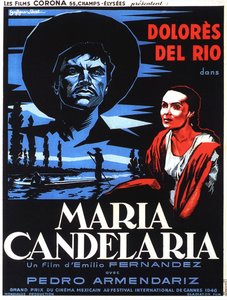
The very first Cannes Film Festival was held in 1946. (The festival was originally schedule to debut in 1939 but the start of World War II put those plans on hold.) 45 films from 18 nations were entered into competition and, when it came time to announce that winner of the Grand Prix (which later became known as the Palme d’Or), the result was a tie. With the number of films competing, that’s not surprising. In fact, there have been many ties over the history of Cannes. What is surprising is that the tie was between a total of 11 films: Brief Encounter, Hets, The Last Chance, The Lost Weekend, Men Without Wings, Neecha Nagar, Red Meadows, Rome Open City, La symphonie pastorale, Velikiy perelom, and Maria Candelaria.
Last night, Jeff and I watched Maria Candelaria on YouTube.
Directed by Emilo Fernandez (who many consider to be the father of the Mexican film industry), the majority of Maria Candelaria takes place in Mexico in 1909, shortly before the start of the Mexican Revolution. Delores del Rio plays Maria, an indigenous woman who is shunned by the people of her village because her mother was a prostitute. The corrupt and greedy store owner, Don Damian (Miguel Iclan), is entranced by Maria’s beauty and wants her for himself. However, Maria loves a poor but honest farmer named Lorenzo (Pedro Armendariz). Though Maria and Lorenzo want to get married, they find their efforts thwarted at every turn by the jealous Don Damian, with Damien going so far as to shoot the pig that Lorenzo was hoping to be able to sell to have the money to not only marry Maria but also to pay off a long-standing debt that he owed Damian. When Maria grows ill, Damian spitefully refuses to sell Lorenzo the medicine that she needs. When Lorenzo breaks into the store and attempts to steal it, he’s sent to prison. Now desperately needing money to get Lorenzo out of prison, Maria poses for a well-meaning painter (Alberto Galan). When the villagers find out that Maria is posing, a chain of events are unleashed that lead to tragedy.
After reading all of that, you may be wondering how many bad things can happen to one well-meaning and loving couple. Nothing seems to go right for Maria and Lorenzo over the course of this film but, at the same time, their love never falters. They remain innocent, regardless of how much they are wronged by the greedy Damian and judged by the hypocritical villagers. Though the film focuses more on melodrama and romance than politics, the pro-revolutionary message is easy to see. The Mexican Revolution, the film argues, had to be fought for the honor of people like Maria and Lorenzo.
It’s all a bit heavy-handed but it’s effectively directed and acted and it’s hard not to get caught up in a film that is so unapologetic about embracing the melodrama. Delores del Rio was a Hollywood starlet who, tiring of the stereotypical roles that she was being offered, returned to Mexico and made several films with Emilo Fernandez. She and Pedro Armendariz have a very real chemistry as Maria and Lorenzo and they both bring a certain world-weariness to their parts that prevents Maria and Lorenzo from becoming idealized stereotypes. Maria and Lorenzo may be optimistic and often naïve but they’re not fools. They know that life will never be easy. Visually, the film is full of striking images of the Mexican countryside, which Fernandez portrays as being slowly corrupted by the growth of civilization.
Maria Candelaria was a hit not only at Cannes but also in Mexico. It’s still regularly cited as one of the best movies to come out of Mexico’s film industry. Though she eventually tired of working with the moody Fernandez, del Rio would continue to appear in movies in both Mexico and Hollywood. Fernandez went on to spend several decades as Mexico’s most popular director, before eventually falling out of favor for Luis Bunuel. Today, most cineastes remember him for playing the evil General Mapache in Sam Peckinpah’s The Wild Bunch.

Who do you blame when a good show goes bad? In this case, I think we can blame Greg Berlanti. Greg is a terrific artist, but he spreads himself too thin, gets distracted, and all of his show go up in smoke after two seasons. I think he just gets bored too easily. Arrow was great the first two and a half seasons, but it started a rapid decline once Greg made 100 different cape shows. Titans follows that pattern as well. The first two season of Titans was some of the greatest television that I’d ever seen. It was realistic, dark, and had humor. The cast was diverse and terrific. The fight scenes looked amazingly real. Not since The Watchmen, could I see myself living in a world with superheroes.
Then Titans, like you’re first real relationship with a person whom you thought about marrying – fell apart when your study session with the blonde outdoorsy girl with the Italian last name took a left turn, your lady found out, and she quickly started dating an event planner with a ponytail.
Anywho, once Alan Ritchson (Hawk) moved on to Reacher on Amazon Prime, the show lost its heart; it stopped being realistic. The worst example of this was casting Jay Lycurgo as Tim Drake. To be clear, he is a good actor, but he’s 100lbs soaking wet. See below.

This character had no superpowers and Tim was knocking out dudes twice his size with one punch. It looked straight up silly. Caped crusader movies are kinda goofy just by having people run around in these weird outfits. This was a bridge too far. His acting is good, but this is an action show- not some IFC thinkpiece about skinny Gen-Z bloggers. When he tried to fight and look tough, I couldn’t help but laugh. It’s just stupid looking and takes you totally out of their world. Don’t waste your time- Greg has clearly moved on and let the laziest writing and casting take over. All of the realism and fun has been drained out of the show with the precision of a surgeon.
“51%” Jonathan Crane develops a fear toxin because that’s what he does. “Home” – we watch Hawk die and the series with him. “Souls” – we see Hawk, Tim, and Donna again, but sadly all 100lbs of Tim Drake doesn’t stay dead- too bad for us. “Troubled Water”, “The Call is Coming From Inside The House”, “Prodigal”, and “Purple Rain” Donna comes back to life and Tim Drake – The hero who no one deserves- saves the day from fear toxin by making it rain lightning or something similarly dumb.
But Case, this review is so short. My response: I didn’t give up on this show, Greg did. There is nothing worthwhile here anymore. Take up a hobby, but don’t watch this show anymore. It’s simply not worth it. Greg, you are loved and have proven to make great television; well, up to 26- 38 episodes of it before you lose that lovin feelin. You’ve lost that lovin feelin could be Greg’s Biography. Greg, try a new song as your spiritual touchstone…Waterfalls are pretty and nice, but if you go chasing them – you lose your greatest love- stick to the rivers and the lakes that you’re used to. Please let’s both not kid ourselves, The Flash and Legends was never going to complement Arrow and my study session was NEVER about the books.
The Great Philosophers TLC knew it best…. Greg, have a listen…..
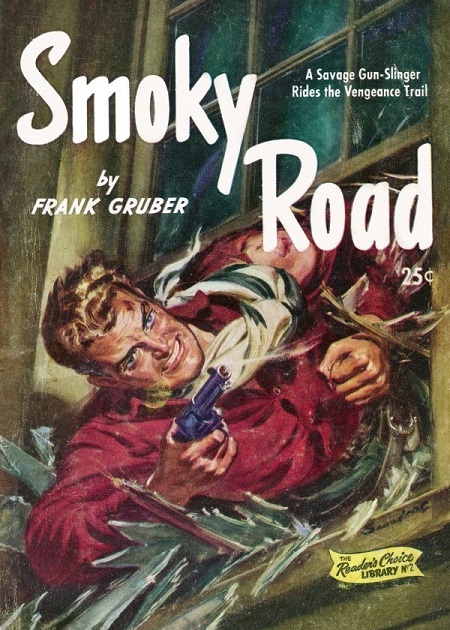
by Norman Saunders
This exciting cover is credited to Norman Saunders, who has been featured many times on this site.
Enjoy!
With the Cannes film festival underway in France, I’ve decided to spend the next few days watching and reviewing some of the films that previously won the Festival’s top prize. In 1952, what would eventually become the Palme d’Or was known as Grand Prix du Festival International du Film and it was actually awarded to two separate films. One of those films was Renato Castellani’s Two Cents Worth of Hope. The other was Orson Welles’s adaptation of Othello.
Oh, Othello. Where to begin, with this well-made Shakespearean adaptation that, by today’s standards, many would consider to be problematic?
Othello is one of Welles’s most important films, not just because of its quality but also because it was one of the first films of his European exile. It was also the first Welles’s production to last for over a year. In this case, it took three years to finish filming Othello. As Welles himself often pointed out, one of the film’s key sequences began in Morocco but ended in Rome. Working with a low budget, Welles would take roles just to have enough money to shoot another few feet of film. (Reportedly, his salary for The Third Man went right into Othello.) Pieces of scenes would be filmed years apart, often with the actors speaking to the camera as opposed to another performer. Actors regularly became unavailable and were replaced. And yet somehow, Welles managed to edit all of the seemingly random bits and pieces into a coherent and frequently powerful film. Over the years, the chaotic production of Othello would become the norm for Welles and he would become as known for the films he was forced to abandon as he was for the films that he had made. But, in 1952, Welles’s perseverance and his determination to bring his vision to the screen were still appreciated and the Cannes jury, headed by author Maurice Genevoix, saw fit to honor his achievement.
At the same time, this is also the film in which the white Orson Welles played the Moor of Venice. Of course, in 1951, it was still pretty much a tradition that every Shakespearean would eventually play Othello and that he would wear dark make-up while doing so. Welles opts for a light bronzer, one that makes him appear to have a deep tan. While it’s undeniably jarring to see Orson Welles playing a North African, it’s still not quite as jarring as seeing what Laurence Olivier did in his Oscar-nominated version of the play.
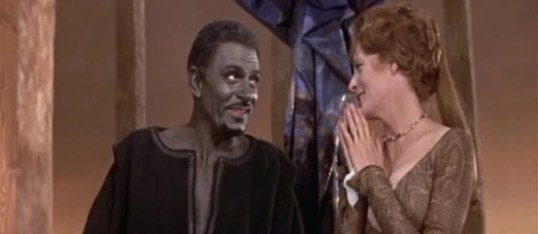
Laurence Olivier’s Othello
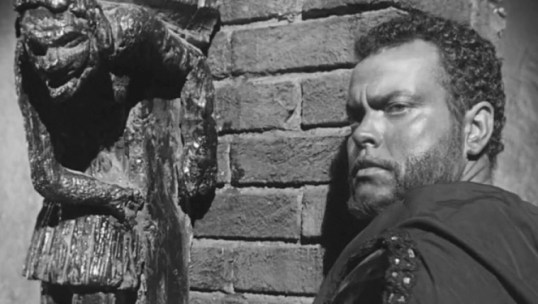
Orson Welles’s Othello
I have to admit that I held off on seeing this film precisely because I didn’t want to watch a film featuring Orson Welles, a director who I greatly admire, in blackface. Many people are probably never going to see this film for precisely that reason and that’s certainly understandable. In the end, it’s a decision that everyone will have to make for themselves. That said, having watched the film, I can now say that Orson Welles gives one of his best performances as Othello, playing him as a brilliant warrior who knows that, because of his background, he will never be fully accepted by the people of Venice. They’ll expect him to fight their battles for him but, when he marries the white Desdemona (Suzanne Cloutier), he is still expected to prove that he’s not some sort of savage. In fact, the only thing that prevents him from being brought up on charges is that Venice needs him to fight in another battle. Being a permanent outsider leaves Othello open to the manipulations of the evil Iago (Michael Mac Liammor), who pretends to be a friend but who instead views everyone around him with contempt and jealousy. Welles captures Othello’s anger but also his emotional vulnerability. As a permanent outsider, Othello is so used to being betrayed that it doesn’t take much from Iago to push him over the edge.
Welles directs the film like a film noir, filling the screen with menacing shadows and framing the film’s tragic finale like a horror film. He makes the film’s low-budget works to its advantage. As opposed to the grandeur that one normally associates with Shakespeare, there’s a seediness to the locations in Welles’s version of Othello. As Othello’s jealousy and paranoia grows, Venice itself appears to become more cluttered and cramped. It’s as if the viewer is seeing the location through Othello’s eyes, a once imposing city that, with each little secret or lie, edges closer to death. As both a director and an adapter of Shakespeare’s original text, Welles tells the entire story of Othello in less than 90 minutes, a pace that reflects Othello’s quick decent into irrational paranoia.
Admittedly, it’s not a perfect film. Mac Liammor was reportedly the best Irish stage actor of his time but his inexperience with film acting is obvious and it makes him a less than ideal Iago. Traditionally, Othello is usually dominated by whichever actor plays the role of Iago, as it’s Iago who pushes the story forward and narrates the action. However, Welles removes the moments when Iago narrates and speaks to the audience. Welles gives us an Othello that is clearly about the title character and this production is less interested in the reasons behind Iago’s betrayal than in what happens to Othello as a result. (Othello becomes yet another Welles film that is ultimately about the importance of friendship and loyalty.) Not surprisingly, with the film firmly centered on Welles’s performance, the rest of the cast struggles to make as strong of an impression. Only Suzanne Cloutier, cast as Desdemona, manages to give a performance that escapes from Welles’s shadow.
At Cannes, Othello defeated, among others, An American In Paris, Detective Story, Umberto D., and Viva Zapata. As often happened with Welles’s later films, it didn’t get much of an initial release in America but it has since been rediscovered by film connoisseurs. Needless to say, the Criterion release is the one to check out.
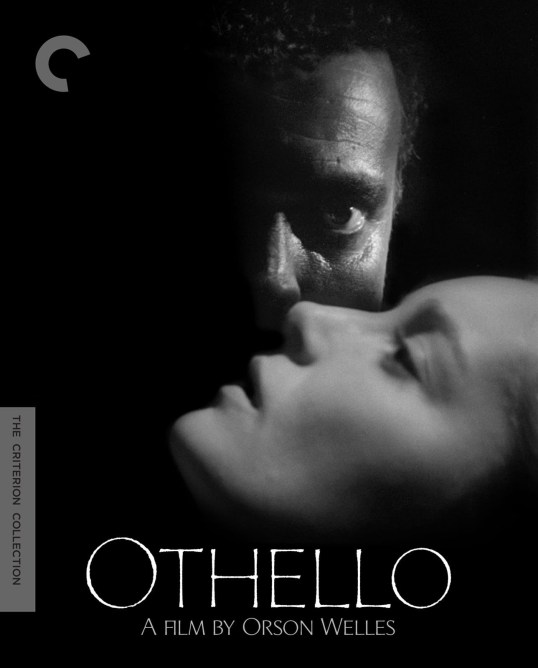
4 Or More Shots From 4 Or More Films is just what it says it is, 4 shots from 4 of our favorite films. As opposed to the reviews and recaps that we usually post, 4 Shots From 4 Films lets the visuals do the talking!
125 years ago, on this date, Frank Capra was born in Sicily. Capra was six years old when his family immigrated to the United States and, for the rest of his long life, he would often talk about seeing the Statue of Liberty from the deck of a boat sailing to Ellis Island. Capra went on to become a director whose work celebrated the ideals and the promise of America. He not only gave us the holiday classic, It’s A Wonderful Life, but he also directed one of the few political films that matteed, Mr. Smith Goes To Washington. And let us not forget that the first two comedies to win the Oscar for Best Picture were directed by Capra, It Happened One Night and You Can’t Take It With You.
In honor of a great career and legacy, here are….
6 Shots From 6 Films

Ladies of Leisure (1930, dir by Frank Capra, DP: Joseph Walker)
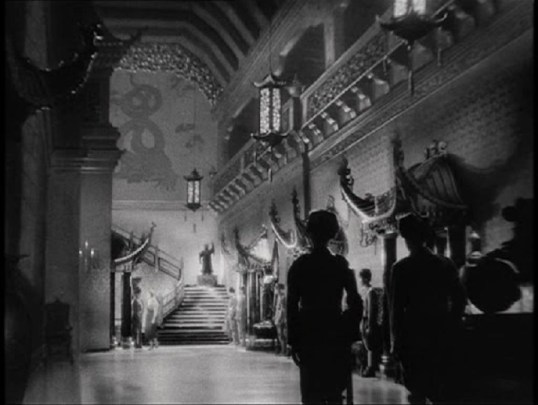
The Bitter Tea of General Yen (1932, dir by Frank Capra, DP: Joseph Walker)
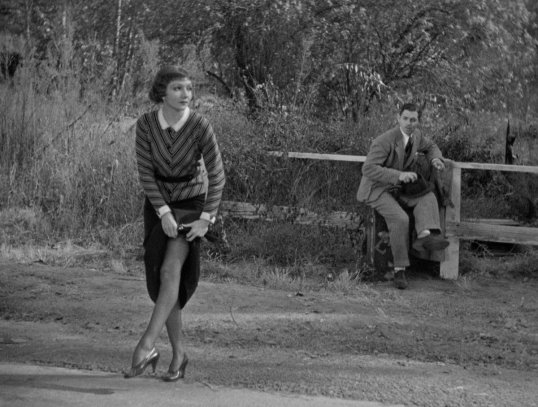
It Happened One Night (1934, dir by Frank Capra, DP: Joseph Walker)
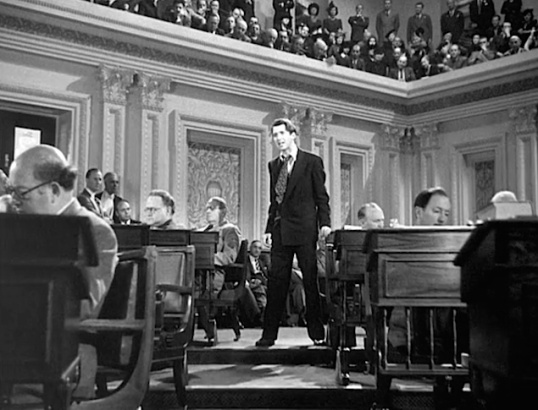
Mr. Smith Goes To Washington (1939, dir by Frank Capra, DP: Joseph Walker)

It’s A Wonderful Life (1946, dir by Frank Capra, DP: Joseph Walker and Joseph Biroc)
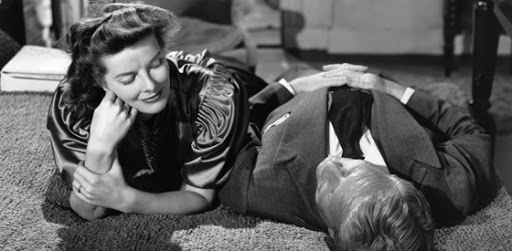
State of the Union (1948, dir by Frank Capra, DP: George J. Folsey))
 Through the Shattered Lens