Music Video of the Day: We Will Rock You by Warrant (1992, directed by Jeff Stein)


Does anyone remember Gladiator?

No, I’m not talking about the Gladiator with Russell Crowe.  I’m talking about a film that came out in 1992 that starred James Marshall and Cuba Gooding, Jr. as two teenagers who get caught up in the lucrative world of street fighting.  Robert Loggia plays a trainer.

As was typical of films of the era, the soundtrack featured cover tunes by glam metal bands who were suddenly affordable due to the rise of Nirvana and grunge.  This video is for Warant’s cover of Queen’s We Will Rock You.  The video itself is split between footage of Warrant performing and footage taken from the movie.  So, if you’ve forgotten this version of Gladiator, consider this to be a refresher.

Enjoy!

Cronenberg returns to Cannes with the Crimes of the Future teaser!


David Cronenberg’s been keeping busy with his latest, Crimes of the Future. It looks like Existenz, but with major upgrades. The film stars Academy Award Nominee Viggo Mortensen (Eastern Promises, A History of Violence), Léa Seydoux (No Time to Die), and Academy Award Nominee Kristen Stewart (Spencer). I can’t begin to understand what the plot’s about, but given it’s Cronenberg, we’re all in.

Crimes of the Future will compete in this years Cannes Film Festival for the coveted Palm d’Or.

Music Video of the Day: (We Want) The Same Thing by Belinda Carlisle (1990, directed by ????)


It’s not quite Heaven Is A Place On Earth but (We Want) The Same Thing did very well for Belinda Carlisle in Europe, where it was enough of a hit to reach the 6th spot on the UK charts.  This was the 6th and final single to be released from Carlisle’s 3rd album, Runaway Horses.  The video alternates between Belinda in love and Belinda performing.

A little bit of Belinda Carlisle trivia: Belinda is the daughter-in-law of the late actor, James Mason.  She married Morgan Mason in 1986.  Before Mason married Belinda, he worked on Ronald Reagan’s first presidential campaign and held a post in the State Department until 1982.  Mason went on to become a film producer.  He and Belinda currently live in Bangkok.

Enjoy!

Hell-Fire Austin (1932, directed by Forrest Sheldon)


Having just gotten out of the army after serving in World War I, Bouncer (Nat Pendleton) and his friend, “Hell-Fire” Austin (Ken Maynard), head out to find their fortune in the west.  Austin claims that he’s an old west legend but, despite his claims, he still can’t get away with not paying his bill at a local café.  Austin and Bouncer are arrested and sentenced to work on a chain gang.

Times are tough but they start to look up when businessman Mark Edmonds (Alan Roscoe) arranges for them to be set free, on the condition that they train his horse and then ride it to victory in an upcoming race.  Edmonds wants the ranch that’s owned by Judy Brooks (Ivy Merton) and, in order to get it, he has to make sure that her horse, Tarzan, doesn’t win the race and the prize money that comes with it.  The only problem with the plan is that Austin likes Tarzan and he’s a little partial to Judy as well.

Hell-Fire Austin is an amusing film.  Like many of  the early western stars, Ken Maynard was a former rodeo star who turned to the movies and he looked authentic jumping on and riding a horse.  In Hell-Fire Austin, he and Nat Pendleton are a good comedy team, playing off of each other as only two friends who have been through both war and prison could.  The comedy comes less from what they say and more from their attitude towards each other.  They’re stuck with each other, no matter how much they might wish differently.  Hell-Fire Austin is an extremely simple movie but fans of the genre should enjoy it.  It’s post-World War I setting adds an extra element of meaning to the story, with Austin and Bouncer standing in for all the soldiers who, having seen terrible fighting in Europe, were now back in America and wondering what to do with their rest of their lives.  Austin and Bouncer had west, hoping to find a life like the one they’ve seen in the movies.  They find it but, of course, they have to go to prison first.

Ken Maynard was an actor who probably could have been nicknamed “Hell Fire” himself.  He was a big star in the early days of Hollywood but his reputation for drinking too much and being egotistical and temperamental sabotaged his career and he ended up back where he began, doing rodeo tricks for Ringling Bros.  He spent his last years living in a trailer, nearly forgotten and selling “memorabilia” that later turned out to be fake, a sad ending for an authentic cowboy.

Music Video of the Day: Problem Child by The Beach Boys (1990, directed by ????)


I have never seen any of the Problem Child films and I have mixed feelings about learning that, in the 90s, The Beach Boys had gone from Pet Sounds to performing the theme song for this particular film.  But none of that matters because we’re all here for Gilbert Gottfried, rest in peace.

Enjoy!

Law of the Rio Grande (1931, directed by Forrest Sheldon)


I nearly didn’t review Law of the Rio Grande.

First, the only copies I could find were at the Internet Archive and on YouTube.  The available copies run 48 minutes but according to the IMDb, Law of the Rio Grande originally had a 57-minute run time.  If that number is correct, that means that the versions on the Internet Archive and YouTube are missing 9 minutes.  Since there doesn’t appear to have been anything objectionable in the film (this is a 1931 b-western, after all), I’m going to guess that the 9-minutes were probably cut when the movie started playing on television in the 50s.  That is something that happened to a lot of the old western programmers.  Television was quick to buy them because they were cheap and they made for appropriate children’s programming but the movies were always edited for time and often, the original versions were lost.

Secondly, edited or not, Law of the Rio Grande is not very good.  It was made, for a very low-budget, by Syndicate Pictures, a poverty row studio.  The majority of the cast was made up of actors who had found success in the silent era but who never made the adjustment to the sound era.  Though the actors have the right look to play cowboys, none of them know how to actually make dialogue sound convincing.  There’s also a persistent sound of crackling static in the background of most of the scenes.  I don’t know if that’s the fault of the film or if it’s just a bad upload but it’s obvious that the cast and crew of Law of the Rio Grande were not used to working with sound.

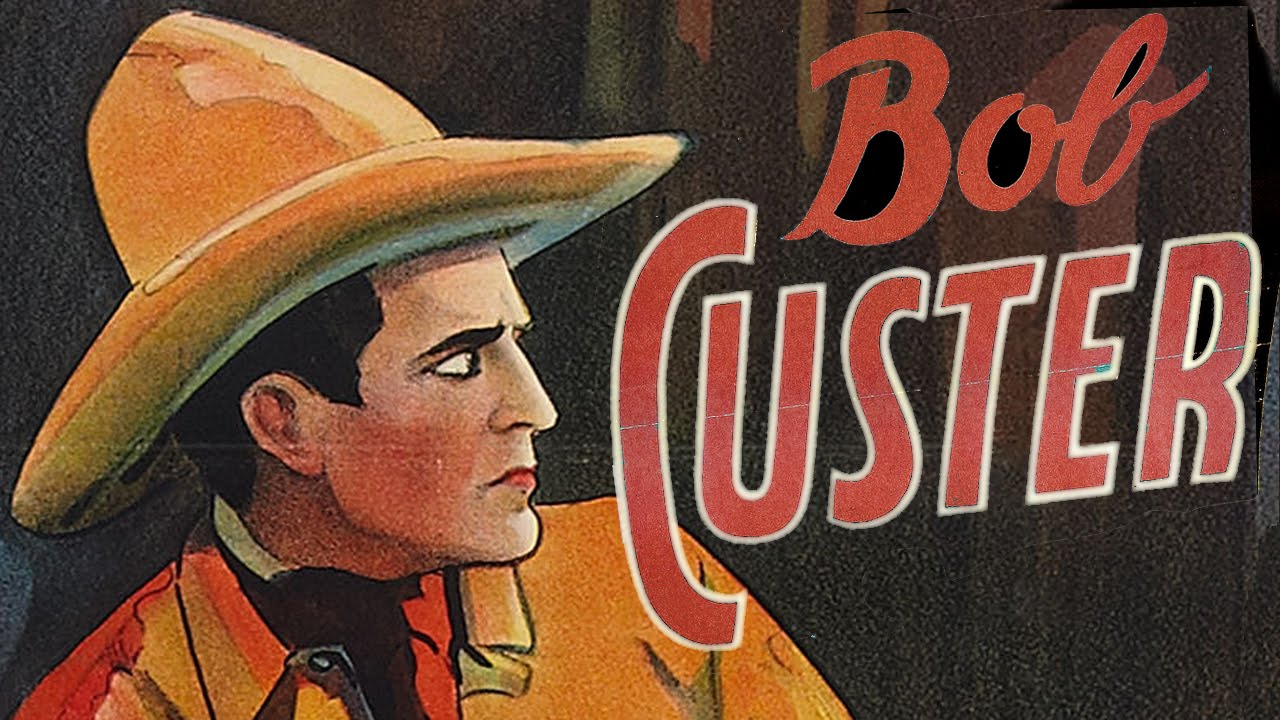
Despite the film’s title, the Rio Grande was nowhere to be seen in the version that I saw.  Instead, the film is about two outlaws, Jim (Bob Custer) and Cookie (Harry Todd), who are determined to go straight.  Jim and Cookie end up working for Colonel Lanning (Carlton S. King) and his daughter, Judy (Betty Mack).  But then a former acquaintance known as the Blanco Kid (Edmund Cobb) shows up and threatens to reveal the truth about Jim’s background.  It’s a typical western programmer, with the main message being you can’t escape your past but you can beat it up in a fair fight.

The kids probably loved it in 1931.  Today, it’s mostly interesting as an example of one of Bob Custer’s final films.  Custer was a legitimate rodeo star who went to Hollywood during the silent era and who had a lot of success because he looked authentic jumping on a horse.  Like many silent era stars, he didn’t have to actually recite or even know his lines.  He just had to be himself.  Unfortunately, the sound era destroyed his career because, while he may have looked like a character from the old west, he didn’t sound like one.  Unable to find work at the major studios, Custer ended up making movies like this one for studios like Syndicate Pictures.  He retired from acting in 1936 and went on to become a building inspector for city of Los Angeles.  It turned out that he was a better engineer than he wan actor and eventually, he named Chief Building Inspector for the city of Newport Beach, California.  He passed away in 1974, nearly forty years after starring in his final film.  He was 76 years old.

TV Review: The Girl From Plainville 1.5 “Mirrorball” (dir by Pippa Bianco)


Well, I tried.

I really did.  Coming off of the high that I got off reviewing each episode of The Dropout, I thought it would be pretty easy to review all 8 episodes of The Girl From Plainville but, having watched the fifth episode last night, I think I’m done.

Don’t get me wrong.  I will continue to watch the series.  (There’s only three weeks left.)  And I’ll certainly include any thoughts that I have about the show in my “Week in Television” post.  But I think I’m done with trying to come up with 500-1000 words to use to review each episode because, quite frankly, there’s just not much to say about The Girl From Plainville.  The story of how Michelle Carter encouraged Conrad Roy to commit suicide is well-known.  The fact that Michelle Carter was put on trial and convicted is also well-known.  This show is trying to build-up suspense about a story that most viewers will already know.

It perhaps wouldn’t matter if The Girl From Plainville had something new or unexpectedly insightful to say about the case.  But the fact of the matter is that Michelle Carter is not that interesting of a human being.  Everything that I’ve read and seen about the case seems to suggest that she really didn’t have much going on inside of her brain.  Because she lacked an actual personality, Michelle learned how to behave and how to interact through social media and television.  Conrad’s death allowed her to live her life as if it was an episode of Glee, or at least that’s what Michelle was hoping.  And now, years after Conrad’s suicide, Michelle is out of prison and being played in a miniseries by Elle Fanning.  It doesn’t seem to be quite fair, does it?

As for last night’s episode, it felt pretty much like a filler episode.  The prosecution team continued to build a case against Michelle while Michelle had to deal with going from briefly being the most popular girl in school to being an absolute pariah.  We also got a few clumsily handled flashbacks to Michelle texting Conrad.  Last weekend, I watched Dopesick, which also aired on Hulu and also used a jumbled timeline.  The timeline in Dopesick did occasionally get confusing but, at the same time, it worked because it took place over several years and the actors could be made to look older or younger, depending on the timeline.  If Michael Keaton had a hint of hair, you know the show was taking place in the 90s.  If he was bald, you know it was 2004.  The Girl From Plainville, on the other hand, is only dealing with a two-year period and, as such, it’s hard to keep track of what’s happening when.  The characters played by Elle Fanning and Chloe Sevigny pretty much look and act the same in 2012 as they do in 2014.  It’s a very clumsily constructed story structure, one that does the miniseries little good.

That said, Elle Fanning continues to give a convincingly unhinged performance as Michelle and Colton Ryan is appropriately vulnerable as Conrad.  (Sorry,  I’m not going to call him Coco.)  I think if the miniseries had done away with all of the flashback nonsense and just told their story in chronological order, Fanning and Ryan’s strong performances would have been better served.  For now, I’m done with doing full reviews of this show but, if next week’s episode is a surprisingly good one, that could change.