Joe Walsh, who joined the Eagles in 1976, originally wrote and performed In The City for the 1979 cult classic, The Warriors. Around the same time that The Warriors came out, The Eagles released their sixth studio album, The Long Run, which featured the full band’s version of In The City.
This was an early music video, released before MTV was even a thing and when music vides were still viewed as largely being a novelty. Like most of the music videos of the era, it’s a simple performance clip.
After countless pandemic-related delays, A Quiet Place II will finally be released on May 28th. Here’s the final trailer, which was released yesterday. As you can tell, it appears that John Krasinski will at least briefly appear in the film, despite the death of his character at the end of the previous film. (It appears that Krasinski’s scene is a flashback to the beginning of the alien invasion.) Krasinski, of course, will also be returning to direct. Also returning to star in the film is my personal role model, Emily Blunt!
When I watch this video, I get the feeling that Muse has been abducted by aliens and they’re being forced to perform in a sort of space casino. That’s the feeling I get from the production design and just the general look of the band. And really, when you think about it, it makes sense. If I was an alien looking for entertainment, I would definitely beam up Muse.
Before he revolutionized cinema, Orson Welles revolutionized both theater and radio. As the host and mastermind behind the Mercury Theatre On The Air, Welles was heard on a weekly basis as the show broadcast adaptations of literary classics into American homes. In 1938, both Welles and Mercury Theatre On The Air achieved a certain immortality with their broadcast of War of the Worlds. What is often forgotten is that, one week after terrifying America, the Mercury Theatre presented an adaptation of Joseph Conrad’s Heart of Darkness, one which featured Welles in the role of Kurtz and his future Citizen Kane co-star, Ray Collins, as Marlow.
This broadcast was significant in that, when Welles first went to Hollywood, it was with an eye towards turning Heart of Darkness into a film. Welles planned to shoot the film strictly from the point-of-view of Marlow, with the camera serving as Marlow’s eyes. Welles not only planned to play Kurtz in the film but he also intended to provide the voice of Marlow. Unfortunately, the film was never made. With the outbreak of war in Europe, it was felt that the audience most likely to embrace Welles’s experiment would no longer be going to the movies. Welles would instead make his cinematic debut with Citizen Kane, a film that fully embodies Welles’s artistic vision regardless of what Mank tried to sell everyone last year. As for Heart of Darkness, it would later be adapted for television, appearing in greatly altered form as an episode of Playhouse 90 in 1958. Boris Karloff played Kurtz and Roddy McDowall played Marlow and someone decided that it would be a good idea to add a subplot in which Kurtz is revealed to by Marlow’s long lost father. There would be many attempts to turn Conrad’s novella into a feature film but it was not until 1979, with Francis Ford Coppola’s Apocalypse Now, that Conrad’s story would appear on the big screen, albeit in massively altered form. Nicolas Roeg would later direct his own version of Heart of Darkness, one that featured Tim Roth as Marlow and John Malkovich as Kurtz. (I haven’t seen it but that just sounds like perfect casting.)
Today, in honor of the 106th anniversary of the birth of Orson Welles, here is the Mercury Theatre On The Air’s production of Heart of Darkness. This broadcast also features an adaptation of the play, Life With Father. The casts are as follows:
Heart of Darkness: Orson Welles (Author, Ernest Kurtz), Ray Collins (Marlow), Alfred Shirley (Accountant), George Coulouris (Assistant Manager), Edgar Barrier (Second Manager), William Alland (Agent), Virginia Welles (Kurtz’s Intended Bride), Frank Readick (Tchiatosov)
(For those keeping track, Welles, Collins, Coulouris, and Alland would all have key roles in Citizen Kane. Alland played the reporter who is assigned to discover the meaning of Rosebud. Ray Collins played Boss Jim Gettys, the political boss who prevents Kane from being elected governor. Coulouris played Kane’s guardian, Walter Parkes Thatcher. And Welles, of course, was Charles Foster Kane, American. )
Life With Father: Orson Welles (Father), Mildred Natwick (Mother), Mary Wickes (Employment Office Manager), Alice Frost (Margaret), Arthur Anderson (young Clarence Day).
This program was originally aired on November 6th, 1938. Welles was 22 years old at the time of this broadcast. So, sit back and enjoy Orson Welles and the Mercury Theatre.
4 (or more) Shots From 4 (or more) Films is just what it says it is, 4 (or more) shots from 4 (or more) of our favorite films. As opposed to the reviews and recaps that we usually post, 4 (or more) Shots From 4 (or more) Films lets the visuals do the talking.
As I mentioned previously, the great Orson Welles was born 106 years ago today. And that means that it’s time for….
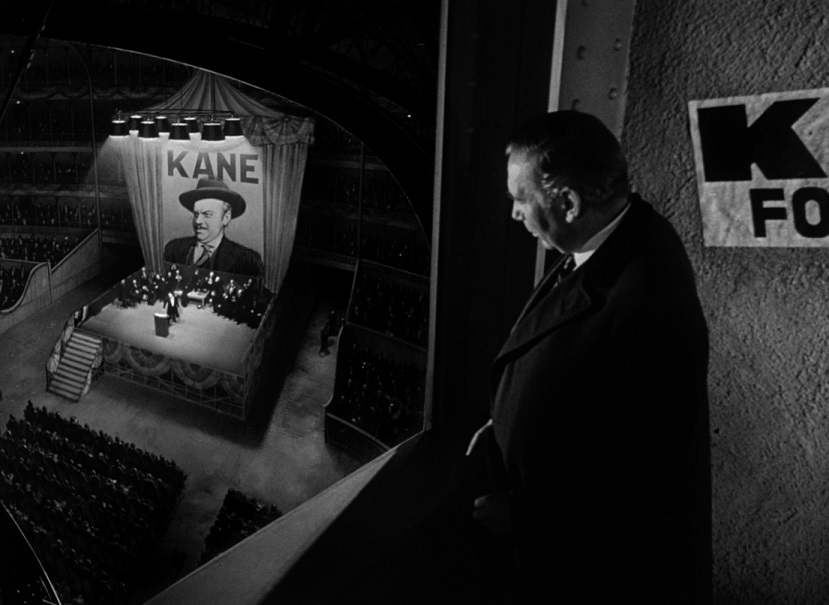
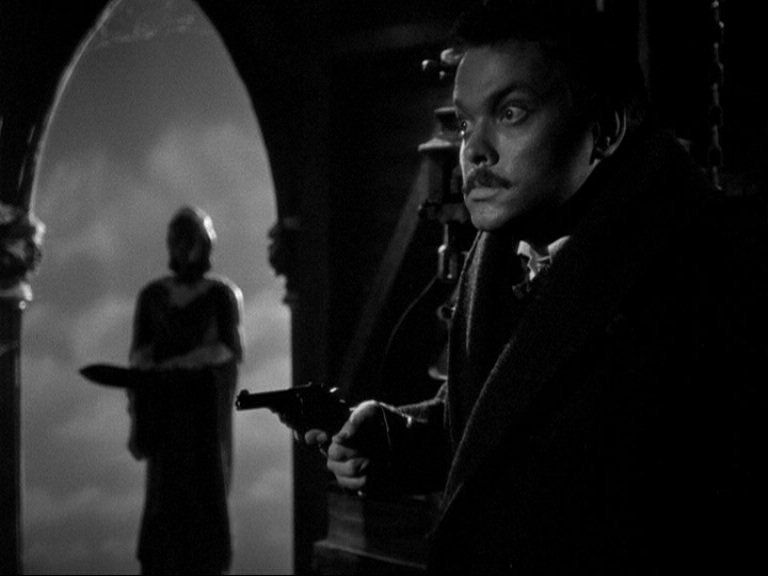
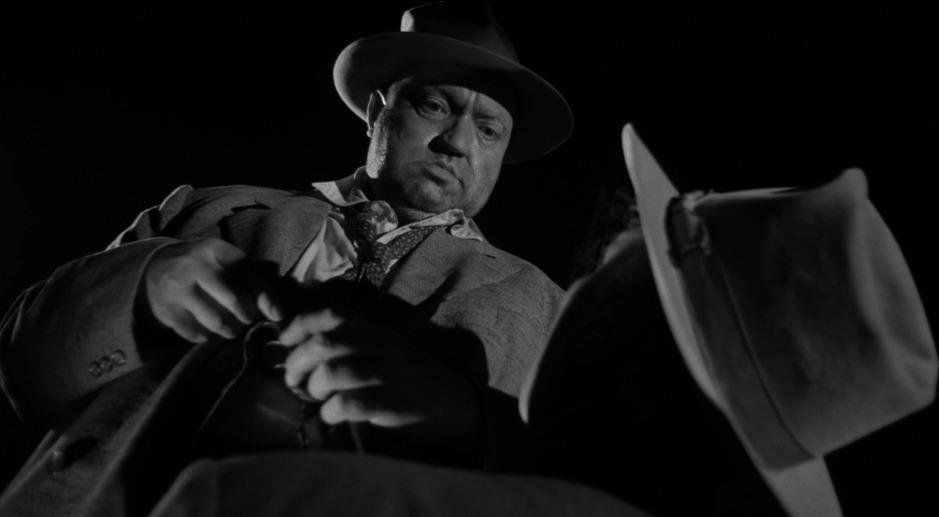
4 Shots From 4 Orson Welles Films
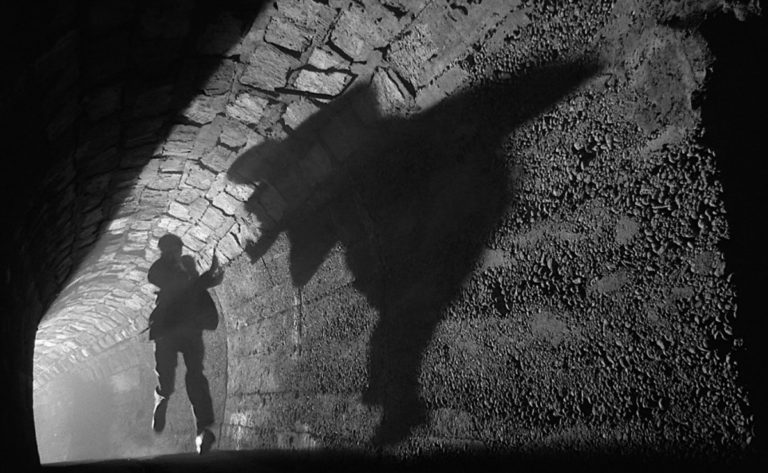
Citizen Kane (1941, dir by Orson Welles, DP: Gregg Toland)The Stranger (1946, dir by Orson Welles, DP: Russell Metty)Touch of Evil (1958, dir by Orson Welles, DP: Russell Metty)The Trial (1962, dir by Orson Welles, DP: Edmond Richard)
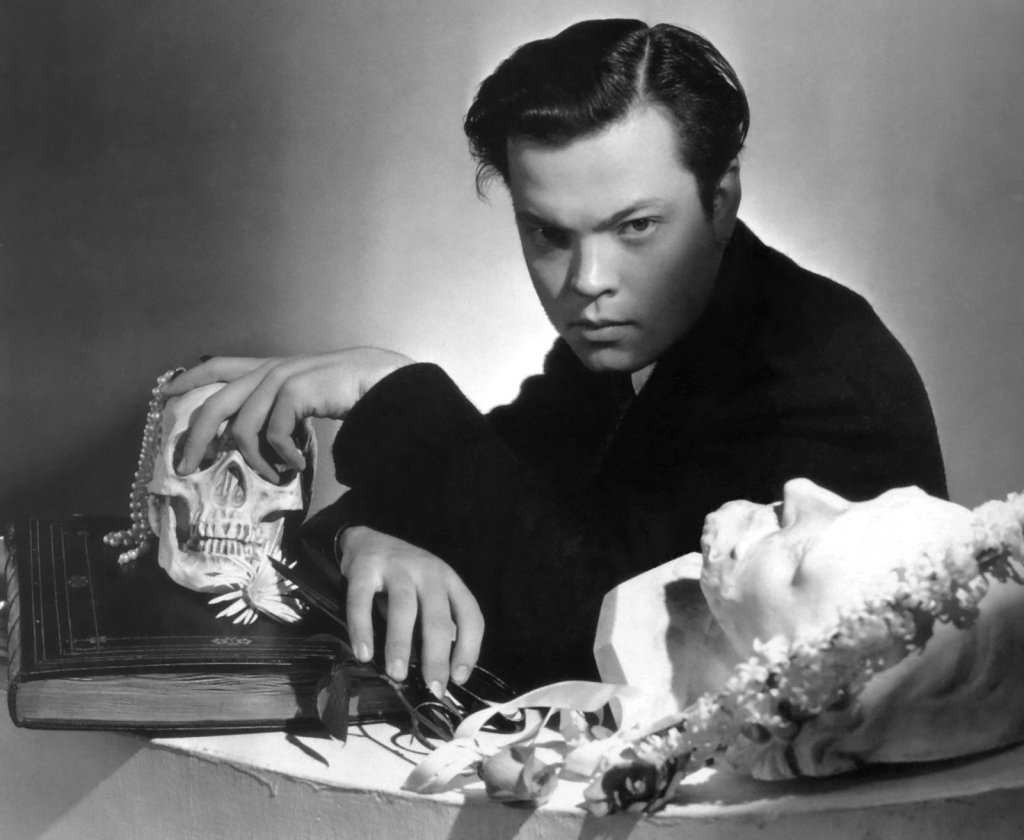
The great Orson Welles was born 106 years ago today, in Kenosha, Wisconsin. Orson Welles was one of the greatest directors of all time, a showman and an artist who changed the way that people watched and thought about films. He was the visionary who helped to usher in the era of modern filmmaking and who proved that movies could be art and Hollywood never forgave him for it. Merely seven years after the release of Citizen Kane, Orson Welles found himself as such a pariah in the American film industry that he relocated to Europe. There, he made some of his best films though few of them would be fully appreciated when first released.
(Indeed, there still seems to be the strange need among some to try to diminish Orson Welles’s talents and achievements. Just last year, Mank tried to deny him the credit that he most certainly deserved for Citizen Kane. Interestingly enough, David Fincher claimed that his father’s original script portrayed Welles even more negatively than Welles came across in the finished film. One has to wonder about the motives of anyone who would slander Orson Welles while deifying Upton Sinclair.)
1965’s Chimes At Midnight is one of Welles’s best. Filmed in Spain, Chimes at Midnight is combination of five of Shakespeare’s plays, primarily Henry IV, Part 1 and Henry IV, Part 2, but also Richard II, Henry V, and The Merry Wives of Windsor. Welles cast himself in the role of Falstaff, enjoying life while educating the young Prince Hal in the ways of the world. When Prince Hal becomes Henry V, Falstaff attends his coronation, just to be rejected. The new king has new place in his court for someone like Falstaff. Was Prince Hal perhaps a stand-in for the many filmmakers who claimed to have been inspired by Welles’s work but who still refused to help Welles when he later came to them for help? Perhaps.
In the scene below, Falstaff is rejected by the new king. It’s a heart-breaking moment and one that features some of Welles’s best work as both an actor and a director.
The MLB season is still young but so far, my Rangers aren’t doing that well. We’re at the bottom of the AL West. Overall, we’ve got a better record for the Tigers but things still aren’t looking good. My love for my team may be unconditional but it would still be nice if they could have a good season for once. It’s been a while.
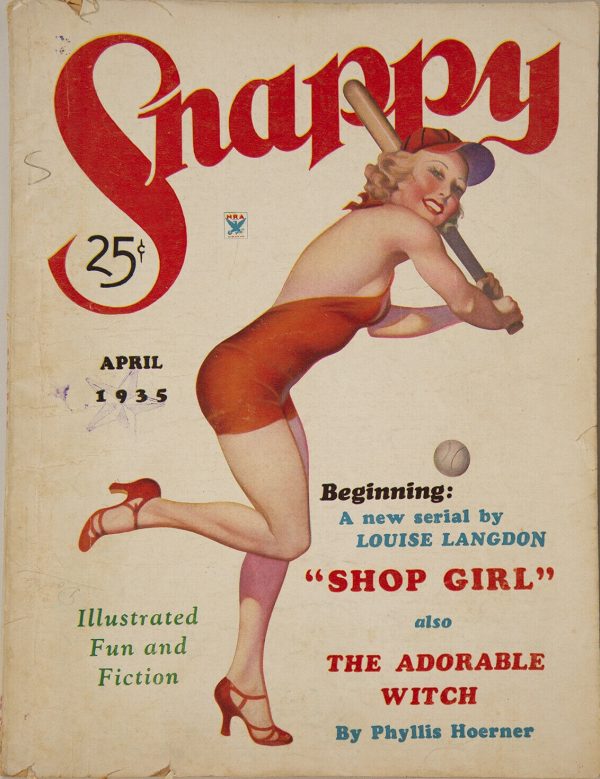
This cover gives me hope. IF she can play baseball in high heels than anything’s possible! If she can get a hit than the Rangers can still turn things around and win another pennant! Go Rangers!
This cover is from 1935. I wish I knew who the artist was because he’s restored my faith in baseball!
I’m not going to say much about this video, beyond that fact that it reminds me — in a good way — of Jakalope. If Degrassi were still on the air (RIP), Mothica would definitely be playing during all of the big scenes.
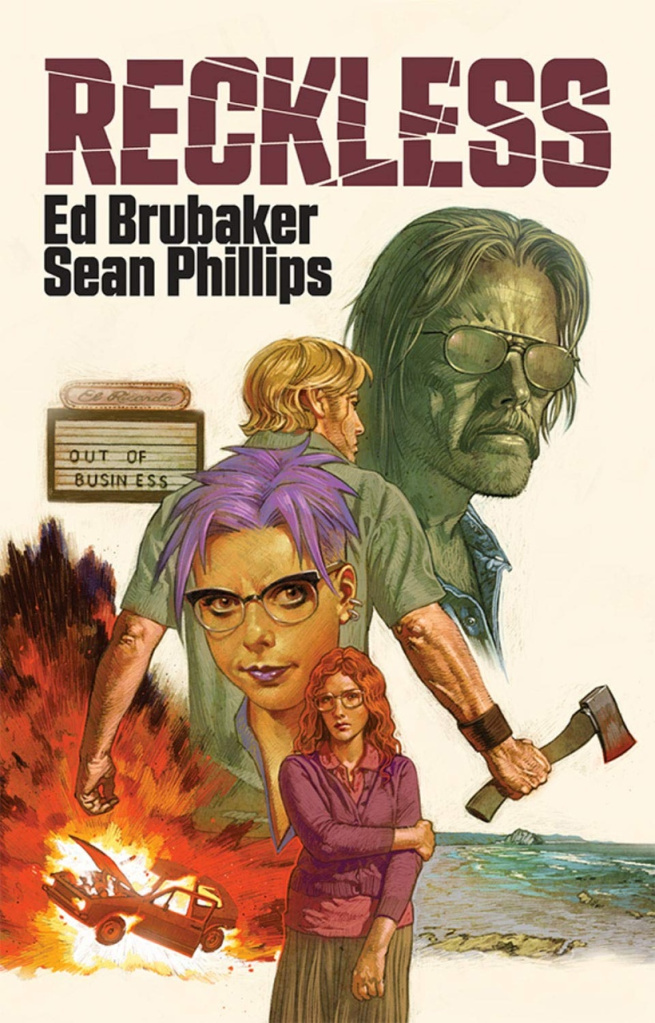
I did this last year, so I’m doing it again : in an effort to gin up interest in my Patreon site, I’m posting a selection of reviews that ran on there originally with the brazen goal being to get you, dear reader, to part with a buck (or more, if you wish) per month so that yours truly can find some level of intellectual justification for the sheer amount of time I put into cranking out so much comics criticism. Really, anything helps and is much appreciated. Next up : proof that I don’t ignore the comics mainstream entirely, as I take a look at the first volume in the new graphic novel series from the fan-favorite creative team of Ed Brubaker and Sean Phillips —
Here’s the deal : the crime comics “dream team” of Ed Brubaker and Sean Phillips have been at it for so damn long…



 Through the Shattered Lens