Film Review: Testament (dir by Lynne Littman)


The 1983 film, Testament, is about death.  It’s about the death of a family, the death of a town, the death of a way of life, and the death of hope.

And you may be saying, “Well, gee, Lisa — that sounds like a really happy movie.”

Well, it’s not meant to be a happy movie.  Testament is a painfully grim movie about the end of the world.

The movie takes place in the town of Hamelin, California, which we’re told is 90 minutes away from San Francisco.  It’s a nice town, the type of place where everyone knows each other.  Mike (Mako) runs the local gas station and cares for his disabled son, Hiroshi (Gerry Murillo).  Elderly Henry Abhart (Leon Ames) spends his time on his radio, talking to strangers across the world.  Fania (Lilia Skala) offers up piano lessons.  Father Hollis (Philip Anglim) looks over the spiritual needs of the parish.  It’s a normal town.

The town is home to the Weatherlys.  Carol (Jane Alexander) is a stay-at-home mom who does volunteer work and who is directing the school play.  Tom (William Devane) is a common sight riding his bicycle through town every morning before heading off to work in San Francisco.  They have three children.  Mary Liz (Roxanna Zal) is a teenager who is taking piano lessons.  Brad (Ross Harris) is always trying to impress his father and is looking forward to his 14th birthday.  Scottie (Lukas Haas, in his first film) is the youngest and never goes anywhere without his teddy bear. They’re a normal family living a normal life in a normal town.

And then, one day, everything changes.  Scottie is watching Sesame Street when the program is suddenly interrupted by a clearly terrified anchorman who announces that New York has been bombed.  The president is about to speak but, before he can, there’s a bright flash of light, an distant explosion, and the entire town loses power.

At first, the people of Hamelin try to remain hopeful.  Though Tom works in San Francisco and San Francisco is among the many cities that have apparently been bombed (by who, we never learn), he also left a message on the family’s answer machine, telling them that he was on his way home.  Even with Tom missing, Carol continues to insist the he’ll be coming home at any minute.

Tom doesn’t come home.

The rest of the film follows the slow death of the town.  Even though the town was not damaged by the blast, the fallout soon hits.  Cathy (Rebecca De Mornay) and Phil (Kevin Costner) bury their newborn baby after it falls ill from radiation poisoning.  Mike, Henry, and Fania all start to grow physically ill and, in some cases, dementia sets in.  Father Hollis goes from being hopeful to being tired and withdrawn as he tries to attend to each and every death.  Larry (Mico Olmos), a young boy whose parents have disappeared, briefly moves in with the Wetherly family.  He disappears about halfway through the movie and we never learn if he left or if he died.  All we know is that no one mentions him or seems to notice that he’s gone.

Over the course of the film, Carol buries two of her children.  By the end of the film, her remaining child is starting to show signs of being sick, as is she.  Testament, which opened with bright scenes of a happy town, ends in darkness, with only a handful of people left among the living.  Even those who are alive are clearly dying and can only speak of the importance of remembering all of it, what they had and what they lost.

Sounds like a really happy film, right?  Well, it’s meant to be depressing.  It was made at a time when nuclear war was viewed as being not just probable but also inevitable.  Testament is a film that portrayed what a lot of people at the time were expecting to see in the future and, as a result, it’s not meant to be a particularly hopeful movie.  It’s a film that accomplishes what it set out to do, thanks to a great (and Oscar-nominated) performance from Jane Alexander and Lynne Littman’s low-key direction.  Unlike a lot of atomic war films, Testament does not feature any scenes of burning buildings or excessive gore.  That actually what makes it even more disturbing.  Even after the war, Hamelin still looks like it did beforehand, with the exception that many of the houses are now empty and that all of the residents are slowly dying.

(Would I have reacted as strongly to the film if I hadn’t watched it at a time when many people are afraid to go outside?  Perhaps not.  But this pandemic has brought extra power to a lot of films that may not have had as much of an impact in 2018.)

Testament is a powerful film, though not necessarily one that I ever want to watch again.

Here The Trailer For Dead!


This is a trailer for a film called Dead.  I haven’t heard much about this film but death is a universal theme.  Is he a zombie or is he a ghost?  I’m hoping for a ghost.  I’m a little bit tired of zombies.

Well, regardless of whether he’s a ghost or a zombie, this dead cop has a job to do.  He needs to capture the man responsible for his death!

Here’s the trailer!

Here’s The Trailer For Abyssal Spider!


Hey, who doesn’t love spiders?

With the exception of the video’s thumbnail image, this trailer is actually pretty smart about not showing us the actual spiders.  I wish more trailers would take this approach and not give away the entire movie.

Abyssal Spider is scheduled to be released on September 11th.

Here’s The Trailer For Let Him Go!


In Let Him Go, Kevin Costner plays a retired sheriff who tries to rescue his grandson from a family that’s living off the grid.

This looks like a typical Costner film.  It’s always easy to imagine Kevin Costner as being the pickup driver who pulls up next to you at the gas station and who says, in the most disappointed of tones, “Your back tire is low, did you know that?”  As I’ve said in the past, I’ve never been a huge Kevin Costner fan just because he seems like he’d be a pain to live next door to.  “When you mowed your yard, you clipped some of my grass, did you know that?”  “I was up all night listening to your music.  I work in the morning, did you know that?”  And so on and so on.

That said, those of you who are into modern day westerns might get a kick out of this film.  Here’s the trailer:

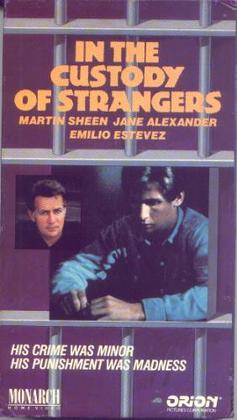
In The Custody of Strangers (1982, directed by Robert Greenwald)


In this television film, Emilio Estevez plays the world’s worst son but his behavior makes sense because he also has the world’s worst father (played by Estevez’s real-life father, Martin Sheen).

When teenager Danny Caldwell (Estevez) gets arrested for crashing into a police car while driving drunk, his mother, Sandy (Jane Alexander), wants to bail him out and bring him home.  However, Frank Caldwell (Sheen) is an old-fashioned disciplinarian and he decides that his son needs to spend a night in jail in order to teach him a lesson.  Even though, as a juvenile, Danny is given a private cell, he still snaps when the older inmate in the cell next door starts coming onto him.  After smashing the man’s head against the cell bars, Danny picks up a battery charge and is sucked into the system.

While Frank and Sandy struggle to get Danny released from jail, Danny falls deeper and deeper into despair and anger.  It’s an overcrowded, busy jail and Danny is often left in isolation for both his safety and the safety of the other prisoners.  Even though the warden (Kenneth McMillan) is sympathetic to Danny and can tell that he’s not really a hardened criminal, there’s only so much that he can do for him.  Meanwhile, on the outside world, Frank stubbornly refuses to admit that he made a mistake by leaving Danny in jail overnight.  When a job opportunity presents itself in another state, the unemployed Frank misses some of Danny’s hearings so that he can interview for it, leaving Danny feeling abandoned all over again.

For obvious reasons, the casting of Martin Sheen and Emilio Estevez as father and son works very well in this film.  Not only is there the obvious family resemblance but both Sheen and Estevez project the same attitude of anger and resentment towards the world.  If Danny has a chip on his shoulder, it’s because he inherited from his father.  In The Custody of Strangers does a good job of showing how being imprisoned can often turn someone who made a mistake into a hardened criminal but, even though it’s mostly critical of the criminal justice system, it doesn’t let Frank off the hook either.  Frank may say that he was just trying to discipline his son but the film makes clear that what he actually wanted was for jail to do his job as a parent.  The results are disastrous and the film ends on a note of ambiguity.  After what Danny has been through, it’s clear that he’ll never be the same person again.

Sheen, Alexander, and Estevez all give good performances in In The Custody of Strangers.  The only ray of hope that the film offers is the kindly warden and he’s also the film’s biggest flaw because it’s hard to believe that, with everything else going on in the jail, he would have had time to take such a benevolent interest in just one inmate.  In real life, Danny Caldwell would have been even more lost than in this movie.

The Past Never Dies — Not Should It : Paula Lawrie’s “High Socks New Jersey 1950”


Ryan C. (fourcolorapocalypse)'s avatarRyan C.'s Four Color Apocalypse

One could make a strong argument that Paula Lawrie takes the most unique approach to memoir of any graphic artist working today, filtering her childhood experiences through a modernist lens in the pages of her ongoing My Geometic Family ‘zine — which we’ve examined on this blog in the past and whose title I would encourage you to take quite literally indeed — but I think what strikes me most about her work, in addition to the combination of technical expertise and  visionary conceptualization evidenced in all of her richly-detailed illustrations, is how she seamlessly combines the dual viewpoints of her young, admittedly naive, self with that of the worldly (perhaps even world-weary) grown woman that she is today. It’s one thing to see events through a child’s eyes, but quite another to see them through the eyes of an adult who is, in turn, seeing them through…

View original post 663 more words

Film Review: When The Wind Blows (dir by Jimmy Murakami)


Over the past few years, I’ve seen some extremely depressing animated films.

I cried during the first fifteen minutes of Up.  I cried during the final ten minutes of Toy Stories 3 and 4.  Actually, now that I think about it, I think I’ve sobbed through every single PIXAR film, with the exception of the movies about the talking cars and the one about the good dinosaur.  My point is that I’m not one of those people who automatically assumes that, just because a film is animated, it’s necessarily going to make me laugh.  I fully understand that not all animated films are for children and that a cartoon can be just as serious and dark as a live action movie.

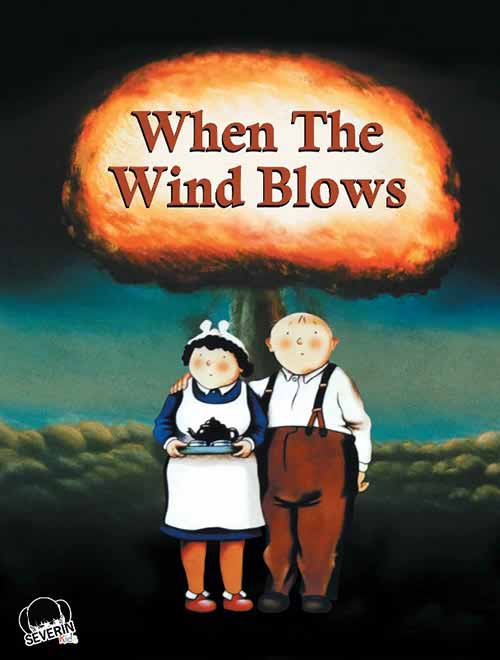
That said, I don’t think anything could have prepared for the 1986 film, When The Wind Blows.  To say that When The Wind Blows is bleak would be an understatement.  Is When The Wind Blows a depressing film?  Yes, you could say that.  It’s a film about an elderly couple facing the end of the world with optimism and a never-ending faith that things will turn out okay.  This is the most trusting couple in the world and, in the end, they end up crawling into their own separate potato sacks, where they struggle to recite the Lord’s Prayer as they both die a slow and painful death.  It’s not just that When The Wind Blows is depressing.  It’s also that it’s a film that takes place in a world bereft of hope.  It’s a film that has a message but, at the same time, it also seems to be convinced that it’s a message to which no one will bother to listen.

Jim and Hilda Bloggs (voiced by John Mills and Dame Peggy Ashcroft) are a loving couple who own a rather nice cottage in rural England.  They’re very content in their life and more than a bit complacent.  They have faith that both the milk and the paper will be delivered every morning.  Hilda has a nice garden going.  Jim regularly takes the bus down to the library, where he reads the newspapers and picks up pamphlets about what to do in case of a nuclear attack.  When the news comes over the radio that Britain will probably be attacked in 3 days, Jim industrially sets out to make a shelter for himself and Hilda.

It’s not much of a shelter.  In fact, it’s really just two doors leaning against a wall.  However, Jim and Hilda are simply following the instructions that they found in a government-printed pamphlet and both of them have a good deal of faith in the “power that be.”  As they wait for the war to break out, they remember just how much they enjoyed World War II.  Everyone was in it together during World War II!  And Jim has faith that everyone will continue to be in it together during this latest war.

The bomb eventually drops.  The animation, which previously had the feel of an old school Christmas special, becomes dark and ominous as the world around Jim and Hilda’s house erupts into flames.  Jim and Hilda hide in their little shelter.  Though the pamphlets say that they shouldn’t leave the shelter for at least two weeks, Jim and Hilda leave within a few hours.  They walk around outside and look at the charred remains of the garden.  Hilda wonders what fallout looks like.  Jim isn’t sure.

And, at this point, we know they’re both as good as dead.  (Interestingly enough, it does appear that they survived longer than their neighbors, who perhaps did not hide behind a door.)  The rest of the film is essentially watching Jim and Hilda waste away while remaining convinced that someone from the government is going to come and save them.  You find yourself wondering if the two of them are really as naive as they seem or if they’re both in a shared denial about what’s happened.  It’s probably a combination of the two.

It’s an undeniably effective film.  It not only works as an anti-war film but also as an anti-government film.  Both the Left and the Right will find things to appreciate in the film’s story.  But my God is it ever a depressing movie.  It’s a well-made film that I’ll probably never voluntarily watch again.

19