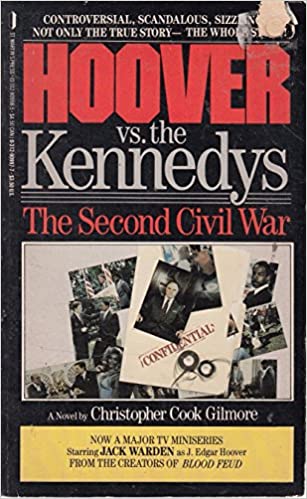
Hoover vs. The Kennedys: The Second Civil War (1987, directed by Michael O’Herlihy)


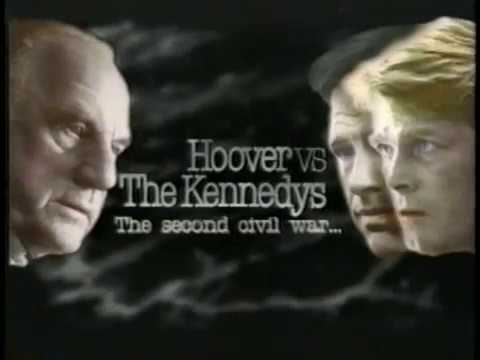
The year is 1961 and the young and dynamic John F. Kennedy (Robert Pine) has been elected president.  While the rest of the nation waits to see how Kennedy will lead, FBI director J. Edgar Hoover (Jack Warden) is convinced that he will continue to do what he’s always done.  As he explains it to his aide and only friend, Clyde Tolson, Hoover is a longtime friend of President Kennedy’s father, Joseph (Barry Morse).  Hoover knows how the Kennedys made their money and he also knows that the Kennedys probably stole the election.

Hoover quickly discovers that John F. Kennedy isn’t going to be like the other presidents under which he has served.  Kennedy appoints his self-righteous brother, Robert (Nicholas Campbell), as attorney general and Robert immediately sets out to make Hoover’s life unbearable.  When Hoover brings the brothers evidence that civil rights leader Martin Luther King (Leland Gantt) is not only associating with known radicals but that he also cheats on his wife, John and Bobby just laugh at him.  While John pursues an affair with Marilyn Monroe (Heather Thomas) and Bobby tries to reign in the FBI’s excesses, Hoover continues to collect information for his files and schemes to outlast both Kennedys.

Hoover vs. The Kennedys was a made-for-TV movie, one of the many films that have been made about the conflicts between the Kennedys and J. Edgar Hoover.  Since a good deal of the film is made up of Hoover and the Kennedy Brothers snapping at each other on the phone and then telling their closest aides about how much they dislike each other, it seems hyperbolic to call their relationship the “second civil war.”  Though the film does go as far as to suggest that Hoover didn’t make much of an effort to investigate the background of Lee Harvey Oswald, it doesn’t go any further when it comes to the theories surrounding John Kennedy’s assassination.  As well, the film is one of the rare ones to not speculate that Hoover and Clyde Tolson were more than just friends.  Instead, Hoover vs. The Kennedys concentrates more on all of the scandalous stories surrounding the Kennedy brothers.  The mob connections.  The womanizing.  The arrogance.  It’s all recreated here.  Perhaps because this was a Canadian production, Hoover vs The Kennedys doesn’t portray anyone positively.

The acting is a mixed bag.  Nicholas Campbell is believably abrasive as Bobby while Robert Pine was several years too old to be a convincing JFK.  Heather Thomas is an adequate Marilyn Monroe while Leland Gantt comes across as too emotional to be a believable Martin Luther King.  (In Gantt’s defense, the movie does not seem to know what to do with the character of King, treating the civil rights icon like a prop to be trotted out whenever some Hoover/Kennedy conflict is needed.)  The film’s best performance comes from Jack Warden, who plays Hoover as being a puritanical hypocrite who knows that, no matter who tries to push him out, he’s not going anywhere unless he wants to.  Hoover outlasted several presidents and Warden portrays him as being the ultimate political survivor.

As far as Kennedy films are concerned, Hoover vs. The Kennedys is okay but it doesn’t offer up anything new.  Some of the most important roles are miscast and the movie never goes into much depth, beyond repeating all of the usual rumors.  Jack Warden’s a good J. Edgar Hoover, though.  The movie is not easy to find but it has been uploaded on to YouTube.  And, if you can’t find the movie, you can always order the novelization off of Amazon.
 

Music Video of the Day: Dead Horse by Hayley Williams (2020, dir by Zac Farro)


Who among us has not beat a dead horse?

When I watch this video without the music, my immediate assumption is that it’s about someone who joined a cult and who has just discovered that the leader of the cult is either from outer space or from the future.  The video just has that sort of threatening, science fiction feel to it.  That said, the song is actually about someone looking back on a breakup that was apparently a long time coming but which she still might not have been emotionally prepared for.

Enjoy!

Cinemax Friday: Electra (1996, directed by Julian Grant)


No, this is not the terrible Electra film starring Jennifer Garner.  Instead, this the Electra where Shannon Tweed shoots lighting from her finger tips.

In this offering, Shannon Tweed plays Lorna, who is the stepmother of Billy (Joe Tabb).  Billy has a job cutting down trees.  He uses an axe instead of a chainsaw because no one does anything that makes sense in Electra.  Billy has a girlfriend named Mary Anne (Katie Griffin).  Lorna hates Mary Anne because Lorna wants Billy and, even if he won’t admit it, Billy wants Lorna too.

Billy is also the sole survivor of an experimental test group that was used to develop a super drug that can provide the people who take it with super strength.  Billy still takes the drug on a regular basis, though he doesn’t seem to really understand how it works.  He’s just in it for the super strength.

Marcus Roache (Sten Eirik) is an evil billionaire who is confined to a wheelchair.  He knows that, if he can get Billy’s super strength, he’ll be able to walk again and then he can use the powers to take over the world.  However, other than through taking the pills, the only way that Billy can pass on his powers is through sexual intercourse so Marcus sends two of his employees — Gina (Dyanne DiMarco) and Karen (Lara Daans) — to abduct Billy and seduce him.  Since Gina and Karen both wear leather dominatrix costumes, discretion is apparently not important.  Marcus hopes that Billy will impregnate one or both of them and they will give birth to a superbaby who will go on to father a super race that will work for Marcus.  When Billy manages to resist the best efforts of Gina and Karen, Marcus brings in his secret weapon, Lorna!  Lorna now dresses like Gina and Karen and, eventually, she reveals that she can now fire electricity with her fingers, which is which she is now known as Electra!

(Of course, it could also have something to do with her wanting to get it on with her stepson.)

Of the many films that Shannon Tweed appeared in during the 1990s, Electra might be the most ludicrous.  It’s pretty bad but it was probably never meant to be good and it’s doubtful anyone watched this film for the plot.  They watched the film for Shannon Tweed in black latex and shooting lightning bolts from her fingers.  Electra does not disappoint where that’s concerned.  As usual, Tweed is better than her material but the film itself is too slapdash and amateurishly done to really be as much fun as it should be.  A film featuring both super serums and Shannon Tweed should never have slow spots but Electra has a few.  Deliberate camp can be difficult for even the most skilled directors to pull off and Electra often seems like it’s trying too hard to appeal to the “so bad it’s good” demographic.  If this has been directed by someone like Fred Olen Ray, it would be probably be a cult classic but, as it is, this is really only for the most dedicated fans of Shannon Tweed.

Music Video of the Day: Je t’aime encore (2020, dir by Loic Prigent)


This video reminds me that I need to get a haircut.  It also reminds me that a lot of cults like to dress in all white.  I’m not sure why but it really does seem to be the popular look for people who are communing with spirits or waiting for aliens.

Enjoy!

From The Paper Rocket Vault : Robyn Chapman’s “Twin Bed”


Ryan C. (fourcolorapocalypse)'s avatarRyan C.'s Four Color Apocalypse

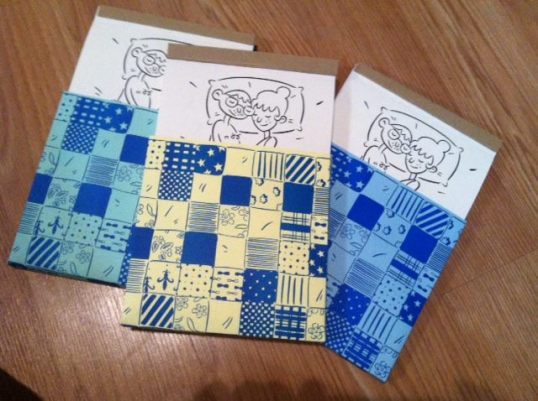
Billing itself as a “micro graphic novella,” 2016’s Twin Bed was the first published cartooning from Paper Rocket Mini Comics proprietor Robyn Chapman in a good number of years, and there’s a fun air of formal experimentation to it throughout : the publication comes packaged in a paper “slipcase” illustrated to look like a quilt that the reader “uncovers” to get at the book itself, and the story is constructed as a series of roughly 100 single-panel-per-page images that feature a static background (that being a guy’s bedroom) with Chapman’s two unnamed protagonists positioned differently over/within said unchanging space. It’s a choice that no doubt saved the cartoonist a little bit of time when it came to drawing the thing, sure, but it’s also a bold and risky one — after all, if the narrative and the characters’ actions aren’t interesting, the whole thing could get pretty old pretty fast.

View original post 709 more words

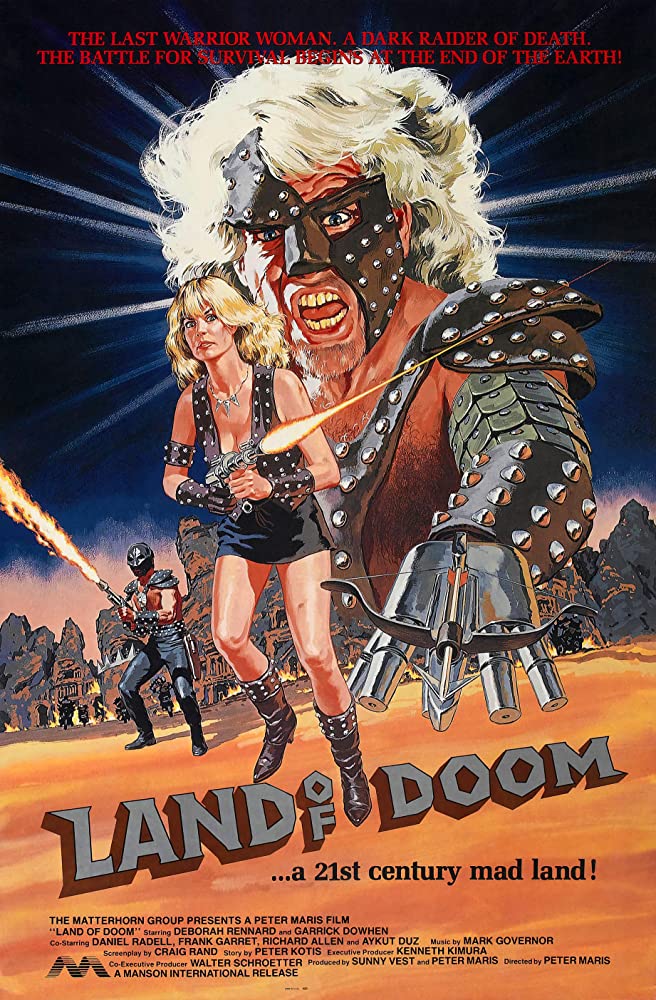
Land of Doom (1986, directed by Peter Maris)


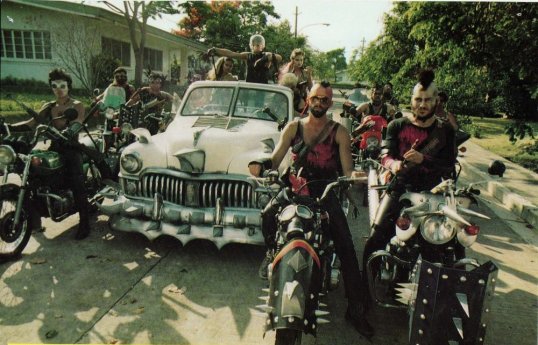
Land of Doom takes place after the “final war.”  If you’ve ever seen an 80s Road Warrior rip-off, you know all about the final war.  It was the war that destroyed society and everyone always says that there’s nothing left to say about it.  Regardless of which film you’re watching, the final war always leads to people getting mohawks, wearing leather, and riding motorcycles.  Phantom of the Opera-style half masks also become popular after the final war.  The world becomes a rough place after it ends.

Land of Doom follows all of the typical post-apocalyptic rules, except that the main warrior is a disillusioned woman instead of a cynical man.  Call it Mad Maxine.  Harmony (Deborah Rennard) is a warrior who is making her way through the desert, searching for a possibly nonexistent paradise.  When Harmony first meets Anderson (Garrick Dowhen), she doesn’t want anything to do with him but then Anderson saves her from a rattlesnake so she is now obligated to let him tag along with her.  It turns out that Anderson has been exiled from another community and the new head of that community, Slater (Daniel Radell), is determined to kill him.  Anderson believes in a world of equality while Slater doesn’t.  It never makes sense for Slater to waste time and resources trying to kill Anderson since Anderson is already voluntarily leaving but I guess the final war destroyed logic along with everything else.

It’s a typical post-apocalyptic romp.  Harmony and Slater run through the desert while being pursued by a bunch of bikers who look like they should be in a Damned cover band.  There’s a lot of stunts and a lot of violence but there’s not a lot of plot or consistency.  It you’re into low-budget Road Warrior rip-offs, it’s a good enough way to pass the time.  Deborah Rennard is a credible heroine as Harmony and everyone else in the cast overacts to such an extent that it’s more fun to watch than it should be.  You may be tempted to compare the film, with its female warrior to Mad Max: Thunder Road but don’t do it.  Land of Doom never puts as much thought into its storyline or its themes as any of the Mad Max films did.  Land of Doom is brainless fun.

It may not be the greatest film ever made about the end of society but it’s sometimes entertaining and it’s probably the best we can hope for after the final war.

4 Shots From 4 Films: Special Ruggero Deodato Edition


4 Shots From 4 Films is just what it says it is, 4 shots from 4 of our favorite films. As opposed to the reviews and recaps that we usually post, 4 Shots From 4 Films lets the visuals do the talking!

Today is the 81st birthday of the great Italian director, Ruggero Deodato!  And that, of course, means that it’s time for….

4 Shots From 4 Films

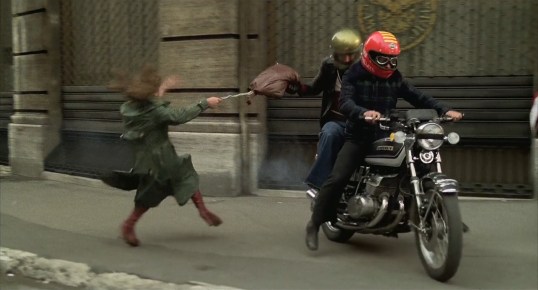
Live Like A Cop, Die Like A Man (1976, dir by Ruggero Deodato)

The House on The Edge of The Park (1980, dir by Ruggero Deodato)

Raiders of Atlantis (1983, dir by Ruggero Deodato)

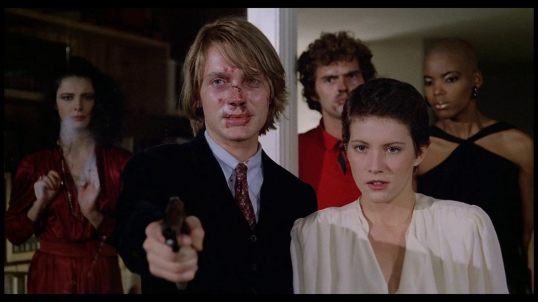
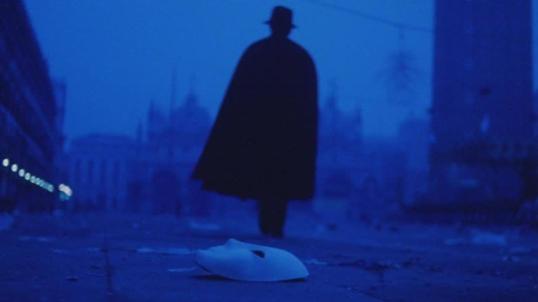
Phantom of Death (1988, dir by Ruggero Deodato)

Scenes That I Love: The Ending of High Noon


119 years ago today, Gary Cooper was born in Helena, Montana.

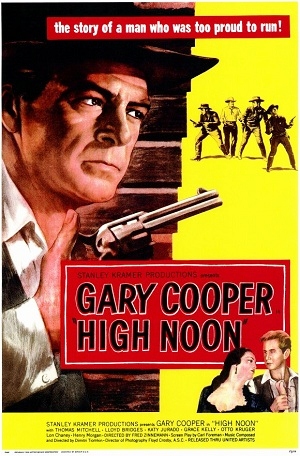
Cooper was an actor who, for many viewers, represented the American ideal.  He played characters who were strong and modest and who refused to compromise their principles.  Though Gary Cooper appeared in many films over the course of his career, he is probably destined to be forever associated with High Noon.  In this classic western, Cooper plays Will Kane, the marshal who finds himself abandoned by almost everyone when a group of killers come to town looking to kill him.  The film is often seen as being a commentary on the 1950s Red Scare.  Cooper, who was a committed anti-Communist and about as conservative as anyone in Hollywood, stood up for the film’s screenwriter, the blacklisted Carl Foreman and threatened to walk off the picture when it appeared that Foreman’s writing credit might be removed.  That was what a huge part of Cooper’s appeal.  He did the right thing, even if it meant standing up for someone with whom he didn’t agree.  There aren’t many Gary Coopers left today, are there?

Below, we have the final scene of High Noon, in which the cowardly townspeople finally come to support Marshal Kane.  Kane, disgusted by their actions, can only throw away his star and leave town.  Even without dialogue, Cooper lets you know exactly what is going through Kane’s mind.  It’s a great scene from a great film featuring a great actor.