I share this video in memory of Carl “Coral” Grimes.
Enjoy.
(With the Oscars scheduled to be awarded on March 4th, I have decided to review at least one Oscar-nominated film a day. These films could be nominees or they could be winners. They could be from this year’s Oscars or they could be a previous year’s nominee! We’ll see how things play out. Today, I take a look at the 1949 best picture nominee, The Heiress!)
 “I have been taught by the masters.”
— Catherine Sloper (Olivia De Havilland) in The Heiress (1949)
I’m not going to spoil too much of the ending of The Heiress, beyond saying that those are the words with which Catherine ends the film. Taken out of context, they may not seem like much. However, after you’ve spent two hours with Catherine, her father, and the man who claims that he’s in love with her, these are perhaps seven of the most chilling words ever uttered. When you hear them, you don’t know if you should cheer or be very, very afraid. Myself, I had both reactions but, then again, I often do.
The Heiress, which is based on a play that’s based on a novel by Henry James, takes place in 19th century New York City. Austin Sloper (Sir Ralph Richardson) is a widely admired and very successful physician. He’s also a very cold man, one who has never recovered from the death of his wife. He lives with his daughter, Catherine (Olivia de Havilland). Catherine is shy and is continually told that she’s plain and boring. She’s devoted to her father, though Austin is cruelly manipulative of her. Catherine, who has never been in a relationship, has pretty much accepted that she’s destined to be alone.
Or, at least, she has until she meets Morris Townsend (Montgomery Clift).
From the first minute that Catherine meets him, Morris seems to be perfect. He’s handsome. He’s intelligent. He’s witty. He’s charming. He’s Montgomery Clift, for God’s sake! For Catherine, it’s love at first sight and Morris says that it’s the same for him. Suddenly, Catherine’s life no longer revolves around her father. Now, she dreams of marrying Morris.
Austin isn’t happy about this. Despite showing his daughter nothing but disdain for most of her life, Austin suddenly become protective of her. He says that Morris only wants to marry her because she stands to come into a great deal of money. To prove his point, he announces that, if Catherine and Morris get married, he will disinherit Catherine and neither she nor her husband will ever get their hands on his money.
How will Morris respond to Austin’s threat? Well, you’ll have to watch the movie to find out and you really should! The Heiress is a great movie, featuring noirish direction from William Wyler and brilliant performances from by de Havilland, Richardson, and Clift. Dr. Sloper may be a monster but Richardson plays him with so much authority that it’s hard to dismiss his worries about Morris, no matter how much you may want to. Montgomery Clift, meanwhile, keeps you guessing about Morris’s intentions. And, finally, the great Olivia de Havilland deservedly won an Oscar for her performance as Catherine Sloper. Over the course of the film, Catherine goes from being a withdrawn wallflower to being a … well, I can’t tell you anymore. I don’t want to spoil the film any more than I already have. The ending will leave you shaken in the best possible way.
The Heiress was nominated for best picture but lost to All The King’s Men.
This is an update to my The Lullaby Preview and Review.
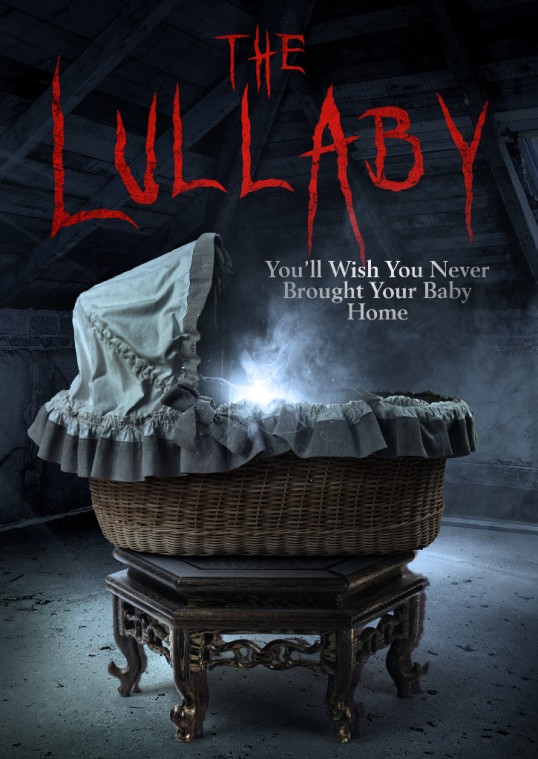
Confirmations of cities offering the limited release for the new supernatural horror film The Lullaby from South African filmmaker Darrel James Roodt (“Sarafina!“), opens March 2, 2018 in the following theaters:
LA – Laemmle Music Hall
NY – Cinema Village
Atlanta – Plaza Theater
Cleveland – Tower City Cinemas
San Francisco – The Roxie
Miami – Cinema Paradiso
Chicago – Facets Cinema
Boston – Apple Cinemas
Dallas – AMC Grapevine 30
Phoenix – AMC Arizona Center 24
The Lullaby also will be available on the same day, March 2, 2018, on VOD.
Credits:
Uncork’d Entertainment presents a Phoenix Film with Valhalla Productions Directed by Darrell James Roodt
You can check out the trailer here:
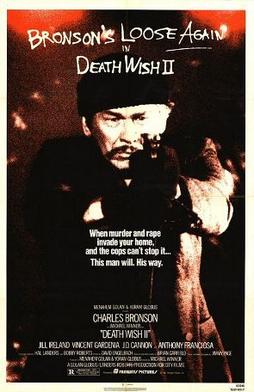 To quote John McClane, “How can the same shit happen to the same guy twice?”
It has been eight years since Paul Kersey (Charles Bronson) lost his wife and single-handedly cleaned up New York City. The first Death Wish ended with Paul in Chicago, preparing to gun down a new group of criminals. I guess Chicago didn’t take because, at the start of Death Wish II, Paul is in Los Angeles and he’s working as an architect again. He has a new girlfriend, a bleeding heart liberal reporter named Geri (Jill Ireland, Bronson’s real-life wife) who is against the death penalty and who has no idea that Paul used to be New York’s most notorious vigilante. Having finally been released from the mental institution, Carol (Robin Sherwood) is living with her father but is now mute.
Crime rates are soaring in Los Angeles and why not? The legal system is more concerned with the rights of the criminals than the victims and Paul has retired from patrolling the streets. But when a group of cartoonish thugs rape and kill his housekeeper and cause his daughter to fall out of a window while trying to escape them, Paul picks up his gun and sets out for revenge.
Death Wish II was not the first sequel to Death Wish. Brian Garfield, the author of the novel on which Death Wish was based, never intended for Paul to be seen as a hero and was disgusted by what he saw as being the film’s glorification of violence. As “penance,” he wrote a sequel called Death Sentence, in which Paul discovered that he had inspired an even more dangerous vigilante. When Menahem Golan and Yoram Globus bought the rights to produce a second Death Wish film, they decided not to use Garfield’s sequel and instead went with a story that was co-written by Golan.
It’s the same basic story as the first film. Again, Paul is a mild-mannered architect who is a liberal during the day and a gun-toting reactionary at night. Again, it’s a home invasion and a death in the family that sets Paul off. Again, Paul gets help from sympathetic citizens who don’t care that the police commissioner (Anthony Franciosa) wants him off the streets. Jeff Goldblum played a rapist with a switch blade in the first film. This time, it’s Laurence Fishburne who fills the role. (Fishburne also carries a radio, which he eventually learns cannot be used to block bullets.) Even Detective Ochoa (Vincent Gardenia) returns, coming down to Los Angeles to see if Paul has returned to his old ways.
The main difference between the first two Death Wish films is that Death Wish II is a Cannon film, which means that it is even less concerned with reality than the first film. In Death Wish II, the criminals are more flamboyant, the violence is more graphic, and Paul is even more of a relentless avenger than in the first film. In the first Death Wish, Paul threw up after fighting a mugger. In the second Death Wish, he sees that one of the men who raped his daughter is wearing a cross, leading to the following exchange:
“Do you believe in Jesus?”
“Yes, I do.”
“Well, you’re going to meet him.”
BLAM!

Death Wish II is the best known of the Death Wish sequels. It made the most money and, when I was a kid, it used to show on TV constantly. The commercials always featured the “You believe in Jesus?” exchange and, every morning after we saw those commercials, all the kids at school would walk up to each other and say, “You believe in Jesus? Well, you’re going to meet him.” It drove the teachers crazy.
Overall, Death Wish II is a lousy film. Michael Winner, who was always more concerned with getting people into the theaters than anything else, directs in a sledgehammer manner that makes his work on the first film look subtle. He obscenely lingers over every rape and murder, leaving no doubt that he is more interested in titillating the audience than getting them to share Paul’s outrage. The script is also weak, with Geri so poorly written that she actually gets more upset about Paul going out at night than she does when she learns that Paul’s daughter has died. When Paul sets out to track down the gang, his method is to merely wander around Los Angeles until he stumbles across them. It doesn’t take long for Paul to start taking them out but no one in the gang ever seems to be upset or worried that someone is obviously stalking and killing them.
There are a few good things about the film. Charles Bronson was always a better actor than he was given credit for and it’s always fun to watch Paul try to balance his normal daily routine with his violent night life. Whenever Geri demands to know if he’s been shooting people, Paul looks at her like he is personally offended that she could possibly think such a thing. Also, the criminals themselves are all so cartoonishly evil that there’s never any question that Paul is doing the world a favor by gunning them down. For many otherwise sensible viewers, a movie like Death Wish II may be bad but it is also cathartic. It offers up a simple solution to a complex issue. In real life, a city full of Paul Kerseys would lead to innocent people getting killed for no good reason. But in the world of Death Wish II, no one out after nightfall is innocent so there’s no need to worry about shooting the wrong person.
Finally, the film’s score was written by the legendary Jimmy Page. The studio wanted Isaac Hayes to do the score but Winner asked his neighbor, Page. Page took the film, retreated into his studio, and returned with a bluesy score that would turn out to be the best thing about the movie. The soundtrack was the only one of Page’s solo projects to be released on Led Zeppelin’s record label, Swan Song Records.
Tomorrow, Bronson returns with Death Wish 3!

Artist Unknown
Happy Levi Strauss Day!
(No joke, it’s a real holiday.)
Who would win in a fight between Carl Sagan and Zeus? Personally, I’m putting my money on Zeus because he was like a God and all and I think they pretty much win every fight they get into.
That, however, has nothing to do with this wonderfully strange little video, which I personally think deserves more attention than it has gotten. So, I’m sharing it here. Don’t ask me to explain the video. I just like the imagery and the overall surreal feel of it all.
Enjoy!

So, has everyone seen the latest episode of The Walking Dead? If not, why are you reading this review? I ask because, on another site that I write for, I’ve got two people bitching at me for revealing too many spoilers about the shows that I review and, as a result, I felt the need to post an apology to those people. As far as apologies go, it was fairly passive-aggressive and I’d hate to have to be that insincere on this site. So, in other words, if you haven’t watched the latest episode of The Walking Dead, don’t read this review. Thanks!
(Okay, I think I’ve rambled on long enough that anyone who didn’t want spoilers should have left by now.)
On Sunday night, the eighth season of AMC’s The Walking Dead resumed and oh my God, I have got such mixed feelings about what I just watched. Before I go any further, allow me to share something that I tweeted back in April of 2017:
In other words, I can’t say that I’m shocked that Carl’s dead. In fact, to a certain extent, I kind of respect the show for following through as opposed to coming up with some last-minute contrivance to allow Carl to live. At the same time, I do think that the death of Carl has robbed the show of some potentially intriguing future storylines. In the comic, Carl is still alive and he’s even bonded a bit with Negan. During Season 7, the show seemed to be laying the foundation for that storyline but apparently, Negan’s going to have to bond with some other kid now. Maybe Henry. Maybe Judith.
I guess the main thing that bothers me about Carl’s death is that I really do feel that it was mostly due to the fact that the show’s pace has slowed down to such an extent that Chandler Riggs was getting too old to play the role. The Walking Dead has been on the air for 8 seasons but how many years have actually passed in the show? It’s hard to say but really, it doesn’t seem like Carl should be any older than 14 or maybe 15. Meanwhile, Chandler Riggs is closing in on 19. It’s hard not to feel that the show’s producers decided to kill Carl off rather than maybe just wrap up a few storylines and have season 9 open with a “Four years after the defeat of the Saviors” title card.
Myself, I’ve frequently gotten annoyed with Carl as a character, even though I’ve always appreciated Chandler Riggs’s performance. That said, Carl was one of the few characters left on the show with room to grow. Rick is never going to change. If Negan does become the friendly gardener that we saw in Carl’s fantasy, it’s going to have more to do with expedience than anything else. Carl, though, was still discovering who he was and what he believed. The majority of the characters have spent the last three or four seasons in a rut. By virtue of being young, Carl was one of the few characters who actually had a chance of breaking out of that rut.
I mean, to be absolutely honest, I always assumed that the show would end with Carl shooting Rick before he could reanimate. If you go all the way back to season 1, that’s the ending that the show has appeared to be logically building up to. Now, I guess Judith will have to do it.

As for the episode itself … again, my feelings were mixed. This episode was determined to wring every last drop of emotion out of Carl’s passing. When it worked, it was largely due to the performances of Riggs, Danai Gurira, and the always underrated Andrew Lincoln. At the same time, there was a part of me that started to resent just how much the show dragged out Carl’s death. I know that AMC likes to do “super-sized” episodes of The Walking Death but, in this case, I think this episode would have been more effective if it had just been an hour. Yes, that single gunshot was heart-rendering but, up until I heard it, there was a part of me that feared the show was planning to drag Carl’s death out over the entire rest of the season.
While Carl was dying, Carol, Morgan, and a few other people went off to rescue Ezekiel. Gavin, who was always one of the most obnoxious of the Saviors, is now dead and yay for that. Morgan has apparently decided that he’s okay with killing people again. Morgan also apparently now has Jason Voorhees-style super strength.
It wasn’t a bad episode, though it certainly didn’t carry the power that it would have carried if it had happened during the fourth or fifth season. On the one hand, I’ve always appreciated the fact that anyone can die on The Walking Dead. On the other hand, characters die so frequently (and then pop up on the Talking Dead to say goodbye) that it’s now easy to get cynical about the whole thing.
In fact, it may be too early to say whether The Walking Dead handled Carl’s death the right way. It depends on how this all plays out. Will the show use Carl’s death as an excuse to go off in an unexpected direction or will we promptly get back to Negan chuckling and Rick giving speeches? I’m actually looking forward to next week, just because I’m interested in seeing which Rick we’re going to get. Are we going to get the crazy Rick who appeared after Lori died or are we going to get the catatonic Rick who showed up after Negan executed Abraham and Glenn? Or maybe it’ll be the return of the Stoic Rick who shot zombie Sophia because he knew he had no other choice. Which Rick will it be?
We’ll find out next week … hopefully.
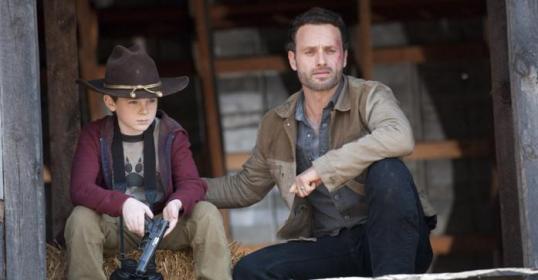
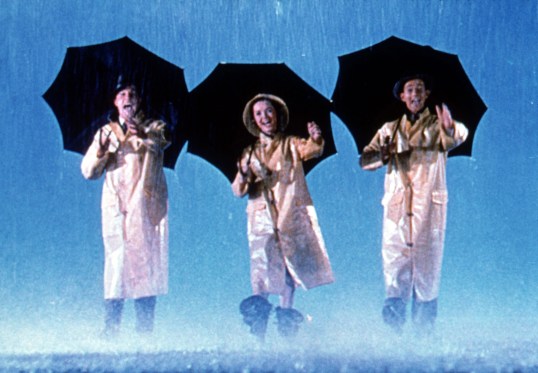
As I sit here writing this, it has finally stopped raining! Every other day this week, it rained. By the end of Thursday night, my backyard literally looked like a swamp. Usually, when the weather gets weird in Texas, it leads to me getting a lot written but that didn’t happen this week. I was distracted by the combination of the Olympics and Celebrity Big Brother. Fortunately, both of those are now over.
Anyway, here’s my week in review:
Movies That I Watched
TV Shows That I Watched

Books That I Read
Music To Which I Listened
Links From Last Week
Links From The Site
For me, anyway, next week is going to be all about reviewing films that have been nominated for Best Picture throughout the years!
Have a great week!
(Want to see what I watched and read last week? Click here!)

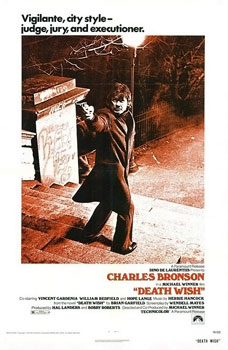 To quote “Dirty” Harry Callahan, “I’m all broken up about his rights.”
In 1972, a novel by Brian Garfield was published. The novel was about a meek New York City accountant named Paul Benjamin. After Paul’s wife is murdered and his daughter is raped, Paul suffers a nervous breakdown. A self-described bleeding heart liberal, Paul starts to stalk the streets at night while carrying a gun. He is hunting muggers. At first, he just kills the muggers who approach him but soon, he starts to deliberately set traps. Sinking into insanity, Paul becomes just as dangerous as the men he is hunting. Garfield later said that the book was inspired by two real-life incidents, one in which his wife’s purse was stolen and another in which his car was vandalized. Garfield said that his initial response was one of primitive anger. He wondered what would happen if a man had these rageful thoughts and could not escape them.
The title of that novel was Death Wish. Though it was never a best seller, it received respectful reviews and Garfield subsequently sold the film rights. At first, Sidney Lumet was attached to direct and, keeping with Garfield’s portrayal of Paul Benjamin, Jack Lemmon was cast as the unlikely vigilante.
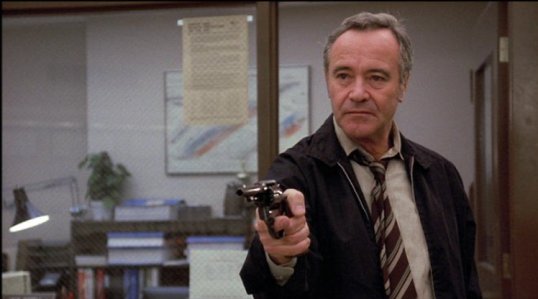
Lumet, ultimately, left the project so that he could concentrate on another film about crime in New York City, Serpico. When Lumet left, Jack Lemmon also dropped out of the film. Lumet was replaced by Michael Winner, a director who may not have been as thoughtful as Lumet but who had a solid box office record and a reputation for making tough and gritty action films.
Winner immediately realized that audiences would not be interested in seeing an anti-vigilante film. Instead of casting an actor with an intellectual image, like Jack Lemmon, Winner instead offered the lead role (now named Paul Kersey and no longer an accountant but an architect) to Charles Bronson. When Winner told Bronson that the script was about a man who shot muggers, Bronson replied, “I’d like to do that.”
“The script?” Winner asked.
“No, shoot muggers.”
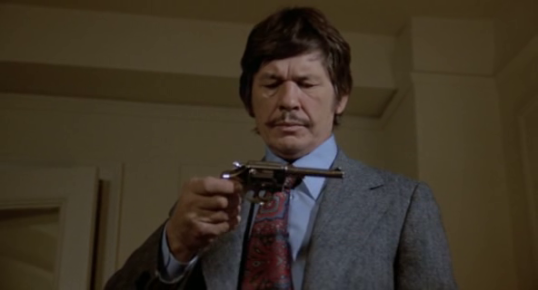
At the time that he was cast, Charles Bronson was 52 years old. He was the biggest star in the world, except for in America where he was still viewed as being a B-talent at best. Bronson was known for playing tough, violent men who were not afraid to use violence to accomplish their goals. (Ironically, in real life, Bronson was as much of an ardent liberal as Paul Kersey was meant to be at the beginning of the movie.) Among those complaining that Charles Bronson was all wrong for Paul Kersey was Brian Garfield. However, Bronson accepted the role and the huge box office success of Death Wish finally made him a star in America.
To an extent, Brian Garfield was right. Charles Bronson was a better actor than he is often given credit for but, in the early scenes of Death Wish, he does seem miscast. When Paul is first seen frolicking with his wife (Hope Lange) in Hawaii, Bronson seems stiff and awkward. In New York City, when Paul tells his right-wing colleague (William Redfield) that “my heart does bleed for the less fortunate,” it doesn’t sound natural. But once Paul finds out that his wife has been murdered and his daughter, Carol (Kathleen Tolan), has been raped, Paul gets mad and Bronson finally seems comfortable in the role.
In both the book and the original screenplay, both the murder and the rape happened off-screen. Never a subtle director, Winner instead opted to show them in a brutal and ugly scene designed to get the audience as eager to shoot muggers as Bronson was. Today, the power of the scene is diluted by the presence of Jeff Goldblum, making his screen debut as a very unlikely street thug. Everyone has to start somewhere and Goldblum got his start kicking Hope Lange while wearing a hat that made him look like he belonged in an Archie comic.

With his wife dead and his daughter traumatized, Paul discovers that no one can help him get justice. The police have no leads. His son-in-law (Steven Keats) is a weak and emotional mess. (As an actor, some of Bronson’s best moments are when Paul makes no effort to hide how much he loathes his son-in-law.) When a mugger approaches Paul shortly after his wife’s funeral, Paul shocks himself by punching the mugger in the face.
When Paul is sent down to Arizona on business, he meets Ames Jainchill (Stuart Margolin), a land developer who calls New York a “toilet” and who takes Paul to see a wild west show. Later at a gun club, Paul explains that he was a conscientious objects during the Korean War but he knows how to shoot. His father was a hunter and Paul grew up around guns. When Paul returns to New York, Ames gives him a present, a revolver. Paul is soon using that revolver to bring old west justice to the streets of New York City.
As muggers start to show up dead, the NYPD is outraged that a vigilante is stalking the street. Detective Frank Ochoa (Vincent Gardenia) is assigned to bring the vigilante in. But the citizens of New York love the vigilante. Witnesses refuse to give an accurate description of Paul. When Paul is wounded, a young patrolman (Christopher Guest, making almost as unlikely a film debut as Jeff Goldblum) conspires to keep Paul’s revolver from being turned over as evidence.

The critics hated Death Wish, with many of them calling it an “immoral” film. Brian Garfield was so disgusted by how Winner changed his story that he wrote a follow-up novel in which Paul is confronted by an even more dangerous vigilante who claims to have been inspired by him. Audiences, however, loved it. Death Wish was one of the top films at the box office and it spawned a whole host of other vigilante films.
Death Wish is a crude movie, without any hint of subtlety and nuance. It is also brutally effective, as anyone who has ever felt as if they were the victim of a crime can attest. In a complicated and often unfair world, Kersey’s approach may not be realistic or ideal but it is emotionally cathartic. Watching Death Wish, it is easy to see why critics hated it and why audiences loved it.
It is also to see why the movie made Bronson a star. Miscast in the role or not, Bronson exudes a quiet authority and determination that suggests that if anyone could single-handedly clean-up New York City, it’s him. An underrated actor, Bronson’s best moment comes after he punches his first mugger and he triumphantly reenters his apartment. After he commits his first killing, Bronson gets another good scene where he is so keyed up that he collapses to the floor and then staggers into the bathroom and throws up. Garfield may have complained that the Death Wish made his madman into a hero but Bronson’s best moments are the ones the suggest Paul has gone mad. The real difference between the book and the movie is that the movie portrays madness as a necessary survival skill.
This Friday, a new version of Death Wish will be playing in theaters. Directed by Eli Roth, this version starts Bruce Willis as Dr. Paul Kersey. Will the new Death Wish be as effective as the original? Judging from the trailer, I doubt it. Bruce Willis or Charles Bronson? I’ll pick Bronson every time.

Tomorrow, Bronson returns in Death Wish II!
So, this year I am making a sincere effort to review every film that I see. I know I say that every year but this time, I really mean it. Unfortunately, over the past two weeks, real life has interfered with my movie reviewing, if not my move watching.
So, in an effort to catch up, here are four quick reviews of some of the movies that I watched over the past two weeks!

Michael Keaton as the President of the United States!? Now, that’s a great idea. Michael Keaton plays President Mackenzie. First Daughter was made long before Birdman so Michael Keaton doesn’t really have a huge part but, whenever he does appear, he is totally believable as a world leader. You buy the idea that this guy could win an election and that he’d probably be a good (if not necessarily a great) President. Someone really needs to make another movie where Michael Keaton plays the President. Maybe President Birdman. Just don’t give it to Inarritu to direct because he’ll make it too political…
Anyway, the majority of the film is about Katie Holmes as the President’s daughter, Samantha. Samantha has been accepted to a college in California. She’s excited because it means that she’ll finally be able to have a life outside of the White House. The President is concerned because he loves his daughter and he knows that, if she makes any mistakes in California, his political opponents will try to use her against him. Samantha goes off to college and tries to have a good (but rather chaste) time. Making that somewhat difficult is her secret service entourage. Fortunately, Samantha meets a guy (Marc Blucas) who loves her for who she is and not because her father is the President.
It’s all pretty silly and shallow but I have to admit that I get nostalgic whenever I see this movie. Much like From Justin To Kelly, it’s definitely a film from a more innocent and less angry time. To date, it’s also the last film to be directed by actor Forest Whitaker.

Struggling financially, Kelly (Lara Daans) is forced to move back to her hometown and move in with her sister (Sheila McCarthy). Until she got married and gave up that part of her life, Kelly was once an up-and-coming figure skater. Fortunately, her daughter, Mattie (Michaela du Toit), has inherited her mother’s talent. However, a serious injury shook Mattie’s confidence. Now, she says she doesn’t want to skate anymore. Still, she’s willing to accept a job from Mercury (Elvis Stojko) at the local rink and it’s not too long before, under Mercury’s guidance, Mattie is skating once again. Mattie also befriends another skater, Heather (Taylor Hunsley). Heather happens to be the daughter of Rose (Natasha Henstridge), who was once in love with Kelly’s father…
It sounds like the set-up of a melodramatic Lifetime movie but actually, Ice Girls is a sweet-natured film about two ice skaters, one who has a mother who is too protective and the other who has a mother who is too driven. In the end, both of them end up skating for themselves and not their mothers and that’s a good message for the film’s target audience of young skate fans. The majority of the cast is made up of actual ice skaters, so the skating footage is pretty impressive. It’s a predictable movie but I enjoyed it when I watched it on Netflix.
 Raising the Bar
I also watched this one on Netflix, a day after I watched Ice Girls. (I was in an Olympics sort of mood, even though neither film took place at the Olympics.) Raising the Bar feels a lot like Ice Girls, except that the ice skaters were now gymnasts and instead of relocating to Toronto, the family in Raising the Bar relocates all the way to Australia. Once in Australia, Kelly (Kelly Johnson) finds the courage to re-enter gymnastics and ends up competing against her former teammates.
Kelly Johnson gives a good performance in the lead role. Though it may be predictable, Raising the Bar is an effective and sweet-natured family film. Perhaps the most interesting thing about watching the film was that I quickly found myself rooting against the American team. Australia all the way!
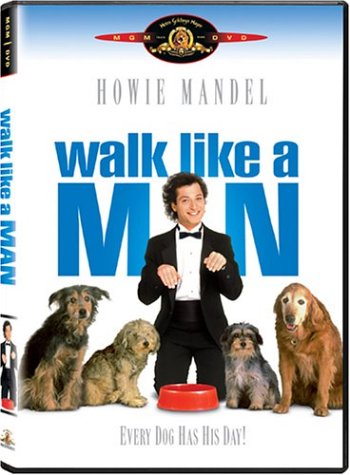
Oh, what sweet Hell is this?
Okay, I’m going to try to explain what happens in this movie. You’re not going to believe me. You’re going to think that I’m just making all of this up. But I swear to a God … this is an actual movie.
When he was a baby, Boba Shand (Howie Mandel) got separated from his family. His mother and his father assumed that he was gone forever but what they didn’t know was that Bobo was found and raised by a pack of wild dogs. For twenty years, Bobo lives as a dog. Then he’s discovered by Penny (Amy Steel), an animal researcher who tries to teach Bobo how to be a human. However, as time passes, Penny comes to realize that maybe she’s making a mistake trying to change Bobo. Bobo is innocent and child-like and obsessed with chasing fire engines. When he has too much to drink, he runs around on all fours. And … PENNY’S IN LOVE WITH HIM!
Seriously, she’s in love with a man who thinks he’s a dog.
However, Bobo stands to inherit a fortune and his evil brother (Christopher Lloyd) is planning on having him committed. Penny has to prove that Bobo is human enough to manage his own affairs while also respecting his desire to continue living like a dog.
I’m serious. This is a real movie.
Anyway, making things even worse is the performance as Howie Mandel. Mandel has always been a rather needy performer and the role of a man who thinks he’s a dog only serves to bring out his worst instincts. Remember when Ben Stiller played Simple Jack in Tropical Thunder? Well, Mandel’s performance is kinda like that only worse. At one point, Bobo walks up to a mannequin in a mall and says, “I have to go pee pee. Come with me,” and I nearly threw a shoe at the TV. Oh my God, it was so bad.
The main problem with Walk Like A Man is that it wants to have it both ways. It wants to be a wild comedy about Howie Mandel chasing fire engines but it also makes us want to tear up when Penny explains why Bobo should be allowed to live as a dog.
All in all, it’s a really bad movie. And yes, it does actually exist.
 Through the Shattered Lens