Have you ever wanted to know how Leatherface from The Texas Chainsaw Massacre became Leatherface?
No, of course not.
But here’s a movie about it, anyway.
Have you ever wanted to know how Leatherface from The Texas Chainsaw Massacre became Leatherface?
No, of course not.
But here’s a movie about it, anyway.
Here’s the trailer for Goodbye, Christopher Robin!
For a while, I’ve been predicting that this film could be an Oscar nominee. It’s a biopic. It’s about British people. And it’s about war. With Dunkirk and Darkest Hour also probable contenders, it’s looking like next year’s Oscar telecast could very well be dominated by the British going to war.
This one opens on October 13th and it will provide some counter programming for all the ghost movies and found footage rip-offs.
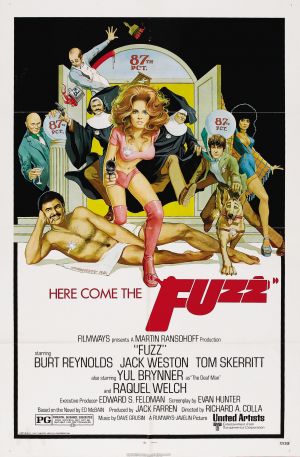 Detective Eileen McHenry (Raquel Welch) has just been given her new assignment and she is about to find out that there is never a dull day in the 87th Precinct. How could there be when the precinct’s top detectives are played by Burt Reynolds, Tom Skerritt, and Jack Weston? Or when Boston’s top criminal mastermind is played by Yul Brynner? There is always something happening in the 8th Precinct. Someone is stealing stuff from the precinct house. Someone else is attacking the city’s homeless. Even worse, Brynner is assassinating public officials and will not stop until he is paid a hefty ransom!
Based on the famous 87th Precinct novels that Evan Hunter wrote under the name Ed McBain, Fuzz has more in common with Robert Altman’s MASH than The French Connection. (Skerritt and Bert Remsen, who plays a policeman in Fuzz, were both members of Altman’s stock company.) Much like Altman’s best-regarded films, Fuzz is an ensemble piece, one that mixes comedy with tragedy and which features several different storylines playing out at once. Scenes of homeless men being set on fire are mixed with scenes of Reynolds and Weston going undercover as nuns. (Of course, Burt does not shave his mustache.) Since it was written by Hunter, the film’s script comes close to duplicating the feel of the 87th Precinct novels. Unfortunately, Richard A. Colla was a television director and Fuzz feels more like an extended episode of Police Story or Hill Street Blues than a movie. Unlike Altman’s best films, Fuzz‘s constantly shifting tone and the mix of comedy and drama often feels awkward. Fortunately, Fuzz does feature good performances from Reynolds, Westin, Skerritt, and Brynner, along with a great 70s score from Dave Grusin. Raquel Welch is never believable as cop but she’s Raquel Welch so who cares?
Happy International Cat Day from the Shattered Lens!
4 Shots From 4 Films
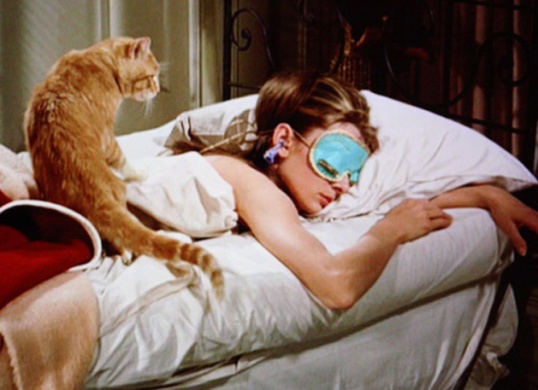
Breakfast at Tiffany’s (1961, dir by Blake Edwards)

Inferno (1980, dir by Dario Argento)
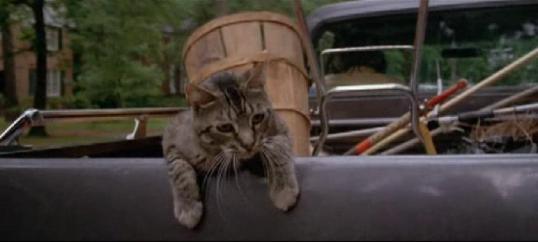
Cat’s Eye (1985, dir by Lewis Teague)
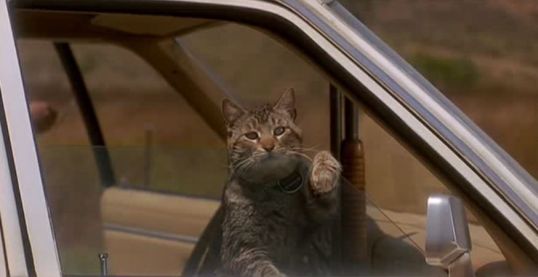
Sleepwalkers (1992, dir by Mick Garris)
Catnip party at my place!

by Samson Pollen
By the time you read this, I will probably be having a tube put down my throat to measure pressure caused by my esophagus. I might also have another that I have to wear for 24 hours as I try to stress test my body’s acid reflux. This should be an interesting couple of days. I probably won’t get back to these posts for a little while. Since there are tubes involved, I might as well do another music video by The Tubes.
I already mentioned it back when I did She’s A Beauty, but The Tubes helped get MTV on their feet. This video was in heavy rotation on MTV. It wasn’t on the radio. Yet, they found out that in Tulsa, Oklahoma, where they had a high concentration of cable subscribers, The Tubes were selling in record stores. This gave MTV evidence that their network could sell records.
Since last time I didn’t quote the section about this from the book, I Want My MTV, here it is:
Bob Pittman [one of the founders of MTV]: We needed to be very scientific about the impact MTV was having on the record industry. So I sent John Sykes and Tom Freston to Tulsa, Oklahoma. And one night, Sykes and Freston called me very excited. They’d been to a record store, and the store had suddenly sold out of the Tubes, and we were the only people playing the Tubes, so it had to be because of us. We had our first evidence that MTV was selling records.
Songfacts also tells this story:
This was the song that proved the power of MTV to sell records. The network launched on August 1, 1981, and “Talk To Ya Later” was in hot rotation. Very few radio stations played the song (or anything by The Tubes) in America, but a few months after MTV went on the air, Tubes records were selling out in Tulsa, Oklahoma. At the time, you couldn’t get MTV in New York or Los Angeles, but lots of people had cable in Tulsa and the cable system carried it. Local radio wasn’t playing The Tubes, so MTV was the only explanation for the sales surge. The network used this information to convince record companies that they had to make music videos (delivered to MTV free of charge, of course) to promote their artists, and many did.
When you go to listen to the video, then you’ll hear something weird. For some reason, the volume is low for awhile, and then goes up for no reason that I could figure out. I have no idea if that was intentional, or a mistake made when they put this video up.
I don’t want to talk about Russell Mulcahy for the umpteenth time. The song speaks for itself, and the video sets the story in a chaotic TMZ-like fashion. My favorite part of the video is the insertion of stills that are cut into the video–a moment that people will see, but without context.
Hopefully, this whole thing won’t be too hard, and I can get back to these posts sooner rather than later.
Enjoy!
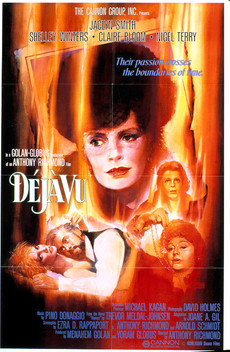 Damn, son. I’ve seen some bad movies before but Deja Vu is something else altogether.
Around the mid-80s, Menahem Golan and Yoram Globus decided to prove that Cannon Films was capable of doing more than making movies about Chuck Norris refighting the war in Vietnam. Golan and Globus had already made money, now they wanted respect. Teaming up with respected directors (Robert Altman directed an adaptation of Sam Shepard’s Fool For Love for them) and casting actors who had slightly more range than Chuck Norris or Reb Brown, Cannon tried to go the prestige route. Some of the Cannon’s quality movies actually were good movies. The same year that Deja Vu came out, Cannon’s Runaway Train scored several Oscar nominations. However, Deja Vu is a far more representative example of a Cannon prestige film. It may have had higher production values than Missing in Action but it was still a Golan/Globus production through and through.
Nigel Terry (best known for playing King Arthur in John Boorman’s Excalibur) plays Michael, a screenwriter who views a documentary about a famous and tragic ballerina and is shocked to discover that she looks just like his actress fiancée. (Both roles are played by Jaclyn Smith.) Michael is even more shocked when it turns out that he looks exactly like the ballerina’s husband. Convinced that his girlfriend is the reincarnation of the ballerina, Michael researches her life and murder. Meanwhile, his fiancée starts to act strangely.
Deja Vu starts out a merely mediocre, slowly paced and miscast. (There is no chemistry whatsoever between Nigel Terry and Jaclyn Smith.) But then Shelley Winters shows up, playing a Russian psychic named Olga Nabokova. As soon as Winters started to deliver her lines in one of the least convincing Russian accents that I have ever heard, Deja Vu made the leap from being merely bad to being a cinematic trainwreck. While Terry and Smith sleepwalk through their roles, Winters and, later, Claire Bloom (cast as the ballerina’s mother) chew up every piece of scenery that they can get their hands on. Though the plot may be so predictable that it will cause viewers to have deja vu of their own, it must be said that, eventually, Deja Vu becomes so bad and misjudged that it is impossible to look away. Golan and Globus may have had Oscars in their eyes when they decided to produce this prestige pic but instead, they won the laughter of anyone who comes across it on TV.
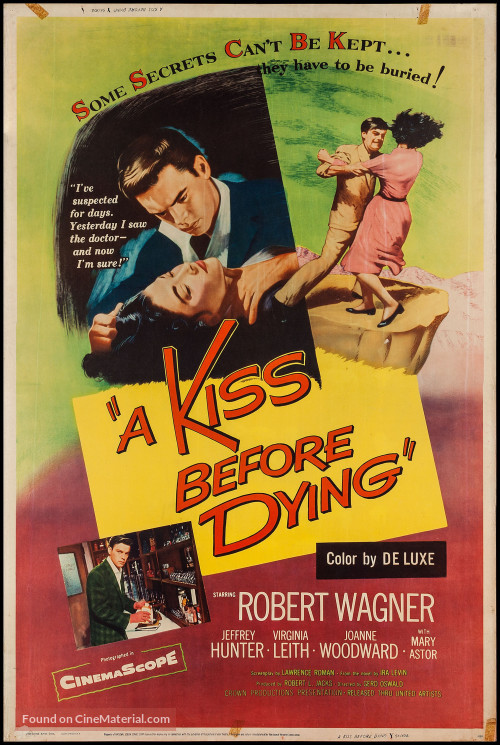
A KISS BEFORE DYING is part soap opera, part film noir, and 100% 50’s kitsch! Based on the best selling debut novel by Ira Levin (who went on to give us ROSEMARY’S BABY and THE STEPFORD WIVES), it’s also the debut of director Gerd Oswald (who went on to give us AGENT FOR HARM and BUNNY O’HARE !). Lawrence Roman’s screenplay has some suspense, but his characters are all pretty dull and dumb, except for Robert Wagner’s turn as a charmingly sick sociopath.

Wagner is college student Bud Corliss, from the wrong side of the tracks, dating rich but naïve Dorie Kingship (Joanne Woodward) to get his hands on dad’s copper mine loot. And when I say naïve I’m not just whistling Dixie; this girl’s downright dense! Bud, after learning she’s pregnant, decides the best thing to do is not marry her, but bump her off. He whips up some poison…
View original post 563 more words
The cover below were all done by an artist named Samson Pollen. As is so often the case with the illustrators of the pulp era, I could not find much biographical information about him so his work will just have to speak for itself:



by Les Edwards

 Through the Shattered Lens