The Fabulous Forties #38: The Devil Bat (dir by Jean Yarbrough)


1940_devil_bat_012

The 37th film in Mill Creek’s Fabulous Forties box set was 1940’s The Devil Bat, which Gary Loggins reviewed on this site back in October.  Since, for the most part, I agree with Gary’s review, I’m going to recommend that you go read it and then I’ll just add a few thoughts of my own.

The Devil Bat is usually described as being one of the films that Bela Lugosi made during his decline, even though he made it just a year after appearing in a supporting role in the Oscar-nominated Ninotchka.  Lugosi plays Dr. Paul Carruthers, a small-town chemist who uses radiation to create a gigantic bat that he unleashes on everyone who he feels has wronged him.  The bat targets anyone who makes the mistake of wearing an aftershave lotion that Carruthers has created.

I would argue that there is a hint of genius to be found within The Devil Bat.

First off, there’s the fact that the giant bat is so clearly fake that it actually becomes rather charming.  Wisely, the film makes no effort to convince you that the bat is real.  Whenever that big, fake bat is lowered in on a bunch of often-visible wires, it works as almost a Brechtian alienation device.  In much the same way that Godard used jump cuts in Breathless, Devil Bat uses that big, fake bat to remind the audience that they are watching a film.  As a result, the audience has no choice but to think about the conventions of the horror genre and how their own world view has been shaped by watching movies like Devil Bat.

The other hint of genius is the satirical masterstroke of casting Bela Lugosi as a small town chemist.  Lugosi remains Lugosi, regardless of what role he plays.  When the film’s characters accept, without even a second glance, that Bela Lugosi, with his thick accent and his theatrical acting style, is a humble suburbanite, the film becomes a perhaps inadvertent satire of American conformity.

Needless to say, Lugosi was always a far better actor than he has ever been given credit for being.  In The Devil Bat, he plays Dr. Carruthers with a weary sense of resignation.  Carruthers never becomes a standard evil villain.  Instead, he’s a man who has been so beaten down by life that he now see no other option beyond using a giant bat to kill those who he feels has betrayed him.  Much as he would in Ed Wood’s Bride of the Monster, Lugosi brings an almost redemptive sadness to his mad scientist.

The end result is that poor, misunderstood and underestimated Bela elevates the entire film.
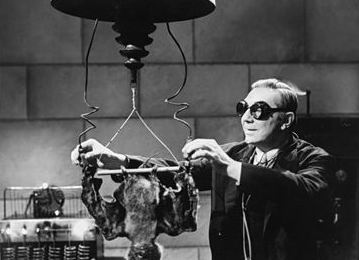
db

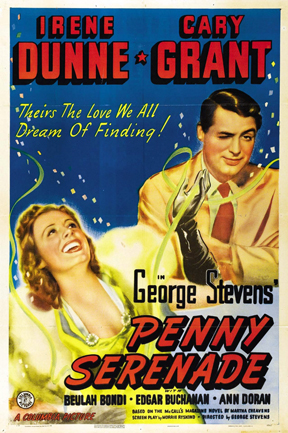
The Fabulous Forties #37: Penny Serenade (dir by George Stevens)


Penny_Serenade_1941_Poster

How many tears can be jerked by one tear jerker?

How melodramatic can one melodrama get?

These are the type of questions that I found myself considering as I watched the 36th film in Mill Creek’s Fabulous Forties box set, 1941’s Penny Serenade.

Penny Serenade opens with Julie (Irene Dunne) announcing that she’s planning on leaving her husband, Roger (Cary Grant).  Fortunately, before Julie goes through with her plan, she listens to a song called You Were Meant For Me.  Perhaps not coincidentally, the song is included on an album called The Story Of A Happy Marriage.  As she stares at the spinning vinyl, Julie starts to have flashbacks!

No, not flashbacks of the LSD kind.  (Though, interestingly enough, Cary Grant was reportedly a big fan of LSD…)  Instead, she has flashbacks of her marriage to Roger.  We see how she first met Roger while she was working in a music store.  Roger stopped by the store to tell her that a record was skipping and it was love at first sight.  However, Roger had no interest in getting married.  Or, at the least, he didn’t until Julie opened up a fortune cookie and read the fortune: “You get your wish — a baby!”

Julie continues to stare at the spinning record and we discover that eventually, she and Roger did get married.  Julie did get pregnant but, as the result of an earthquake, she lost the baby.  (Curse you, fortune cookie!  CURSE YOU!)  Meanwhile, Roger took over a small town newspaper and revealed himself to have absolutely no idea how to handle money.

Because of the earthquake, Julie will never be able to have a child.  (DAMN YOU, FORTUNE COOKIE!  DAMN YOU FOR YOUR LIES!)  However, they can still adopt!  She writes to Miss Oliver (Beulah Bondi), the head of the local orphanage.  Julie demands to be given a baby with “blue eyes and curly hair.”  Fortunately, Miss Oliver apparently has a surplus of curly-haired, blue-eyed babies but she’s still reluctant to approve the adoption.  After all, Julie is such a terrible housekeeper!  However, she is impressed by how much both Julie and Roger want a baby so Miss Oliver puts aside her concerns and allows them to have a baby for two years.

At the end of the two years, Roger and Julie have to go to an adoption hearing.  Unfortunately, the paper has gone out of business, the family has absolutely no money, and the fortune cookie has stopped giving advice.  Fortunately, Roger is Cary Grant and who can say no to Cary Grant?  Roger promises the judge that he’ll always love and take care of the baby…

But that’s not all!  The movie is not over yet.  And even as Roger makes his plea, we can’t help but think about the fact that this movie is being told in flashback and that present day Julie is still planning on leaving Roger.  Now, I’m not going to spoil the movie by going into why or revealing what happens in the end.  I’ll just say that it involves more tragedy and more melodrama.  In fact, it includes so much tragedy and so much melodrama, that it starts to get a little exhausting.  How much bad stuff can happen to Cary Grant!?

And the record just keeps spinning…because what goes up must come down, spinning wheel got to go round…

Over the course of his long career, Cary Grant only received two Oscar nominations.  Penny Serenade was his first nomination and, as a fan of Cary Grant’s comedies, it saddens me to say that Cary’s nominated performance really wasn’t that good.  Watching this film, you can tell that Cary felt that this was his chance to prove himself as a dramatic actor and, as a result, he acts the Hell out of every scene.  Of course, Cary’s undying popularity comes from the fact that he rarely seemed to be acting.  His charm was in how natural he was.  In Penny Serenade, he never seems natural.  He’s trying too hard and it’s just odd to see Cary Grant trying too hard.

If you want to see Cary Grant at his best, check out The Awful Truth.  Or maybe The Philadelphia Story.  Those are two great films that prove that Cary Grant was a great actor.  Even a rare misfire of a performance can’t change that fact.

Until next time…

Ride a painted pony, let the spinnin’ wheel spin. … Ride a painted pony, let the spinnin’ wheel turn.

The Fabulous Forties #36: Dishonored Lady (dir by Robert Stevenson)


40s

15 to go!

That’s what I find myself thinking as I begin this review of the 35th film in Mill Creek’s Fabulous Forties box set.  I’ve only got 15 more of these reviews to go and then I will be finished with the Fabulous Forties.

Oh, don’t get me wrong.  Over the past two months, I’ve seen some very good movies from the 1940s — The Black Book, The Last Chance, Trapped, and a few others.  However, I have also had to sit through things like Jungle Man, Freckles Comes Home, and Lil Abner.  The Fabulous Forties has been an uneven collection, even by the standards of Mill Creek.  However, the important thing is that I’m getting to discover films that I probably would otherwise have never known about.  I love watching movies, even ones that don’t quite work.

Fortunately, the 35th film in the Fabulous Forties does work.

Dishonored_Lady_poster

The 1947 film Dishonored Lady stars the beautiful Hedy Lamarr as Madeline Damien.  Madeline would appear to have it all.  She’s wealthy, she’s socially well-connected, she lives in Manhattan, and she has a glamorous job as the fashion editor of a slick magazine called Boulevard.

So, if Madeline’s life is so perfect, why does she end up crashing her car outside of the house of psychiatrist Richard Caleb (Morris Carnovsky)?  Madeline says it was just an accident but Dr. Caleb immediately understands that she wrecked her car as part of a suicide attempt.  He takes Madeline as a patient and we quickly learn that Madeline is actually on the verge of a nervous breakdown.  When she’s not working, she’s usually drinking.  When she’s not drinking or working, she’s having sex with almost every man she meets.

(Or, as the film primly insists, “making love” to every man she meets.)

And what’s remarkable is that, for a 1947 film, Dishonored Lady is rather sympathetic to Madeline.  While it portrays her lifestyle as being self-destructive, it doesn’t condemn her.  It doesn’t attempt to argue that her problems are a fitting punishment for her decisions, as opposed to so many other 1940s films.  Even when Dr. Caleb’s counseling leads to Madeline quitting her job, the film refrains from criticizing Madeline for wanting to have a career.  Instead, it simply suggests that Boulevard is a toxic environment, almost entirely because of the sleazy men that Madeline has to deal with on a daily basis.

Madeline ends up renting a small apartment and rediscovering her love for painting.  Speaking of love, she also falls in love with her neighbor, Dr. David Cousins (Dennis O’Keefe).  At first, she doesn’t tell David anything about her past but, when she’s falsely accused of murder, she has no choice but to tell him everything.  Will David stand by her or will he prove to be yet another disappointment?  And will Madeline be able to prove her innocence even while her past in put on trial?

I really liked Dishonored Lady.  It’s a surprisingly intelligent film and Hedy Lamarr gives a great performance in the role of Madeline.  Dishonored Lady proved to be a pleasant surprise and you can watch it below!

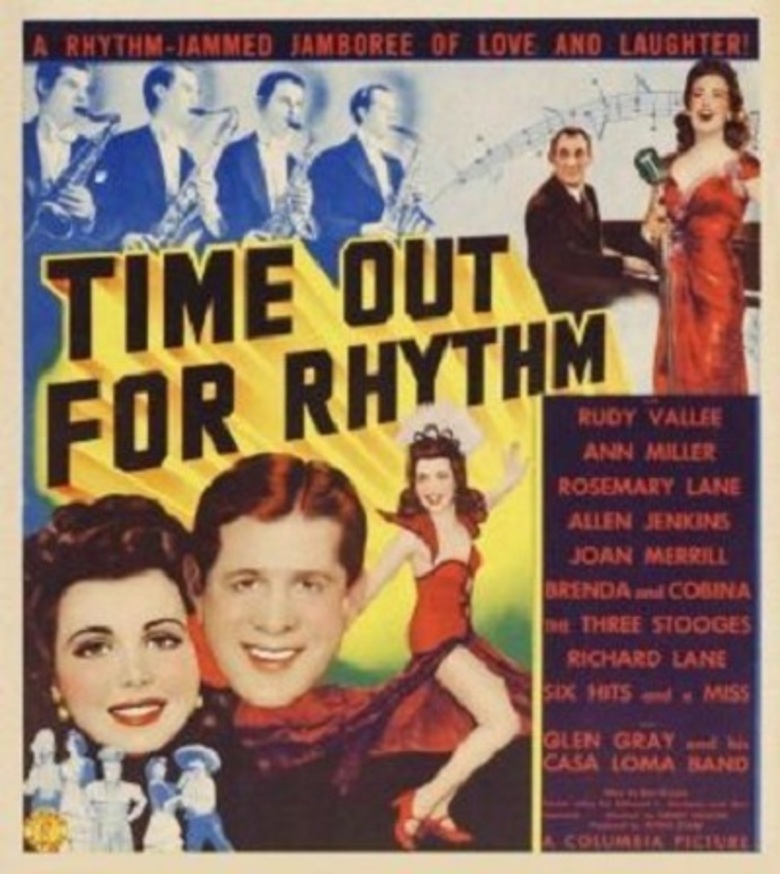
That’s Entertainment!: TIME OUT FOR RHYTHM (Columbia 1941)


gary loggins's avatarcracked rear viewer

to1

Most of you “Cracked Rear Viewers” know I run an occasional series titled ‘Cleaning Out the DVR’, where I do capsule reviews of five or six different films. TIME OUT FOR RHYTHM was going to be included in my next ‘DVR’ entry, but after watching it, I’ve decided to give it the full treatment. This has happened only once before (see PENELOPE). It’s a 40’s B-movie lovers dream, a second-tier all-star musical comedy, and it gives The Three Stooges probably their best feature showcase of the 40’s. Plus the tap-dancing wonders of lovely, leggy Texan Ann Miller. Now how can you beat that!

tio2

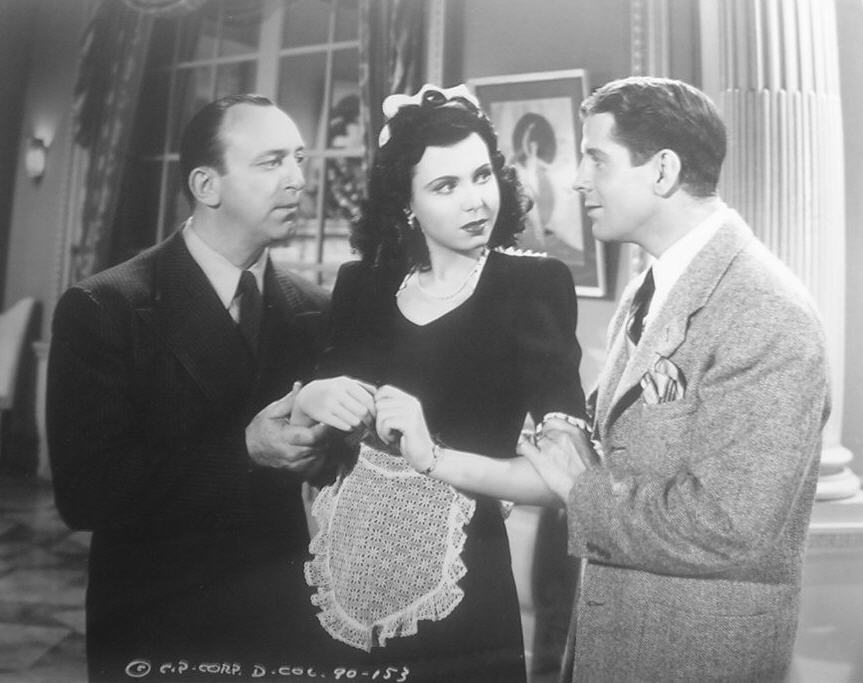
The plot’s as old as film musicals themselves: theatrical agents Rudy Vallee and Richard Lane become successful, and develop a hit show. Lane’s former flame (Rosemary Lane, no relation) comes between them, and the partners break up. Vallee and sidekick Offbeat (comic Allen Jenkins) discover Rosemary’s maid (our girl Ann)…

View original post 557 more words

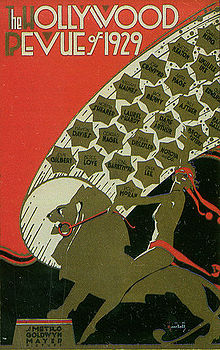
Lisa Reviews An Oscar Nominee and It’s Damn Important: The Hollywood Revue of 1929 (dir by Charles Reisner)


220px-The_Hollywood_Revue_of_1929_(film)_poster

Last night, I really needed a break from thinking about this stupid, asinine presidential election that we have coming up here in the U.S.  Fortunately, TCM provided me with one by showing The Hollywood Revue of 1929!

The Hollywood Revue of 1929 is probably one of the most obscure film to ever be nominated for best picture.  It’s a plotless collection of songs and comedy bits, all performed by actors who were under contract to MGM.  In fact, the movie might be best described as a two-hour commercial for MGM.  The message of the film seems to be: “Now that movies have sound, look what MGM can do!”

With the exception of Greta Garbo and Lon Chaney, every MGM star makes an appearance in Hollywood Revue.  Everyone sings a song and does a dance, even if some of them are better singers and dancers than others.  The revue is hosted by Conrad Nagel (who looks very dapper in a tux but still seems to be strangely uncomfortable with his hosting duties) and Jack Benny (who plays his violin and gets annoyed every time he’s interrupted by an MGM stock player).  Joan Crawford (who Nagal describes as being “one of my favorites”) sings, “Got A Feeling For You,” and she may be off-key but you can’t help but appreciate the fact that she’s doing her best.  Buster Keaton does a dance.  Laurel and Hardy perform a magic act that doesn’t go very well.  Marion Davies does a tribute to the military and I’m sure that, somewhere, William Randolph Hearst was smiling.  Chorus girls sit in the background and smile at the camera and, as someone who knows what it’s like to be in the chorus, I enjoyed watching as a few of the smarter and braver ones attempted to steal the audience’s attention away from the headliners.

At one point, Jack Benny reached into his suit jacket and revealed that a miniature version of actress Bessie Love was apparently living in the pocket.  He held Bessie in the palm of his hand and proceeded to have a conversation with her and all I could think about was the end of Mulholland Drive, when that tiny old couple cornered Naomi Watts in her apartment.  When Benny placed Bessie on the ground, she grew to normal height and sang a song.

During the second half of the film, silent screen star John Gilbert plays the balcony scene from Romeo and Juliet, opposite Norma Shearer.  First he does it in Shakespeare’s words and then he does it again in 1929 language.  Lionel Barrymore directs them.  Interestingly enough, Shearer (who was married to The Hollywood Revue‘s producer, Irving Thalberg) would later play Juliet in 1936’s Romeo and Juliet.  Barrymore, though best remembered as Mr. Potter from It’s A Wonderful Life, actually was a prominent film director in 1929 and would even invent the boom mic.  As for Gilbert, legend has it that the Hollywood Revue was the first time that audiences actually heard him speak and they were so unimpressed with his voice that his career ended.  Having now seen Gilbert speak — well, he didn’t have the greatest or sexiest voice but he still sounded better than Jean Hagen did in Singin’ In The Rain.

Speaking of Singin’ In the Rain, that song was specifically written for Hollywood Revue!  The entire cast sings it at the end of the film.

Seen today, there’s something charming about how old-fashioned and corny The Hollywood Revue is.  I imagine that some people will laugh at it but, honestly, it’s still more entertaining than that stupid live version of The Sound of Music that they put on TV two years ago.  The Hollywood Revue is basically the classic film equivalent of a high school talent show, where everyone does their best and a good deal of the charm comes from seeing how silly it all is.  If you love TCM, you’ll enjoy seeing all the Golden Age performers trying to do their best.  If you don’t love TCM, then go to Hell.

The Hollywood Revue is usually listed as being a nominee for best picture.  Actually, the truth is a little bit more complicated.  For the 2nd annual Academy Awards, there were no nominees.  Instead, the awards were determined by a select committee and only the winners were announced.  Much like the Cannes Film Festival, no film received more than one award.  Broadway Melody (which starred Hollywood Revue‘s Bessie Love) was named best picture.

However, notes were kept of the committee’s meeting and those notes indicate that Hollywood Revue was considered as a possible pick for best picture.  Hence, Hollywood Revue is considered to be a best picture nominee even though there were no official nominees that year.

Anyway, if you’re a classic film lover, keep an eye out for Hollywood Revue the next time that it shows up on TCM!

Artist Profile: Clarence Doore (1913 — 1988)


Born in Canada, Clarence Doore settled and worked in both Massachusetts and Connecticut.  He was active from the late 1930s until the mid-1960s.  During World War II, he was stationed at the Climatic Research Laboratory, where the army studied the effects of extreme weather conditions on soldiers.  Doore’s sketches of soldiers fighting in snow and ice led to the Pentagon adopting the use of the fur-lined “Eisenhower jacket” for alpine troops.

Doore did illustrations for several pulp magazines and paperback publishers.  His exciting work can speak for itself.

15 Western NovelsAmazing StoriesChampions For MenFive Western NovelsMan's AdventuresMarshall of Deer CreekMysterious Jungle of DeathRage For MenReal Men

Rugged Men (Dec., 1958).  Cover by Clarence Doore

The Day Paris FellThrilling SportsTrue Weird

6 Late Trailers For A Monday


Hi, everyone!

So, usually, I post my latest edition of Lisa Marie’s Favorite Grindhouse and Exploitation Film trailers on Sunday.  However, yesterday was the final day that Cabaret was scheduled to be performed down here, at the Winspear Opera House, in Dallas.  Jeff and I caught the final matinée performance and it was absolutely wonderful!

However, it also meant that I did not have time to do my usual Sunday morning posting.

Still, I am nothing if not dedicated!  So, here below, are 6 late trailers for this wonderful Monday!  Admittedly, these trailers may feel a little bit random.  There’s no real theme to be found … or maybe there is.

Randomness can be a theme.

Right?

Anyway…

1) The Dark (1979)

I actually own a couple of DVD boxsets that feature The Dark but I’ve never actually gotten around to watching the movie.  Say what you will about the apparent cheapness of the special effects, the monster does look like he could serve as potential nightmare fuel.

2) The Evil (1978)

It feels appropriate to follow up The Dark with The Evil.  I’ve never seen this one either, but it’s apparently a haunted house film.  There’s some evil involved.

3) The House Where Evil Dwells (1982)

On the other hand, I have seen The House Where Evil Dwells.  Oh my God, is it ever a boring movie!  But the trailer’s kinda fun.

4) Ghosthouse (1988)

Despite what the credits may say, Ghosthouse was not directed by Humbert Humphrey.  This is an Umberto Lenzi film.  This trailer is actually pretty tame by Italian horror standards but it’s still graphic enough for me to suggest that you not watch it at work or if you’re disturbed by fake-looking gore.

5) Zombie 5: Killing Birds (1988)

I actually reviewed Killing Birds on this site a while ago.  I’ve always liked this trailer.  It’s full of atmosphere and it has an almost dream-like intensity to it.

6) Teenage Exorcist (1991)

And finally, let’s end things with the trailer for Teenage Exorcist!

So, I guess we did kind of end up with a theme here — evil monsters, haunted houses, and stuff.  I’m glad that worked out!

degrassi

Well, damn.  That’s not nice…