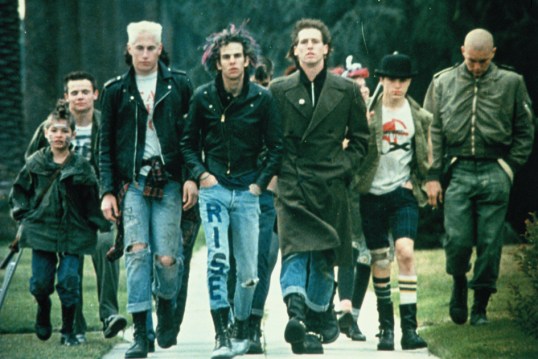
I’ve been reviewing film on this site for over four years now and one theme that I find myself returning to, time-after-time, is that I love movies that serve as time capsules. I love movies that were made specifically to capitalize on specific trends, culture, and fashion. Many people dismiss these films as being dated but that’s precisely why I enjoy them. I just love seeing how the world once looked and how life was once lived.
The 1984 film Suburbia definitely falls into that category. Produced by the legendary Roger Corman and directed by documentary filmmaker Penelope Spheeris, Suburbia tells the tale of The Rejected, a group of teenage runaways and other outcasts who, having both rejected and been rejected from conventional society, now illegally live in an abandoned house in the middle of the suburbs. The film focuses on two runaways — Sheila (Jennifer Clay), who was abused by her father, and Evan (Bill Coyne), who is fleeing an alcoholic mother. Both of them — along with yet another runaway named Joe Schmoe (Wade Waltson) — are invited to live in the “T.R. House” by the group’s leader, Jack Diddley (Chris Pedersen), on the condition that all three of them allow themselves to be branded with the letters “T.R.” In short, when you’re rejected, you’re rejected for life.
Eventually, all three of them settle into life at the house. Joe and Sheila start a tentative relationship. Evan brings his younger brother Ethan (Andrew Pece) to the house. They spend their days frightening their conventional, middle class neighbors and being harassed by a group who, rather ominously, refer to themselves as “Citizens Against Crime.” When they need food, they either steal it or they rummage through other people’s garbage. Jack’s stepfather, a cop named Bill (Donald Allen), drops by the house and tells them that they need to leave before someone tries to make them leave. The Rejected, however, refuse to forced out. It all leads to both violence and tragedy…
What makes Suburbia an interesting film (even for someone like me, who would probably be spit at by the residents of the T.R. House) is that Spheeris is both clearly on the side of the Rejected but, at the same time, she also makes no attempt to idealize them. The film does not shy away from showing that the residents of the T.R. House are, for the most part, angry, violent, and self-destructive. However, Spheeris suggests that, in a society that continually tries to co-opt and neuter all forms of rebellion, the Rejected don’t have much of a choice but to continually go to the next extreme. She finds a humanity and a beauty in their often hopeless existence because, even if they are doomed, at least they’re going to be doomed on their own terms.
Spheeris filled the film with non-actors and local Los Angeles musicians (A very young Flea plays one of the residents of the house) and, as a result, Suburbia features some of the most wooden performances and awkward line readings that I have ever seen or heard. But, what the cast lacks in acting ability, they make up for with the right attitude and the right look. And you can see that in perhaps the film’s best and most iconic scene, the infamous punk parade.
And you can watch that parade below!
 Through the Shattered Lens
Pingback: Back to School #35: Sixteen Candles (dir by John Hughes) | Through the Shattered Lens
Pingback: Back to School Part II #17: The Boys Next Door (dir by Penelope Spheeris) | Through the Shattered Lens
Pingback: Lisa Marie’s Week In Review: 9/18/23 — 9/24/23 | Through the Shattered Lens