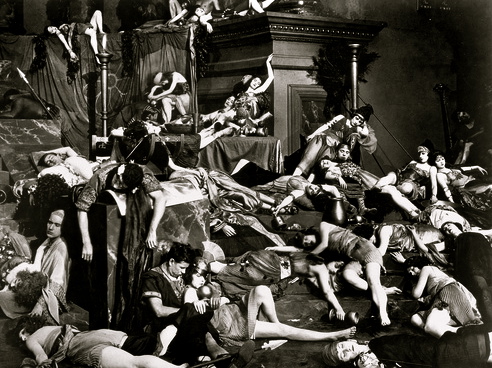
Manslaughter Orgy
You really can’t talk about film melodrama without talking about Cecil B. DeMille.
From a modern perspective, we tend to dismiss DeMille as simply being the director of the fun but undeniably campy version of The Ten Commandments that pops up on TV every Easter. Those of us who know our Oscar history are usually quick to roll our eyes over the fact that DeMille’s film The Greatest Show On Earth won best picture over High Noon, The Quiet Man, Moulin Rogue, and such unnominated films as Singin’ In The Rain and The Bad and the Beautiful. For those who know the history of the blacklist, DeMille is a convenient villain — a director who supported the blacklist while other more critically admired directors like John Huston and John Ford spoke out against it. In fact, it sometimes seems that the only positive thing you hear about Cecil B. DeMille is that, when he showed up playing himself in Sunset Boulevard, he came across as being a nice man.
But, when you actually study the history of American film, it becomes obvious that — even if he’ll never be a critical favorite — Cecil B. DeMille is one of the most important figures in the history of American film. Starting in 1913, DeMille directed movies for over 43 years. In many ways, he was one of the first directors to truly understand how to best exploit the commercial possibilities of a good melodrama. DeMille understood that audiences enjoyed watching sin at the start and during the middle of a film as long as a healthy dose of salvation was present at the end. That salvation allowed audiences to embrace the sin without having to deal with guilt. With his early silent films, DeMille established the formula that is still used in cinematic melodrama to this day.
Consider, for example, DeMille’s 1922 film Manslaughter.
Manslaughter tells the story of Lydia (Leatrice Joy), a wealthy young woman who — much like me — likes to drive fast and dance. As we’re told in one of the opening title cards, “Her proud boast is that life has never stopped her!” When we first meet Lydia, she’s in her car and she’s racing alongside a train. When a cop pulls her over for speeding, Lydia nonchalantly bribes him with an expensive bracelet. (Myself, I always just cry whenever I get stopped for speeding. It’s just as effective and far less expensive.)
Lydia has a boyfriend, a rather self-righteous district attorney named Daniel O’Bannon (played by Thomas Meighan, a familiar face to those of us who enjoy silent melodrama). We are informed that Daniel loves Lydia for the “girl he thinks she could be, not for the girl she is.” Apparently, that’s meant to be romantic. I don’t know — if a guy ever said that to me, I’d probably slap him. And then I’d get my boyfriend to beat him up…
As Daniel watches Lydia drink and dance her way through a decadent Christmas celebration (which is captured, in loving and fascinating detail, by DeMille), he tells her, “Don’t you think you better put on the brakes before life does it for you?”
“Modern girls don’t sit home and knit!” Lydia replies. (You go, Lydia!)
Eventually, Daniel finds himself musing that “we’re no different than Rome.” He then proceeds to visualize all of the party goers taking part in a massive Roman orgy… (Daniel also visualizes what is reportedly one of the first same sex kisses to ever appear in a mainstream American film.)
Anyway, as you might be able to guess from the title, Lydia eventually kills someone with her reckless driving and guess who ends up prosecuting her in court? None other than Daniel, who links Lydia’s irresponsible behavior to — you guessed it — the collapse of ancient Rome. While Lydia find salvation in prison, Daniel starts to embrace the very sin that he originally railed against…
Manslaughter has got a reputation for being one of DeMille’s weaker silent films. It’s definitely heavy-handed in its moralizing and Meighan, as good as he may have been in films like The Racket, is actually pretty boring here. However, I still enjoyed Manslaughter, or I should say that I enjoyed the scenes in Manslaughter that unapologetically celebrated the decadence of Lydia’s life. Leatrice Joy gives a fun and likable performance in those scenes and how can you not enjoy watching people get wild in the 1920s?
Watch Manslaughter below!
 Through the Shattered Lens