VGM Entry 45: A Link to the Past
(Thanks to Tish at FFShrine for the banner)
I never did find out why Koji Kondo did not score Zelda II: The Adventure of Link, but then, very little about that game made much sense in any department. The Legend of Zelda: A Link to the Past got the series back on track both stylistically and musically.
Yet the music to A Link to the Past never much agreed with me as a kid (though I enjoyed it more than Super Mario World). It’s got a really dark side to it which I think often goes unrecognized, and which made it incredibly appropriate for the game. I mean, there is nothing warm and fuzzy about A Link to the Past. Monsters all over the place, guards out to kill you… The whole world’s got only one town in it and everyone there’s a crook or a witch or just all around unfriendly. Your only real companion is some chick’s voice in your head, and you don’t really ever get to interact with her along the way. In spirit, this was more some horror/nightmare game than a standard adventure/RPG. It made me really uncomfortable as a kid, and it should have. You know, half your companions might die or betray you in Final Fantasy IV, but at least you had them. As Link, you’re quite alone in the world.
I think Koji Kondo perpetuated the angst. You can divide the majority of the soundtrack into string and trumpet tracks and harp tracks. The latter are soothing, sure, but they mostly occur in little safe haven faerie pools. I’m sure glad Tinker Bell is on my side, but I don’t think I’ll be sheathing my sword any time soon. And the former, the former are spooky. Seriously. When you get the same tones on the Hyrule Castle theme (2:25) that you hear in the Forest (3:55) there’s got to be something up. Hyrule Castle is supposed to be protecting your realm, and sure, you’re an unwelcome guest, but the effect is to make the castle itself feel like it’s under some dark spell. You’re not just battling corrupt politicians here; there’s something evil pervading this whole world. Indeed, the forest ends up being one of the most comforting songs on the album, because the flute it least renders it merely mysterious and not obviously dangerous.
Kakariko Village (not sampled here), the only town in the game, uses slightly different tones, but they still have that sort of ghostly texture to them, and in consequence it feels no more comforting than that enchanted mysterious forest.
I think I can best describe my childhood Link to the Past experience as simultaneously captivating and unnerving. I don’t care to speculate what Koji Kondo had in mind when he composed it, but suffice to say I think its consistency with the gameplay is phenomenal.
How, you may be asking, did I come to see The Clones, an extremely obscure and low-budget science fiction thriller from 1973?
It all started when I first saw the trailer for the film on 42nd Street Forever, a compilation of old school grindhouse trailers. For whatever reasons, the trailer for The Clones fascinated me. Whether it was the extremely dry narration or the fact that the trailer actually ended with a quote from a then-member of the U.S. Senate, I felt that The Clones was a film that I, as a student of film and history, simply had to see.
How obscure is this film? It’s so obscure that The Clones has never even been released on DVD. In order to see the film, I had to go on Amazon and order a used VHS copy from a some guy in Indiana. When it arrived in the mail, the first thing I noticed was the big “Property of the St. Augusta Public Library” that was stamped on the back of the worn video box.
The fact that my copy of The Clones had obviously seen better days actually added a lot to the viewing experience. Much as true grindhouse fans treasure every scratch and auditory pop whenever they watch a film like Fight For Your Life or Last House on Dead End Street, I found myself oddly proud that my copy of The Clones had obviously survived so much just so that it could eventually end up as a part of my video library.
As for the film itself, The Clones is one of those wonderful low-budget films that deserve to be rediscovered. Dr. Gerald Appleby (well-played by an actor named Michael Greene) is a nuclear scientist who discovers that he’s been cloned and that the clone has essentially been out living his life whenever the original Appleby has been at work. Though it’s hinted that he’s being set up by foreign spies, the reason for Appleby’s cloning remains obscure throughout the entire film. Whether this narrative obscurity is intentional or not, it actually serves the film well as it helps to transform Appleby into almost a Kafkaesque figure.
When Appleby attempts to reveal to the proper authorities that he’s been cloned, he finds himself accused of being an imposter and is forced to literally run for his life. The majority of the film deals with Appleby being chased across the California desert by not only the mad scientist who cloned him (a wonderfully demented Stanley Adams) but also by two ruthless federal agents. The two federal agents are played by Otis Young and Gregory Sierra, two character actors who appeared in several films during the 70s. Sierra and Young are a lot of fun to watch in this film and it’s hard not to like them, even if they technically are villains. They both just seem to be having so much fun trying to kill our hero.
From what little information that I’ve been able to gather about this film’s production, it appears that The Clones was one of the first motion pictures to attempt to take advantage of the paranoia that most people feel over the prospect of humans being cloned. When seen today, the film’s story is a bit predictable because, to be honest, there’s really only so much when you can do with cloning as a plot device. However, The Clones remains an oddly effective film. The low budget (and lack of special effects) actually contributes to the film’s success. Without the crutch of spectacle, The Clones is forced to pay attention to things like characterization. How’s that for a concept?
The film eventually climaxes with a genuinely exciting shoot out in a deserted amusement park and then it all ends, in typical 70s fashion, in a climax that manages to be both fun and depressing at the same time.
The Clones is not necessarily an easy film to see but it’s well worth the effort.
VGM Entry 44: Final Fantasy IV
(Thanks to Tish at FFShrine for the banner)
Supposedly the sound team at Square was so overburdened when it came to scoring Final Fantasy IV that they occasionally camped out in sleeping bags at the office. Or so claim Nobuo’s rather zanny liner notes for the game’s official soundtrack, dated “April 13, 1991, 1:30 a.m. (in the office, naturally)”. Whatever the veracity of this, the end result was probably the best game soundtrack composed up to that time.
Nobuo Uematsu must have been waiting a long time for this. “Prelude” received its main melody to finally become the song we think of today. “Prologue” (Main Theme) got an epic introduction to overtake the recently revamped Dragon Quest theme. Hell, something approaching real orchestration was possible!
The process of adjusting to the Super Nintendo took a lot of time and energy, and it didn’t get any easier. Nobuo Uematsu has stated that Final Fantasy VI was his most challenging score, and one can imagine a perfectionist’s realization that Super Nintendo sound, though vastly superior to the Nintendo, was still sufficiently limited for the possibility of excruciatingly sampling every option. Perhaps that’s why Final Fantasy IV and Final Fantasy VI especially turned out so great; lacking the sense of unrestrained freedom of true orchestration, attention to detail was taken to painstaking extremes. Perhaps. I don’t know.
The track list for the sample above is:
“Prelude”(0:00)
“Prologue” (0:55)
“Red Wings” (1:35)
“Main Theme” (Overworld) (2:16)
“Into the Darkness” (3:00)
“Fight 1” (3:32)
“Mystic Mysidia” (4:31)
“The Airship” (5:20)
“The Big Whale” (5:50)
“Theme of Love” (6:27)
“Palom & Porom” (7:11)
“Chocobo-Chocobo” (7:38)
“Land of Dwarves” (8:12)
“Epilogue” (8:37)
“Fanfare” (9:24)
It’s something of a testament to how amazing Final Fantasy IV really is that garudoh’s ten minute sampler does not even include the vast majority of my personal favorites. And since I am at liberty to write these articles however the hell I want to, I present you with my top five Final Fantasy IV tracks, roughly in order:
#5: Fabul
The music of Fabul could not possibly be better suited for its role in the game. Here you’ve got an isolated, well fortified castle guarded by monks, which are pretty much ninjas and way cooler than Edge anyway. And there’s nothing friendly about this town. It’s been a long, long time, but I recall never exactly feeling welcome there, and I certainly shouldn’t after all the trouble. “Fabul” isn’t just appropriately oriental, it’s also pretty grim. There’s a sense of foreboding about it which perfectly captures the events your arrival foretells.
#4: The Lunarians
“The Lunarians” was my favorite Final Fantasy IV track as a kid. I remember pounding away at it for hours on my mother’s piano, which must have been especially grating since I’ve never taken a piano lesson in my life. This isn’t some ‘light in the darkness’ track. The pretty melody is completely haunting, and that forcefully struck deep note is entirely complimentary to it. No, there’s no sort of contrast here. This song captures a beautiful and dangerous mystery.
#3: The boss battles
Yes I know I’m cheating. Final Fantasy IV is packed full of outstanding fight music. The final battle, featured above, is the most dramatic of the lot–as well it should be–but only barely. “The Fierce Battle” also does wonders for capturing a heightened sense of danger and urgency. Really, though the whole multiple tiers of combat music thing was probably done before, Final Fantasy IV has to be one of the first games to make effective use of it. “Fight 2“, the standard boss tune, emerges out of the same brief introduction as the basic combat theme (see garudoh’s mix) and steps the action up a notch with faster drumming, more pronounced bass, brass accents, and a more central role for the strings. “The Fierce Battle” goes farther still, allowing the brass to share center stage with the strings, except unlike in “Fight 1“, the brass melody lines here actually feel like the real deal. The track comes off as very orchestral to me, and intense in a way that just wasn’t possible prior to the SNES. “The Final Battle” mixes the best of each world and contributes a rock beat to top off the job.
#2: Troian Beauty
This appropriately titled song might just be a simple waltz helped along by harp arpeggios, but that’s precisely why it works. It’s just a beautiful song–a real stroke of genius from an artist of whom we expect such feats. It’s one of the most frequently covered Final Fantasy songs you’ll find (I even stumbled across a banjo rendition), as it translates well into nearly any arrangement. It’s one of my personal favorite songs to cover, using Kabukibear’s version. If you’re not familiar with his arrangements, this is a great place to start.
My favorite Final Fantasy IV song of all might be a little anticlimactic, as it’s featured in the garudoh compilation, but I hope you’ll give it some consideration before writing it off as a relatively generic song in relation to the tracks accompanying it.
#1: Red Wings
If I was ever to form a video game cover band, and I’ve been kicking around the idea since I was old enough to pick up a guitar, “Red Wings” would definitely be my top priority. Just imagine the possibilities for subtle intensification in this song. Sure, Uematsu’s version might only be a minute long, but I could see this building up into a ten minute marathon, starting out with that martial snare and climaxing with an Atsuo-intense drumset massacre, with room for all kinds of instrumental variation in between. Ok, maybe that’s my vision for the song and not the song itself, but I think Uematsu lays out a prototype for something truly epic here.
I haven’t been as big a fan of Capcom’s Resident Evilsurvival horror game franchise (weird considering that zombie fiction and entertainment is like catnip to me), but the upcoming and latest entry in the series has me excited. Resident Evil 6looks to return the series to its zombie roots after spending the last two titles veering away from it.
While the gameplay still looks to be just something upgraded and tweaked from games past the story itself looks like something that I would find interesting as it moves the danger from being localized to something more global in scope. I’m really hoping that this title brings me back to the franchise which was great in the beginning then began to lose steam and ideas in it’s latest offerings.
This latest trailer takes a page out of the Halofranchise’s marketing book by making it live-action. It might be only 90 seconds but getting a glimpse of how a world reacts to the onset of a zombie apocalypse makes for a nice, brief piece of entertainment.
Resident Evil 6is set for an October 6 release for the Xbox 360, PS3 and Windows PC.
(As a sidenote, it is true that I usually try to feature trailers that are a bit older than these but what can I say? I talked it over with the trailer kitties and we all love the Asylum.)
While I enjoyed the other, better-known Thor, I could not help but think that it definitely would have been a better movie if it had featured more dinosaurs. Apparently, the Asylum agreed.
VGM Entry 43: ActRaiser
(Thanks to Tish at FFShrine for the banner)
Three other SNES games I have yet to mention were relased in 1990. One was Gradius III, composed by the Konami Kukeiha Club (in this case Junichiro Kaneda, Seiichi Fukami, Miki Higashino, Keizo Nakamura, and Mutsuhiko Izumi) and originally released in the arcade in 1989. Another was Pilotwings, composed by Soyo Oka. The third was easily the most impressive soundtrack released in 1990.
I have questioned Yuzo Koshiro’s judgement in the past, but I will do no such thing today. ActRaiser (Enix, 1990) decisively set the RPG and adventure gaming musical standard on the SNES. Funny that it wasn’t either. Through this weird and extraordinary amalgamation of side-scroll action and city simulation, Yuzo Koshiro crafted not only the first truly and unconditionally great Super Nintendo soundtrack, but the first gaming music I have encountered to feel like a real orchestration, and not merely the basis for one.
This was inevitable. The likes of Nobuo Uematsu and Koichi Sugiyama were crafting music that was clearly intended for orchestration in the early days of the Nintendo. Moreover, while arcade systems may have been capable of creating similarly orchestrated sounds, the extended gameplay associated with this sort of music just wouldn’t have been practical. That Yuzo Koshiro was the first to pull it off though, and to pull it off so well, comes as somewhat of a surprise to me. He was by no means new to this genre of music, but it never seemed to be his desired focus. As a musician who would end up best known for clubhouse-mixable material, the level of success he achieved within the symphonic spectrum on the SNES is remarkable, far exceeding both his PC-8801 material and all of my expectations.
But then, ActRaiserwas part side-scroller. There was room for action music of a more ‘single level’ sort than say, an RPG battle tune. On “Filmore”, or “Filmoa”, Koshiro got to let loose his more rocking nature. It’s actually remarkable that he managed to retain such an authentically classical vibe in the midst of it. Whatever light bulb went off on in his head, he managed to produce one of the Super Nintendo’s most famous pieces. “Filmore” deserves just about any amount of praise you can heap on it.
Already within a month of the Super Nintendo’s Japanese launch, here was a musician utilizing the new technology to create essentially a fully orchestrated album. ActRaiser was recorded by a real symphony the following year, and while action tracks like “Filmore” sounded distinctly different, Yuzo Koshiro’s softer stuff was barely distinguishable from the original material. I mean, don’t get me wrong, the difference in quality is obvious, but the parts were already written. Little needed be added to convert the music into a live performance. On songs like “Sacrifices” you can plainly tell that Koshiro was himself making no distinction. There is no attempt to conform to limitations here. Koshiro did not need to alter his orchestral vision to suit a distinctly electronic sound. That was a concern of the past. On the SNES you could sound orchestral if you wanted to with no misgivings, or you could maintain older styles of video game composition and sound worlds above your predecessors, as in the case of say, Bombuzal. Many musicians would go on to effectively fuse both.
There had been unconditionally excellent game soundtracks before outside of the C64. Hisayoshi Ogura and Tim Follin were the names attached to many of these, while I will continue to hold that Kenneth W. Arnold reigned supreme. Manami Matsumae, and moreso Takashi Tateishi, managed two rare ‘perfect’ NES compositions. But these were all such grand exceptions. The SNES would begin to pump out rivals at an alarming rate, and would continue to do so for its entire history. The system’s proximity to real instrumentation allowed musicians to do nearly anything they wanted with it.
I think maybe Commodore 64 music sounds so great because it is so distanced from any natural sounds that it feels like an entirely new genre of music, more on the cutting edge than outdated. Of the rest, arcade music was simply too much of a small niche market to really thrive, while the Nintendo’s sound was some wishy-wash in between. Musicians like Manami Matsumae and Takashi Tateishi managed to really embrace the chippy sound and give their music a fresh vibe, but most artists were stuck in that middle ground of being far, far distanced from real instrumentation and yet a bit too close to constitute anything else. Even the best efforts, like Final Fantasy and Dragon Quest, were only great by NES standards. Super Nintendo music, like Commodore 64 music, could be great in its own right, and much like the C64, the SNES would inspire a generation of competitive and creative musicians determined to leave their mark on the world.
Last night, I turned over to the SyFy network and I watched a little film called 2-Headed Shark Attack.
Why Was I Watching It?
I blame twitter. Every Saturday, at 8:00 pm, a group of brave and witty film fans log onto twitter and spend the next two hours deconstructing whatever movie might happen to be playing on the SyFy network that night. Last night, that film was 2-Headed Shark Attack.
Also, how often do you get to see a shark with two heads? I saw a lamb with two heads once and that was pretty disturbing but a shark with two heads? Seriously, there was simply no excuse for not watching.
(Speaking for myself, I couldn’t handle having two heads, just because I suspect the other head would be an attention whore.)
What Was It About?
For some reason, there’s a bunch of incredibly stupid college students on a boat that’s floating out in the middle of nowhere. Apparently, they’re taking part in a “semester at sea” program though, as I watched the film, I came to suspect that they had actually been kidnapped by pirates claiming to be professors and they were unknowingly being delivered to a white slavery ring in Aruba.
Anyway, the head professor (or pirate) is Prof. Babish (former Bachelor Charlie O’Connell) and when the boat starts to sink, largely because of his own stupidity, he decides to take all of his students to a nearby atoll. There, they can all hang out and deliver terrible dialogue while the ship’s hull is repaired and the professor’s wife (Carmen Electra) works on her tan.
The only problem is that the atoll is in the process of sinking and there’s a shark with two heads prowling the waters…
What Worked?
Like most Asylum films, 2-Headed Shark Attack is a film that was made to be watched with friends. If you’re taking the film seriously, you’re missing the point. This is one of those films that invites you to sit back and laugh along with it.
The two-headed shark was the best actor in the film and it was easy to root for him.
Charlie O’Connell has a scene where he gets what appears to be a minor scratch on his leg and he responds by going, “Ow, ow, ow, ow, ow, ow, ow, ow…” for about ten minutes straight. It simply has to be seen to be believed.
What Did Not Work?
The film’s heroine was played by Brooke Hogan and wow. Whether it was because of the sleep-inducing way she delivered her lines or the fact that her character claimed that she could repair the boat because, “My dad was a welder,” I have to say that I have never so wanted to see one person get devoured by a two-headed shark.
Initially, those of us on twitter were really excited because we thought that one of the characters was named Tequila. However, it soon became obvious that we had all misheard and his name was actually Dikilla. Don’t get me wrong, Dikilla is a pretty good name but, after we had all had so much fun with the idea of him being named Tequila, it was hard not to be disappointed to discover that we were wrong.
“OH MY GOD! Just like me!’ Moment
Though she was roundly despised by just about everyone on twitter, I have to admit that I very much related to the character who became known as “the blue eyeshadow girl.” She was the girl who continually came up with the silliest solutions to the group’s predicament. She also had a gun for most of the film but, during the final minutes, revealed that she had absolutely no idea how to use it when she fired point-blank at the two-headed shark and, somehow, managed to miss every time. Even as I made fun of her on twitter, I silently thought to myself, “That would so be me if I had ever signed up for a semester at sea.”
VGM Entry 42: SNES
(Thanks to Tish at FFShrine for the banner)
Are we really there? I had naively intended to start this whole project off with a simple one to two post summary of video game music prior to 1990, then jump right away into the Super Nintendo. I suppose it didn’t quite work out that way.
I don’t know much about technological specifications. I have no idea what made the SNES tick the way it did. But there had to be something inspirational to musicians in its design. The Super Famicom was launched in Japan on November 21, 1990. By the end of the year it had nine titles, and as far as I’m concerned only two of them lacked noteworthy soundtracks. That’s better than the Genesis/Mega Drive managed in its first two years. And of the two that fail to impress me, Final Fight (Capcom) was a port arrangement of the arcade original and Super Ultra Baseball (Culture Brain, Super Baseball Simulator 1.000 in the U.S.) was precisely what it sounds like–the sort of game only a Tim Follin would put serious energy into.
F-Zero (Nintendo)’s soundtrack, composed by Yumiko Kanki (Naoto Ishida also wrote two tracks for it), is not one of the best on the SNES. Top 50? Eh, probably. But it sounds unbelievably better than nearly anything before it. The system brought nearly arcade-quality music to the mass consumer market, but also to musicians accustomed to having to compensate for lack of quality with highly creative song-writing.
So you got both. And you would continue to get both for the better part of a decade. Bombuzal (Image Works) was originally released for the Commodore 64, Amiga, and Atari ST in 1988. Its original version, composed by Ross Goodley as best I can tell, was pretty catchy in its own right. But the clarity of each tone on the Super Nintendo version (later released in North America as Kablooey), arranged, I believe, by Hiroyuki Masuno, gives the song a degree of fullness it could have never possessed before, even on the Amiga. And much like the Commodore 64/Amiga musicians of old, Hiroyuki Masuno was not afraid to improvise, incorporating his own melodies into the song and altering the rhythm and general vibe to suit his own whims. Hiroyuki Masuno’s revised Bombuzal theme is downright addicting.
SD The Great Battle (Banpresto) is a fun soundtrack to point out, both because you’ve almost certainly never heard it and because I think it really shows off how much better fairly generic scores could sound now. I mean, there is absolutely nothing special about what Norihiko Togashi did here. When the melodies are not a bit too overly repetative for their catchiness to be a virtue, they’re not particularly memorable at all. The only thing really to distinguish it from a standard to slightly above average NES soundtrack is the sound quality. But Norihiko Togashi makes excellent use of this. The accompaniment often pans and fades. The slap bass effectively fills in the percussion while still sounding like a real bass, and these never tastelessly overpower the melody as they’re so inclined to do on the Genesis/Mega Drive. It’s a completely forgettable little work which nevertheless surpasses a lot of the competition of its day.
Super Mario World by Koji Kondo obviously deserves mention, though I am not as fond of it as I perhaps ought to be. As a kid, I honestly found it kind of annoying, and I can understand why. Koji Kondo’s weird mix of Caribbean, Latin American, and African rhythms and instrumentation sound more like the sort of “world music” sampler cd you find at Starbucks than authentic ethnic music. (I find it funny that the PHD-waving ethnomusicologists I met in college placed the highest value in that sort of crap.) But this is Mario, not bad scholarship, so what he was borrowing for his compositions is really quite irrelevant. The end result is what matters, and the end result of most of these songs is pretty cheesy, whether you like it or not. It’s not until the ending credits (8:14) that Koji Kondo returns to the classic sound that so delights me in Super Mario Bros. 2. (That being said, Super Mario World‘s credits is one of my favorite Kondo songs ever.) This might have been the first game I ever personally owned–no more pretending the neighbor kid was my friend!–but it doesn’t hold much nostalgic value for me, and I think the music is somewhat to blame.
But enough with the negative criticism. Let’s not overlook the shear quantity of unique tracks in this game (well over 30 if we include some of the variations and shorter jingles). The “world music” gig is only a dominant fraction of a much larger collection. Such noteworthy tracks as “Forest of Illusion” (6:12), “Sub Castle”, “Koopa Junior”, “The Evil King Koopa”, and “Athletic” possess none of these nusences (as long as you stay away from Yoshi, which I never did, hence perhaps my youthful distaste). And had there ever been a game even remotely approaching Super Mario World‘s extent of gameplay relativity? Kondo’s own work on Super Mario Bros. 3 might come the closest, and it’s a long ways off. Super Mario World offered a ridiculous degree of diversity, with each zone and situation possessing a distinct and entirely appropriate sound. This might come to be the future norm for RPGs and adventure games, but we’re dealing with a simple side-scroller here.
Super Mario World was a grand showcase of the endless new possibilities made available by the Super Nintendo. It may lack some of the timeless classics of Super Mario Bros and Super Mario Bros 2, but only in proportion to its length. Its place in the history books of video game music is well deserved.
VGM Entry 41: Game Boy
(Thanks to Tish at FFShrine for the banner)
I nearly forgot to address the Game Boy. Released in April 1989, by the end of 1990 it was already pushing 100 titles. Perhaps production was easy and inexpensive, I don’t know, but this was a system that shot off at lightning speed. In consideration of all of the great music chiptune artists are making on the Game Boy today, I made a diligent effort to listen to a good 80 or so of these early titles. I figured there had to be a ton of hidden gems out there, but there really weren’t.
It’s actually really surprising how completely ho-hum the vast, vast majority of early Game Boy soundtracks were. Even those you might expect to be leading the pack, Castlevania: The Adventure (Konami, 1989, Dracula Densetsu in Japan) and Super Mario Land (Nintendo, 1989) for instance, offered next to nothing worth noting. Those which did peak my interest were often quite obscure. Fist of the North Star: 10 Big Brawls for the King of Universe (Electro Brain Corp., 1990) for instance has no identifiable composer. I searched long and hard to no avail.
This game supposedly stunk, and perhaps the music was not held in very high regard because of this. I thought it was a pretty solid effort. The Game Boy’s bass tones are very full and encompasing, capable of giving a song a great deal of depth. Very few musicians actually put this to use, but whoever composed Fist of the North Star had an ear for it. The way the extended bass notes compliment the melody reminds me a lot of Ryuji Sasai’s approach on my favorite Game Boy soundtrack, which we’ll be getting to here in another year.
The title track to Battle Bull (SETA, 1990), composed by Takayuki Suzuki, strikes me for its ability to pack in such a big sound. It is stylistically exactly the sort of thing I set out to find. It’s a shame there seems to be only one song here, because Suzuki turns out to be one of the few Game Boy composers who really understood how to make the most of the system. In retrospect after looking a few years ahead, this is easily one of the best Game Boy songs I have ever heard.
Square’s SaGa series became a nearly annual event following the first instalment, Makai Toushi SaGa, released for the Game Boy in December 1989. The first three were known in North America as the Final Fantasy Legend series–a title chosen in the hopes that familiarity would boost sales. I know the strategy worked for me. But the series did share at least one thing in common with Final Fantasy, at least initially. Nobuo Uematsu was commissioned to compose it. Despite what you might read, I am fairly confident that he composed Final Fantasy Legend in its entirety. At least, the liner notes displayed by vgmdb.net claim this. Final Fantasy Legend II, released the following December, was a joint effort, with Kenji Ito tackling about half of the tracks.
I am only going to present the original Final Fantasy Legend here out of consideration of space, but the sequel is about equal in quality and worth checking out. Nobuo Uematsu did an excellent job of carrying over his style onto the Game Boy, and a few tracks, like the introduction and the victory fanfare, would become series staples. The only noteworthy RPG series for the Game Boy to the best of my knowledge, the Final Fantasy Legends boasted a much larger song selection than most other Game Boy games at the time, and the consistant high quality really put to shame most of the competition.
Nobuo Uematsu and Kenji Ito really definitively proved that the dearth of good Game Boy music was a consequence of negligent composers, not system restraints. Uematsu was as new to the Game Boy as anyone else when he composed his first work for it, and, as you can plainly hear, that was a simple enough challenge to overcome. Much like the first three Final Fantasy soundtracks, the music of the first two SaGas did not so much conform to the system as force the system to conform as much as possible to a multi-platform vision of what an RPG ought to sound like. The music of Final Fantasy Legend you are hearing here certainly bears a distinctly Game Boy sound in so far as it was impossible not to, but the music neither capitalizes on the systems strengths nor succumbs to its difficulties. It really just sounds like Uematsu doing his thing in the early years.
Gargoyle’s Quest (Capcom, 1990) was pretty amazing. It was created by Harumi Fujita, the original arcade composer of Bionic Commando, and Yoko Shimomura, a new name to the business who you’ll be hearing plenty more of in the future. It is also a part of the Ghosts’n Goblins series, which you’ve heard pleanty of already.
Gargoyle’s Quest does everything right. The decision to abandon percussion altogether did wonders for enhancing the semi-classical melodies. The songs are consistantly well-written, and the melodies are often permitted to run wild, with no stagnation and no breaks in the actual presence of sound. The Game Boy had by far the most beautiful tones of the chippier-sounding systems–that is, pre-SNES/Genesis/Amiga–and they always seem to ring out to their fullest in states of perpetual transition. I don’t know, maybe I’m superimposing what worked best for Gargoyle’s Quest onto what worked best for the Game Boy in general, but it seems like this is the sort of system where you can never have too many notes.
But if that’s stretching matters, I would at least say that the Game Boy is a system on which boldness almost always profits. It’s a shame that Tim Follin didn’t, to the best of my knowledge, write any Game Boy music. But anyway, Gargoyle’s Quest, one of the best soundtracks the system would ever know, was certainly not lacking in it. I might never be able to really put my finger on the features that so strongly attract me to this system, but you’re hearing a lot of them right now. You can hear the soundtrack in its entirety here, once again compliments of explod2A03.
Funny that, for all I just said, my favorite Game Boy soundtrack of this 1989-1990 period is soft and simple Yakuman (Nintendo, 1989), a mahjong game composed by Hirokazu Tanaka and only released in Japan. A frequently occurring figure in my articles, Tanaka’s game audio history goes all the way back to monotone bleeps in the 1970s. His role as a major composer would rapidly fade after 1990, but he was partly responsible for such esteemed works as Metroid, Mother, Earthbound, Dr. Mario, and the Nintendo ports of Tetris. He also composed Super Mario Land for the Game Boy, which I find quite dull. Go figure.
Well, that wraps up my thoughts on the first two years of the Game Boy. Honorable mention goes to Maru’s Mission (Jaleco, 1990, composer again unknown) and Burai Fighter Deluxe (Taxan, 1990/1991), composed by Nobuyuki Shioda. And really I was a bit harsh on Castlevania: The Adventure. I don’t care for it, but it’s not bad.
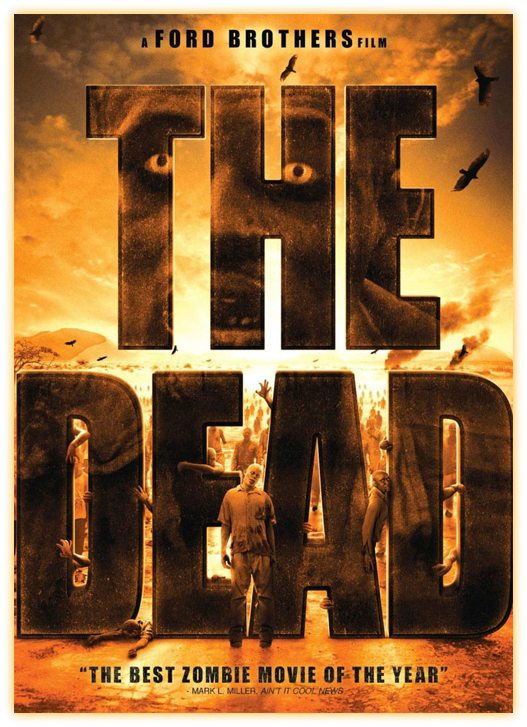
I’ve heard the collective groans from many who have achieved zombie oversaturation. For some reason the renaissance of the zombie subgenre which began during the early 2000’s continues unabated. One just has to look at the huge popularity of Robert Kirkman’s long-running horror comic book The Walking Deadright up to the even more popular tv adaptation of the comic book which now enters it’s 3rd season on AMC TV. Yet, not everything zombie-related in entertainment could be considered scary or even entertaining. If one looks at the dozens of direct-to-video which seems to come out month in and month out that barely rises above amateur production and execution one does have to feel that the subgenre should just die and go away. Then something like The Deadby the British sibling filmmakers The Ford Brothers comes along and breathes some fresh blood into the scene.
An indie film shot pretty much in northwest Africa (Burkina Faso and Ghana), The Deadis a throwback to the classic Romero zombie films before the new millennium and, even moreso, the Italian zombie films of Lucio Fulci with emphasis on Zombie. The Ford Brothers pretty much shot the film in some of the worst conditions a film crew could find itself in. It doesn’t matter whether it was the baking mid-day heat in the open plains and desert right up to the very real armed conflict which continues in the region to this very day. These two British siblings definitely took some guerilla filmmaking lessons from their hero Romero in how to stretch their tiny budget and still come out with a very good production.
The Deadis a pretty straightforward zombie film and acts more like a road film than your typical zombie story which tend to focus heavily on the siege aspect of the genre. We don’t get sieges in this film. The openness of the African plains and desert made for an interesting change of pace to the typical urban and/or countryside locales past zombie films ended up using. The film also spent so much of it’s running time in broad daylight which also made it stand out from it’s zombie film brethren which used night time as a prop to create dread and mounting terror. The Ford Brothers were able to use that very brutal heat and searing African midday sun to give the film a beautiful look but also one that highlighted it’s apocalyptic and hopeless situation. The light showed zombies shambling along from every direction, slow as they may be, in that steady, silent pace that was as inevitable as Death itself.
The story of the film is quite bare bones with the opening sequences pretty much introducing the two storylines that would intersect very early and combine to become one. There’s the lone survivor of a military evacuation flight out of the area and back to America (at least Europe) in Lt. Brian Murphy (played by Rob Freeman) whose role as a flight engineer in the doomed flight gives him the necessary technical skills to fix an abandoned vehicle he finds, but who is not what one would call a hardened soldier unlike Sgt. Daniel Dembele (played Ghana actor by Prince David Oseia) whose role as a soldier gives him the skills to protect Murphy. The two become traveling companions who must traverse the post-apocalyptic West African landscape that always have zombies, silent and sure slowly and patiently finding their way to the two no matter how fast and far they go.
Murphy wants to get back to his wife and daughter back in the States though he doesn’t know if they’re still alive or not. Daniel wants to find his son who was rescued by soldiers in the beginning of the film as their home village succumb to an attack of the dead. These similar goals become the very thing which helps the two bond together despite their cultural and ideological differences.
The film doesn’t go too heavy with the themes and ideas of Africa and zombies, but they’re there and the Ford Brothers don’t try to avoid them either. Throughout the film one could see that the film could easily be a metaphor for the birthplace of mankind also becoming the beginning of its end. There’s also the shadow of the crimes of Western colonialism and interference in a land whose people have been exploited and used like chess pieces on the grand world stage. Like some of the best zombie films, The Deaduses the apocalyptic setting and the danger of the zombies as a way to explore serious themes and ideas but do so without being too obvious or heavy-handed. In fact, the Ford Brothers actually were quite subtle with their handling of these ideas throughout the film. This made for a much more streamlined story, but also kept the film from heading into epic territory.
Freeman spends almost the whole time on the screen which stretched his performance somewhat. At times his dialogue came out natural and then on another sequence he would come off stilted. It’s not surprise that some of the best scenes Freeman’s Murphy had was when in the presence of Oseia’s Sgt. Daniel Dembele. Hiss presence on screen almost overshadows Freeman at times and one could almost wonder how much the better the film would’ve been if it was just Daniel searching for his son and no Murphy character to distract things. Oseia’s performance becomes the moral center of the film and as the story unfolded one felt like rooting for the man to find his son even though the odds on him succeeding rises with each passing minute.
The Deadis not a perfect film and one could say that it’s very straightforward nature becomes too generic and evident at certain times during the film. Yet, the rough and raw way the Ford Brothers wrote and shot the film with some very good performances from it’s cast made up for any shortcomings the film had. Even the gore effects wasn’t hampered by the minuscule budget. This film should satisfy gorehounds and story aficionados both. That’s something that most indie zombie films can’t boast about that this film can. The film’s ending leaves things somewhat open for a sequel (something the brothers are open to exploring as a future project) with the final shot evoking a “Lone Wolf and Cub” vibe before the fade to black.
The Ford Brothers’ The Deadsaw a very limited release in 2010 and 2011 but has now seen a wide DVD/Blu-Ray release for 2012. For some it would be a buy and a keeper, but at the very least it deserves a rental to see what all the hoopla was about.


 Through the Shattered Lens