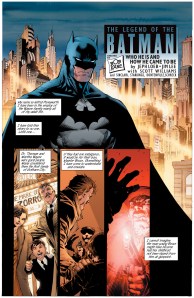
The above image, in case you hadn’t figured it out, is an updating of the classic Batman “quick-version” origin story, “The Legend Of The Batman – Who He Is And How He Came To Be” by Bill Finger and Bob Kane that I included with the last post. This modernized version was done for the Jeph Loeb/Jim Lee Batman storyline “Hush,” which is considered something of a modern “classic” even though, for my money, it pretty much sucks. I’ve never been a fan of Lee’s art, and the story here is essentially another drawn-out murder mystery by Loeb a la his “Long Halloween” storyline, and in point of fact he even employs the exact same plot conceit to disguise the identity of the true killer that he used in that previous series! All of which has precisely zero to do, specifically, with the hypothetical storyline of our hypothetical Bat-trilogy, save for one thing — folks who have read the “Hush” story should know that the Batman/Catwoman relationship depicted therein will have a big influence on how I see their relationship developing in this series. In an ideal world, I suppose, we’d just be able with this new series to come right out and admit a couple less-than-well-kept secrets about the Batman — namely that he’s gay and that he has a taste for a bit of, as the British would so politely put it, “rough trade,” but I think the world is, sadly, about 20 years years away from being ready and able to accept an openly gay Batman, so in this trilogy we’re going to keep up the pretense, paper-thin as it’s getting to be at this point, that the Caped Crusader is, indeed, heterosexual.
But we’re a good few posts away from really getting into the “meat” of how I see the whole Batman/Catwoman relationship evolving, being that we just wrapped up our pre-credit “teaser” sequence, the credits themselves have just rolled, and the there’s already a bit of a conundrum brewing in the audience’s mind as to whether or not this really is the Batman we’ve always known — as in, Bruce Wayne — at all.
Our first scene after the credits roll would be to see Bruce Wayne examining a large computer screen in the nearly-completed Batcave, and as the ever-reliable Alfred Pennyworth enters, they’ll exchange some dialogue about how two years of intense legwork are nearly complete — the cave itself, where Wayne has essentially been living and training, is all set, the “Bat vigilante” is firmly fixed in the public mind as a force that seems to be on their side, and their super-computer has been able to pin all the crime lords in town barring Vincent Lucchesi with plenty of criminal charges. Now is the time for the next phase in Bruce Wayne’s master plan to begin — he’ll “return” to Gotham officially, stake his claim to Wayne Enterprises through a surrogate, take the reins of the Thomas And Martha Wayne Foundation himself as his “day job,” and at night he’ll concentrate on nailing Lucchesi in his “Bat-vigilante” persona.
For that, though, he’ll need some help — and he’s zeroed in on two people on the “inside” that he’s made a calculated determination he can trust — new police commissioner Jim Gordon and new DA Harvey Dent. His period of working alone is over, and now that he’s delivered every other big crime lord in town to them, he’s earned a level of trust and respect from both these men. Lucchesi’s going to be a tougher nut to crack, though, because unlike the other guys, who could all be tied to the drug trade eventually through various phony business set-ups, bank accounts, etc., Gotham’s last “crime lord” doesn’t actually seem to be involved in the drug trade at all — the strangest thing Bruce Wayne/Batman has been able to come across in regards to Lucchesi is his well-concealed , even more well-concealed than the other guys were in regards to their involvement with the drug trade, orchestration of the shipment of large amounts of a perfectly legal, albeit quite dangerous, form of liquefied fertilizer into town, which naturally has Batman thinking that he’s working on a massive bomb of some sort.
Now, hopefully a competent screenwriter quite weave all this into a naturally-enough-sounding conversation that wasn’t too heavy on the info-dump and that would end with Alfred saying something along the lines of “well, all these questions will have to wait, sir, because Bruce Wayne is due in on a flight from San Francisco at noon on Friday.”
“And so I do, Alfred, and so I do.”
“And how, pray tell, do you intend to get to San Francisco undetected, sir?”
“You know, Alfred, I’m feeling a bit nostalgic — I thought I’d hop the rails for old times’ sake.”
I think I’ll leave it at that for now, since the next scene, with a clearly disguised-to-give-him-a-disheveled appearance Bruce Wayne playing hobo and riding in the back of a boxcar is the next crucial stage in the overall setup of the film’s first act and probably deserves a post of its own, so we’ll focus in on that tomorrow.
What say you to our little setup so far, then? Thumbs up? Thumbs down? Still too early to tell? As always, any and all comments are welcome, whether positive, negative, or aggressively neutral!
Since I previously shared two of my favorite scenes from The Brady Bunch Movie, I figured that today I would share one of my favorite scenes from 1996’s A Very Brady Sequel. In this scene, the Brady kids abduct Tim Matheson and force him to take part in an elaborate musical number.
While I try to review just about every film I see, there are times when I don’t get to review a film as soon as I would like. Fortunately, in this age of Netflix, DVDs, and Blu-ray, it’s never too late to review a film! I saw the following four films earlier this year. These reviews are a little late but here they are.
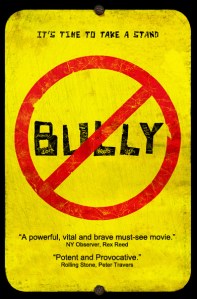
1) Bully (directed by Lee Hirsch)
This documentary, which follows and tells the story of several bullied teenagers over the course of one year, has the best of intentions and it’s definitely effective as far as making you dislike bullies and feel sorry for their victims. That said, did anyone really like bullies before this film was released?
Bully got a lot of attention when it was released earlier this year and a lot of people (who should have known better) said that the film itself was a solution to the problem of bullying. I doubt that this film (or anything else, for that matter) will solve the issue of bullying but it is a well-made look at what kids do whenever adults aren’t watching (and, sad to say, sometimes when they are).
One problem I did have with this film is that it chooses to limit itself to schools in small towns and rural communities, which gives the whole enterprise something of an elitist feel. Are there no bullies up north?
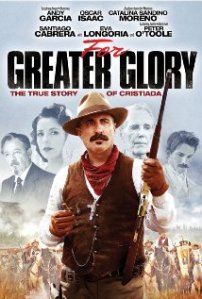
2) For Greater Glory (directed by Dean Wright)
For Greater Glory is a dramatization of the bizarrely obscure period of Mexican history known as the Cristero War. In 1920s, Mexican President Plutarco Elias Calles (played in this film by Ruben Blades) started a violent and relentless crackdown on the country’s Catholic faithful. Churches were burned, priests and nuns were murdered by supporters of the government, and eventually Catholic peasants rose up in violent rebellion. The Cristero War lasted from 1926 until 1929, eventually ending with a truce that was brokered by the U.S. Ambassador to Mexico, Dwight Morrow (played by Bruce Greenwood).
For Greater Glory set box office records in Mexico but it received some pretty negative reviews from American film critics. To a certain extent, the negative reviews are not surprising. The film is long, frequently heavy-handed and melodramatic and it’s also unapologetically pro-Catholic in its storytelling. (Roger Ebert, who never seems to get tired of apologizing for having been born into a Catholic family, was especially critical of that aspect of the film.)
With all that in mind, I still enjoyed For Greater Glory. It’s a well-made and ultimately rather moving film (though I imagine some parts of the film might be a bit confusing if you don’t have at least a little bit of a Catholic background) and it features excellent performances from Andy Garcia and Oscar Isaac as two of the rebel leaders. In many ways, For Greater Glory feels like a throwback to the epic films of the past and that’s not necessarily a bad thing.
3) Sound of My Voice (directed by Zat Batmanglij)
Like last year’s Another Earth, Sound of My Voice is a science fiction film that stars and was co-written by Brit Marling. The difference between the two is that Another Earth was a pretentious mess while Sound of My Voice is an effectively creepy little film that puts story and atmosphere above trite pronouncements about the state of existence.
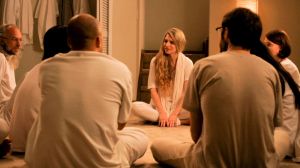
Brit Marling plays a mysterious woman who claims to have been sent from the future. She has a devoted cult of followers who spend their nights sitting on the floor around her, listening to her talk about the horrors waiting for them in the future. Two journalists go undercover and infiltrate her cult, hoping to expose her as a fraud.
Sound Of My Voice keeps the viewer guessing as to whether or not Marling is who she says she is and the film’s ending, while not a total surprise, is still effective enough to inspire debate after the end credits roll. As opposed to Another Earth, Marling gives an actual performance here and is both creepy and sympathetic at the same time.
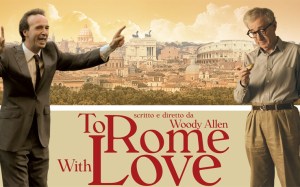
4) To Rome With Love (directed by Woody Allen)
Woody Allen’s follow-up to Midnight in Paris, To Rome With Love tells four separate stories that all take place in Rome. Despite the fact that the cast features everyone from Alec Baldwin to Roberto Begnini to Penelope Cruz to Ellen Page, the true star of the film is the city of Rome. I spent the summer after I graduated high school in Italy and this film brought back a lot of good memories.
Unfortunately, the film’s four stories are pretty uneven and the film’s frequent transitions from story to story are pretty awkward. The worst story features Alec Baldwin meeting his younger self (played by Jesse Eisenberg) and trying to prevent him from falling in love with a neurotic actress (Ellen Page). The film’s best story is a satiric fable about an ordinary man (played, in an excellent performance, by Roberto Begnini) who wakes up one day to discover that he’s the most famous man in Italy.
The film doesn’t really work but I still loved to getting to see Rome once again.
Down here in Texas, we love our legends and the Phantom Killer is one of the most haunting. In 1946, as American soldiers were returning from World War II and the country was looking forward to a future of peace and prosperity, an unknown killer stalked the moonlit streets of my former hometown of Texarkana, Texas. (Technically, of course, Texarkana is located in both Texas and Arkansas. In Texas, it’s usually assumed that the killer had to be from the Arkansas half of the town.) From February until May, he attacked 8 people and killed 5 of them. He stalked lovers who were parking at night and those that survived said that he hid his face underneath a white mask. Despite the best efforts of both the Texas Rangers and the Texarkana police, the Phantom Killer was never captured and his reign of violence ended just as mysteriously as it began.
(My personal theory is that he ended up moving to California where he later became the Zodiac killer because, seriously, the two cases are so disturbingly similar. Eventually, he left California and moved to Ohio and, living under a false name, he killed himself in 2002. )
When you read the facts of the Phantom Killer’s murder spree (not to mention all of the rumors and urban legends that have sprung up around the case), the main thing that jumps out at you is just how much it all truly does sound like a low-budget horror film. Therefore, it’s not surprising to discover that, in 1976, the case served as the basis for just that. What is surprising is just how effective The Town The Dreaded Sundown is.
The film was directed by Charles B. Pierce, an independent filmmaker who was based in Arkansas. Pierce had previously directed The Legend of Boggy Creek, a “documentary” that was about the mysterious Bigfoot-like creature who is rumored to live in Fouke, Arkansas. (Fouke, incidentally, is a town that my family briefly called home though none of us ever saw or heard any Bigfoots wandering about.) Using the money that he made off of the Boggy Creek film, Pierce wrote, directed, and produced The Town The Dreaded Sundown.
Using the same technique that made The Legend of Boggy Creek such a success, Pierce filmed The Town That Dreaded Sundown on location in Texarkana and, along with established actors like Ben Johnson, Andrew Prine, and Tina Louise Dawn Welles, Pierce cast the film with local citizens. When seen on screen, it’s obvious that these citizens are not professional actors. However, what they may lack in talent they make up for authenticity. (If nothing else, The Town That Dreaded Sundown is a rare Texas-set film in that it doesn’t feature any yankees butchering the dialect.) The fact that the film is narrated by a grim-sounding narrator only adds to the film’s documentary-like feel.
Admittedly, the film does take some liberties with the story of the Phantom Killer but what’s important is that it’s accurate when it matters. The film gets the basic facts correct and even the most outlandish of embellishments (such as a scene where the killer uses a trombone to kill one of his victims) don’t detract from the film’s power to frighten and disturb. If nothing else, these feel like the type of details that one might spontaneously mention while telling an old ghost story. Unlike a lot of “true crime” films, The Town The Dreaded Sundown never devotes too much time to trying to figure out the killer’s motives or drop hints as to his identity. Instead, the film emphasizes the fact that the Phantom Killer could never be understood and was never stopped. He simply existed, a malevolent force of evil. This makes the film far more effective than it would have been if Pierce had spent the movie trying to explain that which can not be explained.
Unfortunately, The Town That Dreaded Sundown has never been released on DVD but it does show up occasionally on TCM. Keep an eye out for it!
VGM Entry 57: Snatcher (part 2)
(Thanks to Tish at FFShrine for the banner)
Needless to say, when a game is released in six formats over a span of eight years the list of credits gets pretty wild. If we take Wikipedia’s unsourced credit synopsis for every Snatcher release mingled into one, it would appear that Akira Yamaoka, Keizou Nakamura, Masanori Adachi, Kazuhito Imai, and Masanori Ouchi are responsible for the score. But let’s not do that.
Konami’s ost releases generally only credit the Kukeiha Club as a collective, so that’s of no real help. Thanks to Snatcher‘s devout fan base though, a video of the end credits is available on youtube for every version of this game. They struck me as a bit suspect in so far as every version except the PC-Engine was in English, when only the Sega CD version was officially translated. But I do get the feeling–I’m sure plenty of people could easily confirm or deny–that a lot of games in Japan for whatever reason have English credits.
In any case, the PC-8801 ending credits are perhaps the most thorough I’ve ever seen in a game, and whether their English (Engrish really) is a fan translation or the authentic original, I do think it would be nice to provide a transcript. This is the track by track credits as listed in the two-part youtube video posted by AFX6502, condensed to save some space. Most tracks were listed with two names: one in quotations and one in parenthesis.
Compositions by M. Ikariko:
“Prologue Demo” (Bio Hazard Snatcher)
“Title Telop” (Evil Ripple)
“Pursuer Part1” (Creeping Silence)
“Pursuer Part3” (Pleasure of Tension)
“Pursuer Part4” (Endless Pursue)
“Katrine Part1” (Innocent Girl)
“Katrine Part2” (Theme of Katrine)
“Bath Room” (Virulent Smile)
“Joy Division” (Decadance Beat)
“Blow Up Tricycle”
“Mortuary Part1” (Morg)
“Restoration”
“Search Light” (Spreading Diehard)
“Credits”
“Game Over” (Lement for The Death)
Compositions by M. Shirakawa:
“Team Logo” (Slave to Metal)
“Jaime” (Theme of Jaime)
“Outer Heaven2” (Theme of Izabel)
“Title Part1” (Theme of JUNKER)
“Title Part2” (Theme of Randam)
“Title Part3” (Faded Memories)
“Title Part5” (Peace of Mind)
“Action” (Danger Dance…and Justice for all)
“Epirogue” (Beyond Sorrows)
Compositions by S. Fukami:
“Theme of Opening” (Twilight of Neo Kobe City)
“Outer Heaven1” (The Entrance to Hell)
“Goodbye Randam” (Eternal Promise)
“Requiem” (For Harry)
Compositions by S. Masuda:
“Pursuer Part2” (Criminal Omen)
“Pursuer Part5” (Follow up the Scent)
“Wrong Answer” (Axia)
“Transform Risa” (Virtual Image)
Compositions by M. Izumi:
“Ending 1” (Master of Puppets Among The Disease)
“Theme of Ending” (We Have to Struggle for Our Future Against Our Doubt)
Compositions by M. Adachi:
“Theme of Metal Gear” (Theme of Tara)
-remix from “Metal Gear” RC_750 1987-
Joint composition by I. Mizutani and M. Ikariko:
“Snatcher Title” (Squeak!!)
Composition by Pear Point:
“Jingle Bell” (Jingle Bell 2042)
So there you have it. Originally, Masahiro Ikariko composed 16 of the tracks, the rather elusive M. Shirakawa composed 9, and the remaining 13 were composed by a combination of Masanori Adachi, Seiichi Fukami, Mutsuhiko Izumi, Iku Mizutani, and another virtually anonymous figure, S. Masuda. Ikariko, Shirakawa, Fukami, and Masuda are given clear precedence over Adachi, Izumi, and Mizutani in the credits, and must have comprised the main music team. (While the credits to the original MSX version of Metal Gear are likewise confusing and Adachi is not listed where I looked, I have to assume he wrote the original song, “Theme of Tara”, upon which the Snatcher tune is based and had no direct involvement here.) We don’t even know M. Shirakawa and S. Masuda’s full names. Isn’t that something?
The PC-8801 credits tell us quite a bit more about Snatcher‘s music than simply the track-by-track credits. For instance, chief editors Hideo Kojima and Naoki Matsui named the songs. Iku Mizutani did the sound effects, and Masahiro Ikariko and Kazuhiko Uehara “arranged” the music–a credit Konami clearly distinguishes from composition.
The MSX2 credits are included in the PC-8801 version, so there’s no ambiguity on this front. Masahiro Ikariko and Kazuhiko Uehara made the MSX2 arrangements (with the exceptions of “Theme of Metal Gear”, converted by Uehara and Mizutani, and “Jingle Bell”, converted by Ikariko, Uehara, and Shirakawa).
The PC-Engine credits are in Japanese, and in the mess of a hundred open Firefox tabs I’ve lost track of the url to the translation I found, but I did copy it down:
It’s kind of weird to me that Shirakawa, who wrote a quarter of the music in the game, is not included here, but perhaps he and Masuda had left Konami and were erased from memory. Or perhaps Ikariko, Fukami, and Izumi returned to write additional material, but based on the songs I’ve heard, I get the impression that the list of original compositions for the PC-Engine version is quite short. Based on how the PC-8801’s credits were worded, I am lead to believe the PC-Engine arrangement was Kazuki Muraoka’s baby, with Motoaki Furukawa filling in the few added original tracks, however Furukawa has referred to himself as being “in charge of the BGM” for the PC-Engine port. Whether he meant merely the new compositions or the arrangements of the originals is beyond me.
The PC-Engine version and future releases included a revamped intro scene, for which I’ve provided the Sega CD take in spite of its awful voice acting, so that you can hear it in English. “One Night in Neo Kobe”, the song beginning at 2:55 in this video, was one of the new PC-Engine additions written by Motoaki Furukawa (he also confirmed composition of “Tears and Stains”, which must be “Tear-Stained Eyes“), and it remains one of the most famous songs of the game.
The Sega CD port was the first major departure from Ikariko and company’s original score. The credits here, which I’ve derived directly from the English version of the game, are pretty vague:
This list is kind of strange, because it was the Sega CD port’s arrangement that made it so drastically distinct from the first three versions. The songs were still based on the originals, but in a manner akin to Rob Hubbard and Tim Follin’s liberal port adaptations (consider the C64 ports of Commando and Bionic Commando respectively, for example). The credits clearly refer to the Sega CD arrangement, and Masanori Adachi must have been directly involved this time around. Even so, some of the tracks, “One Night in Neo Kobe”, aren’t even arrangements, but rather the exact same songs appearing on the PC-Engine. It’s pretty odd that Motoaki Furukawa and Kazuki Muraoka are restricted to a “Special Thanks” mention at the end of the credit roll.
Also, the distinction between “Sound Design” and “Sound Programmer” is completely obscure here. Konami don’t even bother with distinguishing between music and sound effects. Some of the ‘sound design team’ credits may have almost no real involvement in the music. Keizou Nakamura is credited specifically for SFX in a later version of the game, suggesting that that was his role here as well, and someone claiming to have spoken with Akira Yamaoka says he had little to no involvement in the project.
At this point in time technology may have advanced to the point where “programmer” did not as a rule imply “arranger”, and it’s possible that Osamu Kasai and Akira Souji’s contributions comprised a technical task which made the audio possible but did not affect what it actually sounded like. Never mind my uneducated speculation though; suffice to say the Sega CD port is a grey area dividing the old Snatcher compositions from the new.
Most PSX/Sega Saturn Snatcher songs were in fact new compositions entirely distinct from the originals. “The Morgue” is an example in which the changes are pretty rewarding. I think they definitely improve the whole ‘surrounded by rotting corpses’ atmosphere, whether that is actually the appropriate atmosphere for the scene in context or not. It does little to compensate for the outrageous censorship rules Sony inherited from Nintendo, but whatever. Here are the credits for both:
PSX: Sound System Programmer:
Noritada ‘Nor’ Matukawa Sound Mixer:
God Adachi Music Composer/Arranger/Performer:
KIDA-Sun SFX:
Hiroe Noguchi Guest composers:
Hiroshi Tamawari
Akira Yamaoka
Kosuke Soeda Guest Performer:
Tappy Original Score Composers:
Kazuki Muraoka
Motoaki Furukawa
Saturn: Sound Programmer:
Akiropito Sound Mixer:
Masanori Adachi
Music Composer/Arranger/Performer:
KIDA Sun
Syouichirou Hirata SFX:
Keizou Nakamura Guest composers:
Akira Yamaoka
Hiroshi Tamawari
Guest Performer:
Tappy Original score composers:
Kazuki Muraoka
Motoaki Furukawa
Akira Yamaoka
Hiroshi Tamawari
KIDA Sun
If you’re curious about the aliases here, “Akiropito” is Akira Souji, “God Adachi” is Masanori Adachi, “Tappy” is Tappi Iwase, and I couldn’t find the slightest clue for identifying “KIDA-Sun”. This makes for an odd discussion, as “KIDA-Sun” appears to be the most responsible party for the PSX and Saturn soundtracks. It’s also rather strange that Akira Yamaoka, Hiroshi Tamawari, and KIDA-Sun are listed as original score composers on the Saturn but not on the PSX, as to the best of my knowledge the Saturn used the exact same songs, making only minor (but always for the better) changes throughout. I don’t know that this change to the credits indicates a real change though: Akira Yamaoka and Hiroshi Tamawari are listed as ‘guest composers” in both versions, and a guest composer is still a composer, so it might all boil down to redundancy. In that case, we need only ask what became of Kosuke Soeda.
So basically, our credits look like this:
PC-8801 and MSX2
Composition: Masahiro Ikariko (16), M. Shirakawa (9), Seiichi Fukami (4), S. Masuda (4), Mutsuhiko Izumi (2), Iku Mizutani (1), Masanori Adachi (1)
Arrangement: Masahiro Ikariko, Kazuhiko Uehara
PC-Engine
Composition: Primarily the original 1988 staff, with additions (probably) limited to Kazuki Muraoka and Motoaki Furukawa
Arrangement: Kazuki Muraoka
Sega CD
Sound staff: Keizou Nakamura, Masanori Adachi, Kazuhito Imai, Masanori Ouchi, Akira Yamaoka
Sound Programmer: Osamu Kasai, Akira Souji

 Through the Shattered Lens