Thousand Years of Dreams Day 04: In the Mind of a Captive


On the 4th Day of our Thousand Years of Dreams we find Kaim, the eternal warrior, remembering a particularly hopeless and spirit-sapping dream of a time when he was imprisoned during his thousand years of wandering the lands.

There’s something beyond just the horror of imprisonment and how it’s  effect on the mind and spirit of the imprisoned is more dangerous than to their body. While the dream is about one of the many time he has experienced such stagnation of the mind and spirit the very theme underlying the tale could be attached to one’s everyday life. One doesn’t have to be in an actual prison to have an idea of what Kaim speaks of.

This actual prison could be of one’s making as they go through life stuck in doing something which saps their creativity and spirituality. Anyone who has ever found themselves in a line of work which does nothing to encourage growth and foster enjoyment of life would understand what Kaim speaks of. Who here has seen themselves stuck in a job they hate, but unable to quit because they’ve lost sight of how to enjoy life thus work is all there is. Who here has found themselves in a relationship which has stagnated and afraid to free themselves because they don’t see themselves as able to find new friends and partners to enjoy life with.

It’s these prisons both real and of metaphorical which this dream tries to impart a lesson which Kaim tries to remember. That brief puff of air moving a welcome respite to the unchanging air or the change of scenery even if the briefest of moments helps in keeping one’s sanity and spirit from dying. It’s such little things that we try to remember to do to bring a semblance of change to our humdrum and locked in lives which brings people a step closer to freedom and fully enjoying once again.

I find this dream quite illuminating in how so many of us refuse to risk new things and attempt the unknown for fear of failure, embarrassment and ridicule. We’d rather keep ourselves safe and secure doing the same things over and over again and as each such day passes the more bricks we build around our own personal prisons.

In the Mind of a Captive

He knows that it is useless. But he can’t suppress the impulse that wells up from within his own flesh.

He needs to do it—to hurl his entire body against the bars. It does no good at all. His flesh simply bounces off the thick iron bars. “Number 8! What the hell are you doing?” The guard’s angry shout echoes down the corridor. The prisoners are never called by name, only by the numbers on their cells. Kaim is Number 8.


Kaim says nothing. Instead, he slams his shoulder against the bars.

The massive bars of iron never nudge. All they do is leave a dull, heavy ache in Kaim’s superbly conditioned muscles and bones.

Now, instead of shouting again, the guard blows his whistle, and the other guard come running from their station.

“Number 8! What’s it going to take to make you understand?”

“Do you want to be thrown into the punishment cell?”

“Don’t look at me like that. Start resisting, and all it will get you is a longer time in here!”


Sitting on the floor of his cell, legs splayed out, Kaim ignores the guards’ shouts.

He has been to the punishment room any number of times. He knows he has been branded a “highly rebellious prisoner.”

But he can’t help himself.

Something is squirming deep down inside him.

Some hot thing trapped inside there is seething and writhing.


“Some war hero you turned out to be!” says one guard.

“You can’t do shit in here. What’s the matter, soldier boy? Can’t do anything without an enemy staring you in the face?”

The guard next to him taunts Kaim with laughter.

“Too bad for you, buddy, no enemies in here? Nobody from your side, either. We’ve got you locked up all by yourself.”

After the guards leave, Kaim curls up on the floor, hugging his knees, eyes clamped tight.


All by myself—

The guard was right.

I thought I was used to living alone, in battle, on the road.

But the loneliness here in prison is deeper than any I’ve ever experienced before.

And more frightening.

Walls on three sides, and beyond the bars nothing but another wall enclosing the narrow corridor.

This dungeon was built so as to prevent prisoners from seeing each other, or even to sense each others’ presence.


The total lack of a change in the view paralyzes the sense of time as well. Kaim has no idea how many days have passed since he was thrown in here. Time flows on, that much is certain. But with nowhere to go, it simply stagnates inside him.

The true torture that prison inflicts on a man is neither to rob him of his freedom nor to force him to experience loneliness.

The real punishment is having to live where nothing ever moves in your field of view and time never flows.

The water in a river will never putrefy, but lock it in a jar and that is exactly what it will eventually do.

The same is true here.


Maybe parts of him deep down in his body and mind are already beginning to give off a rotten stench.

Because he is aware of this, Kaim drags himself up from the floor again and slams himself into the bars over and over.

There is not the remotest chance that doing so will break a bar.

Nor does he think he can manage to escape this way.

Still, he does it repeatedly.


He can’t help himself. He has to do it again and again.

In the instant before his body smashes into that bars—for that split second—a puff of wind strikes his cheek. The unmoving air moves, if only for that brief interval. The touch of the air is the one thing that gives Kaim a fragmentary hint of the flow of time.

The guards comes running, face grim with anger.

Now I can see human shapes where before there was only a wall. That alone is enough to lift my spirits. Don’t these guards realize that?

“All right, Number 8, it’s the punishment room for you! Let’s see if three days in there will cool your head!”


Kaim’s lips relax into a smile when he hears the order.

Don’t these guys get it? Now my scenery will change. Time will start flowing again. I’m thankful for that.

Kaim laughs aloud.

The guards tie his hand behind him, put chains on his ankles, and start for the punishment room.

“What the hell are you laughing at, Number 8?”

“Yeah, stop it! We’ll punish you even more!”

But Kaim just keeps on laughing; laughing at the top of his lungs.


If I fill my lungs with all new air, will the stench disappear?
Or have my body and mind rotted so much already that I can’t get rid of the stench so easily?
How long will they keep me locked up in here?
When can I get out of here?
Will it be too late by then?
When everything has rotted away, will I become less a “him” than an “it,” the way our troops count enemy corpses?


Kaim can hardly breathe.

It is as if the air is being squeezed out of his chest and the excruciating pain of it is drawing him back from the world of dreams to reality.

Was I once in a prison in the far, far distant past?

He half-wanders in the space between dream and reality.

He has had this dream any number of times—this nightmare, it might even be called. After waking, he tried to recall it, but nothing stays in his memory. One thing is certain, however: the appearance of the jail and of the guards in the dream if always the same.


Could this be something I have actually experienced?
If so, when could it have been?

There is no way for him to tell.


Once he is fully awake, those questions he asked between dream and reality are, themselves, erased from his memory.

He springs up with a scream, his breath labored, the back of his hand wiping the streams of sweat from his brow, and all that is left is the shuddering terror. It is always like this.

Now, too—


He mutters to himself as he attempts to retrieve whatever memory is left in a remote corner of his brain. “What kind of past life could I have lived through?”

End
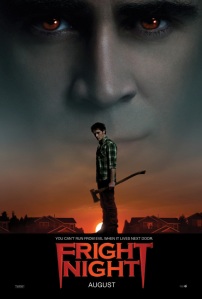
Quick Review: Fright Night (dir. by Craig Gillespie)


I want to say great things about Craig Gillespie’s remake of Fright Night. I want to say that it was worth seeing and it was full of awesome moments. I also wanted to be able to write this review without making so many comparisons to the 1985 Original by Tom Holland. Not that the original was a masterpiece by any means, but I dozed off (just a little) on this film.

If there’s only one reason I could give for recommending Fright Night, it would be to get a taste of what Vampires should be. Don’t read me wrong on this. I own all four Twilight books in hardcover, read them repeatedly, and have seen the three films that came out in the theatre. It’s just nice to see a vampire movie that shows vampires more as predatory creatures than sparkling A&F models.  There’s an edge to this film that’s pretty fun in a lot of ways. Both Colin Farrell and David Tennant have great roles here and even Anton Yelchin holds his own, but there’s a weird breakdown that happens. Fright Night is a good film, as long as you don’t try to make any kind of direct comparisons to the source material.

The story focuses on Charlie Brewster (Yelchin), a teenager – the story being in Vegas this time –  who discovers he has a vampire named Jerry Dandrige (Farrell) living next door to him. When the vampire confronts Charlie, Charlie is forced to seek out help in the form of Peter Vincent (Tennant) to defeat him. While there were a few scenes that really stood out for me and I found myself smiling more often than rolling my eyes, the pacing of this was off. Other audiences may find that the movie moved well. I felt like they were just throwing things to say “Well, wouldn’t it be cool if they did this, and then that.”

The two problems I had with Fright Night were it’s pacing and Chris Mintz-Plasse. Chris is fun to watch at the start, and I’d love to see him do more, but someone really has to give him something where he’s not playing the “token geek”.  While I liked the movie overall, there’s a lot of verbal exposition in the beginning of the film, as Charlie doesn’t so much discover the truth about Jerry, but is pretty much told the entire scenario he’s in about 15 minutes into the start. I had a problem with that. Again, depending on the audience, the movie may move just fine.

Fright Night is one of those films could be a love it or hate it. I’m of the audience that will probably catch it again when it’s out on video, but it doesn’t feel like anything you really have to rush to the theatre for.

“Don’t You Forget About Me” — The Psych Version


Okay, so basically this is just a commercial for a show that I don’t watch but it’s just so adorable that I had to feature it.  The show, by the way, is called Psych and it’s on the USA network.  I know a lot of people who love this show but I’ve honestly never seen it, largely because I always forget just where exactly the USA network is located on AT&T U-verse.

But if I do end up tracking down the USA Network and watching an episode, it’ll be because of this commercial.  Seriously, it’s just so adorable!


6 Trailers That Will Change The Way The Trees Look At Midnight


It’s Saturday and that means its time for my favorite part of  the week — the latest edition of Lisa Marie’s Favorite Grindhouse and Exploitation Trailers!

1) The Losers (1970)

Not to be confused with the 2010 action film, this Losers has been described as the best “bikers-in-Viet-Nam film ever.”  It was directed by Jack Starrett and, like every other biker film from 1970, it stars William Smith.

2) The Girl on a Motorcycle (1968)

Continuing the theme of crazed bikers, this trailer is short but effective.  Especially when Alain Delon pulls down that zipper with his teeth….

3) Chatterbox (1977)

This is another short trailer, in fact, I think — at just 30 seconds — it might be the shortest trailer I’ve ever featured in this series.  Anyway, Chatterbox is a film about a woman whose vagina can talk and, apparently, sing.  I have never seen this film though I have seen a few isolated clips.  I hope if my vagina ever starts to speak, it 1) has a less annoying voice and 2) just displays a lot more wit and personality in general.  Anyway, the talking vagina is not featured in this trailer.  Anyway, you wouldn’t know any of that from watching the trailer, which I think is odd.  I mean, if you’re going to make a film about a talking vagina, shouldn’t the vagina be allowed to speak for itself?  Just saying…

4) Baba Yaga (1973)

Like all good things, this trailer comes to us from Italy.

5) Disco Fever (1978)

Wow!  Disco, a concorde, dirt bike racing, braless dancers, and a boring 40 year-old rock star with a cocaine-flecked beard.  Could this film be any more 70s?  “Disco Fever — Everything is perfect…until the music stops!”

6) American Fever (1978)

Okay, I’m either in a disco mood or else I’m running a fever because I just have to end things with a second disco film.  This is an Italian film.  Does anyone out there own the American Fever soundtrack? 


Thousand Years of Dreams Day 03: White Flowers


For Day 3 of the 33 Days of Thousand Years of Dreams we have the Lost Odyssey dream sequence called “White Flowers”.

Like the first two dreams already posted this one continues to have Kaim remembering one of the uncounted memories he thought had had lost. Memories which stretches a thousand years or more. “White Flowers” is a dream memory that leans towards melancholy, but with a sense that it was still one of the happier moments in the life of the eternal warrior. For those who are not eternal it’s a poignant short story on how calamitous events and how they’re initially remembered change through the decades and centuries. How the farther one gets from the initial catastrophe the less mournful each anniversary becomes until it finally turns celebratory for how survivors have recovered and their descendants prospered.

In the end, “White Flowers” more personal and intimate meaning as scene from the eyes of Kaim gives the lesson that we should always live our lives to the fullest. Lives that could continue for decades and into old age, but also lives easily snuffed out just before it has truly begun to live. Live life every day like it was the last then do the same when a new day begins.

White Flowers

Lovely white flowers mask the town. They bloom on every street corner, not in beds or fields set aside for their cultivations, but blending naturally and in line with every row of houses, as though the buildings and the blossoms have grown up together.

The season is early spring and snow still lingers on the nearby mountains, but the stretch of ocean that gently laps the town’s southern shore is bathed in refulgent sunlight.

This is an old and prosperous harbor town.

Even now, its piers see many cruise ships and freighters come and go.


Its history, however, is sharply divided between the time “before” and the time “after” an event that happened one day long ago.

People here prefer not to talk about it—the watershed engraved upon the town’s chronology.

The memories are too sorrowful to make stories out of them.

Kaim knows this, and because he knows it, he has come here once again.


“Passing through?” the tavern master asks him.

At the sound of his voice, Kaim responds with a faint smile.

“You’re here for the festival, I suppose. You should take your time and enjoy it.”

The man is in high spirits. He has joined his customers in glass after glass until now and is quite red in the face, but no one shows any signs of blaming him for overindulging. Every seat in the tavern is filled and the air reverberates with laughter. Happy voices can be heard now and then as well from the road outside.

The entire town is celebrating. Once each year the festival has people making merry all night long until the sun comes up.


“I hope you’ve got a room for the night, Sir. Too late to find one now! Every inn is full to overflowing.”

“So it seems.”

“Not that anyone could be foolish enough to spend a night like this quietly tucked away under the covers in his room.”

The tavern master winks at Kaim as if to say “Not you, Sir. I’m sure!”

“Tonight we’re going to have the biggest, wildest party you’ve ever seen, and everybody’s invited—locals or not. Drink, food, gambling, women: just let me know what you want. I’ll make sure you have it.”


Kaim sips his drink and says nothing.

Because he is planning to stay awake all night, he has not taken a room—though he has no plans to enjoy the festival, either.

Kaim will be offering up a prayer at the hour before dawn when the night is at its darkest and deepest. He will leave the town, sent off by the morning sun as it pokes its face up between the mountains and the sea, just as he did at the time of his last visit. Back then, the tavern master, who a few minutes ago was telling one of his regular customers that his first grandchild is about to be born, was himself just an infant.

“This one’s on me, drink up!” says the tavern master, filling Kaim’s shot glass.

He peers at Kaim suspiciously and says, “You did come for the festival, didn’t you?”


“No, not really,” says Kaim.

“Don’t tell me you didn’t know about it!
You mean you came here by pure chance?”

“Afraid so.”

“Well, if you came here on business, forget it.
You’ll never get serious talk out of anybody on a special night like this.”

The tavern master goes on to explain what is so special about this night.

“You must’ve heard something about it. Once, a long time ago, this town was almost completely destroyed.”


There are two great events that divide history into “before” and “after”: one is the birth or death of some great personage—a hero or a savior.

The other is something like a war or plague or natural disaster.

What divided this town’s history into “before” and “after” was a violent earthquake.

It happened without warning and gave the soundly sleeping people of the town no chance to flee.

A crack opened up in the earth with a roar, and roads and buildings just fell to pieces.

Fires started, and they spread in the twinkling of an eye.

Almost everyone was killed.


“You probably cant imagine it. All I know is what they taught me in school. And what does ‘Resurrection Festival’ mean to a kid! It was just something that happened ‘once upon a time.’ I live here and that’s all it means to me, so a traveler like you probably can’t even begin to imagine what it was like.”

“Is that what they call this holiday? ‘Resurrection Festival’?”

“Uh-huh. The town was resurrected from a total ruin to this.
That’s what the celebration is all about.”

Kaim gives the man a grim smile and sips his liquor.

“What’s so funny?” the tavern master asks.


“Last time I was here, they were calling it ‘Earthquake Memorial Day.’
It wasn’t a festival for this kind of wild celebrating.”

“What are you talking about?
It’s been the ‘Resurrection Festival’ ever since I was a kid.”

“That was before you were old enough to remember anything.”

“Huh?”

“And before that, they called it ‘Consolation of the Spirits.’ They’d burn a candle for each person who died, and pray for them to rest in peace. It was a sad festival, lots of crying.”

“You sound as if you saw it happening yourself.”

“I did.”


The tavern master laughs with a loud snort.

“You look sober, but you must be plastered out of your mind! Now listen, it’s festival night, so I’m going to let you off the hook for pulling my leg, but don’t try stuff like that in front of the other townspeople. All of our ancestors—mine included—are the ones who barely escaped with their lives.”

Kaim knows full well what he is doing. He never expected the man to believe him.

He just wanted to find out himself whether the townspeople were still handing down the memories of the tragedy—whether, deep down behind their laughing faces, there still lingered the sorrow that had been passed down from their forefather’s time.


Called away by one of his other customers, the tavern master leaves Kaim’s side but not without first delivering a warning.

“Be careful what you say, Sir. That kind of nonsense can get you in trouble. Really. Think about it: the earthquake happened all of two hundred years ago!”

Kaim does not answer him.

Instead, he sips his liquor in silence.

Among the ones who died in the tragedy two hundred years ago were his wife and daughter.

Of all the dozens of wives and hundreds of children that Kaim has had in his eternal life, the wife and child he had here were especially unforgettable.


In those days, Kaim had a job at the harbor.

There were just the three of them—he, his wife, and their little girl.
They lived simply and happily.

The same kind of days that had preceded today would continue on into endless tomorrows. Everyone in the town believed that—including Kaim’s wife and daughter, of course.

But Kaim knew differently. Precisely because his own life was long without end and he had consequently tasted the pain of countless partings, Kaim knew all too well that in the daily life of humans there was no “forever.”

This life his family was leading would have to end sometime. It could not go on unchanged. This was by no means a cause for sorrow, however. Denied a grasp upon “forever,” human beings knew how to love and cherish the here and now.


Kaim especially loved to show his daughter flowers—the more fragile and short-lived the better.

Flowers that bloomed with the morning sun and scattered before the sun went down. They were everywhere in this harbor town: lovely, white flowers that bloomed in early spring.

His daughter loved the flowers. She was a gentle child who would never break off blossoms that had struggled so bravely to bloom. Instead, she simply watched them for hours at a time.

That year, too…


“Look how big the buds are! They’ll be blooming any time now!” she said happily when she found the white flowers on the road near the house.

“Tomorrow, maybe?” Kaim wondered aloud.

“Absolutely!” his wife chimed in merrily. “Get up early tomorrow morning and have a look!”

“Poor little flowers, though,” said the daughter. “It’s nice when they bloom, but then they wither right away.”

“All the better” said Kaim’s wife. “It’s good luck if you get to see them blooming. It makes it more fun.”


“It may be fun for us,” answered the girl. “But think about the poor flowers. They work so hard to open up, and they wither that same day. It’s sad…”

“Well, yes, I guess so…”

A momentary air of sadness flowed into the room, but Kaim quickly dispelled it with a laugh.


“Happiness is not the same thing as ‘longevity’!” he proclaimed.

“What does that mean, Papa?”

“It may not bloom for long, but the flower’s happy if it can open up the prettiest blossom and give off the sweetest perfume it knows how to make while it is blooming.”

The girl seemed to be having trouble grasping this and simply nodded with a little sigh. She then broke into a smile and said, “It must be true if you say so, Papa!”

Your smile is more beautiful than any flower in full bloom.

He should have said it to her.

He later regretted that he had not.

The words he had uttered so carelessly, he came to realize, turned out to be something of a prophecy.


“Well now, young lady,” he said. “If you’re getting up early to see all the flowers tomorrow morning, you’d better go to bed right now.”

“All right, Papa, if I really have to…”

“I’m going to bed now, too” said Kaim’s wife.

“Okay, then. G’nite, Papa.”

His wife said to Kaim, “Good night, dear. I really am going to bed now.”

“Good night” Kaim replied, enjoying one last cup to ease the day’s fatigue.


These turned out to be the last words the family shared.


A violent earthquake struck the town before dawn.

Kaim’s house collapsed in a heap of rubble.

Kaim’s two loved ones departed for that distant other world before they could awaken from their sleep and without ever having had a chance to say “Good morning” to him.


The morning sun rose on a town that had been destroyed in an instant.

Amid the rubble, the flowers were blooming—the white flowers that Kaim’s daughter had wanted so badly to see.

Kaim thought to lay a flower in offering on his daughter’s cold corpse, but he abandoned the idea.

He could not bring himself to pick a flower.

No one—no living being on the face of the earth, he realized—had the right to snatch the life of a flower that possessed that life for only one short day.


Kaim could never say to his daughter,
“You go first to heaven and wait for me: I’ll be there before long.”


Nor would he ever know the joy of reunion with his loved ones.


To live for a thousand years, meant bearing the pain of a thousand years of partings.


Kaim continued his long journey.

A dizzying numbers of years and months followed by: years and months during which numberless wars and natural calamities scourged the earth. People were born, and they died. They loved each other and were parted from the ones they loved. There were joys beyond measure, and sorrows just as measureless. People fought and argued without end, but they also loved and forgave each other endlessly. Thus was history built up as the tears of the past evolved gradually into prayers for the future.


Kaim continued his long journey.

After a while, he rarely thought about the wife and daughter with whom he had spent those few short days in the harbor town. But he never forgot them.

Kaim continued his long journey.

And in the course of his travels, he stopped by this harbor town again.


As the night deepened, the din of the crowds only increased, but now, as a hint of light comes into the eastern sky, without a signal from anyone, the noise gives way to silence.

Kaim has been standing in the town’s central square. The revelers, too, have found their way here one at a time, until, almost before he knows it, the stone-paved plaza is filled with people.

Kaim feels a tap on the shoulder.

“I didn’t expect to find you here!” says the tavern master.

When Kaim gives him a silent smile, the tavern master looks somewhat embarrassed and says, “There’s something I forgot to tell you before…”

“Oh…?”


“Well, you know, the earthquake happened a long time ago. Before my father and mother’s time, even before my grandparents’ generation. It might sound funny for me to say this, but I can’t imagine this town in ruins.”

“I know what you mean.”

“I do think, though, that there are probably things in this world that you can remember even if you haven’t actually experienced them. Like the earthquake: I haven’t forgotten it. And I’m not the only one. It may have happened two hundred years ago, but nobody in this town has ever forgotten it. We can’t imagine it, but we can’t forget it, either.”


Just as Kaim nods again to signal his understanding of the tavern keeper’s words, a somber melody echoes throughout the square. This is the hour when the earthquake destroyed the town.

All the people assembled here close their eyes, clasp their hands together, and offer up a prayer, the tavern master and Kaim among them.

To Kaim’s closed eyes come the smiling faces of his dead wife and daughter. Why are they so beautiful and so sad, these faces that believe with all their hearts that tomorrow is sure to come?


The music ends.

The morning sun climbs above the horizon.

And everywhere throughout the town bloom countless white flowers.


In two hundred years, the white flowers have changed.

The scientists have hypothesized that “The earthquake may have changed the nature of the soil itself,” but no one knows the cause for sure.

The lives of the flowers have lengthened.


Where before they would bloom and wither in the space of a single day, now they hold their blooms for three and four days at a time.

Moistened by the dew of night, bathed in the light of the sun, the white flowers strive to live their lives to the fullest, beautifying the town as if striving to live out the portion of life denied to those whose “tomorrows” were snatched away from them forever.

End

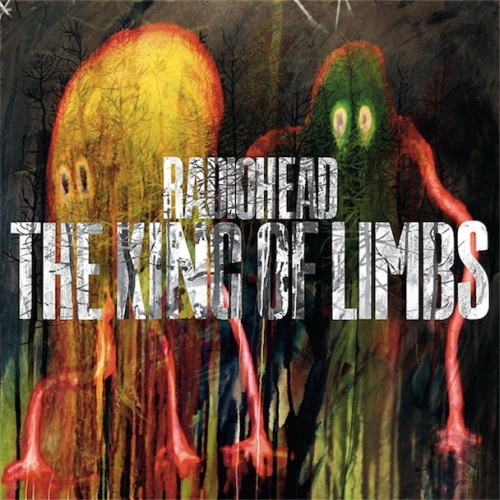
Review: Radiohead – The King of Limbs


I have never heard anyone say that a Radiohead album was bad. They’re probably the most respected group of musicians in the world, and not without good reason. But they do change quite a lot. Not every album is for everybody. Kind of like Kid A, In Rainbows just really didn’t do much for me when it was released. Oh, I recognized it as one of the better albums of the year, but it just wasn’t my thing. The problem was an eight year gap. By 2011, I’d long played all of the others to death. Radiohead had faded from my favorite band in the world to a distant memory–some pleasant reminder of my high school years and nothing more.

So The King of Limbs is pretty much a dream come true. As that kid who always liked Amnesiac more than Ok Computer, what I would have ideally wanted in a new Radiohead album probably doesn’t comply with the average opinion. But I won. The King of Limbs is a return to that smooth, laid back, jazzy side of the band that poked its head out in 2001 and then went into hiding for a decade.


Bloom

It’s pretty hard to talk about what makes any Radiohead album good, but I think I can safely point to the bass effects as The King of Limb’s most dominant feature. The first three tracks are all similarly constructed–short drum loops that vary little over the course of a given song, underpinned by bass sounds that are always looking forward and lending a great deal of flavor to otherwise very repetitive music. There’s a gliding feeling present throughout, like the songs are sliding across ice in perpetual motion. Little electronic bubbles of sound dot the bass progression, lighting the path. You don’t anticipate the destination, you just enjoy the ride. Vague? It’s a Radiohead album. You can only really talk about it in metaphors.


Morning Mr. Magpie

Like any Radiohead album, the track order matters for better or worse, despite being only 37 minutes long. I’m not going to say there’s a definite, intentional progression to it, but everything feels like it’s in the right place to create a well-rounded picture. The first three songs all have this incredibly chill Amnesiac feel to them–the same sort of vibe I get from say, I Might Be Wrong and Dollars and Cents. You can’t necessarily feel a transition coming in Little By Little, but it’s decidedly less dreamy than the first two. If they’re going to make a move, it’s the best one to lead off from. What follows might not be expected though. Feral turns out to be one of those experimental glitchy Radiohead à la Aphex Twin efforts that found some presence in The Gloaming but were otherwise regulated to b-sides starting on the Knives Out and Pyramid Song singles.

Track five, Lotus Flower, returns to elements of the first three songs, but there’s nothing smooth about it. It feels pretty tense if you ask me. Thom’s voice is more longing, an eerie keyboard sneaks in and out of the background, and there’s this kind of creepy clapping hand effect that makes me feel like the whole song is about ready to snap. I haven’t yet convinced myself that I like it, and the span of Feral and Lotus Flower is definitely the weak link of the album for me, but better to keep the tension to the middle than to throw me off at the beginning or end. From track six on it’s a calm ride again.


Codex

Codex, my favorite track, might start out feeling like Pyramid Song, and it has a lot of the same dreamy qualities, but it never picks up. It’s just Thom, a piano, and some minimal mournful effects. What he’s singing is anybody’s guess half the time, and the cd packaging offers no guidance there, but what I looked up put it as “Slight of hand, jump off the end into a clear lake, no one around. / Just dragonflies flying to the side. No one gets hurt. You’ve done nothing wrong. / Slide your hand, jump off the end. The water’s clear and innocent. The water’s clear and innocent.” Simple and beautiful, and the antithesis of the song that precedes it.

The next song, Give Up the Ghost, follows the same trend, replacing minimalistic piano for equally subdued guitar and a backing vocal loop that has a sort of blues feel to me. The two go together perfectly to round out the real meat of the album. I think I’d describe the first seven tracks as gliding forward smoothly, hitting a rocky road, and being content to stand perfectly still and fade away. Then there’s Separator.


Separator

I’m not sure where this song comes from. It feels out of place and yet perfectly fitting, a sort of ending credits. Radiohead have a long tradition of putting the most out of place song at the end, usually with great results, and this is no different. Separator is smooth and upbeat, a lot like the first three songs, but it’s stationary like Give Up the Ghost. Who knows what the band’s getting at here, but it’s suggestive in a lot of ways. It’s a song about waking up. The album is done, the dream is finished, but “if you think this is over with you’re wrong.“. It’s just the separator; there’ll be more to come. Never mind how fatalistic the last two tracks felt, no one is giving up the ghost here.

Radiohead have been around for an awfully long time, but it’s only the brevity of this album that makes it feel like a late-career effort to any extent. It’s difficult to rate the quality in comparison to other Radiohead albums because of the lack of quantity, but it’s excellent in its own right. If anything it feels more like Radiohead in their prime to me than In Rainbows did (if I can call that 1997-2003 without much debate), but it also demands a more timely follow-up than they’ve been offering lately. I’m sure if you already like Radiohead you don’t require any convincing to check this one out, but I especially recommend it to my fellow Amnesiac fans.

Thousand Years of Dreams Day 02: A Hero’s Return


While “Hanna’s Departure” was my favorite dream sequence from Lost Odyssey the rest had their own emotional power and for some were more relevant. What I failed to mention in the Day 01 post was just who the person named Kaim being mentioned in the dream. Kaim is the main protagonist in the game and he’s an immortal who has lost all the memories of experiences gathered through 1000-years of journeying the world he’s in.

These dreams, when activated in the game through a fortuitous encounter with someone or witnessing a seemingly random event, begin to add layers of complexities to the Kaim character and what he had experienced throughout the millenia as wandering immortal warrior.

Day 02’s dream sequence is quite relevant to today’s times as we see Kaim re-live a memory of a warrior returning from 3 years of war and battles. We see how Kaim’s reaction to this battle-weary veteran differs from that of a younger man’s who has never experienced war first-hand. With tens of thousands of soldiers, airmen and sailors returning from battlefields in Iraq and Afghanistan it’s hard not to find a link with the experiences those men and women went through with the prospect of returning to their loved ones a major reason for them to stay alive and do what they had to do to accomplish that goal.

A Hero’s Journey

Alone in a crowd of rugged men, nursing his drink in the far corner of the old post town’s only tavern: Kaim.

A single man strides in through the tavern door. Massively built, he wears the garb of a warrior. His soiled uniform bespeaks a long journey. Fatigue marks his face, but his eyes wear a penetrating gleam—the look of a fighting man on active duty.


The tavern’s din hushes instantly. Every drunken eye in the place fastens on the soldier with awe and gratitude.

The long war with the neighboring country has ended at last, and the men who fought on the front lines are returning to their homes. So it is with this military man.

The soldier takes a seat at the table next to Kaim’s, and downs a slug of liquor with the forcefulness of a hard drinker—a man who drinks to kill his pain.


Two cups, three, four…

Another customer approaches him, bottle in hand, wearing an ingratiating grin—a typical crafty town punk.

“Let me offer you a drink,” wheedles the man, “as a token of gratitude for your heroic efforts on behalf of the fatherland.”

The soldier unsmilingly allows the man to fill his cup.

“How was it at the front? I’m sure you performed many valiant deeds on the battlefield.”

The soldier empties his cup in silence.


The punk refills the cup and adopts an ever more fawning smile.

“Now that we’re friends, how about telling me some war tales?

You’ve got such big, strong arms, how many enemy soldiers did you ki—”

Without a word, the soldier hurls the contents of his cup into the man’s face.

The punk flies into a rage and draws his knife.

No sooner does it leave its sheath than Kaim’s fist sends it flying through the air.


Faced with the powerful united front of Kaim and the soldier, the punk runs out muttering curses.

The two big men watch him go, then share a faint smile. Kaim doesn’t have to speak with the soldier to know that he lives in deep sadness. For his part, the soldier (having cheated death any number of times) is aware of the shadow that lurks in Kaim’s expression.


The tavern’s din returns.

Kaim and the soldier pour each other drinks.

“I’ve got a wife and daughter I haven’t seen since I shipped out,” says the soldier. “It’s been three long years.”

He lets himself smile shyly now for the first time as he takes a photograph of his wife and daughter from his pocket and shows it to Kaim: the wife a woman of dewy freshness, the daughter still very young.

“They’re the reason I survived.

The thought of going home to them alive was all that sustained me in battle.”


“Is your home far from here?”

“No, my village is just over the next pass. I’m sure they’ve heard the news that the war is over and can hardly wait to have me home.”

He could get there tonight if he wanted to badly enough. It was that close.

“But…” the soldier downs a mouthful of liquor and groans.

“I’m afraid.”


“Afraid? Of what?”

“I want to see my wife and daughter, but I’m afraid to have them see me.

I don’t know how many men I’ve killed these past three years. I had no choice. I had to do it to stay alive. If I was going to get back to my family, I had no choice but to kill one enemy soldier after another, and each and every one of those men had families they had left at home.”

It was the code of war, the soldier’s destiny.

To stay alive in battle, you had to go on killing men before they could kill you.


“I had no time to think about such things at the front. I was too busy trying to survive. I see it now, though—now that the war is over. Three years of sin are carved into my face. This is the face of a killer. I don’t want to show this face to my wife and daughter.”

The soldier pulls out a leather pouch from which he withdraws a small stone.

He tells Kaim it is an unpolished gemstone, something he found shortly after he left for the battlefield.


“A gemstone?” Kaim asks, unconvinced. The stone on the table is a dull black without a hint of the gleam a gem should have.

“It sparkled when I first found it. I was sure my daughter would love it when I brought it home to her.”

“Gradually, though, the stone lost its gleam and turned cloudy.”


“Every time I killed an enemy soldier, something like the stain of his blood would rise to the surface of the stone. As you can see, it’s almost solid black now after three years. The stone is stained by the sins I’ve committed. I call it my ‘sin stone.'”

“You don’t have to blame yourself so harshly,” says Kaim,
“You had to do it to stay alive.”

“I know that.” says the soldier. “I know that. But still… just like me, the men I killed had villages to go home to, and families waiting for them there…”


The soldier then says to Kaim, “You, too, I suppose. You must have a family.” Kaim gives his head a little shake. “Not me.” he says. “No family.”

“A home village at least?”

“I don’t have any place to go home to.”

“Eternal traveler, eh?”

“Uh-huh. That’s me.”

The soldier chuckles softly and gives Kaim a sour smile. It is hard to tell how fully he believes what Kaim has told him. He slips the “sin stone” into the leather pouch and says,

“You know what I think? If the stone turned darker every time I took a life, it ought to get some of its gleam back every time I save a life.”


Instead of answering, Kaim drains the last drops of liquor from his cup and rises from the table. The soldier remains in his chair and Kaim, staring down at him, offers him these words of advice:

“If you have a place you can go home to, you should go to it. Just go, no matter how much guilt you may have weighing you down. I’m sure your wife and daughter will understand. You’re no criminal. You’re a hero: you fought your heart out to stay alive.”

“I’m glad I met you.” says the soldier. “I needed to hear that.”

He holds out his right hand to Kaim, who grasps it in return.

“I hope your travels go well.” says the soldier.

 
“And your travels will soon be over,” says Kaim with a smile,
starting for the door.

Just then the punk charges at Kaim from behind, wielding a pistol.

“Watch out!” bellows the soldier and rushes after Kaim.

As Kaim whirls around, the punk takes aim and shouts,
“You can’t treat me like that, you son of a bitch!”

The soldier flies between the two men
and takes a bullet in the gut.


And so, as he so desperately wished to do, the soldier has saved someone’s life.

Ironically, it is for the life of Kaim, a man who can neither age nor die,

that the soldier has traded his one and only life.


Sprawled on the floor, nearly unconscious, the soldier
thrusts the leather pouch into Kaim’s hand.

“Look at my ‘sin stone,’ will you?

“Maybe…maybe.” he says, chuckling weakly,
“some of its shine has come back.”

Blood spurts from his mouth, strangling the laugh.

Kaim looks inside the bag and says,
“It’s sparkling now. It’s clean.”

“It is?” gasps the soldier. “Good. My daughter will be so glad…”


He smiles with satisfaction and holds his hand out for the pouch.

Gently, Kaim lays the pouch on the palm of his hand and folds the man’s fingers over it.

The soldier draws his last breath, and the pouch falls to the floor.

The dead man’s face wears a peaceful expression.

The stone, however—the man’s ‘sin stone,’ which has rolled from the open pouch—is as black as ever.

 End

Source: Lost Odyssey Wiki

Trailer: Underworld: Awakening


She’s back…

I’ve got mixed feelings about this one.  I have a total girlcrush on Kate Beckinsale and I support any movie where women get to kick as much ass as the boys.  At the same time, it’s hard not to look at this and think: “Again?”

Still, one thing’s for sure.  It’s got to be better than Dylan Dog: Dead of Night.

Review: Peste Noire – L’Ordure à l’état Pur


“The verb troll originates from Old French troller, a hunting term.” I kind of want to end right there. But I’ve read reviews of 2009’s Ballade cuntre lo Anemi francor, one of my favorite albums ever, that basically accused Famine of making something intentionally horrible. To just say no, Ballade was a work of genius, L’Odure is their intentionally horrible album, without any justification, would be a bit naive.

I don’t think I can really say what I want to say about L’Ordure without taking a good look at Ballade though, so let me start with the opening song of their 2009 album.


La Mesniee Mordrissoire (on Ballade cuntre lo Anemi francor)

Following a short introduction track, La Mesniee Mordrissoire kicks off perhaps the most dark and disturbing album I’ve ever heard. Famine’s infamously twisted vocals, the peculiar, unnatural way in which the album is distorted, the unity of all of its seemingly random features, the cackles, the ultra-nationalistic chants, the contrast of all this to riffs and beats that are sometimes happy, sometimes longing in an entirely human sort of way, everything about this album is warped beyond belief. And it just gets “better”. I wish I was a psychopath just so I could have the fulfillment of jabbing my victims with a red-hot poker while dancing to track 3. … Ok well, anyway…

I refuse to believe that this album was a fluke. I refuse to believe that Famine’s real intention was to create something really awful and he just by accident shit out a masterpiece. Sure, it might have vastly exceeded his expectations–works of this caliber often surpass their creators–but it was not a complete accident.

At the same time, a lot of what you hear on Ballade couldn’t have been recorded with a straight face by a normal person, and I have no reason to believe Famine isn’t one. I for one don’t think I could chant “sieg heil! sieg heil!” or sing a chorus of “la la la la lala” without busting out laughing regardless of how well it fit my artistic vision. I typically see Famine being accused of immaturity, not of being a radical, but I fail to see why he couldn’t have taken the album seriously and still gotten a kick out of the elements of it which, when taken out of context, are completely ridiculous.

When I say L’Ordure à l’état Pur, translated to something like Garbage in its Pure Form, is horrible, I’m saying that I think Famine intended it to be horrible. I think it has next to nothing conceptually in common with its predecessor. It’s like he’s saying “No, this is immature. Do you see the difference?”

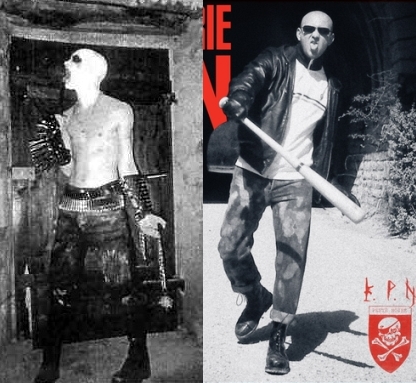
L’Ordure à l’état Pur came packaged with an image change for the band that might clarify the difference.


Cochon Carotte Et Les sœurs Crotte

This is the only song I’m going to sample from L’Ordure à l’état Pur, because I think it’s all you really need to hear to decide whether you want to pick up the whole thing or not. If you can appreciate sound samples from scat pornography, belching noises substituted for drum beats, Famine doing his best impression of an irritated chicken, and really bad techno, maybe this album is for you. Hell, maybe you can kid yourself into thinking the band is making some statement about society. But for me, Famine is just trolling here. Maybe he wanted people to derive some sort of meaning from it all, or maybe he just wanted to sit back and laugh at all the people who try to. I think I’ll not risk falling victim to the latter.

L’Ordure à l’état Pur has a few really great features, but by and large it’s awful. Take the album title literally. You might think there is meaning buried beneath the joke, but that is the joke.

Thousand Years of Dreams Day 01: Hanna’s Departure


So, we begin the first of 33 straight days of bringing the best thing about Mistwalker Studios’ 2008 role-playing game, Lost Odyssey, and why to this day its 33 short stories contained within the game as dream sequences remain one of the best writing in gaming ever. These short stories were written by Japanese novelist Shigematsu Kiyoshi. This collection of dreams would be collected under the title, “Thousand Years of Dreams”.

The first dream was the very first one a player acquires and comes across during the game. It is this dream which will trigger the main hero’s recollection of 33 total dreams as he travels and meets up and/or comes across situations to trigger a specific dream. This first dream is titled “Hanna’s Departure” and comes early in the game. Despite being the first it is also one of the best of the 33 and once you’ve watches and read the attached video clip of it above you will understand why. Below will be a transcript of the dream, but I recommend watching the video first and foremost.

Hanna’s Departure

The family members have tears in their eyes when they welcome Kaim back to the inn from his long journey.

“Thank you so much for coming.”

He understands the situation immediately.

The time for departure is drawing near.


Too soon, too soon.

But still, he knows, this day would have come sometime, and not in the distant future.

“I might never see you again,” she said to him with a sad smile when he left on this journey, her smiling face almost transparent in its whiteness, so fragile—and therefore indescribably beautiful—as she lay in bed.


“May I see Hanna now?” he asks.

The innkeeper gives him a tiny nod and says, “I don’t think she’ll know who you are, though.”

“She hasn’t opened her eyes since last night,” he warns Kaim. You can tell from the slight movement of her chest that she is clinging to a frail thread of life, but it could snap at any moment.

“It’s such a shame. I know you made a special point to come here for her…”

Another tear glides down the wife’s cheek.


“Never mind, it’s fine.” Kaim says.

He has been present at innumerable deaths, and his experience has taught him much.

Death takes away the power of speech first of all. Then the ability to see.

What remains alive to the very end, however, is the power to hear. Even though the person has lost consciousness, it is by no means unusual for the voices of the family to bring forth smiles or tears.

Kaim puts his arm around the woman’s shoulder and says, “I have lots of travel stories to tell her. I’ve been looking forward to this my whole time on the road.”

Instead of smiling, the woman releases another large tear and nods to Kaim, “And Hanna was so looking forward to hear your stories.”

Her sobs almost drown out her words.


The innkeeper says, “I wish I could urge you to rest up from your travels before you see her, but…”

Kaim interrupts his apologies, “Of course I’ll see her right away.”

There is very little time left.

Hanna, the only daughter of the innkeeper and his wife, will probably breathe her last before the sun comes up.

Kaim lowers his pack to the floor and quietly opens the door to Hanna’s room.


Hanna was frail from birth. Far from enjoying the opportunity to travel, she rarely left the town or even the neighborhood in which she was born and raised.

This child will probably not live to adulthood, the doctor told her parents.

This tiny girl, with extraordinarily beautiful doll-like features, the gods had dealt an all-too-sad destiny.


That they had allowed her to be born the only daughter of the keepers of a small inn by the highway was perhaps one small act of atonement for such iniquity.

Hanna was unable to go anywhere, but the guests who stayed at her parent’s inn would tell her stories of the countries and towns and landscapes and people that she would never know.

Whenever new guests arrived at the inn, Hanna would ask them,

“Where are you from?” “Where are you going?”

“Can you tell me a story?”


She would sit and listen to their stories with sparkling eyes, urging them on to new episodes with “And then? And then?” When they left the inn, she would beg them, “Please come back, and tell me lots and lots of stories about faraway countries!”

She would stand there waving until the person disappeared far down the highway, give one lonely sigh, and go back to bed.


Hanna is sound asleep.

No one else is in the room, perhaps an indication that she has long since passed the stage when the doctors can do anything for her.

Kaim sits down in the chair next to the bed and says with a smile.

“Hello, Hanna, I’m back.”

She does not respond. Her little chest, still without the swelling of a grown woman, rises and falls almost imperceptibly.


“I went far across the ocean this time,” he tells her. “The ocean on the side where the sun comes up. I took a boat from the harbor way way way far beyond the mountains you can see from this window, and I was on the sea from the time the moon was perfectly round till it got smaller and smaller then bigger and bigger until it was full again. There was nothing but ocean as far as the eye could see. Just the sea and the sky. Can you imagine it, Hanna? You’ve never seen the ocean, but I’m sure people have told you about it. It’s like a huge, big endless puddle.”

Kaim chuckles to himself, and it seems to him that Hanna’s pale white cheek moves slightly.


She can hear him. Even if she cannot speak or see, her ears are still alive.

Believing and hoping this to be true, Kaim continues with the story of his travels.

He speaks no words of parting.

As always with Hanna, Kaim smiles with a special gentleness he has never shown to anyone else, and he goes on telling his tales with a bright voice, sometimes even accompanying his story with exaggerated gestures.

He tells her about the blue ocean.

He tells her about the blue sky.

He says nothing about the violent sea battle that stained the ocean red.

He never tells her about those things.


Hanna was still a tiny girl when Kaim first visited the inn.

When she asked him “Where are you from?” and “Will you tell me some stories?” with her childish pronunciation and innocent smile, Kaim felt soft glow in his chest.


At the time, he was returning from a battle.

More precisely, he had ended one battle and was on his way to the next.

His life consisted of traveling from one battlefield to another, and nothing about that has changed to this day.

He has taken the lives of countless enemy troops, and witnessed the deaths of countless comrades on the battlefield. Moreover, the only thing separating enemies from comrades is the slightest stroke of fortune. Had the gears of destiny turned in a slightly different way, his enemies would have been comrades and his comrades enemies, This is the fate of the mercenary.


He was spiritually worn down back then and feeling unbearably lonely. As a possessor of eternal life, Kaim had no fear of death, which was precisely why each of the soldier’s faces distorted in fear, and why each face of a man who died in agony was burned permanently into his brain.

Ordinarily, he would spend nights on the road drinking. Immersing himself in an alcoholic stupor—or pretending to. He was trying to make himself forget the unforgettable.

When, however, he saw Hanna’s smile and begged him for stories about his long journey, he felt a far warmer and deeper comfort then he could even obtain from liquor.


He told her many things…

About the beautiful flower he discovered on the battlefield.

About the bewitching beauty of the mist filling the forest the night before the final battle.

About the marvelous taste of the spring water in a ravine where he and his men had fled after losing the battle.

About a vast, bottomless blue sky he saw after battle.


He never told her anything sad. He kept his mouth shut about the human ugliness and stupidity he witnessed endlessly on the battlefield. He concealed his position as a mercenary for her, kept silent regarding his reasons for traveling constantly, and spoke only of things that were beautiful and sweet and lovely. He sees now that he told Hanna only beautiful stories of the road like this not so much out of concern for her purity, but for his own sake.


Staying in the inn where Hanna waited to see him turned out to be one of Kaim’s small pleasures in life. Telling her about the memories he brought back from his journeys, he felt some degree of salvation, however slight. Five years, ten years, his friendship with the girl continued. Little by little, she neared adulthood, which meant that, as the doctors had predicted, each day brought her that much closer to death.


And now, Kaim ends the last travel story he will share with her.

He can never see her again, can never tell her stories again.

Before dawn, when the darkness of night is at its deepest, long pauses enter into Hanna’s breathing.

The frail thread of her life is about to snap as Kaim and her parents watch over her.

The tiny light that has lodged in Kaim’s breast will be extinguished.

His lonely travels will begin again tomorrow—his long, long travels without end.


“You’ll be leaving on travels of your own soon, Hanna.” Kaim tells her gently.

“You’ll be leaving for a world that no one knows, a world that has never entered into any of the stories you have heard so far. Finally, you will be able to leave your bed and walk anywhere you want to go. You’ll be free.”

He wants her to know that death is not sorrow but a joy mixed with tears.

“It’s your turn now. Be sure and tell everyone about the memories of your journey.”

Her parents will make that same journey someday. And someday Hanna will be able to meet all the guests she has known at the inn, far beyond the sky.


I, however, can never go there.

I can never escape this world.

I can never see you again.

“This is not goodbye. It’s just the start of your journey.”

He speaks his final words to her.

“We’ll meet again.”

His final lie to her.


Hanna makes her departure.

Her face is transfused with a tranquil smile as if she has just said,

“See you soon.”

Her eyes will never open again. A single tear glides slowly down her cheek.

End

Source: Lost Odyssey Wiki