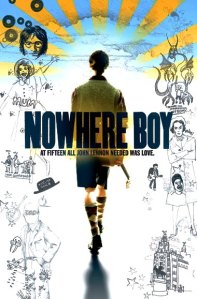
At first glance, Sam Taylor-Wood’s Nowhere Man sounds just a little bit too cutesy. The movie, which covers the youth of John Lennon, starts with the death of John’s Uncle George, covers both his attempts to reconcile with his mother Julia (portrayed here as being bipolar) and his troubles relationship with the aunt who actually raised him, details how John came to form his own band (The Quarrymen) and first met Paul McCartney and George Harrison, and ends with John preparing to leave for Germany. Yet the movie works surprisingly well and, by the end, is actually quite touching regardless of whether you idolize John Lennon or if you think Imagine is one of the most overrated songs of all time. By refusing to indulge in any easy sentimentality about either John Lennon or the iconic figure he would eventually become (the word “Beatles” is never uttered at any point in the film), Taylor-Wood crafts a touching coming-of-age story about an alienated teenager trying to find peace with his dysfunctional existence. The fact that the teen is going to grow up to be the John Lennon is secondary to the plot.
The film works mostly because of the cast. The young John Lennon is played by Aaron Johnson who, earlier this year, was the lead in Kick-Ass. I have to admit that I didn’t care much for Johnson in Kick-Ass. His performance seemed generic and bland and he was overshadowed by Nicolas Cage, Chloe Grace Moretz, Mark Strong, Christopher Mintz-Plasse, and just about everyone else in the movie. Here, however, Johnson gives a strong, sympathetic performance as a character who often comes across as being neither. He both manages to capture the young Lennon’s sensitivity as well as his anger and cocky arrogance.
However, the movie truly belongs to the two actresses playing Lennon’s aunt and mother, Kristen Scott Thomas and Anne-Marie Duff. Scott Thomas has an especially difficult job as her character is far less flamboyant and, at first sight, a lot less interesting as Duff’s. However, as the film progresses, Scott Thomas starts to subtly reveal the dry humor that lies underneath her character’s serious expression. As for Duff, she dominates the film as surely as Julia dominated her son’s life. Duff doesn’t resort to any of the easy (and insulting) clichés that are usually used to represent bipolar disorder on film. Instead, she captures both the exhilarating high of being manic along with the constant fear of the depressive episode that we always know is destined to follow. It’s a spot-on performance that elevates this film above the standard coming-of-age story.
Wisely, neither the director nor her actors ever get caught up in the fact that their film is about the John Lennon. There’s no portentous foreshadowing or awkwardly staged moments designed to specifically make you go, “Hey, that’s John Lennon!” Even the first time that Lennon meets Paul McCartney and, later, George Harrison is handled in a casual, off-hand manner. Taylor-Wood has enough faith in her audience to believe that we’ll be able to understand the importance of John being introduced to a younger guitar player named Paul without bashing us over the head with the fact that this is the Paul McCartney. As such, while you’re always aware that this is a movie about John Lennon, you can also see the movie as simply being the story of an alienated teenager who finds salvation through music.
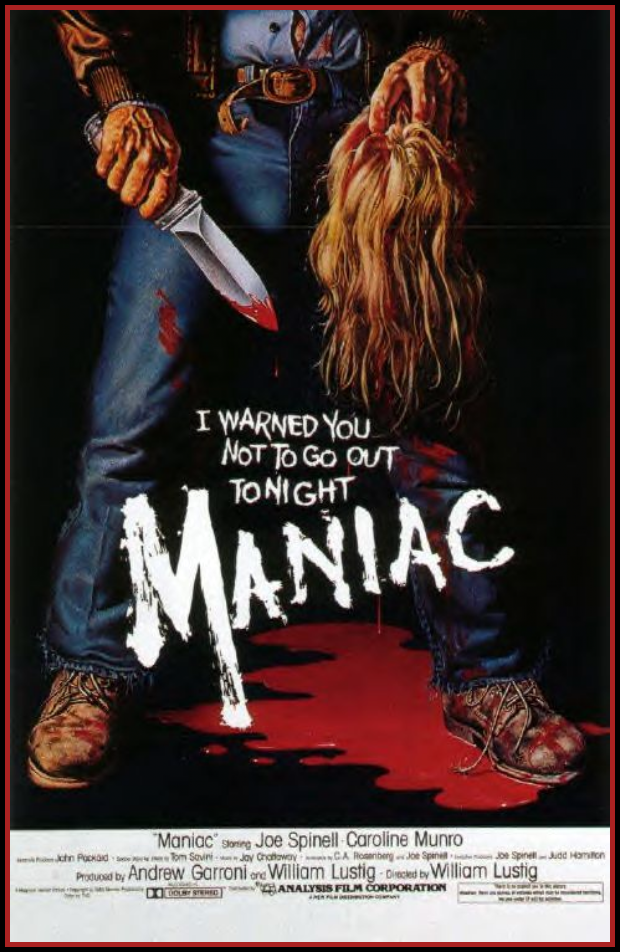
The newest flick to make “The Daily Grindhouse” is the controversial slasher/splatter offering from one of the 1980’s masters of the American grindhouse cinema. William Lustig’s Maniac definitely fits the criteria of what makes a grindhouse flick.
Lustig’s flick helped start the so-called “splatter film” subgenre in horror. While more mainstream (and I used that term very loosely) horror like Friday the 13th and Black Christmas brought the “slasher film” genre to the public eye it was the release of Maniac which gave “splatter” the notoriety it craved. It was a flick which was released by it’s distributor as unrated since they refused to let the MPAA screen it for certification knowing the it would automatically get the dreaded “X-Rating”. This rating would kill off any attempt for it to get shown in cinema theaters (even some owners of grindhouse theaters would deny to screen it). But it was a colleague of special effects and make-up artists (also an actor in Maniac) who gave Lustig and it’s distributor the backdoor way to get the flick seen.
George A. Romero’s classic epic zombie film Dawn of the Dead was released unrated and it still made quite the box-office haul that it gave future filmmakers a way out of the MPAA’s X-Rating hell. Maniac would get the same treatment and, while it didn’t get quite the box-office success as Romero’s zombie opus, it did make enough coin to be become one of Lustig’s moderate successes.
The flick was controversial not just for the decision to release it unrated but also for the label of misogyny it received from film critics who did see it. It didn’t help Lustig’s cause that the film was practically about a pyschotic and schizophrenic man who murders and scalped beautiful women to help decorate the mannequins he kept in his home. This flick was the grindhouse version of Hitchcock’s Psycho (to me a film that would be grindhouse if not for Hitchcock being the filmmaker thus given classic status by the elite cineaste crowd) and where Hitchcock kept the violence as something to be imagined Lustig went for the jugular and showed everything.
The most controversial scene would forever be the slow-motion sequence of Joe Spinelli’s killer, Frank Zito, taking a shotgun and shooting Tom Savini’s character point-blank in the head. The scene was so horrific and realistic in its execution that people left the theater right after the scene ended thinking even worse things were to be shown for the next hour (acclaimed film critic Gene Siskel left right after that scene). Tom Savini’s experience as a combat photographer during the Vietnam War gave him the necessary know-how to create the “Disco Boy Scene” so realisticly and which made him one of the early “fathers of the splatter genre”.
Maniac would propel Lustig to cult-status in the horror genre not because of the quality of his work, but for how he pulled no punches in showing the violence in his films even if got him labeled misogynistic and exploitative in mainstream cinema. His flicks were average for the most part, but they were definitely grindhouse in that they spoke to the most base denominator and that’s sex and violence sells and he didn’t sugarcoat it.
Old school Italian horror films are, often times, a collection of “what the fuck” moments. Here’s one of my favorite “what-the-fuck” moments from one of the ultimate “what-the-fuck” movies, 1980’s Burial Ground: The Nights of Terror.
(By the way, contrary to rumor, Peter Bark, who plays the kid in this clip, was not a midget. He was just a really ugly 16 year-old.)
This pick for song of the day marks the fifth time the “Bards” from Germany has made an appearance. This song marks the third track to be chosen from their latest album, At The Edge of Time. To say that I am a fan of Blind Guardian would be just a tad bit of an understatement.
“Valkyries” is the latest song of the day and it’s Blind Guardian at their most progressive metal. As a band they’ve grown from a German speed and thrash metal band then became one of the progenitors of the power metal subgenre. For the past dozen or so years they’ve evolved their sound to incorporate progressive, melodic, symphonic and orchestral stylings to their basic power metal sound.
This song has lead bard Hansi Kürsch writing about Norse mythology, specifically the concept of the Valkyries who fly and roam above the battlefield to take those worthy slain warriors to Valhalla. Kürsch has been one of the best songwriters in the metal scene that I’ve had the pleasure to listen to. His songs are musical epic poems and if one has been following the previous “song of the day” entries involving this band they would’ve seen just how complex and intricate the lyrics Kürsch as come up with for each and every song. “Valkyries” lyrics are no different and listening to him sing it in his distinct voice conjures up images of glorious battlefields and brave warriors clashing in battle.
Listening to this song definitely would make for a great way to pump one up for the possibility of going into battle with battleaxe and sword in hand.
Valkyries
To the gods of the north, I pray And raise my cup for the fallen ones Then I cry In Valhalla they’ll sing
Rain Red blood keeps pouring down Come Valkyries, join me on that final ride
Here I lie bleeding Odin, I await thee
The battle rages on
New lines they’re weaving The future, the past and the present They’re one They will reveal their mask To show me a way to survive This bitter war
Soon it will be over He will be the one We’ll weave in
And terror will now rule these lands
When the battle is lost And the slain ones are chosen Valkyries will guide us home When the battle is lost And the slain ones are chosen Valkyries will guide us home
Destiny A spinning wheel The path of glory Round and round Come join us On your final ride to Asgard Let’s move on fast Allfather waits So let’s heed the final call
For now We leave this world behind It’s over
All glory to the brave Still blood will rain Through storm and fire Let war winds reign It’s the feast for the crows
Follow the light Just follow the light Or fade away
Soon it will be over He will be the one We’ll weave in and terror will now rule these lands
When the battle is lost And the slain ones are chosen Valkyries will guide us home When the battle is lost And the slain ones are chosen Valkyries will guide us home
We’ll keep on weaving We’re crushing through lines With our battering swords We’re marching on Assign the brave To survive This bitter war
Soon it will be over He will be the one We’ll weave in
And terror will now rule these lands
When the battle is lost And the slain ones are chosen Valkyries will guide us home When the battle is lost And the slain ones are chosen Valkyries will guide us home We’ll heed the final call A call to arms The valkyries will guide us home
Then finally I hear them say Carry on For Valhalla awaits you
For our latest Anime of the Day I have chosen the very controversial title School Days which aired from July through to September of 2007.
The series was adapted by anime studio TNK from the visual novel and eroge of the same title published by the company Overflow. School Days was your typical “harem” visual novel eroge where the main protagonist (most of the time male though there’s a few where it’s reversed and it’s a female) becomes involved with several of the female characters in the game. The goal of these eroge was to try and navigate through the many relationships between the protagonists and the many female characters around him (usualy in a sexual nature) and get the perfect ending which always ends up being the so-called “good ending”.
With School Days the main protagonist is one Makoto Ito who starts off as being a mild-mannered and polite high school student. This doesn’t last long as he become embroiled with the many female classmates he’s known for years and those he recently met. To say that the character of Makoto becomes addicted to having sex with his female classmates would be an understatement.
While there are several female characters in School Days who become involved with Makoto in one way or another it’s the duo of Kotonoha Katsura and Sekai Saionji who become rivals for Makoto’s affection. Just like the visual novel the anime series was adapted from (the visual novel was also adapted as a manga series) the complex and increasingly malicious attitudes by some of the leads in the series would lead to more than one tragedy for all involved. This is a series which starts off as a light-hearted harem title but as the series progresses towards its climactic finale it somehow takes a huge turn into the darkside that by the time it does make that turn the viewer has become so invested in the characters and the story that it becomes a major shock to the system.
School Days has become controversial since its release due to a real-life killing where a young high school girl kills her father with an axe which some thought as being too similar in tone to a sequence in the series. The controversy from such a real-life event caused the tv station broadcasting the series to replace almost half the running time of the final episode with an image of a nice boat and classical music playing in the background. This became such a major internet meme that saying “Nice Boat” has become the comment of choice when discussing controversial scenes and plot developments of any series that’d be ripe for studio censorship.
The series in all its form also emphasizes the character stereotype of yandere. School Days definitely has its major share of yandere characters and the many different endings to the visual novel shows how some of the yandere characters in the story deal with the callous way Makoto has dealt when dealing with their affections towards him. It gets bloody, violent and more than just a tad crazy-insane.
School Days is definitely one of the more seriously twisted anime offerings out there which doesn’t involved hentai in its description whatsoever. It’s a series that if it was a live-action series would be similar in tone and scope to many of filmmaker Ken Park’s films which deal with teenage highschool relationships, sex and the consequence which can come from it.
Four years ago, I was in Recycle Books in Denton, Texas and I came across a book called something like “Unknown Legends of Rock and Roll.” The book came with a CD that featured music by some of the bands featured in that book. The first song on that CD (and my personal favorite) was Smashed Blocked, a song from a band called John’s Children.
Folk metal, pagan metal, viking metal, these terms all share a common root in black metal, starting with Bathory’s stylistic transition in the late 80s. I decided to break the rest of this down into my top 20 straight up black metal songs and this, my top 25 songs that extend beyond the genre without breaking from it wholesale. I’ve obviously taken a lot of liberties in determining what goes where. Don’t regard this as any sort of ordering of favorites so much as the order I happened to settle on after a number of considerations.
I think black metal is one of the most diverse genres to be found, and rather than trying to divide up a dozen sub-genres, I’d like to highlight through twenty five songs the vast world lying beneath blast beats and tremolo picking.
25. Ceremonial Embrace – Mysterious Fate
I know very little about this band. They appeared out of Finland in 2000 to release one fairly average album and then disappear back into obscurity. The opening track however, Mysterious Fate, is an impressive take on a sound you might associate with Windir – staccato synth supported by sweeping slower moments that focus heavily on melody without ever really ceasing to be black metal.
24. Enslaved – Clouds
One of the original “second wave” black metal bands, Enslaved (along with ex-Emperor frontman Ihsahn) really pioneered the transition from the raw style into something much more complex. I like to think of this song, off their 2008 release Vertebrae, as one of the better tracks to exemplify what you might call “post-black”, a prefix that, as in all other genres, can suggest a dozen different things and might be better seen as an approach to music than a stylistic trait. You might alternatively call this progressive black metal, though I like to restrict my usage of that term.
23. Astrofaes – Path to Burning Space
If black metal in the 90s meant Norway, black metal in the 2000s meant Ukraine. This, one of Astrofaes’s earliest works, really shows both the all-encompassing guitar and the folk elements that have come to define a lot of what is Ukrainian black metal. They weren’t the first to really capitalize on these – that credit belongs to a band I’ll be showcasing frequently herein – but in exploiting them they really helped to make “Ukrainian black metal” something distinct and recognizable.
22. Hellveto – Warpicture
When Poland’s Hellveto first started to make their mark in the early 2000s I remember hearing them described as “war metal”, a term that has since fallen into disuse. While this music would today be called pagan metal, with maybe an “orchestral” additive, at the time it was something really unique, and it still stands apart as decidedly different from the Russian bands, like Arkona and Pagan Reign, that helped pioneer the genre.
21. Nokturnal Mortum – Perun’s Celestial Silver
Welcome to the first of many entries I’ve slotted for what I consider to be the greatest black metal band of all time: Nokturnal Mortum. To merely credit them with the explosion of black metal in Ukraine is to miss how completely unique their music still is. No one has managed this sound before or since – primitivism in its ideal. The shrill, lo-fi guitars, the violent brutality of Russian and Ukrainian that Germanic languages don’t quite encompass, a folk sound that is both beautiful and enraged… This isn’t just a statement about the past, it is a violent declaration of war on the present. It is unfortunate that the band has yet to get over their stance on white supremacy and their virulent antisemitism (this song appears as track 88, a neo-nazi symbol for “Heil Hitler”), but it is also a testament to the authenticity of their sound.
20. Drudkh – Ars Poetica
Drudkh have put out eight albums and one EP since 2003, making them one of the most prolific metal bands on the market. Were that not enough, almost every member has played a role in at least one other prominent Ukrainian black metal band during this time. They’ve had their ups and downs, and 2009’s Microcosmos received its fair share of criticism, but I struggle to find any fault in this track. Dark, intense, reverent, in Drudkh can be heard the same renunciation of the present and praise for a distant past that characterizes Nokturnal Mortum (although without the racist undertones, though a sort of guilt by association has still landed them on many a list of nsbm bands.)
19. Triglav (Триглав) – The Warrior of Honour
Like Nokturnal Mortum, Drudkh, and Astrofaes, Triglav hail from Kharkiv, Ukraine. A lesser known band of the scene, having only released one album, theirs is a pagan metal sound that owes much more to black metal than most.
18. Ihsahn – A Grave Inversed
Enough with Ukraine. I take you now to Ihsahn, former Emperor front-man and possibly the most talented musician to emerge from black metal. “Progressive” anything in metal terms conjures to my mind an obnoxious, pretentious focus on esteeming technical skill over song writing (maybe I just heard way too much Dream Theater when I was in high school), but Ihsahn’s “prog black” indulgence is a glorious and rare exception. His 2010 release, After, might be his best work to date, and this track somehow manages to incorporate a saxophone into black metal and still be fucking awesome. I have ridiculous respect for this man, and I hope upon hearing what he’s done here you will too.
17. Altar of Plagues – Through the Collapse: Watchers Restrained
A lot of what I’ve come to think of as post-black metal feels to be founded in the depressive/atmospheric styles that characterize usbm. (If I may digress, Xasthur provides guest vocals on Agalloch’s monumental Ashes Against the Grain.) Having only really taken form over the past few years, there may be much more to come. If you don’t like what follows the first two minutes of this song, don’t bother listening through it. It doesn’t return to the opening sound. White Tomb as a full album though, and especially the introduction of this track, qualify Ireland’s Altar of Plagues as one of many promising new bands in the sub-genre. This was released in 2009.
16. Nokturnal Mortum – Kolyada
This first track, on the other hand, was released much earlier. Nokturnal Mortum’s third album, Goat Horns, was released in 1997 and showcases the high point in their early sound. The band has gone through three major phases, roughly from 1995-1997, 1998-2003, and 2004 to the present. The band has even on occasion re-recorded earlier songs to fit their updated sound, Perun’s Celestial Silver being an example. (That track, of 1999’s NeChrist, originally appeared in 1995 on Lunar Poetry in a very different form.) Their middle period is my favorite and the one I’ll be primarily sticking too, but I’ve provided a second song here, their 2007 re-recording of Kolyada, in case you’re curious what they currently sound like.
15. Enslaved – As Fire Swept Clean the Earth
I here return to Enslaved for their 2003 album Below the Lights. I throw the term post-black metal around loosely, and while this song might have next to nothing in common with Altar of Plagues, such is the case in other genres where the post- tag comes into play. Enslaved are significant both in their music and in the fact that, having been around since the early 90s, a whole lot of current musicians grew up listening to them and stuck with them over the years. This song can be seen as an early example of what became more common later in the decade, and I don’t think it’s a mere coincidence that this particular band wrote it.
14. Windir – Dance of Mortal Lust
Windir are so unique that I had a hard time figuring out how to fit them in here. Valfar froze to death on a mountain in Norway in 2004, and a tragedy though it may be, I don’t think the creator of this music could have been fated a more fitting end. I chose this song for its accessibility, but I encourage you to seek out his entire brilliant discography.
13. Emperor – The Tongue of Fire
By the final Emperor album, in 2001, it becomes difficult to think of them as “mere” black metal, or anything else for that matter. At this point Ihsahn was writing their music fairly independently from the rest of the band as I understand it, and you can here hear the full amalgamation of his black metal days and his transition into something far more complex.
12. Drudkh – Eternity
Blood in Our Wells, released in 2006, is my favorite Drudkh album, and this my favorite track on it. Their earlier albums receive more praise, and I encourage you to listen to them, but for me this is the apex of their accomplishments.
11. Klabautamann – October
If you’re thinking “this isn’t black metal at all”, you’re probably right, but in the context of the album it concludes it ought to be regarded as such. Der Ort was released in 2005, two years after Enslaved’s Below the Lights, and whether there was any direct influence there or not, I think Germany’s Klabautamann accomplished in this song the most beautiful thing to yet emerge from that extension of black metal.
I’ll be posting the remainder of this list, along with a few others, throughout the month. Hope you enjoyed.
While the goth ballerina side of me will always have a special place in my heart for Suspiria and its two sequels, I think that 1982’s Tenebraemay very well be director Dario Argento’s best film. Certainly, it was (to date) his last truly great film before he entered the current, frustratingly uneven stage of his career.
Tenebrae was a return to Argento’s giallo roots after the supernatural-themed horror of Suspiria, Zombi, and Inferno. It was also the work of an audaciously confident director. That confidence is fully on display in the scene below in which the film’s killer menaces a journalist and her lover. Featuring a truly impressive tracking shot in which the camera appears to literally swoop in, out, and over a journalists house without a single cut, the scene ends with one of Argento’s more memorable murders.
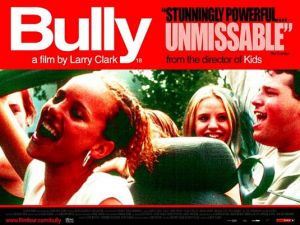
Bullying has been in the news a lot lately. The fact that some people are bullies is hardly a new development, it’s just that now people are actually paying attention to the possible consequences of cruelty. Tragically, it appears it takes people killing themselves for the rest of the world to consider that “Hey, maybe concentrated, socially accepted sadism isn’t a harmless thing.” With so many people finally admitting what they had to have known was true all along, now seems like a good time to reconsider Larry Clark’s controversial and much-maligned 2001 film, Bully.
I can still remember the night, five years ago, that I first saw Bully. I was at a party with a group of friends. Nine of us ended up in a random bedroom, drinking, smoking, and going through all the closets and dressers. I might add, we found some very interesting things while searching. Anyway, someone eventually turned on the TV and there was Bully, playing on one of the movie stations. Since we knew Bully was supposed to be a very explicit, very controversial movie, we left the TV playing and hung out in a stranger’s bedroom for two more hours. There was, obviously, a lot going on in that room and I have to admit that I only paid attention to bits and pieces of the movie. But what I saw stuck with me enough that the next chance I got, I bought the movie on DVD so I could actually devote my full attention to it. In the years since, Bully is not a film that I revisit frequently because, to be honest, it’s the type of movie that makes you take a shower after watching it. It’s also an unusually powerful and disturbing film that sticks with you for a long time after it ends. It’s not a film that I would recommend anyone watch a hundred times. But it’s definitely worth viewing at least once (or maybe even four times if you’re like me).
The bully of the title is 20 year-old Bobby Kent (played by Nick Stahl). Bobby’s “best friend” is passive, blank-faced Marty Puccio (Brad Renfro). Despite being physically stronger, Marty allows himself to be totally dominated by Bobby. Marty accepts Bobby’s constant insults and physical abuse with the meek acceptance of a battered spouse. Bobby, who is on the verge of starting college and presumably making a life for himself that high school dropout Marty could never dream of, even forces Marty to moonlight as a male stripper and to take part in making cheap, gay-themed porn videos. (Bobby insists that he’s not gay himself and, like most guys in denial, goes out of his way to act as much like an insensitive asshole as possible as if to scream to the world, “I’m straight!” despite all the evidence to the contrary.)
As the film begins, Ali (Bijou Philips) and her friend Lisa Marie Connelly (Rachel Miner) step into sandwich shop where both Bobby and Marty work. (Bobby, of course, is the boss.) Apparently, they are appropriately impressed by the sight of Bobby slamming Marty’s head against a refrigerator because soon, all four of them are going out on a double date. While Ali’s content to just give Bobby a blow job, the far more insecure Lisa decides that Marty is the love of her life and starts a relationship with him that the ever-passive Marty simple accepts. However, what Lisa has failed to take into account, is that Marty is already in a relationship and Bobby isn’t ready to just let go. Bobby expresses this by walking in on Marty and Lisa while they’re having sex, beating Marty up, and then (unlike everything else in this movie, this is never explicitly shown) raping Lisa. After this, Lisa discovers that she’s pregnant but she doesn’t know if the baby’s father is the man she claims to love or the man who raped her.
(One thing that surprised me, that night I first watched Bully out of the corner of my eye while me and my friends searched through a stranger’s lingerie, was just how little sympathy most of my friends had for Lisa. While I wasn’t surprised that the majority of guys in the room seemed to feel that Lisa was somehow to blame for disrupting all that precious male bonding, it was the reaction of some of the other girls that truly caught my off guard. While none of them went as far as to say that Lisa deserved to be raped by Bobby, quite a few of them took the attitude that she either brought it on herself or she was lying. Unlike the boys, these girls also felt the need to make several snide remarks about Rachel Miner’s physical appearance. At the time, their attitude really bothered me and I have to admit that I wasn’t as close to any of them afterward.)
(Of course, we Lisa Maries have to stick together…)
Despite having raped his girlfriend, Bobby still considers himself to be Marty’s best friend and Marty — again like an addicted spouse — proves himself to be incapable to simply cut off all ties with Bobby even as the abuse gets worse and Bobby grows increasingly unstable. In one of the film’s more controversial scenes, Bobby and Ali are about to have sex when Bobby decides that the only thing the scene is missing is a gay porn video playing in the background. Ali finds the idea to be disgusting and insinuates that Bobby must be gay. Bobby responds by raping Ali.
Finally, Lisa tells Marty and Ali that they have little choice but to murder Bobby. While this starts out as a somewhat innocent suggestion of the “I wish he was dead,” kind, Lisa soon begins to insist that Bobby must die. Ali recruits her friend Heather (Kelli Garner) and an ex-boyfriend named Donny (a truly scary Michael Pitt) into the conspiracy. (Heather and Donny both agree that Bobby must die though neither one has ever met him.) Lisa, meanwhile, brings in her cousin, video-game geek Derek. Finally, and most fatefully, they decide to get some pointers from the neighborhood hitman (Leo Fitzpatrick).
That’s right. The neighborhood hitman. He’s actually a pretty familiar figure in the suburbs. He’s the 17 year-old white boy who tries to stare out at the world with hateful eyes. He brags to you about how he’s a member of a gang. He tries to rap and speaks in dialogue lifted from Grand Theft Auto. In short, he’s the guy that everyone laughs at whenever he’s not around. His lies should be obvious to anyone with a brain which is exactly why Lisa, Marty, and Ali all assume that he’s an actual hitman. The Hitman agrees to direct their murder and help them kill a person who (like almost everyone else now involved in the conspiracy) he has never actually met.
It all climaxes in one of the most disturbingly graphic and harrowing murder scenes I’ve ever seen, one that manages to snap the audience back into reality after the (needed) comic relief of Fitzpatrick’s absurd wannabe gangster. As he’s repeatedly attacked by this group of made up of bumbling strangers and his “best” friend, Bobby proves himself to be not quite as powerful a figure as everyone had assumed. Instead, he’s revealed as a pathetic, frightened teenager who begs Marty to forgive him (for “whatever I did”) even as Marty savagely stabs him to death.
Unlike the standard rape-revenge flick (and have no doubt, that’s what Bully essentially is), the film’s climatic act of violence doesn’t provide any sort of satisfaction or wish-fulfillment empowerment. Instead, it just sets up the chain of events that leads to the film’s inevitable and disturbing conclusion.
When it first came out, Bully was controversial because of its explicit sex and violence. As a director, Clark employs his customary documentary approach while, at the same time, allowing his camera to frequently linger over the frequently naked bodies of his cast. More than one reviewer has referred to Clark as “a dirty old man” while reviewing this film. (More on that in a minute.) What those critics often seem to fail to notice is that, as explicit as the movie is, some of the most powerful and disturbing elements (like Bobby’s repressed homosexuality) are never explicitly stated.
After seeing this movie a few more times, the thing that gets me is that — in the end — the film’s nominal villains — Bobby and Lisa — are also the only two compelling characters in the entire movie. While all the other characters are essentially passive, Bobby and Lisa are the only ones actually capable of instigating any type of action. As such, they become — almost by default — the heroes of the movie. On repeat viewings, it’s apparent that Bobby and Lisa are really two sides of the same coin. The film’s title could refer to either one of them. They are both insecure, unhappy with who they are, and both of them seem to find a personal redemption by dominating Marty. One of the great ironies of the film is that Bobby and Lisa are essentially fighting a war for the soul of a guy who is eventually revealed to be empty inside. For his part, Marty simply shifts his “forbidden” relationship with Bobby over to Lisa, a relationship that is just as exploitive and destructive as his friendship with Bobby but which is also more socially acceptable because it’s so heterosexual in nature that he’s even knocked up his girlfriend. When Marty finally does kill Bobby, he’s not only killing a bully but he’s attempting to kill of his own doubts about his sexual identity. It’s his way of letting the world know that he’s a “real” man. As for the other characters — Ali, Donny, Heather, and even the swaggering hitman — they are all defined by their utter shallowness. While its clear that none of them are murderous on their own, it also becomes clear that none of them have enough of an individual identity to resist the Bobbys and Lisas of the world.
Despite playing shallow characters, nobody in the cast gives a shallow performance. Down to the smallest role, the actors are all believable in their roles. Whether it’s Michael Pitt’s blank-faced aggression or Leo Fitzpatrick’s comedic swagger, all of the actors inhabit these characters and give performances that are disturbingly authentic. The late Brad Renfro gave one of his best performances as Marty, just hinting at the anger boiling below the abused surface. However, the film belongs to Miner and Stahl. Stahl displays a sordid charm that makes his character likable if never sympathetic while Miner manages to do something even more difficult. She makes Lisa into a character who is sympathetic yet never quite likable. When Bully first came out, critics spent so much time fixating on the fact that Miner’s frequently naked on the film that they forgot to mention that she also proves herself to be an excellent actress.
As I stated, Bully is not a universally beloved film. Most of the reviews out there are negative with a few of the more self-righteous critics accusing the film of being “pornographic” as if the whole thing was filled with close-up money shots of Brad Renfro ejaculating on Rachel Miner’s ass. Strangely enough, you can find hundreds of critics complaining that Clark filmed full frontal nudity but next to none complaining that Clark filmed a brutal and realistic murder scene.
The two most frequent criticisms of Bully are that 1) it plays fast and loose with the true story that it’s based on and 2) that the film is exploitive.
Both criticisms are valid but the first one is the only one that would really bother me. I have to admit that I don’t really know much about the real life murder of Bobby Kent. I just know the version presented in this movie and in the Jim Schultze book that the movie was based on. Of course, everyone arrested and convicted for Kent’s murder has been quick to claim that the movie makes them look more guilty than they actually are. That’s to be expected. However, the main difference between the film and the reality — for me — was that, in reality, victim Bobby Kent did not look a thing like Nick Stahl. Whereas Stahl is clearly no physical match for any of the characters in the film (and hence, it’s easier to feel sorry for him when everyone attacks him at once), pictures of the real-life Bobby Kent reveal an intimidating, muscular, young man who few people would probably ever chose to mess with. Stahl’s Bobby is a bully because everyone else in the film is too passive to stand up to him. The real Bobby could probably get away with being a bully because he literally looked like he could rip another man’s arm off.
The other criticism is that this movie — with its combination of tits and blood — is essentially just an “exploitation” film. Well, it is. But as I’ve explained elsewhere, just because a film is exploitive, that doesn’t mean that it’s not a good movie. Art and exploitation, more often than not, are clandestine lovers and not bitter enemies. Yes, all of the characters — male and female — do spend a good deal of time showing off their bodies but then again, what else would these otherwise empty characters do? Their surface appearance is really all they have. Yes, the camera does linger over all the exposed flesh but then again, so do most people. If anything, critics attempted to punish Clark for openly acknowledging that majority of his audience is waiting to either see Bijou Phillips’ twat or Nick Stahl’s dick. Yes, Bully is exploitation but it’s exploitation in the best grindhouse tradition. It’s a film that’s honest specifically because it is so sordid and exploitive.
When all is said and done, Bully is the epitome of a movie that is too sordid to ever be corrupted.
The latest pick from Grindhouse of the Day will be from the sci-fi genre and this one I remember clearly as I saw it several times on one of those UHF channels that showed cheap sci-fi and horror flicks. This particular grindhouse pick made a major impression in my preteen mind due to the awesome laserblast weapon which gave the flick its title. Yes, the latest grindhouse pick is literally titled, Laserblast.
It was released in 1978 and I’d hazard a guess and say it was part of the cheap, B-movie craze that tried to capitalize on the megasuccess of Star Wars. This sci-fi grindhouse was awesome when I first saw it as an 8-year old but now I look at it and think to myself, “This thing is so awful that it’s gone beyond any level of awfulness and come out the other side as some sort of classic.” It’s still quite awful, but even now it still entertains even if not the same reasons as when it was first seen. I can understand why the MST3K guys over at Comedy Central picked on it.
The flick had a late 70’s, San Fernando Valley porn sheen to it, but minus all the stuff which made those flicks must-see. The special effects were rudimentary, though I will say that the stop-motion animation for the aliens who hunted down the people who got corrupted by the laserblaster were quite good for such a low-budget. If I had to tell someone two reasons why this should be seen at least once its for the aliens and the awesome cheesiness of the laserblaster.
This flick has the distinction of being director Michael Rae’s only film. He hasn’t made a film since. It would seem he gave it all to this single one. It’s also notable for being the first major work for composer Joel Goldsmith (son of renowned film composer Jerry Goldsmith) who would continue later in his career to composing the soundtrack to sci-fi tv series and major videogame franchises.






 Through the Shattered Lens