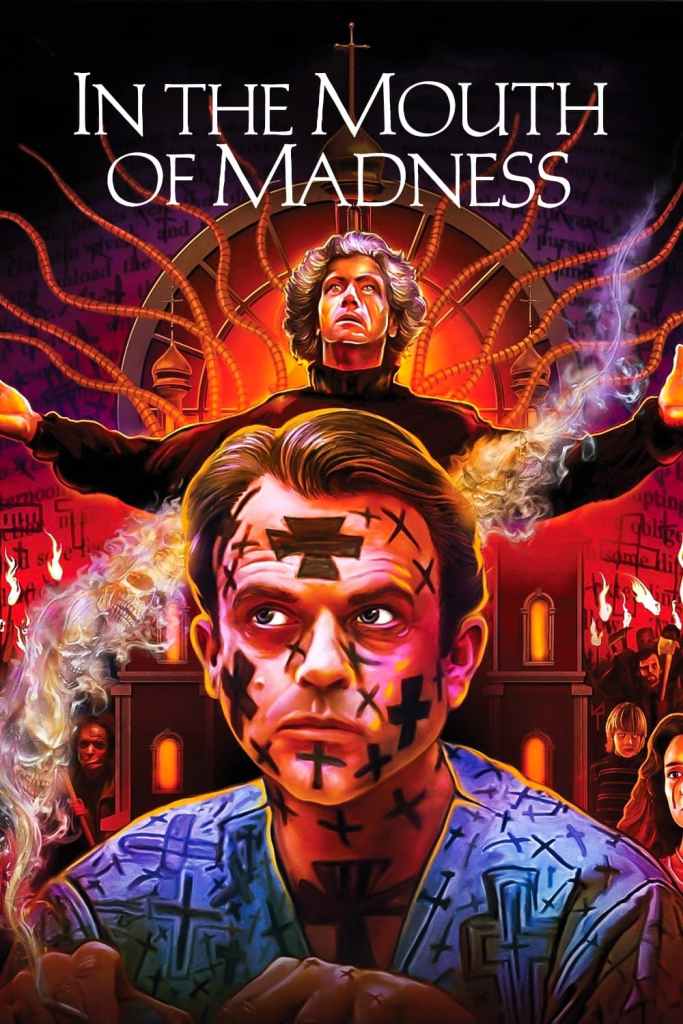
“There are things in this world that go beyond human understanding.”
John Carpenter’s reputation as one of the great American horror directors rests on his ability to merge the cinematic with the philosophical—to craft films that stay frightening not because of what they show, but because of what they suggest. Yet by the early 1990s, Carpenter’s once unshakable relationship with audiences had weakened. His influence remained undeniable, but several of his later films seemed to miss the spark that defined Halloween, The Fog, or The Thing. Then arrived In the Mouth of Madness (1995), a work that signaled a late creative resurgence. It paid intelligent homage to two pillars of horror literature—Stephen King and H. P. Lovecraft—while offering a disturbing reflection on authorship, sanity, and the power of belief. The film reasserted Carpenter’s command not only over frightening imagery but also over the psychological territory that underpins enduring horror.
At a narrative level, In the Mouth of Madness follows John Trent (Sam Neill), an insurance investigator known for exposing fraud and deception. His skepticism becomes both his strength and undoing. Trent is hired by publishing executive Jackson Harglow (played by the legendary Charlton Heston) to locate Sutter Cane, a best-selling horror novelist whose disappearance threatens both the company’s finances and the stability of Cane’s obsessed fanbase. Every sign points to something far stranger than a publicity stunt. Cane’s readers are exhibiting troubling behavior, as though the author’s new book has triggered more than just entertainment—it has become contagion.
Carpenter crafts Trent’s descent into uncertainty with meticulous pacing. At first, Neill’s character regards the assignment as routine, dismissing the hysteria surrounding Cane’s novels as marketing excess. But when his investigation hints that the locations and events in Cane’s fiction may correspond to real places and real disturbances, the film begins to twist the rational into the uncanny. The story’s sense of unreality builds with deliberate restraint—incidents grow progressively stranger, but never so overt that Trent can confidently identify what’s madness and what’s truth. Carpenter thrives on this ambiguity, pulling both protagonist and viewer into an atmosphere where logic erodes and fiction itself seems to rewrite reality.
Accompanying Trent on his search is Linda Styles (Julie Carmen), the publisher’s editor assigned to ensure the investigation runs smoothly. While her performance has sometimes been considered subdued, Styles functions as the audience’s second perspective: observant, mildly skeptical, and gradually aware that the world around her no longer behaves according to its former rules. Carpenter positions her as a necessary counterpoint to Trent’s brittle rationalism, highlighting the conflict between recognizing patterns and succumbing to fear. As they move closer to locating Cane, their surroundings take on the familiar haunted quality of an archetypal New England town—Hobb’s End—built from the shared DNA of King’s Castle Rock and Lovecraft’s Arkham. The town becomes more than setting; it is a physical embodiment of literary influence and psychological instability.
The choice of Sam Neill proves essential to the film’s success. His trademark combination of intelligence and emotional vulnerability allows Trent’s transformation from calculating skeptic to disoriented seeker to feel natural rather than theatrical. Few actors could portray a man so evidently rational who nonetheless finds himself seduced by forces his disciplined mind cannot resist. Neill’s body language carries much of the horror; his expressions shift between dry disbelief and quiet terror, suggesting that intellect offers no protection once perception itself begins to betray you. Carpenter exploits this performance with close framing and asymmetric compositions, visually trapping Trent in spaces that subtly curve or distort. The director’s technical command ensures that even ordinary scenes seem charged with quiet wrongness.
While In the Mouth of Madness never references the mythos of Lovecraft by name, its influence saturates the film. Lovecraft’s hallmark—cosmic indifference—exists here not through tentacled gods but through the crumbling borders between fiction and the human mind. The suggestion is that the very act of creating and consuming stories might awaken something ancient and uncontrollable. When Trent confronts the nature of Cane’s work, Carpenter’s direction avoids overstatement. Instead of grand confrontations, he conveys horror through disorientation—the feeling that language, images, and even memory are slipping toward incoherence. Reality itself becomes a character, unstable and untrustworthy.
Jürgen Prochnow’s portrayal of Sutter Cane adds another layer of unease. His calm, confident manner diverges from standard portrayals of deranged genius. Prochnow makes Cane unnerving precisely because he appears so certain of his vision. The author views himself not as a mere storyteller but as a conduit, claiming that what he writes merely reveals a preexisting truth. Through him, Carpenter explores a potent question that haunts all creators: does imagination serve human purpose, or is it an independent force that uses human minds as tools? Cane’s conviction blurs that line, turning the creative process into possession. To audiences familiar with the concept of “mad artists” in literature, his belief offers both fascination and dread.
Carpenter imbues this theme with visual invention. The cinematography and set design combine the mundane with the surreal—painted walls pulse, corridors bend, horizons vanish. Rather than relying on excessive gore or digital spectacle, the director emphasizes textures and shadows, creating optical unease rather than overt shock. The town of Hobb’s End seems perpetually detached from time, its streets looping back on themselves. By employing low, creeping camera movements and deliberate color desaturation, Carpenter evokes a dreamscape decaying from within. The film’s sound design—especially Carpenter’s own pulsating score, co-composed with Jim Lang—heightens that tension with rhythmic basslines reminiscent of a heartbeat slowing to a stop. Every technical choice reinforces the narrative’s central sensation: uncertainty.
Michael De Luca’s screenplay deserves particular credit for its clever structure. The film is framed as a story told from inside an asylum, immediately hinting that the perspective may be unreliable. This framing allows Carpenter to shift between psychological thriller and cosmic horror without losing cohesion. As viewers, we are made complicit in Trent’s investigation but warned not to trust his perceptions. The resulting experience is disorienting yet coherent—a cinematic maze where each turn feels inevitable once taken. The writing never lingers long on exposition, instead suggesting connections through implication and repetition. In this way, De Luca’s script succeeds in translating Lovecraftian dread into visual terms: a fear of knowledge itself.
Very few directors have managed this particular tone as successfully. Lovecraft’s fiction often resists cinematic adaptation precisely because its greatest horror lies in what cannot be shown. In the Mouth of Madness solves this problem by making the act of storytelling itself the subject of terror. By focusing on an author whose imagination reshapes reality, Carpenter transforms literary horror into filmic language. In doing so, he edges close to achieving what decades of other attempts had failed to capture—a true Lovecraftian mood rendered on screen, grounded not in spectacle but in existential dislocation.
Despite its craftsmanship and intelligence, In the Mouth of Madness struggled at the box office upon release. Its ambiguity, self-reflexivity, and intellectual leanings proved challenging for mid-1990s audiences who expected more conventional scares. Yet over time, the film’s reputation has flourished. Today, it is often regarded as the concluding entry in Carpenter’s loosely connected “Apocalypse Trilogy,” following The Thing (1982) and Prince of Darkness (1987). All three films share a fascination with humanity confronting forces it cannot comprehend—scientific, metaphysical, or divine. In each, Carpenter presents apocalypse not as fiery destruction but as revelation: the moment when human understanding collapses under greater cosmic truth. That philosophical core links these works across more than a decade of filmmaking.
Revisiting In the Mouth of Madness now, one is struck by how prophetic it feels. Its concerns about cultural contagion and media-induced madness anticipate contemporary conversations surrounding viral misinformation, fandom extremism, and the blurring between online identity and reality. The “disease” in the film—ideas that rewrite perception—mirrors our present anxiety about the stories and images that shape collective belief. Carpenter’s horror, always grounded in social awareness, here expands into a warning about a world unable to distinguish narrative invention from lived experience.
Even limited in budget, Carpenter demonstrates confident control of visual tone and rhythm. His filmmaking reminds viewers that suggestion often unsettles more deeply than spectacle. Rather than overwhelming audiences with jump scares, he leads them through gradual disintegration, where each logical step seems to justify the next until coherence itself fractures. The film invites reflection rather than relief, leaving viewers haunted by the possibility that the boundaries between art and life are far thinner than comfort allows.
While Carpenter would go on to direct more films after 1995, In the Mouth of Madness stands as one of his last profoundly accomplished achievements. It encapsulates the elements that made his earlier works enduring: tight pacing, minimalist storytelling, and ideas that resonate beneath genre tropes. The film’s legacy continues among filmmakers who explore metafictional or cosmic horror, from Guillermo del Toro’s long-sought adaptation of At the Mountains of Madness (a feat that may never come to fruition outside of concept art and videos) to the psychological labyrinths of contemporary horror auteurs. Though Carpenter’s film never directly adapts Lovecraft, it succeeds where many literal adaptations fail—by preserving the essence of incomprehensible terror rather than translating it into spectacle.
Ultimately, In the Mouth of Madness remains a rare horror film that asks not just what we fear, but why we need fear in the first place. Its central notion—that imagination itself can undo reality—strikes at the heart of storytelling. Carpenter’s mastery lies in letting that idea linger long after the credits roll. What begins as an investigation grows into a philosophical nightmare, compelling viewers to question how much of their world is built from collective belief. In that sense, the film transcends its genre to become one of Carpenter’s most unsettling reflections on human perception. Decades later, its message still resonates: the stories we consume may shape us more profoundly than we realize.
 Through the Shattered Lens
Thank you for reminding me of this film, it’s a great one that I always seem to forget about. I was mistaken when I said earlier that a good Lovecraftian film hadn’t been made since Fulci’s Beyond trilogy because In The Mouth of Madness is definitely an unacknowledged gem. 🙂
Both Sam Neill and John Carpenter create exactly the right tone for this type of movie — close to over-the-top without going so far that the move becomes a cartoon.
Sutter Crane, by the way, is one of my favorite “names” ever. Its so very Lovecraftian. 8)
(Lookie! My smile’s wearing sunglasses now!)
LikeLike
I think if Carpenter was given the same kind of leeway in his films as some of the big directors nowadays I think he’d be mentioned in the same breath as Jackson, Del Toro, Nolan and other fantasists of this era. But his “fight-the-Man” personality and doing work outside the huge studio system definitely has burned many bridges.
I’m glad that after almost a decade of being away from feature-films he’s back behind the camera with The Ward which should be out very soon.
You saying that you’re so hot that you gotta wear shades? 🙂
LikeLike
Solid movie. and review. This one merits multiple viewings – so many interesting elements. Sam Neill is the perfect hapless skeptic. Love the final scene.
Carpenter made a film called “Prince of Darkness” several years earlier, which I had not heard about at the time. That one has a really interesting premise, as well, and starts off very promisingly. It creates a palpable sense of dread with a unique concept. Unfortunately, it breaks down somewhat in the second half, whereas “Madness” builds steadily to it;s satisfyingly unsettling conclusion. “Prince of Darkness” is a good film, and a worthwhile view,but I was a disappointed after the great setup.
Not so with “Madness”. Now that you’ve reminded me of it, I’ll be watching it again soon.
LikeLike
Yeah, Prince of Darkness is the second film in what many have started calling as Carpenter’s “Apocalypse Trilogy” which started with The Thing and ends with In the Mouth of Madness. I actually enjoyed Prince of Darkness and I should do a quickie review of it, but you’re right in that the second half wasn’t as strong as the first half.
LikeLike
“Apocalypse Trilogy”…I never heard that, but I can see the common thread. Well, two-and-a-half out of three ain’t bad.
When I started watching “Prince Of Darkness”, I thought I had stumbled upon an unsung horror classic. I was really pulled into the story, and I thought Carpenter might have had a masterpiece on his hands, But the film lost some of the apocalyptic feel, and became more of a typical “possessed by evil” film. It became too involved with some of the individual characters, who were, for the most part, not that interesting (Donald Pleasance not withstanding – no one does really, really worried better.), as well as some unsuccessful and unneeded attempts at comic relief.
It’is a good film; it just seems to me that it did not realize its full potential. A remake with a revised screenplay might be a worthwhile endeavor. (I would definitely hope for that to succeed.)
LikeLike
Pingback: Horror Scenes I Love: In the Mouth of Madness | Through the Shattered Lens