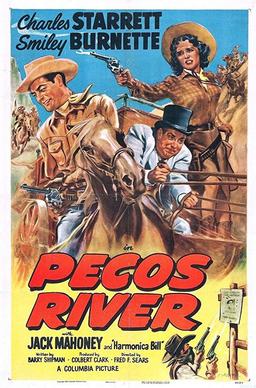
Pecos River (1951, directed by Fred F. Sears)


College student Jack Mahoney (Jock Mahoney) returns to his hometown on the frontier to pay a surprise visit to his father, Old Henry (Edgar Dearing).  Old Henry owns a local stagecoach line and is being targeted by outlaws.  When Jack reaches his father’s house, he discovers that someone has shot Henry in the back.  With the help of Steve Baldwin (Charles Starrett) and Betty Coulter (Anne James), two of Henry’s employees, Jack Mahoney tries to bring his father’s killers to justice.

Also helping is the masked Durango Kid, who tells Jack that Henry was an old friend of his.  Durango, who is never present at the same time as Steve for some reason, teaches Jack how to handle a gun.  When Steve is framed for murder, Durango works even harder to help bring the outlaws to justice.

This late Durango Kid entry has more of an edge that some of the other Durango films.  Both Durango and Jack are out for vengeance and their grim determination sets this one apart from some of Durango’s other, more jokey adventures.

Even with Durango in a serious mood, Smiley Burnette is around to provide some humor.  This time, Smiley is a traveling “specs specialist” who goes from town to town and sells people glasses.  (He also sings two songs while accompanied by Harmonica Bill.)  At the end of the movie, Smiley breaks the fourth wall, puts on a pair of glasses that he says allow him to see the future, and he lets us know whether or not Durango, Jack, and Betty are going to be safe.  Smiley says that he can see himself singing but he can’t hear the song because he only has the glasses.  “Looks like a good song, too.”

One final note: this movie actually features Jock Mahoney in two roles.  Not only does he play college student Jack Mahoney but he was also Charles Starrett’s stunt double in the movie’s action scenes.

Law of the Canyon (1947, directed by Ray Nazarro)


When a gang of outlaws starts hijacking freight wagons and then ransoming them back to their owners, government agent Steve Langtry (Charles Starrett) is sent to investigate.  He both goes undercover as an inexperienced traveler and as the masked Durango Kid.  As always, he is accompanied by Smiley Burnette.  In this installment, Smiley tries to invent a machine that can find silver and he also sings a few songs.  His backing band, The Lone Star Cowboys, follow him everywhere that he goes but they don’t actually get involved in the action.

This is another Durango Kid movie, with all of the usual horse chases and shootouts.  The same action montage that started Phantom Valley also starts this movie.  As always, Charles Starrett is convincing when riding a horse or shooting a gun.

What sets this Durango Kid movie apart from the others is the main villain.  Dr. Middleton (played by a regular member of the Durango Kid stock company, Fred F. Sears) appears to be a kindly man who serves as a middleman between the citizens and the outlaws.  Actually, he is working with the outlaws and receives a commission of every ransom that he negotiates.  The reason he can get away with it is because he’s drugged the Sheriff (George Cheseboro)!  He attempts to drug Durango too but luckily, Smiley drinks the water instead.

While it won’t convert anyone who isn’t already a fan of the genre or the character, this is another entertaining outing for the Durango Kid.

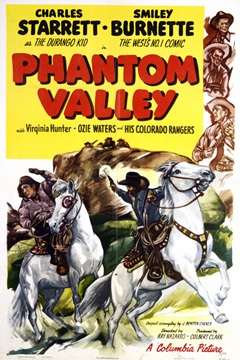
Phantom Valley (1948, directed by Ray Nazarro)


There’s trouble in Phantom Valley.  The ranchers who founded the town are increasingly at odds with the newly arrived homesteaders.  Each side blames the other for the tensions.  Marshal Steve Collins (Charles Starrett) is sent to investigate who is responsible for all of the trouble but, when two people are murdered, it is up Steve’s alter ego, the masked Durango Kid, to investigate and solve the murders.  Helping him out is his ever-loyal sidekick, Smiley Burnette.  Smiley compares himself to Sherlock Holmes, walks around with a magnifying glass, and sings a few songs.

This Durango Kid film opens with a exciting montage of cattle stampedes, shoot-outs, floods, and horse chases.  Even though it’s almost all stock footage that appeared in a countless number of other B-movies, it’s still exciting to watch.  Despite the opening montage, there’s still less stock footage than usual in Phantom Valley.  The emphasis is instead on the Durango Kid as a detective, trying to solve a stone-cold whodunit.  It makes for an interesting change of pace and the Durango Kid gets to show off his intelligence along with his shooting and horse riding skills.  Charles Starrett is convincing as a detective.  Even if he is trying to solve the case a century before finger printing, The Durango Kid knows that hand-writing is just as easy a way to identity a culprit.  Smiley Burnette, as usual, handles the comedic relief and the singing.  I could have done without the songs but Smiley trying to use a magnifying glass and losing his temporary position as the town’s marshal to a child will always be good for a laugh.

Phantom Valley was a welcome change of pace for the Durango Kid.  Western fans will find much to appreciate.

Bonanza Town (1951, directed by Fred F. Sears)


The frontier community of Bonanza Town has been taken over by the corrupt businessman, Krag Boseman (Myron Healey).  No one can stand up to Krag because the local judge (Luther Crockett) is under Boseman’s control.  The judge’s son (Ted Jordan) writes to the Durango Kid and asks him to come to Bonanza Town and lead a group of vigilantes to overthrow Boseman.

The Durango Kid, whose real name is Steve Ramsay (Charles Starrett) somehow receives the letter and heads into town.  As Steve, he gets a job working for Boseman and looks for evidence that Boseman is actually being bankrolled by a notorious outlaw named Henry Hardison (played by the film’s director, Fred Sears).  As the masked Durango Kid, he defuses the vigilante’s violent plan and, with the help of Smiley Burnette, he investigates what Boseman has on the judge.

Charles Starrett played the Durango Kid in 131 films.  In fact, he appeared in so many movies that the majority of Bonanza Town is made up of flashbacks from 1947’s West of Dodge City.  Despite all of the flashbacks, Bonanza Town is one of Starrett’s better films, featuring an interesting story and good performances from both Fred Sears and Luther Crockett.  Sears shows some imagination with his staging of the many gunfights and, as always, Starrett is convincing riding a horse and carrying a gun.

Bonanza Town is a fairly serious film and Smiley Burnette’s trademark comedic relief feels out of place but the kids in 1951 probably enjoyed it.  While everyone else is shooting guns and committing murder, Smiley is running his barber shop and turning a potato into a musical instrument.  While the Durango Kid dispenses frontier justice, Smiley sings a song and leaves his customers bald.  They were a good team.