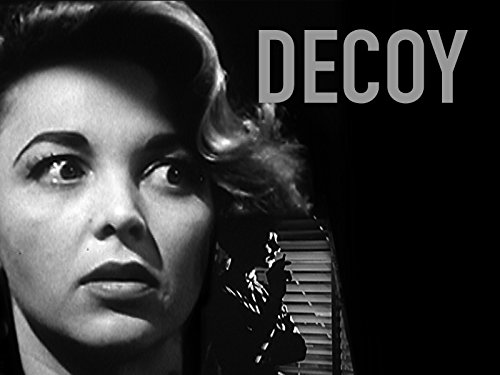
Welcome to Retro Television Reviews, a feature where we review some of our favorite and least favorite shows of the past! On Thursdays, I will be reviewing Decoy, which aired in Syndication in 1957 and 1958. The show can be viewed on Tubi!
This week, Casey investigates an elderly crime lord.
Episode 1.25 “High Swing”
(Dir by David Alexander, originally aired on March 31st, 1958)
Casey rides to the hospital with a young woman named Anne (Zohra Lampert). Anne has overdosed on heroin. Before she dies, Anne tells that Casey that she was poisoned by an old man named Otto Flagler (Albert Dekker). After learning that Anne was a pickpocket, Casey goes undercover as a thief until Otto Flagler approaches her and invites her to come live and work with him and his wife, Lily (Edith Atwater).
Casey is shocked to discover that Lily is in a wheelchair, the result of an accident that occurred when Lily was a trapeze artist. Otto is a mugger because he needs the money to take care of his wife. Casey even starts to feel sorry for Oto and Lily. That said, Casey is still a cop and she has a job to do. When Otto realizes that he and his wife are about to be arrested, he slips heroin into their coffee. By the time the police arrive, both Otto and Lily are dead.
Casey is upset. One of the other cops offers to buy her a cup of coffee. Casey says that she won’t be drinking coffee for a while.
This was a sad episode. Casey didn’t really have to do much to solve the mystery. The whole point of the episode was that Otto and Lily were not master criminals. They were two people who loved each other and found themselves in a desperate situation. That said, Otto did murder Anne so let’s not feel too sorry for him.
Albert Dekker and Edith Atwater both gave good performances and, as always, Beverly Garland was excellent in the role of Casey. This was a good episode.
Of splendour in the grass, of glory in the flower;
We will grieve not, rather find
Strength in what remains behind…
— “Ode: Intimations of Immortality from Recollections of Early Childhood” by William Wordsworth
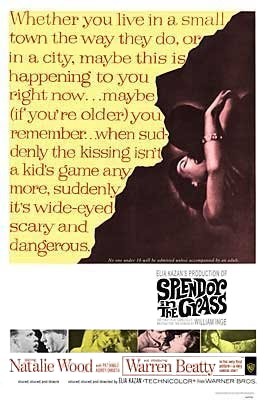
The 1962 film, Splendor in the Grass, takes place in Kansas shortly before the start of the Great Depression. Deanie (Natalie Wood) and Bud (Warren Beatty) are two teenagers in love but, as we learn, youthful love does not always translate into adult happiness.
Bud and Deanie are idealistic and in love but they’re from different social classes. Bud is the son of a boisterous oilman named Ace (Pat Hingle) and Ace acts much like you would expect a millionaire named Ace to behave. Bud’s parents are determined that he attend Yale and that he marry someone else from a wealthy family. They don’t want him to turn out like his older sister, Ginny (Barbara Loden), who drinks, smokes, and is rumored to have recently had an abortion. Meanwhile, Deanie is repeatedly told by her mother that she must always remain a “good girl” and not give in to the temptation to have premarital sex with either Bud or any other boy. If she does, she’ll be forever branded a bad girl and she’ll pretty much end up with a reputation like Ginny’s.
(Interestingly enough, Ace doesn’t have any problem with Bud finding himself a bad girl, nor does he have a problem with taking his son to a speakeasy later in the film. As far as society in concerned, being “good” and following the rules only applies to women.)
Needless to say, things don’t work out well for either Deanie or Bud. Bud is so frustrated that Deanie won’t have sex with him that he dumps her and then has the first of several breakdowns. When Deanie’s attempt to win Bud back by acting more like Ginny fails, she ends up going out with a classmate named Toots Tuttle (Gary Lockwood). Nothing good ever comes from going out on a date with someone named Toots Tuttle. That’s certainly the case here as Deanie and Bud both struggle with the demands of a hypocritical society that expects and encourages Bud to behave in a certain way but which also condemns Deanie for having desires of her own. And, of course, the entire time that Bud and Deanie’s drama is playing out, we’re aware that the clock is ticking and soon the stock market is going to crash and change everyone’s lives forever.
It’s kind of a depressing film, to be honest. I’ve always found it to be rather sad. When we first meet them, Deanie and Bud seem as if they’re perfect for each other but, throughout the entire film, the world seems to be conspiring to keep them apart. By the end of the film, they’ve both found a kind of happiness but we’re painfully aware that it’s not the happiness that either one was expecting while they were still in school. The film suggests that type of happiness might be impossible to attain and a part of growing up is realizing that there is no such thing as perfection. Instead, there’s just making the best of wherever you find yourself.
There’s a scene in this film where Natalie Wood nearly drowns and it always freaks me out, both because of my own fear of drowning and the fact that it foreshadows what would eventually happen to Natalie in 1982. (The fact that Natalie Wood and Robert Wagner’s yacht was called “Splendour” doesn’t help.) Natalie herself was also deeply scared of drowning and just filming the scene undoubtedly took a lot of courage on Natalie’s part. But then again, Natalie Wood’s entire performance is courageous. Natalie Wood gives an emotional and intense performance as Deanie, holding nothing back and it’s impossible not to get emotional while watching her. Making his film debut, Warren Beatty is a bit of a stiff as Bud, though he’s certainly handsome and you can tell why Deanie would have found him attractive. (In high school, you always assume that the boring, handsome guys actually have more depth than they let on.) By the end of the film, you understand that Deanie deserved better than Bud. Then again, Deanie deserved better than just about everything life had to offer her. But Deanie survived and endured and made the best of what she was given because, really, what else could she had done? What other choice did she have?
For her performance in Splendor in the Grass, Natalie Wood received her second Oscar nomination for Best Actress. She lost to Sophia Loren for Two Women and …. well, actually, Loren deserved the award. But so did Wood. 1961 would have been a great year for a tie.
In the 1971 film, Let’s Scare Jessica To Death, Zohra Lampert played Jessica, a woman who is struggling to remain sane.
As the film begins, Jessica has just been released from a mental institution. As Jessica explains it, she’s been hearing voices ever since her father died. She struggles with depression and sometimes, she gets paranoid. Her husband, Duncan (Barton Heyman), has just purchased a farm in Connecticut, a place where he believes that Jessica can find some peace. Their friend, Woody (Kevin O’Connor), will be moving out to the farm with them. Woody is a bit of a hippie. Some people would say that Jessica and Duncan are hippies as well but honestly, both of them seem to be more like people who desperately want other people to believe that they’re hippies as opposed to genuine members of the counterculture.
Upon arriving at their new farm, Jessica is shocked to discover a woman named Emily (Mariclare Costello) standing in their farmhouse. When the shocked Jessica calls out for Duncan, he immediately assures her, “I see her, too!” Emily explains that she’s spent the last few months living in the deserted farmhouse. Though Emily offers to leave, Jessica insists that Emily have dinner with them and spend the night. When it becomes obvious that Woody likes Emily, Jessica suggests that Emily should be allowed to live with them.
Duncan agrees to let Emily stay and, much like Jessica, you immediately start to wonder about his motives. Is he merely letting Emily stay to keep Woody happy? Or is he agreeing with Jessica because he’s scared that disagreeing with her will cause her have another breakdown? Or is it possible that he’s attracted to Emily himself?
As the days pass, Jessica struggles to adjust to life in the middle of nowhere. The location is beautiful but, because it’s so remote, it’s menacing as well. The people in the nearby town are strangely hostile and they always seem to be wearing bandages on their necks. Jessica starts to hear voices in the distance, taunting her and telling her that she has no place out in the country. Are they real or is it just her imagination? Is Jessica trying so hard to convince everyone that she’s okay that she’s actually pushing herself to a relapse? And what about the mysterious blonde girl that keeps appearing in the distance, watching Jessica but running away whenever Jessica tries to approach her?
And then there’s the picture that Jessica finds in an antique shop. It appears to be a picture of Emily but the shop’s owner assures her that the picture is over 100 years old….
Apparently, the script for Let’s Scare Jessica To Death was originally called It Drinks Hippy Blood and it’s intent was satirical. You wouldn’t be able to guess that from watching Let’s Scare Jessica To Death, which is one of the creepiest and most dream-like horror films that I’ve ever seen. Unfolding at a leisurely pace and featuring hazy but gorgeous cinematography, Let’s Scare Jessica To Death keeps both Jessica and the audience off-balance. You’re never quite sure if Jessica is right about Emily and the town or if she’s relapsed and is drowning in a sea of her own paranoia. Duncan and Woody both treat Jessica as if she might fall apart at any second. At times, Duncan and his constant concern is so suffocating towards her that you feel that, if Emily hadn’t been there waiting for them, Jessica would have had to create her. As frightening as Emily may be, only Emily can set Jessica free from her domineering husband.
More than being just a character study of a woman struggling to remain above water, Let’s Scare Jessica To Death is also a portrait of the death of counterculture idealism. Jessica, Duncan, and Woody appear to have a chance to live the ideal hippy life on their Connecticut farm but that dream collapses under the weight of all the petty human emotions and foibles that they wrongly thought they could escape. Duncan treats Jessica like a child, gaslighting her whenever she questions anything that’s going on. Woody seems like a good guy but he’s so laid back that he refuses to stand against the tide. Jessica is betrayed by everyone around her. In the end, not even the mysterious blonde girl is willing to actually warn Jessica about what’s happening.
Zohra Lampert gives a wonderfully empathetic performance as Jessica and Mariclare Costello and Gretchen Corbett are well cast as the enigmatic strangers that Jessica can’t seem to escape. Let’s Scare Jessica To Death is a creepy and atmospheric dream of dark and disturbing things and it’s definitely one to see.

 Through the Shattered Lens