14 Days of Paranoia #3: The Passover Plot (dir by Michael Campus)


First released in 1976 and based on a book that had come out ten years previously, The Passover Plot is a film that asks, “What if Jesus was a political revolutionary who faked his own death?”

Even when the film was first released, that wasn’t a particularly novel or new theory.  Ever since the Crucifixion, there have been conspiracy theorists who have claimed that the entire thing was staged.  Indeed, the early days of the Church were defined by conflicts between different sects debating the true nature of Jesus, with those who believed that he was the son of God and that he had risen from the dead eventually winning out over sects who claimed that Jesus was not divine or that he had actually escaped from the Romans and was instead hiding out in Egypt or even on the island that would eventually become known as Britain.  (The fact that so many Gnostics and other heretics were executed by the Church and their texts suppressed only served to lend them credibility with future theorists.)  Still, every few decades, some new book or film will claim that Jesus faked his death or married Mary Magdalene and gullible people will act as if this is somehow a new argument.  It’s been over 20 years since all of that Da Vinci Code nonsense convinced bored suburbanites across America that they could be experts on both boxed wine and historical conspiracy theories.  We’re about due for a new version of the old story.

As for The Passover Plot, it features Zalman King as Yeshua of Nazareth, an angry young man who dreams of the day when Judea will be free of the Romans.  Having a knowledge of the prophecies of a messiah and also knowing that he is descended from King David, Yeshua specifically patterns his life after the prophecies and presents himself as being not just another revolutionary but instead as being sent by God.  However, he is also aware that it will be necessary for him to “die” and “rise from the dead,” so he goes out of his way to force the hand of Pontius Pilate (Donald Pleasence).  Having seen plenty of crucifixions when younger, Yeshua arranges for the local revolutionaries to drug him so that he’ll appear to be dead.  When he later wakes up, everyone will believe that he has returned from the dead.  The film ends with several title cards, all arguing that the Gospels were written long after Yeshua’s death (“Mark lived in Italy!” one title card proclaims with almost comical indignation) and were subsequently rewritten by “unknown” hands.

The Passover Plot is a weird combination of biblical epic and conspiracy thriller.  Scenes of Yeshua preaching feel as if they could have come from any traditional Biblical epic but they are awkwardly placed with scenes of Yeshua having secret, melodramatic meetings with various conspirators.  It would make for an interesting contrast if not for the fact that the film itself is so slowly paced and boring.  Zalman King, who is best-known for his subsequent career as a softcore filmmaker, spends a lot of time yelling and smoldering intensely but he still doesn’t have the charisma or screen presence necessary to be convincing in the role.  In the scene were he’s meant to be passionate, he shrieks with such abandon that he makes Ted Neeley’s performance in Jesus Christ Superstar feel restrained.  This film asks us to believe that people would not only abandon their previous lives to follow Yeshua but that they would also take part in an elaborate conspiracy that could have gone wrong at any time.  For that to be believable, Yeshua needs to be played by someone who doesn’t come across like the drama student that everyone dreads having to do a scene with.  Far more impressive is Donald Pleasence, whose portrayal of a ruthless and unfeeling Pilate is a marked contrast to some of the more sympathetic interpretations of the character that tend turn up in the movies.

On the plus side, the film does look good.  It was shot on location in Israel and there is a certain authenticity to the film’s recreation of the ancient world.  Along with Pleasence, character actors like Scott Wilson (as Judas!) and Dan Hedaya get a chance to shine.  But otherwise, The Passover Plot is too slowly paced and kooky for its own good.  Conspiracy theorists never seem to understand that the more elaborate a conspiracy theory becomes, the less convincing it is to anyone who isn’t already a true believer.  In the end, how one feels about the film’s conclusions will probably be connected to how one already views Jesus and the Church.  The Passover Plot is not a film that’s going to convince anyone who wasn’t already convinced.

14 Days of Paranoia:
  1. Fast Money (1996)
  2. Deep Throat II (1974)

Music Video of the Day: Last Drag by Traci Lords (2011, dir by Zalman King)


Today’s music video of the day was directed by Zalman King, who would have turned 82 years old today.  King started his career as an actor and appeared in some fairly strange films in the 70s but, in the 80s, he reinvented himself as cinema’s number one purveyor of extremely pretentious yet oddly sincere erotica.  

This video came out a year before King’s death in 2012 and everything about it — from the visual style to the star of the show — is easily identifiable as having been done in King’s signature style.

Enjoy!

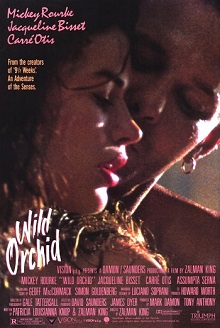
Cinemax Friday: Wild Orchid (1989, directed by Zalman King)


Emily (played by blank-faced model Carrie Otis) is a lawyer who can speak French, Spanish, Portuguese, Chinese, and Italian but who has never spoken the language of love.  A high-powered New York firm hires her away from her former employer in Chicago on the requirement that she immediately head down to Rio de Janeiro.  Claudia Dennis (Jacqueline Bisset) is trying to close the deal on buying a luxury hotel and she needs a lawyer now!

Claudia, however, has plans for Emily that go beyond real estate.  As soon as Emily arrives, Claudia arranges for her to go on a date with the wealthy and mysterious James Wheeler (Mikey Rourke).  Wheeler is single but he’s so far refused all of Claudia’s advances.  She wants to know if he’s adverse to all women or just her.  Wheeler is very taken with Emily but he’s been hurt so many times in the past that he can’t stand to be touched.  Instead, he gets his thrills by being a voyeur.

It leads to a trip through Rio, where everyone but Emily is comfortable with their sexuality.  When Wheeler isn’t encouraging her to watch a married couple have sex in the back seat of a limo, Claudia is encouraging Emily to disguise herself as a man and enjoy the nonstop carnival of life in Rio.  There’s a lot of business double-dealing, many shots of Mickey Rourke riding on his motorcycle, and a final sex scene between Rourke and Otis that is one of the most rumored about in history.  For all of the scenes of Wheeler explaining his philosophy of life, Wild Orchid doesn’t add up too much, though it certainly tries to.

Wild Orchid was a mainstay on late night Cinemax through most of the 90s.  This was Carrie Otis’s first film and to say that she gives a bad performance does a disservice to hard-working bad actors everywhere.  There’s bad and then there’s Carrie Otis in Wild Orchid bad.  She walks through the film with the same blank expression her face, playing a genius who can speak several languages but often seeming as if she’s struggling to handle speaking in just one language.  She looks good, though, and all the movie really requires her to do is to look awkward while Rourke and Bisset chew up the scenery.

On the one hand, Wild Orchid is the type of bad movie that squanders the talents of actors like Mickey Rourke, Jacqueline Bisset, and Bruce Greenwod (who has a small role as a sleazy lawyer) but, on the other hand, it’s a Zalman King film so it may be insanely pretentious but it’s also rarely boring.  Visually, King goes all out to portray Rio as being the world’s ultimate erotic city and the dialogue tries so hard to be profound that you’ll have to listen twice just to make sure you heard it correctly.  My favorite line?  “We all have to lose ourselves sometimes to find ourselves, don’t you think?”  Mickey Rourke says that and he delivers it as only he could.

Wild Orchid may have been a box office bust but it was popular on cable and on the rental market, largely because of that final scene between Rourke and Otis.  Mikey Rourke later married Carrie Otis.  Neither returned for Wild Orchid II: Two Shades of Blue.

Film Review: Some Call It Loving (dir by James B. Harris)


1973’s Some Call It Loving tells the story of Robert Troy (Zalman King).  He’s rich.  He has a girlfriend (or maybe she’s his wife, we’re never quite sure) named Scarlett (Carol White).  He lives in a big, beautiful mansion with Scarlett and Scarlett’s girlfriend, Angelica (Veronica Anderson), and several different women who Robert and Scarlett bring home so that they can all pretend to be someone other than who they are.  (When the film begins, Scarlett is pretending to be the strict head mistress of a finishing school.  Later, she’ll pretend to be a nun.)

Robert seems like he should be happy but, from the minute we see him, it’s obvious that he’s not.  He’s mired in deep ennui and even playing in a jazz band at a nightclub doesn’t seem to bring him any real joy.  Robert plays saxophone.  His best friend in the band is Jeff (Richard Pryor), a barely coherent junkie who is probably only alive because of the pills that Robert keeps him supplied with.

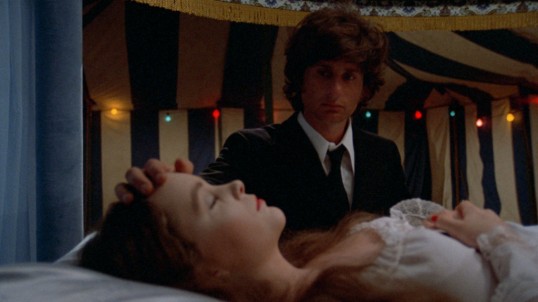
One night, Robert goes to a carnival.  He stops at a tent that apparently houses “Sleeping Beauty.”  Inside the tent, a young woman named Jennifer (Tisa Farrow, later to star in Lucio Fulci’s classic Zombi 2).  Jennifer is in a comatose state.  People pay a dollar so that they can enter the tent and kiss her.  Her “owner” says that Robert can do more with her if he’s willing to pay $50.  Robert instead buys her for $20,000.

It turns out that Jennifer has been in a coma for eight years.  She’s been kept in that state by a “sleeping potion,” a cocktail of drugs that has to be administered on a daily basis.  Robert takes her back to his mansion and doesn’t give her the potion.  Eventually, Jennifer wakes up.

Now, speaking for myself, if I woke up in a strange place after being in a forced coma for eight years, I’d probably be pretty pissed off.  Jennifer, however, cheerfully accepts that the fact that she’s been asleep for eight years and now she’s living with a somewhat creepy man and his two girlfriends.  She’s just happy to have her mansion and her Prince Charming!

While Scarlett and Angelica view Jennifer as being someone new to play games with, Robert starts to develop real feelings for her.  He wants to have a real life with Jennifer but, unfortunately, the only life that Jennifer knows is the fake one that he’s created with Scarlett and Angelica.  Robert finds himself torn between deciding whether or not to commit to Jennifer or to the fake world that he and Scarlett have created at the mansion….

Some Call It Loving is a strange film.  It’s incredibly pretentious in the way that only an art film from 1973 could be.  Reportedly, the film was a box office disaster in America but the European critics loved it.  That’s not surprising because the film’s sensibility is far more European than American.  Not only does the film refuse to judge its characters but it also ends on the type of ambiguous note that seems specifically designed to alienate mainstream audiences.  Though the film’s plot has all the making for a kinky melodrama, it’s actually far more of an erotic fairy tale.  Jennifer really is Sleeping Beauty but, unfortunately, Robert may not be quite prepared to be a true life Prince Charming.  In the end, both Jennifer and Robert are trapped by their own fantasies.

As I said, it’s pretentious but it’s also strangely watchable.  From the opening of the film, director James B. Harris achieves a properly dream-like feel and Zalman King manages to be both compelling and creepy at the same time.  Tisa Farrow is perfectly cast as Jennifer and the mansion where the majority of the film takes place is simply to die for.  Even if Robert is a creep, he at least has good taste when it comes to interior design.  Some Call It Loving is obviously not a film for everyone.  What some will find dream-like, others will find to be muddled and annoying.  But it’s an intriguing artifact of early 70s arthouse cinema.

Six Other Films From Crown International Pictures That Deserved An Oscar Nomination!


An hour ago, I told you about the only Oscar nomination that was ever received by Crown International Pictures, one of the most prolific B-movie distributors of the 70s and 80s.  That nomination was for Best Original Song for Crown’s 1972 film, The Stepmother.

Here are 6 more films from Crown International Pictures that I think deserved some Oscar consideration:

The Teacher (1974)

“She corrupted the youthful morality of the entire school!” the poster screamed but actually, The Teacher was a surprisingly sensitive coming-of-age story about a relationship between a younger man and an older woman.  Jay North and Angel Tompkins both give excellent performances and Anthony James shows why he was one of the busiest character actors of the 70s.

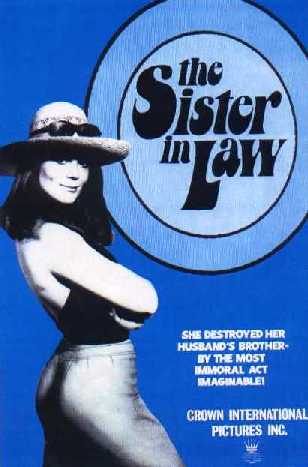
2. The Sister In Law (1974)

John Savage has been acting for several decades.  He’s appeared in a number of acclaimed films but he’s never received an Oscar nomination.  One of his best performances was in this melancholy look at love, betrayal, and ennui in the early 70s.

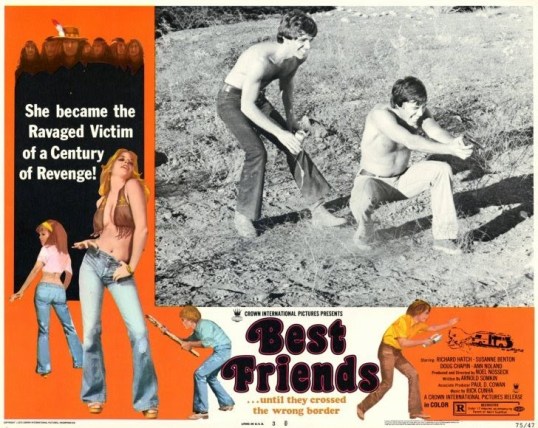
3. Best Friends (1975)

One of the strangest films ever released by Crown International, Best Friends is also one of the best.  A road trip between two old friends goes terribly wrong when one of the friends turns out to be a total psycho.  This well-acted and rather sad film definitely deserves to be better-known than it is.

4. Trip With The Teacher (1975)

Zalman King for Best Supporting Actor?  Hell yeah!

5. Malibu High (1979)

Surely Kim Bentley’s performance as a high school student-turned-professional assassin deserved some sort of consideration!

6. Don’t Answer The Phone (1980)

Don’t Answer The Phone is not a particularly good movie but it certainly is effective.  It made me want to go out and get a derringer or some other cute little gun that I could carry in my purse.  That’s largely because of the performance of Nicholas Worth.  Worth plays one of the most perverse and frightening murderers of all time and Worth throws himself into the role.  It’s one of the best psycho performances of all time and certainly worthy of a Best Supporting Actor nomination.

The TSL’s Daily Horror Grindhouse: Galaxy of Terror (dir by Bruce D. Clark)


galaxy_of_terror

Long before Event Horizon (but, perhaps more importantly, shortly after the original Alien), there was 1981’s Galaxy of Terror!

Produced by Roger Corman and featuring production design and second unit work from James Cameron, Galaxy of Terror tells the story of what happens when, in the future, the crew of the Quest are dispatched to a mysterious planet.  They’re on a rescue mission but what they don’t realize is that they’re heading into a trap!

The crew of the Quest is virtually a who’s who of cult actors.

The youngest member of the crew is Cos.  Cos is scared of everything and, from the minute you see him, you can tell that he’ll probably be the first to die.  Cos is played by Jack Blessing, who subsequently became a very in-demand voice over artist.  You may not recognize the name or the face but you’ve probably heard the voice.

Captain Trainor, who is still troubled by a disastrous mission in the past, is played by Grace Zabriskie, who is rumored to have inspired Bob Dylan’s “Like A Rolling Stone” and who subsequently became a regular member of David Lynch’s stock company.

The fearsome Quuhod is played by one of the patron saints of exploitation filmmaking, the one and only SID HAIG!  Quuhod doesn’t say much but Sid Haig doesn’t have to say much to make an impression.

Technical officer Dameia is played by Taaffe O’Connell.  She suffers through the film’s most infamous and distasteful scenes, in which she’s assaulted by a gigantic space worm.  That scene was apparently insisted upon by Roger Corman and it’s not easy to watch.  At the same time, since the film takes place on a planet that is ruled by pure evil, the scene somehow works.  It’s that scene that tells you that Galaxy of Terror is not going to be your typical B-movie.  That is the scene that says, “This movie is going to give you nightmares!”

Ranger is played by Robert Englund!  That’s right — the original Freddy Krueger himself.  It’s interesting to see Englund in this role because Ranger is actually one of the only likable characters in the film.  It’s strange to see the future Freddy Krueger being menaced by the same type of threats that he unleashed on Elm Street.  But Englund does a good job in the role.  In fact, he does so well that you wonder what would have happened in his career if he hadn’t been forever typecast as the man of your nightmares.

The arrogant and cocky Baelon is played by future director, Zalman King.  It says something about King’s acting career that Galaxy of Terror is not the strangest film that he ever appeared in.

Burned-out Commander Ilvar is played by Bernard Behrens, who is one of those character actors who has a very familiar face.  If you watch any movie from the 80s or 90s that features a weary homicide detective or an unsympathetic bureaucrat, it’s entirely possible that he was played by Bernard Behrens.

Kore, the ship’s cook, is played by Ray Waltson, who is another one of those very familiar character actors.  Over the course of his long career, Waltson appeared in everything from The Apartment to The Sting to Fast Times At Ridgemont High to a countless number of TV shows and TV movies.  Waltson was usually cast in comedic roles so it’s interesting to see him here, playing a role that is very much not comedic.

Alluma, an empath, is played by Erin Moran, who was best known for playing Ron Howard’s bratty sister on the somewhat terrible (but apparently popular and deathless) sitcom, Happy Days.  Moran’s explosive death scene is another reason why Galaxy of Terror has a cult following.

And finally, the “star” of the film is Edward Albert, who plays Cabren.  To return to my earlier comparison to Event Horizon, Edward Albert has the Laurence Fishburne role.

Anyway, our crew is sent on a rescue mission but, when they crash land on the planet Morganthus, they find themselves outside of a desolate pyramid.  They make the mistake of exploring the pyramid and end up being confronted by their greatest fears.  (They also eventually discover that one of their crewmates is a traitor.)  It’s pretty much a typical sci-fi slasher film but it makes an impression because, thematically, it’s just so dark.  The fears that attack the crew members are so ruthless and brutal that they will take even the most jaded of horror fans by surprise.  Galaxy of Terror is relentless and merciless in its effort to scare the audience.

What especially distinguishes Galaxy of Terror is that, despite the obviously low budget, the entire film feels sickeningly real.  A lot of credit for that has to go to James Cameron, who creates a lived-in future that actually feels a lot more plausible than anything to be found in Avatar.

So, if you have the chance, turn off the lights, watch the film in the dark, and prepare for a perfect Halloween nightmare!

http://www.youtube.com/watch?v=mJO07ylhTu4

Val’s Movie Roundup #24: Late Night Cable Edition


I guess after watching Cyber Seduction: His Secret Life this had to be the next roundup. Also it’s been 21 of these things since I last spotlighted this genre of movies. I know how that kid could have been cured of his addiction. Watching these four movies.

IMG_9416

Passionate Intentions (2015) – This one wasn’t even in IMDb when I watched it. They’re still processing my submission as I am writing this. This movie is one of those that has the absolute bare minimum plot, and the rest is just sex. It’s about a couple. The girl is about to inherit some money and it comes between them for awhile. Really, who cares. However, while the acting is bad, the plot doesn’t exist, and the sex is boring, it’s actually rather pretty. Here’s two shots.

IMG_9422

IMG_9425

The movie may be bad, but at least it was well shot. That’s way more than can be said for some of these. Sadly, they didn’t get someone as good for the sound cause that’s a little off.

Oh, and if somebody knows, then tell me what was with this guy and these dog tags. There are two sex scenes with him where he is wearing them. I don’t remember any explanation given. Is this some fetish I’m not aware of?

IMG_9452

IMG_9463

Sexual Wishlist (2014) – Just like Passionate Intentions, this movie has the as little plot as possible and as much sex as possible thing going on. This time it’s a divorce and an argument over who gets a couple of things that keeps them having sex with other people. But this movie has two things Passionate Intentions didn’t have.

IMG_9472

Frankie Cullen

Christie Stevens

Christie Stevens

I’ve seen Frankie Cullen in several of these movies now and he is almost too good for them. I know he has done a few, but he really should be doing B-Movies rather than these. He has enough acting talent for it. His presence usually lifts the movie up.

Unfortunately, Christie Stevens does the opposite. She gives the worst performances I have seen in any of these movies. Her line readings make Ryan O’Neal in Tough Guys Don’t Dance (1987) seem amazing.

At least her lines in Intergalactic Swingers (2013) were so cheesy that it really didn’t matter, but here she is wretched.

Also, some how this movie and Passionate Intentions were shot by the same person, Lex Lynne Smith, but the difference in quality is almost night and day.

IMG_9482

Pleasure Or Pain (2013) – Now that director Zalman King is no longer with us, they seem to be slapping his name onto anything he did. He’s the one who brought us the Red Shoe Diaries. You know, the TV show and movie series that David Duchovny narrated. I always found it funny that you could watch him on network television in the evening, then tune into late night cable and watch him there too. But to the movie.

This is Fifty Shades of Grey if that movie could have actually shown anything. Seriously, that almost tells you exactly what to expect here. Cut out the pointless relationship BS, horrible attempts at characters, and the stupid negotiation scenes and replace it all with arty eroticism. That’s Pleasure Or Pain in a nutshell.

IMG_9502

As you can see, clearly what was missing from Fifty Shades of Grey was a miniature boat. That’s our Christian Grey.

IMG_9487

That’s our Anastasia Steele narrating the story from what appears to be a radio broadcast booth. I’m not sure if they ever explain exactly where she was and it really doesn’t make any difference.

The two meet, get married, and then it’s just erotic scenes from then on. However, while the settings and exact situations may change, it goes to a certain point and never further. Just like Fifty Shades of Grey did. Both go only so far, then dance around there, but don’t actually do anything. King really tried to get arty with this. There’s one scene that both made me think of Jodorowsky’s The Holy Mountain (1973) and what must have been going on at One Eyed Jacks when Lynch wasn’t there filming Twin Peaks.

IMG_9568

IMG_9559

It’s the best of the four films here, but you will get sick of the erotic stuff. There’s really just so so much of it. I was already hurting by the mid point of the movie wanting the thing over with.

IMG_9576

Monster of the Nudist Colony (2013) – Now we’re scraping the bottom of the barrel. Take a whiff of those fingernails because that smell is Monster of the Nudist Colony. Not even Frankie Cullen could save this one.

IMG_9585

There’s an ape loose at a nudist colony where all people do is have sex. For some reason Cullen, a detective, is sent to investigate. And investigate he doesn’t. The movie is just some of the worst shot on video sex I have seen since Sexually Bugged! (2014). In fact, I’m quite sure that it’s the same crew. I even recognize some of the music, which by the way, is the worst music ever. And it has lyrics. One of them keeps repeating that he’s “Johnny Wet Pants”.

While everyone is having sex, the ape kidnaps and ties up a couple of the girls like Fay Wray or something. Just like the kid in Cyber Seduction is cured by jumping in a pool, two girls dancing naked while tied to poles turns the ape back into a man. Cause of course it does!

This really is the worst kind of these late night cable movies. It’s one of those where the girls look into the camera looking for approval like they’re a cat that’s just brought a dead rat to their owner.

Steer clear of this one.

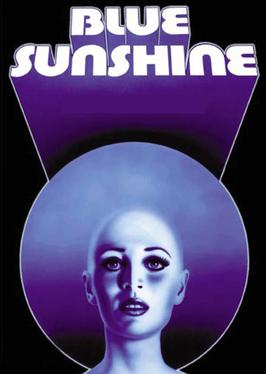
Shattered Politics #42: Blue Sunshine (dir by Jeff Lieberman)


(I wrote an earlier version of this review for HorrorCritic.Com.)

Blue_Sunshine_(film)

Occasionally, on twitter, I would take part in the Drive-In Mob live tweet session.  Every Thursday night, a group of exploitation, grindhouse, and horror film fans gog together and watched the same film and, via twitter, provided their own running commentary track.  It was always terrific fun and a good opportunity to discover some films that you might have otherwise missed.  It was through the Drive-In Mob that I first discovered a low-budget cult classic from 1978, Blue Sunshine.

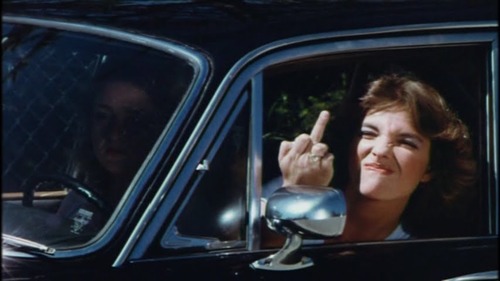
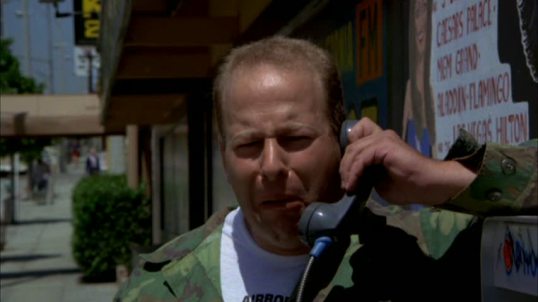
Blue Sunshine (directed by the underrated horror director Jeff Lieberman) opens in the late 1970s.  Across California, people are suddenly going bald and turning psychotic.  At a party, singer Frannie Scott (played by Richard Crystal) has a nervous breakdown when another reveler playfully pulls off his wig and reveals Frannie to be hairless.  Frannie responds by tossing half of the guests into the fireplace and then running out into the night.  He’s pursued by his best friend Jerry Zipkin (played by future director Zalman King) but when Frannie is accidentally killed while running away, Jerry finds himself accused of being a murderer.  Even as the police pursue him, Jerry starts his own investigation.  He quickly discovers that there’s an epidemic of bald people suddenly murdering those closest to them.  The one thing that these people have in common: they all attended Stanford University in the late 1960s and they all used a powerful form of LSD known as “blue sunshine.”  Now, ten years later, they’re all having the worst flashback imaginable.

And, perhaps most dangerously, the campus drug dealer, spoiled rich kid Edward Fleming (Mark Goddard), is on the verge of being elected to the U.S. Congress.  Not only it is possible that Edward may have taken the acid himself but Edward and his campaign manager have their own reasons to try to make sure that Jerry never reveals the truth behind Blue Sunshine.

Blue Sunshine is probably one of the best of the old grindhouse films, a film that embraces the conventions of both the horror and the political thriller genres while, at the same time, neatly subverting our expectations.  Director Jeff Lieberman emphasizes atmosphere over easy shocks and the film’s cast does a pretty good job of making us wonder who is normal and who has dropped the blue sunshine.  Wisely, Lieberman doesn’t resort to giving us any easy villains in this film.  Much like the best horror films, the monsters in Blue Sunshine are as much victims as victimizers.  I especially sympathized by one poor woman who was driven to rip off her wig by the sound of two particularly obnoxious children chanting, “We want Dr. Pepper!” over and over again.  Seriously, that’s enough to drive anyone crazy.

Blue Sunshine is one of those wonderfully odd little cult films that makes me thankful that I own a DVD player.  First released in 1978, Blue Sunshine mixes psychological horror with political conspiracy and the end result is an unusually intelligent B-movie that remains relevant even when seen today.  Blue Sunshine was originally released on DVD by Synapse Entertainment and it has since been re-released by the New Video Group.  I own the Synapse edition, which features a very entertaining director’s commentary with Jeff Lieberman as well as a bonus CD of the film’s haunting and atmospheric score.

http://www.youtube.com/watch?v=vJAAZZiFQ1Y

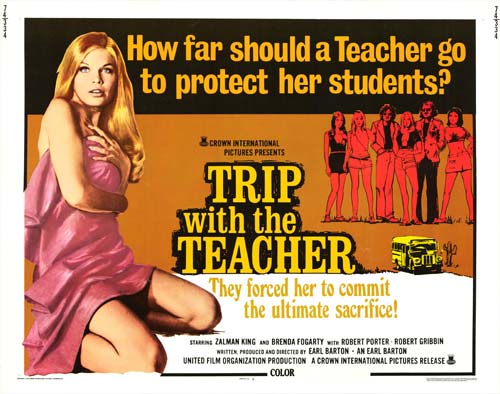
Back to School #16: Trip With The Teacher (dir by Earl Barton)


Trip With The Teacher

(MINOR SPOILERS)

First released in 1975 and subsequently included in a few hundred DVD box sets, Trip With The Teacher is yet another strange film from Crown International Pictures.

CIP_Logo

The film opens with a school bus driving through the California desert.  On board the bus is Miss Tenny (Brenda Fogarty) and four teenage girls.  One thing that I immediately noticed is that director Earl Barton — perhaps realizing that none of the girls had really been given any sort of individual personality — took the time to make sure each of the girls was color-coded so that the audience could keep them straight.  One is dressed in all blue, another in all green, and then another is wearing an unfortunate canary yellow.  Meanwhile, Julie (Cathy Worthington) is obviously meant to be the main girl because she’s allowed to wear not one but two colors — yellow and white.  When we first meet this group, we’re told that they’re on a field trip to see some Navajo ruins but, later on in the film, Julie says that they’re on a camping trip that has nothing to do with school beyond the presence of their teacher.  But the important thing is that they’re on a bus in the middle of the desert.  (The bus, by the way, is being driven by Marvin, who is played by an actor named Jack Driscoll and who might as well have “doomed” tattooed on his forehead.)

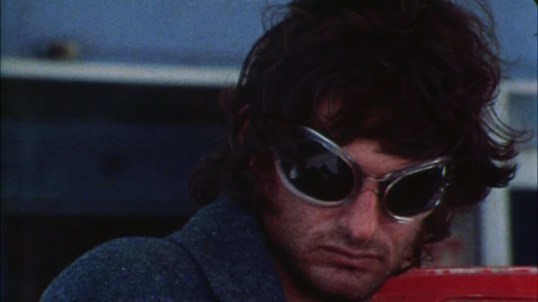
Also in the desert are two motorcycle-riding brothers — goofy Pete (Robert Porter), who has a big mustache and seems like a nice guy up until he starts trying to kill people, and Al (Zalman King), who is surly, wears weird sunglasses, and suffers from narcolepsy.  When Pete gets a flat tire out in the middle of the desert, he’s helped out by a passing motorcyclist named Jay (Robert Gribbin).  (Al sleeps through the entire encounter.)  Jay, who is oddly friendly and talkative, decides that he’ll ride along with these two strangers.

I’ve seen Trip With The Teacher a few times and I have to say that I have never really been able to figure out what’s supposed to be going on with Jay.  He’s the film’s nominal hero but Robert Gribbin plays him as being such a talkative and outwardly friendly character that my natural impulse is to distrust him.  Maybe I’ve seen too many films where the good Samaritan always turns out to be a psycho but Jay is simply too good to be true.

The Way Too Friendly Jay

The Way Too Friendly Jay

Briefly, this suspicion seems to be confirmed when Jay, Pete, and Al come riding up on the school bus and Jay sees Julie through a window.  Julie smiles and waves at Jay and I don’t blame her because I probably would have done the same thing, because Jay is cute, motorcycles are sexy, and you have to do something to pass the time while you’re being driven through the desert.  But then 30-something Jay smiles and starts to wave back at 16 year-old Julie and mouths something like, “Come over here!” before flashing a huge grin and the scene gets undeniably creepy.

(The creep factor is not lessened by Jay later telling Pete, “Gee, that Julie is a really cute girl.”)

Anyway, when the school bus eventually breaks down, the three motorcyclists stop to “help.”  In this case, helps means that Pete and Al use their motorcycles to tow the bus to a remote desert cabin.  After a fight that leaves Marvin dead, Pete and Al decide to take the teacher, the girls, and Jay hostage until they can figure out what to do….

Now, I said earlier that Trip With The Teacher is weird and, believe it or not, it’s not just because of Jay.  In the role of Al, future director Zalman King gives one of the oddest cinematic performances that I have ever seen.  King alternates between underplaying and overacting, randomly going from mumbling to such an extent that you can barely understand him to literally yelling out every single line.  It’s a performance that is so strange that it transcends such mundane concepts as good or bad.  Single-handedly, Zalman King creates a reason for people to actually sit through Trip With The Teacher.

Zalman King in Trip With The Teacher

Zalman King in Trip With The Teacher

The other odd thing about Trip With The Teacher is that, despite all of the bad things that happen on screen, the film features some oddly cheerful music.  The film’s theme song is played over the end credits, which  juxtaposes the music with scenes from the movie.  It’s an odd experience, watching all of these tense scenes play out while listening to that cheerful music.

And you can watch those end credits below!  (This, needless to say, is where the spoiler warning comes into effect.)  In order to get the full effect, be sure to stick with the credits all the way until the music stops playing.

(A quick warning: Though Trip With The Teacher is actually pretty mild as far as 70s grindhouse and drive-in films are concerned, the end credits still feature a few images that some may find disturbing — especially if you haven’t actually seen the film.  Once you’ve actually sat through the film and can put everything in context, it’s pretty much impossible to take any of it seriously.)

6 Trailers of Separation


Hi there!  Welcome to the latest edition of Lisa Marie’s Favorite Grindhouse and Exploitation Trailers.

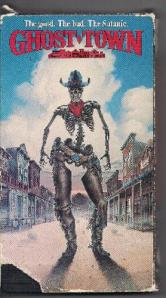
1) Ghost Town (1988)

Let’s start things out with this film from 1988.  I haven’t seen this film but the trailer has a certain silly charm to it and how can’t you enjoy the use of the fake lightning special effect?  Plus, those finger nails screeching across the car — Agck!  Freaky.

2) Blue Sunshine (1976)

This is one of my favorite movies.  Basically, a bunch of hippies take some really powerful acid in 1968 and then, eight years later, they end up having the worst flashback ever!  To say that Zalman King gives an “interesting” performance as the film’s hero is a bit of an understatement.

3) Road Games (1981)

“Jamie Lee Curtis is…Hitch.”  Well, that would probably explain why she was destined to end up hitchhiking.  Seriously, parents — give it some thought before you give your child any old name.  Anyway, Road Games was director Richard Franklin’s follow-up to Patrick and it’s one of the better slasher films of the early 80s.

4) The Dungeonmaster (1985)

Oh my God, this looks like a bad movie.  The trailer, however, is just so silly and kinda endearing in the way that it seems to desperately be saying, “No, it’s not as bad as it looks!  Look — we have ice people!”

5) Conquest (1983)

All I need to say here is that this film was directed by the one and only, Lucio Fulci.

6) Maniac Cop (1988)

Finally, let’s end this latest edition with Bruce Campbell, shall we?  This is the trailer for William Lustig’s Spinell-free Maniac Cop.