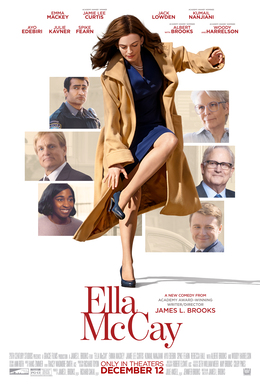
The Winter Olympics have begun and, waking up this morning, I did what any American celebrating the 250th birthday of her country would do. I watched curling. I watched as Team USA defeated Team Switzerland. I enjoyed not only watching America notch up a victory but I also enjoyed the contrast between the super-intense, super-shriekey Swiss team and the relatively mellow American team. Watching the Americans laugh and joke while the Swiss couple yelled at each other left me feeling very patriotic and hopeful.
In fact, it left me in such a good mood that I decided it was finally time to watch Ella McCay.
It’s easy to forget now what a big deal it was when the trailer for Ella McCay was first released in August of 2025. It was the trailer for James L. Brooks’s first film in 15 years, a political comedy for adults. It was full of familiar faces and it looked absolutely awful. Seriously, the trailer was so unappealing that I became rather fascinated by it. Even the worst films can usually scrounge together enough good material to at least come up with a passable trailer. Watching the trailer for Ella McCay, I could only wonder who was responsible for putting it together. Who thought it was a good idea to lead off with that lengthy Woody Harrelson scene? Who thought the wedding scene didn’t look weird? Who didn’t take the time to do something about Spike Fearn’s hair?
There were some who said that Ella McCay shouldn’t be judged based solely on its trailer. They pointed out that director James L. Brooks directed three films that were nominated for Best Picture, two of which were actually good. They pointed out that Ella, her brother, and her husband were all played by British actors who had appeared on niche television shows. Soon, there was a mini-civil war being fought on twitter between those who dismissed Ella McCay based on the trailer and those who promised that they would love the film once it was released.
Then, on December 12, the film was released, the reviews were uniformly terrible, and it tanked at the box office. It took the film a little less than two months to go from the theater to streaming online.
Having now watched Ella McCay, I can say that …. well, yeah, it’s pretty bad.
It’s not necessarily bad for the reasons that I thought it would be. Watching the trailer, I thought the film’s downfall would be the performances of Woody Harrelson and Jamie Lee Curtis. Both of them looked to be acting up a storm. Having now seen the film, I can say that both of them actually do probably about as good a job as could be expected to do with the material that they were given. Neither one is particularly memorable but they’re not terrible either. For that matter, Albert Brooks is amusing as Ella’s boss and mentor, Governor Bill.
Instead, the main problem with the film is that Ella McCay is not a particularly interesting or even likable character, not matter how much the film’s narrator insists otherwise. A policy wonk from a broken home who, at the age of 34, has become lieutenant governor of some nameless state up north, Ella is boring, humorless, and ultimately more than a little annoying. She’s the girl in elementary school who always told on the kids who talked while the teacher was out of the room. She’s your high school classmate who got all judgey if you wore a short skirt. She’s your self-absorbed college roommate who always had to remind you that, no matter what you were going through, her father was a philanderer and her mom was dead. She’s the colleague who voluntarily does all the work on your group project without being asked and then complains that no one helped her. She’s the person who insists that she can change the world but who is still so emotionally stunted and immature that, at 34, she needs her aunt to teach her primal scream therapy. Emma Mackey gives a disjointed performance as Ella, speaking with bland intensity whenever Ella is being serious and then overacting whenever Ella has to be flustered.
As bad as Mackey was, though, she was nowhere near as bad Spike Fearn, who plays Ella’s agoraphobic younger brother, Casey. For some reason, Casey gets a huge subplot that doesn’t really seem to go anywhere. We’re told that Casey hasn’t left his apartment in over a year and we repeatedly see that Casey struggles to communicate with people. The film treats most of this as being a joke and Spike Fearn gives such a twitchy performance that Casey comes across as being far more creepy than he probably should. We’re meant to cheer when Casey reconnects with his ex but I wasn’t silently yelling at her to run as far aways as possible. We spend so much time with Casey that it’s hard not to wonder if maybe the filmmakers themselves realized that Ella wasn’t very interesting but Casey is hardly an appealing alternative.
There’s a lot about Ella McCay that doesn’t work. Just the fact that the film features what appears to be hastily written narration from Ella’s secretary (Julie Kavner) would seem to reveal that someone understood that the film’s mix of tones and incidents really didn’t gel. (Having Kavner actually say, “Hi, I’m the narrator,” is a touch that is more than a bit too cutesy.) Ella’s husband (Jack Lowden) is such an obvious and odious villain that it was hard not to feel that Ella had to have been an idiot to marry him in the first place. There’s a weird plotline involving Ella’s state troopers trying to get overtime. Ella gets involved in one of the most jejune scandals of all time and the film ends with on a note that leaves you wondering how the 80-something Brooks can be so naive about politics.
But really, the main problem with the film is that it never convinces me that I should want Ella McCay to be governor. To quote Karen Black in Nashville, she can’t even comb her hair.
 Through the Shattered Lens