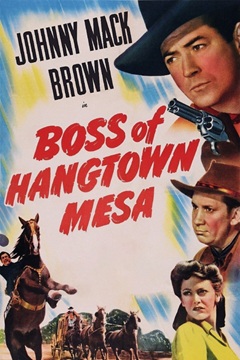
Boss of Hangtown Mesa (1942, directed by Joseph H. Lewis)


The telegraph company has come to the frontier town of Hangtown Mesa and soon, the citizens will be connected to the rest of the world.  The wealthy men who run the town don’t want that to happen because then people might discover how corrupt they are.  They hire a gunman known as the Utah Kid (Hugh Prosser, not looking much like a kid) to come to town and kill the owner of the telegraph line, John Wilkins (Henry Hall).  The Utah Kid steals the clothes of engineer Steve Collins (Johnny Mack Brown) and frames him for Wilkins’s murder.  With the help Betty Wilkins (Helen Deverell) and traveling medicine man Dr. J. Willington Dingle (Fuzzy Knight), Steve sets out to clear his name.

This is a pretty good Johnny Mack Brown western.  The plot isn’t half-bad as far as Poverty Row westerns are concerned and director Joseph H. Lewis keeps things lively.  Lewis not only gets good performances from his cast but he also makes Hangtown Mesa seem like an actual, growing frontier town.  Lewis even manages to create some suspense as The Utah Kid and Steve Collins switch identities.  Comparing Lewis’s westerns to the ones directed by Sam Newfield shows how much difference a good director can make, even within the confines of a poverty row production.  Even Fuzzy Knight is used well!

Boss of Hangtown Mesa is one of the better Johnny Mack Brown westerns, featuring a good story and an interesting idea behind it as it shows how far the bad guys will go to keep their own private fiefdom from connecting with the rest of the world.  Brown is convincing, whether he’s riding a horse or holding a gun.  He’s playing an educated man here, an engineer, but Brown is still a cowboy through-and-through.

Horror Film Review: The Mummy’s Curse (dir by Leslie Goodwins)


When last we checked in with Kharis the Mummy, he was running into a swamp in Massachusetts, carrying the reincarnation of Princess Ananka with him.  Chasing after him were the standard towns people with torches and guns.  It’s not a Universal horror film without angry villagers, even if the movie itself is taking place in Mapleton, Massachusetts.

Upon entering the swamp, both Kharis and Ananka sunk under the water, traumatizing Ananka’s boyfriend but apparently bringing Kharis’s reign of terror to an end.

Well, not so fast!

The 1944 film, The Mummy’s Curse, opens with the townspeople talking about how Kharis continues to haunt the old swamp, so much so that most of the locals refuse to work in the swamp.  Oddly enough, though, the townspeople are suddenly a mix of Cajuns and gypsies.  (The film even opens with a gypsy woman singing a song in a bar.)  The swamp has now become a bayou.  We are repeatedly told that the film is taking place in the same location as the previous Mummy films but suddenly, that location has changed from Massachusetts to Louisiana.

As for the plot of The Mummy’s Curse, it all centers around the swamp.  The Southern Engineering Company (and that really doesn’t sound like a Massachusetts company) is draining the swamp.  The locals are worried that draining the swamp will bring back the curse of the mummy.  Two representatives from the Scripps Museum show up and announce that they want to search the drained swamp for the remains of the mummies.  Dr. James Halsey (Dennis Moore) is typical of the archeologists who tend to show up in these Mummy films.  Meanwhile, his associate is Dr. Ilzor Zandeeb (Peter Coe) who — surprise! — is that latest Egyptian high priest to come to America to try to recover the bodies of Kharis and Princess Ananka.

Ananka (Virginia Christie) is the first to emerge from the swamp, though she has no memory of who she is.  When she is discovered on the side of the road by Prof. Halsey and his love interest, Betty (Kay Harding), they allow her to stay at their camp on the edge of the swamp.  Everyone is really impressed by the fact that this amnesiac knows so much about ancient Egypt.  Eventually, Kharis (Lon Chaney, Jr., again tightly wrapped in bandages) eventually emerges from the swamp as well, determined to protect Ananka.

The Mummy’s Curse was the final film to feature Lon Chaney, Jr. as Kharis.  Unfortunately, it’s pretty forgettable and certainly not a satisfying conclusion to the story of one of Universal’s original monsters.  A good deal of the film’s 60-minute running time is taking up with flashbacks to previous Mummy films and it seems like it takes forever for Kharis to actually get around to spreading the usual mummy mayhem.  Though it may be too much to ask for too much continuity from these films, the sudden switch from Massachusetts to Lousiana is distracting for those of us who have actually invested the time to watch the previous Mummy films.  One gets the feeling that, by the time this film went into production, no one involved really cared that much about poor Kharis and his never-ending mission to protect his princess.

Previous Universal Horror Reviews:

  1. Dracula (1931)
  2. Dracula (Spanish Language Version) (1931)
  3. Frankenstein (1931)
  4. Island of Lost Souls (1932)
  5. The Mummy (1932)
  6. The Invisible Man (1933)
  7. The Bride of Frankenstein (1935)
  8. Dracula’s Daughter (1936)
  9. Son of Frankenstein (1939)
  10. Black Friday (1940)
  11. The Invisible Man Returns (1940)
  12. The Mummy’s Hand (1940)
  13. The Wolf Man (1941)
  14. Ghost of Frankenstein (1942)
  15. Invisible Agent (1942)
  16. The Mummy’s Tomb (1942)
  17. Frankenstein Meets The Wolf Man (1943)
  18. Son of Dracula (1943)
  19. House of Frankenstein (1944)
  20. The Invisible Man’s Revenge (1944)
  21. The Mummy’s Ghost (1944)
  22. House of Dracula (1945) 
  23. Creature From The Black Lagoon (1954)

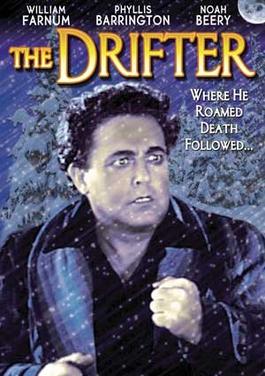
The Drifter (1932, directed by William A. O’Connor)


“This town ain’t big enough for the both of us.”

This line, which has been recycled in so many western parodies, is actually used seriously in The Drifter, a forgotten western from the pre-code era.  The line is delivered by Montana (Russell Hopton) and he’s speaking to a mysterious character known only as The Drifter (William Farnum).

The Drifter is a French-Canadian who has spent decades searching for his lost-lost brother but who is now ready to go into town, get work as a logger, and hopefully find a woman to marry.  Along with a mysterious man who is named Whitey and who is played by Charles Sellon, The Drifter is hired to work for local lumber magnate, John McNary (Noah Beery).  The Drifter impresses everyone with his good hearted ways and he falls in love with McNary’s daughter, Bonnie (Phyllis Barrington).  Unfortunately, Phyllis is already dating Paul LaTour (Bruce Warren), who is her father’s main business rival.  But before The Drifter can concentrate on winning Phyllis away from LaTour and also solving the mystery of his own missing family, he has to deal with the most dangerous man in town, Montana.  As Montana puts it, the town’s not big enough for both him and The Drifter.

The Drifter‘s story is potentially interesting but the low-budget, the shoddy production values, and a slow pace all conspire to do the film in.  This was one of the countless western programmers that was produced in the early 30s.  Like many of the other poverty row productions of the era, it starred an actor who had been huge during the silent era but who struggled to find work during the early years of the sound era.  William Farnum started as a stage actor and as a protegee to Edwin Booth, who was largely considered to be America’s finest stage actor even if he was forever tainted by being the brother of presidential assassin John Wilkes Booth.  Farnum’s very theatrical style of acting made him perfect for both Broadway and for the silent film era, a time when actors had to use big movements and dramatic facial expressions in order to convey their emotions.  When the sound era came along, Farnum’s style was suddenly no longer in vogue and, unfortunately, it took him a while to adjust to working with sound.  Even in a sound film like The Drifter where he had dialogue, Farnum gives the type of overly theatrical performance that was more common during the silent era.  What’s interesting is that Farnum’s performance actually works for the character of The Drifter, who is meant to be an outsider who struggles to communicate with other people.  Despite some implausible twists at the end, the rest of The Drifter isn’t as interesting.

Farnum eventually did adjust to the sound era and he became a respected character actor, playing many captains and many judges.  In 1953, when he died at the age of 76, Hollywood turned out to pay their respects.  Cecil B. DeMille and Paramount Picture co-founder Jesse B. Lasky served as pallbearers.

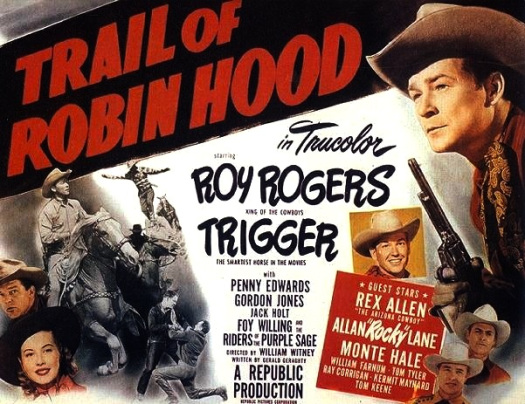
Cowboy Christmas: TRAIL OF ROBIN HOOD (Republic 1950)


gary loggins's avatarcracked rear viewer

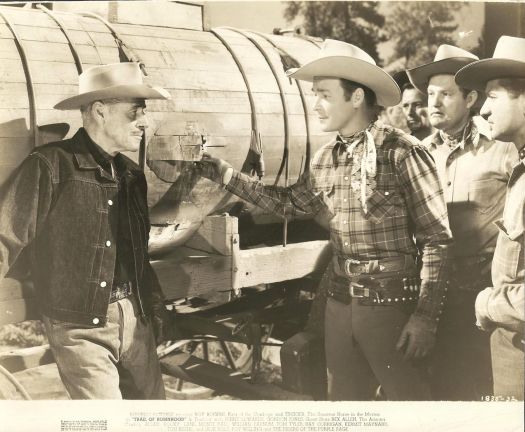
There’s no sign of Robin Hood to be found in the Roy Rogers vehicle TRAIL OF ROBIN HOOD. However, the film has gained a cult following among sagebrush aficionados for the plethora of cowboy stars gathered together in this extremely likable little ‘B’ Western directed by Republic Pictures workhorse William Whitney William Whitney, with plenty of songs by Roy and the Riders of the Purple Sage to go along with that trademark Republic fightin’ and a-ridin’ action (thanks, stuntmen Art Dillon, Ken Terrell, and Joe Yrigoyen!).

Some rustlers have been stealing Christmas trees from ‘retired actor’ Jack Holt’s tree farm. The benign Jack raises his trees to sell at cost to parents of poor kids, but avaricious J.C. Aldridge (Emory Parnell ) and his foreman Mitch McCall (former Our Gang member Clifton Young ) want to put an end to it and corner the Christmas tree market! U.S. Forestry Agent…

View original post 421 more words