Renegade Girl (1946, directed by William Berke)


Missouri in 1864.  The Civil War is raging and the state is divided between those who support the Union and those secretly support the Confederate guerillas led by Willian Quantrill (Ray Corrigan).  The Union’s Major Baker (Jack Holt) is determined to track down rebel Bob Shelby (Jimmie Martin) and he enlists the Native American Chief Whitecloud (played by Chief Thundercloud) to help find him.  Whitecloud has a personal vendetta against the Shelby family and, when he finds Bob, he executes him in cold blood.  Bob’s sister, Jean Shelby (Ann Savage), is also a Confederate sympathizer and she seeks revenge.  Complicating things is that Jean has fallen in love with Union Captain Fred Raymond (Alan Curtis).

One of the many B-westerns produced by Robert L. Lippert and directed by William Berke, Renegade Girl packs a lot of plot into just 65 minutes.  The action is nonstop and fans of westerns will find all of the horse chases, gunfights, and threats of hanging that they could want.  The main thing that distinguishes Renegade Girl from other B-westerns is the fierce performance of Ann Savage as Jean Shelby, a woman who will not stop until she gets her revenge.  While the film’s portrayal of the Quantrill and Chief Whitecloud definitely goes against modern sensibilities, Ann Savage’s performance feels ahead of her time.  No one is going to stand in Jean Shelby’s way.

Chief Thundercloud’s real name was reportedly Victor Daniels, though his past is shrouded in mystery.  He claimed to be a Cherokee from Arizona, though he was listed as being Mexican on a marriage record that was filed before he started his film career.  As Chief Thundercloud, he was a mainstay in westerns from the 30s to the time of his death in 1955.  He was the first actor to play the Lone Ranger’s Tonto and he also played Geronimo in a 1939 Paramount film of the same name.  His final film role was a posthumous appearance in John Ford’s The Searchers.

Deputy Marshal (1948, directed by William Berke)


Deputy Marshal Ed Garry (Jon Hall) is pursuing two bank robbers in Wyoming when he comes across a wounded man.  Harley Masters (Wheaton Chambers) has been shot in the gut but his main concern is holding onto his hat.  Ed takes Harley into town.  They go into the local saloon, where Harley reveals a map hidden in his hat.  He slips the map to Ed before an unseen gunman shoots him a second time.  This time, Harley does not survive.

With the current sheriff “laid up,” Ed decides to stay in town and not only catch the bank robbers but also solve Harley’s murder.  Ed soon finds himself in the middle of a conflict between two rival women (Frances Langford and Julie Bishop) who own ranches and stand to make a lot of money when the railroad comes through.

Deputy Marshal is one of the B-westerns that was produced by Robert Lippert and directed by William Berke in the 40s and 50s.  This one is a step above the usual Lippert production because it combines a murder mystery with the standard western action and there are enough suspects to keep the story interesting.  Jon Hall was best-known for appearing in exotic adventure films, often playing islanders.  His career was in decline when he starred in Deputy Marshal but he makes for a surprisingly believable western hero.  It helps that Hall was older than the typical B-western hero.  His weathered looks make him convincing as an experienced lawman who understood the ways of the west.

Frances Langford, who plays the nicer of the two ranchers, was married to Jon Hall when she appeared in this film.  She gets to sing two songs because this is a Lippert production and Robert Lippert believed that every western should open with a horse chase and should feature at least one song.

While it obviously never won any awards for originality, Deputy Marshal is a better-than-average B-western with an interesting mystery story and a convincing hero.

Gunfire (1950, directed by William Berke)


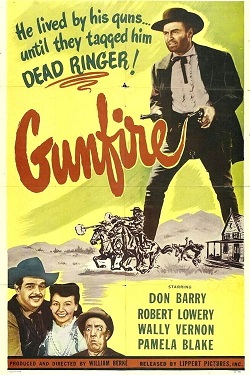
Years after the death of his brother Jesse, Frank James (Don “Red” Barry) has settled down in Colorado and is living a peaceful life as a rancher.  He is even friends with the town’s sheriff, John Kelly (Robert Lowery).  Unfortunately, it’s not always so easy to escape the past, especially when you are one of the few surviving members of one of the Old West’s most notorious gangs.  A former member of the James Gang, Mundy (Claude Stroud), shows up at Frank’s cabin and tries to talk Frank into joining up with him, the Ford brothers (Gaylord Pendleton and Roger Anderson), and their new leader, Bat Fenton (Don “Red” Barry, playing a second role).  When Frank refuses and makes clear that he still wants revenge on the Ford brothers for the murder of Jesse James, the gang goes on a crime spree.  Because he and Fenton look exactly alike, the entire town thinks that Frank is responsible.  Can Frank clear his name and avenge the death of his brother?

There were a lot of poverty row B-westerns produced in the early 1950s and most of them are pretty bad.  However, occasionally you come across a diamond in the rough and that’s the case with Gunfire.  Gunfire tells an interesting story, it has exciting gunfights, and it also features not one but two good performances from Don “Red” Barry!  Barry is equally convincing as both the good Frank and the bad Fenton and the movie uses the double plot as a way to illustrate how difficult it is to escape the sins of the past.  Frank has been “born again” but every time he sees Fenton, he sees not only who he used to be but also who many will always believe him to be.  Gunfire is a good western that shows that you don’t need a huge budget to tell an engaging story.

I Shot Billy The Kid (1950, directed by William Berke)


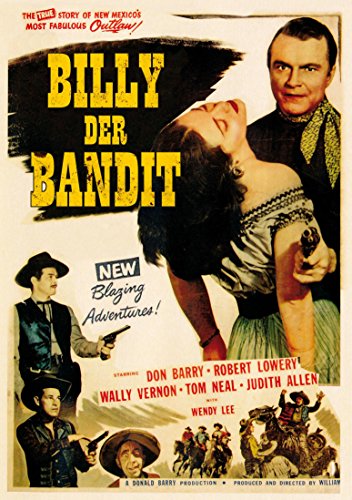
Sheriff Pat Garrett (Robert Lowery) tells the story of his friendship and later pursuit of Billy the Kid (Don “Red” Berry). As Garrett explains it, Billy could be a charming and likable outlaw but he just refused to go straight.  After Billy rescued Garrett from an Indian attack, Garrett even tried to arrange for Billy to get a pardon from New Mexico’s governor, Lew Wallace (Claude Stroud), but when the pardon didn’t arrive in time, Billy felt had been betrayed and continued his life as an outlaw.  Eventually, it fell upon Garrett to track down and put his old friend out of commission.

This film really should have been called I Shot Billy The Man because Don Berry was nearly 40 when he played Billy and he looked like he was closer to 50.  Berry makes the mistake of wearing  hair piece, which just makes it seem as if George Constanza somehow got cast as a notorious western outlaw.  As was true in even his worst westerns, Berry is a convincing gunslinger but he’s just not a very convincing kid.  Meanwhile, Robert Lowery is a boringly upright Pat Garrett.  There’s none of the moral ambiguity that’s present in some of the better retellings of the life of Billy the Kid.

Tom Neal, an authentic tough guy who is best remembered for starring in Detour and for sabotaging his own career by nearly beating actor Franchot Tone to death, appears as a member of Billy’s gang.  Neal was almost as old as Berry but it still seems like the film would have worked better if Neal has played Billy, Berry had played Pat, and Lowery would have taken the less important role of Charlie.  Neal would have brought some authentic toughness to the role while Berry’s onscreen charisma would have countered how boring the film’s version of Pat Garrett comes across as being.  As it is, with Berry miscast and Lowery giving a bland peformance and the entire movie limited by its low budget (it was produced by Robert Lippert, who made Roger Corman seem extravagant by comparison), I Shot Billy The Kid is one of the more forgettable films about the life of William Bonney.

30 Days of Noir #14: Shoot to Kill (dir by William Berke)


The 1947 film, Shoot to Kill (also known as Police Reporter), opens with both a bang and a crash.

The police are chasing a car down one dark and lonely road.  When that car crashes, the police are shocked to discover who was inside of it.  Two men and one woman, all well-dressed.  The men are both dead but the woman is merely unconscious.  The police identify one of the men as being the notorious gangster, Dixie Logan (Robert Kent).  It makes sense that Logan would be fleeing the police but what about his two passengers, newly elected District Attorney Lawrence Dale (Edmund MacDonald) and Dale’s wife, Marian (Luana Walters)?

The police may not be able to get any answers but fortunately, there’s a reporter around!  Mitch Mitchell (Russell Wade) is a crime reporter and, seeing as how he knew both Lawrence and Marian, he seems like the perfect person to get some answers.  (In fact, it was Mitch who first suggested that Lawrence should hire Marian as his administrative assistant, therefore setting in motion the whirlwind romance that would end with them married.)  Mitch goes to see Marian in her hospital room and he asks her what happened.

It’s flashback time!  Yes, this is one of those films where almost the entire film is a flashback.  That, in itself, is not surprising.  Some of the best film noirs of all time were just extended flashbacks.  (D.O.A, Double Indemnity, and Sunset Boulevard, to name just a few examples.)  What sets Shoot to Kill apart is the fact that, occasionally, we even get characters having a second flashback while already in someone else’s flashback.  We’re through the the film noir looking glass here, people.

Lawrence Dale, we’re told, was elected district attorney because he managed to secure the conviction of notorious gangster Dixie Logan, despite Logan’s insistence that he was no longer involved in the rackets.  However, what we soon discover is that not only was Logan actually innocent but Dale specifically prosecuted him as a favor to some of Dale’s rival gangsters.  That’s right, Lawrence Dale was on the take!  It also turns out that Marian has some secrets of her own.  When she first showed up at Dale’s office, she was doing more than just looking for a job.  As for her marriage to Dale …. well, I really can’t tell you what the twist is here because it would spoil the entire film.

Shoot To Kill may clock in at just 64 minutes but it manages to pack a lot of twists and turns into just an hour.  In fact, I’d argue that it probably tries to do a little bit too much.  At times, the film is a bit difficult to follow and a few inconsistent performances don’t help matters.  For instance, Russell Wade is likable as the crime reporter but he still doesn’t exactly have a dynamic screen presence.  Much better cast are Luana Walters and Edmund MacDonald, who both do a good job as, respectively, a femme fatale and a sap.  At the very least, history nerds like me will be amused by the fact that Edmund MacDonald was obviously made up to resemble Thomas E. Dewey, the former Manhattan District Attorney who twice lost the U.S. presidency.

The best thing about Shoot To Kill is the look of the movie.  Filmed in grainy black-and-white and full of dark shadows, crooked camera angles, and men in fedoras lighting cigarettes in alleys, Shoot to Kill looks the way that a film noir is supposed to look.

Regardless of whether it was the filmmaker’s original intention, Shoot To Kill plays out like a low-budget, black-and-white fever dream.  It’s definitely a flawed film but, for lovers of film noir, still worth a look.

Netflix Noir #4: The Mugger (dir by William Berke)


The Mugger 2

For my final Netflix Noir, I watched The Mugger, a film from 1958.

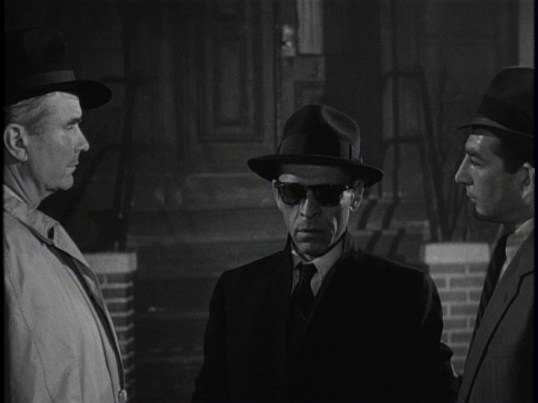
The Mugger is a police procedural.  Taking place in an unnamed city, it stars Kent Smith as Dr. Pete Graham.  Pete’s both a psychiatrist and a cop and, needless to say, he has a lot to deal with.

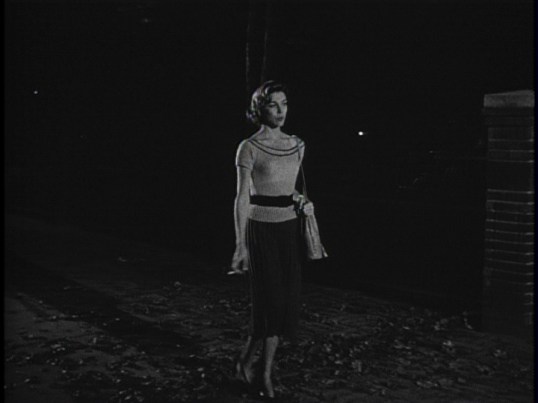
For one thing, his girlfriend, Claire (Nan Martin) is also a cop.  In fact, she’s apparently the only female cop on the entire force!  (“Woman cops?” another detective is heard to say, “Do we really need them?”)  Claire spends most her time working undercover on the dance hall circuit.  Pete wants to get married.  Claire wants to solve a few more cases before making that commitment.  Pete says that’s okay, as long as her plans “include me, a home, and children.”

Pete has also been forcefully recruited to counsel a Jeannie (Sandra Church), the sister-in-law of a local taxi driver.  As the driver explains it, Jeannie is “about 18 and is she built!”  Pete replies, “You shouldn’t get excited about a kid who wants to have a good time,” which seems like an unusually progressive attitude for a cop in the 1950s.  Still, Pete agrees to try to encourage Jeannie to be a little bit less rebellious.  Jeannie, by the way, is my favorite character in the film because she is never in a good mood and she gets to dismiss her older sister’s concerns by saying, “Maybe she’s getting a little old, a little jealous.”

It also turns out that Jeannie’s neighbor, Nick Greco (George Maharis), has a crush on her and apparently, just hangs out in her house all day.  While this seemed rather creepy to me, the film seemed to suggest that this was just normal 50s behavior.  Apparently, since nobody bothered to lock their doors back then, it was also totally appropriate to just hide in someone’s house and listen in on private conversations.

Peter’s other big problem is that there’s a mugger who is robbing women and cutting their cheek with a knife.  I have to give the film some credit here because it doesn’t shy away from discussing the sexual subtext to these attacks, which I imagine was quite daring for a film in the 50s.  Pete comes up with a detailed profile of the attacker, the sort of thing that would make the cast of Criminal Minds jealous.  Claire goes undercover to catch the mugger and there’s a great scene where a drunk sailor tries to harass her and she threatens to shoot him in the knee caps.  Again, this is not the sort of thing that we typically associate with a 50s film…

Which is not to say that The Mugger is not clearly a product of its time.  For one thing, just check out the police force in this city, which is all white, all middle-aged, and — with the exception of Claire — all male.  As well, this is one of those old movies where any woman who walks down a street will be leered at by every guy she passes, including the film’s heroes.  One of the reasons why it was so great to see Claire threaten to cripple that soldier was because it came after 50 minutes of watching Pete and every other man in the film do a double take whenever she entered a room.

Clocking in at a little over 70 minutes and obviously low-budget, The Mugger is an undeniably obscure film.  Checking with the imdb, I discovered only two reviews that had been previously written for this film and one of them was in Turkish!  When I went onto YouTube to look for a trailer, I found nothing.  The Mugger is forgotten and hardly a lost classic but I still enjoyed watching it.  What can I say?  I love my history and, if nothing else, The Mugger is definitely a time capsule.

Watch it on Netflix while you can!

The Mugger